Visiting Bhaktapur, Nepal: Top Sights on Foot
Things to Do in Bhaktapur: A Guide to Nepal’s Living Newari Heritage
Looking for things to do in Bhaktapur? This historic city in Bagmati Province is the smallest of the three ancient kingdoms of the Kathmandu Valley and one of the best-preserved centres of Newari culture. Its royal squares, temples, traditional houses, woodcarving, and continuing daily life make it worth exploring slowly. Neywo offers a free audio guide for Bhaktapur with 7 narrated places, available in 11 languages.
Bhaktapur is known locally as Khwopa, or the City of Devotees. It lies thirteen kilometres from Kathmandu, at the eastern edge of the valley, and was once an important stop on the trade route between India and Tibet. The medieval centre has been a UNESCO World Heritage Site since 1979.
The city’s heritage is not limited to monuments. Its streets still follow rhythms established over centuries, while traditional craftsmanship and local specialities remain part of everyday life. Bhaktapur also makes a rewarding addition to a visit to nearby Kathmandu, the capital of the valley.
What to see in Bhaktapur
Bhaktapur Durbar Square
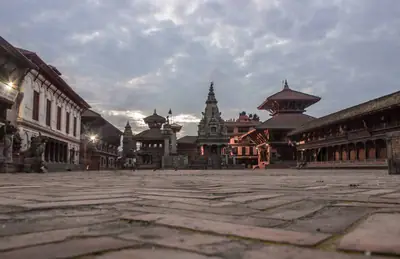
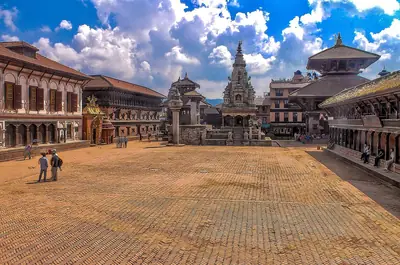
Bhaktapur Durbar Square is the ancient royal heart of the city. The Malla kings made it their seat from the fourteenth century, and the independent Kingdom of Bhaktapur remained based here until its conquest in 1769.
The complex was once made up of ninety-nine courtyards. Around fifteen remain today, after major earthquakes in 1833, 1934, and 2015 caused extensive damage. Restoration continues under the Archaeological Department of Nepal and the Bhaktapur municipality.
The name “Durbar Square” covers four connected areas: Durbar Square itself, Taumadhi Square, Dattatreya Square, and Pottery Square. Together, they bring royal architecture, temples, courtyards, and traditional urban life into one concentrated area. Look for the detailed woodwork, terracotta, stone carving, and metal artistry that characterise Newari craftsmanship.
Shilu Mahadev Temple
In Bhaktapur Durbar Square, the Shilu Mahadev Temple has an unusual and compassionate purpose. This Malla-era Hindu temple was built for children, older people, and people with disabilities who could not undertake the demanding pilgrimage to Gosainkunda, a sacred lake in the mountains.
The temple was intended to bring the spiritual merit of that distant journey to the city, allowing people to receive the same blessings without making the difficult pilgrimage. Shilu Mahadev suffered severe damage in the 2015 earthquake, and reconstruction is underway.
Nyatapola Temple
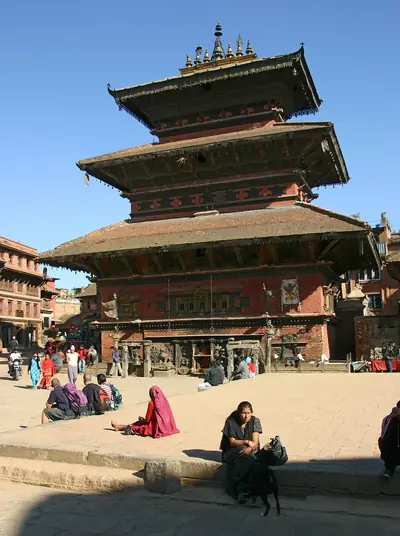
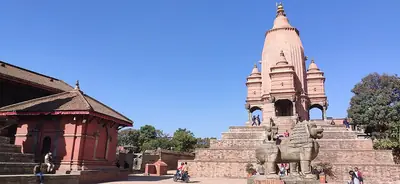
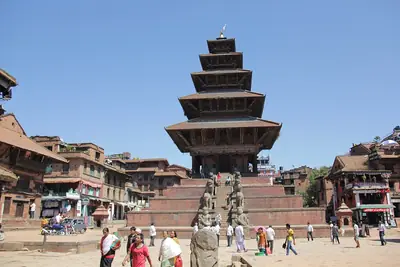
Nyatapola Temple rises above Taumadhi Square as Bhaktapur’s most recognisable landmark. Its five-tiered pagoda is thirty-three metres high, making it the tallest temple in Nepal and the tallest monument in Bhaktapur. The municipality even uses its silhouette on its coat of arms.
The temple’s name comes from Newari and means “something with five storeys”. Its five roofs step back towards a golden pinnacle, while a five-level plinth leads visitors upwards to the temple. Nyatapola is one of only two five-storey temples in the Kathmandu Valley; the other is Kumbheshvara in Lalitpur.
King Bhupatindra Malla commissioned the temple in December 1701, and construction was completed in July 1702. Its rapid construction was intended to demonstrate Bhaktapur’s power at a time of tense relations with neighbouring kingdoms.
Bhairavnath Temple
Also in Taumadhi Square, the Bhairavnath Temple is one of Bhaktapur’s important Hindu shrines. Its pagoda-style design features a tiered roof and intricate wooden carvings, offering a close view of the Newari architectural tradition.
The temple is a useful stop when exploring the connected squares around Durbar Square. Together, Bhairavnath Temple and Nyatapola Temple give Taumadhi Square a particularly strong architectural character.
Pujarimath Museum and the Peacock Window
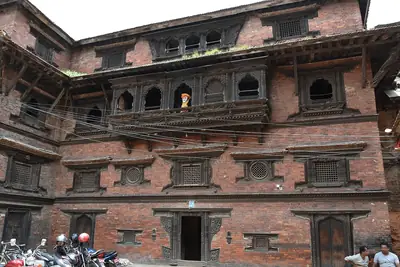
Pujarimath is the oldest of the twelve traditional priest houses that once served Bhaktapur’s Hindu temples. The building is especially famous for its wooden peacock window, an outstanding example of Newar woodcarving and one of the city’s most recognisable details.
The math was originally built in the fifteenth century by the ascetic Gosain Gurubaska Giri during the reign of King Jayayakshya Malla. It was substantially rebuilt in 1763, then destroyed by the 1934 earthquake. After decades of abandonment, the building was examined by the German architect Niels Gutschow in 1962.
Today, the restored priest house functions as a museum dedicated to traditional Nepalese woodcarving. Its rooms place the craft on display inside a building that is itself one of Bhaktapur’s finest examples of it.
Traditional crafts, pottery, and local food
Bhaktapur’s heritage is also visible beyond its principal monuments. Traditional pottery and hand-carved crafts remain part of the city’s local character, particularly around its public spaces and workshops. Pottery Square is one of the four areas included within the historic royal complex.
The wider Bhaktapur District is known across Nepal for Bhadgaunle topi caps and juju dhau, a rich, creamy yogurt traditionally called the “king of yogurts”. These specialities offer another way to encounter the city’s Newari culture alongside its architecture.
Explore Bhaktapur with Neywo
Download Neywo and explore Bhaktapur with the free walking tour City of Devotees: Bhaktapur’s Royal Squares and Peacock Window. It covers 1.11 km, takes about 41 minutes, and includes 5 narrated stops: Bhaktapur Durbar Square, Shilu Mahadev Temple, Nyatapola Temple, Bhairavnath Temple, and Pujarimath Museum.
This is a self-guided walking tour: the app tells the story of each place as you reach it, at your own pace, with no group and no schedule. Neywo has 1 walking tour in Bhaktapur, with stories available in 11 languages. After exploring the city, continue discovering Patan, Dhulikhel, or more of Bagmati Province.
Places with an audio guide in Bhaktapur
7 places in Bhaktapur with a Neywo audio guide. Each one starts telling its story as you reach it.
Self-guided tours in Bhaktapur
1 tour in Bhaktapur, free in the Neywo app. Each stop tells its story as you reach it.
- Walk
City of Devotees: Bhaktapur's Royal Squares and Peacock Window
Bhaktapur was the last Malla kingdom to fall, and its brick lanes still feel medieval. Start in the royal heart of Durbar Square, climb the guarded plinth of the five-roofed Nyatapola in Taumadhi Square, then finish at the Pujarimath priest house and its carved peacock window.
Bhaktapur Durbar Square · Shilu Mahadev Temple · Nyatapola Temple · Bhairavnath temple · Pujarimath Museum
Open this tour: City of Devotees: Bhaktapur's Royal Squares and Peacock Window
Walk Bhaktapur with Neywo
Neywo turns Bhaktapur into a self-guided audio tour. Stories arrive as you reach the place they belong to, and the route reshapes when you wander off it.

