What to See in Geneva, Switzerland: Free Audio Guide
Things to Do in Geneva: What to See in the City
Geneva is a Swiss city shaped by Protestant history, international institutions, watchmaking, museums, and Lake Geneva. Its historic center, riverside landmarks, and cultural collections make it rewarding to explore on foot. Neywo offers a free Geneva audio guide with 42 narrated places, available in 11 languages.
What to See in Geneva
St. Pierre Cathedral
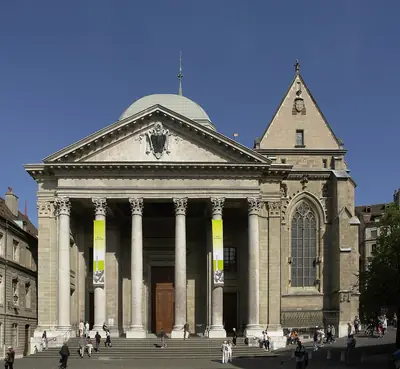
St. Pierre Cathedral, or Cathédrale Saint-Pierre, is one of Geneva’s most important religious landmarks. It has been the principal church of the Protestant Church of Geneva since 1535, although its history as a cathedral reaches back to the end of the 4th century, when it served as the seat of the bishop of Geneva.
The present building took shape during a major reconstruction between the 12th and 15th centuries. Its façade combines a temple-like portico with a soaring Gothic structure, pointed arches, and a tall window. Inside, pale stone, rows of benches, and tombstones marking the resting places of church figures from the 15th and 16th centuries create a calm, uncluttered atmosphere.
International Museum of the Reformation
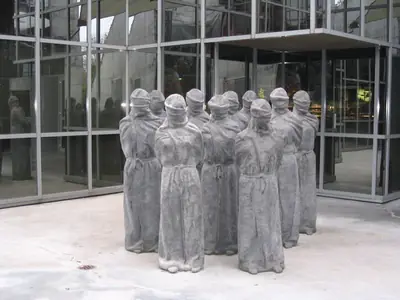
The International Museum of the Reformation explores the history and continuing heritage of the Protestant Reformation. Its story begins with Martin Luther’s protest in 1517 and follows the movement to Geneva, where John Calvin championed the Reformation in 1536.
The museum occupies Maison Mallet, a patrician residence built in 1723 by Gédéon Mallet, a descendant of Huguenot refugees. The site is particularly significant because the house stands on the former cloister of the canons of St. Pierre Cathedral, where Geneva adopted the Reformation on May 21, 1536. A permanent exhibition is arranged across nine rooms, with additional rooms for temporary exhibitions.
Barbier-Mueller Museum
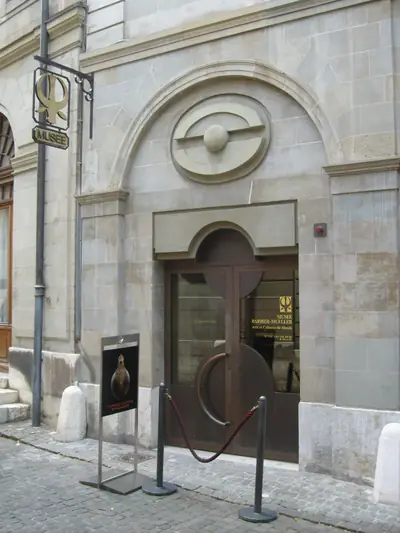
In Geneva’s Old Town, the Barbier-Mueller Museum presents several thousand objects from Tribal and Classical antiquity, including sculptures, fabrics, and ornaments from civilizations around the world.
Founded in 1977, the museum was created to make a remarkable private collection accessible to everyone. Its holdings began with Josef Müller, who started collecting in 1907, and were later continued by his daughter Monique and her husband, Jean Paul Barbier-Mueller. The museum’s programme has also been shaped by collaborations with researchers, poets, and artists.
Musée d’art et d’histoire
The Musée d’art et d’histoire brings together art and history from the Middle Ages through the 20th century. Its fine-art collection includes Italian, Dutch, French, English, Genevan, and Swiss artists.
One notable work is The Miraculous Draught of Fishes, painted by Konrad Witz in 1444 as part of his Saint Peter Altarpiece. The museum also includes Byzantine art and icons, medieval and Renaissance weaponry, silverware, tinware, musical instruments, and textiles. Complete interior furnishings and wood panelling from rooms in the Lower Castle Zizers show how historical interiors can form part of a collection too.
Musée Rath
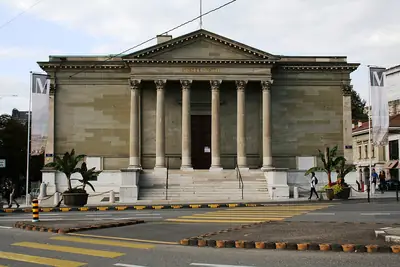
On Place Neuve, Musée Rath occupies a building designed by Samuel Vaucher between 1824 and 1826. Inspired by Ancient Greek temples, it was conceived as a sanctuary dedicated to the muses and opened in 1826 as the first museum in Switzerland to open to the public.
Today, Musée Rath is devoted entirely to temporary exhibitions. Its earlier collections included works connected to J-F Rath’s legacy, objects formerly held in Geneva’s city hall, the Calabri, and Saint-Germain Church, as well as 23 paintings sent by the Louvre in 1805.
Patek Philippe Museum
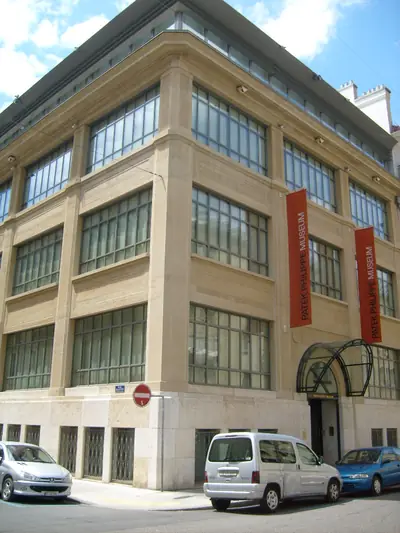
The Patek Philippe Museum is one of Geneva’s most focused places to explore the history of watchmaking. The company’s story began in 1839, when Anthony Patek partnered with Franciszek Czapek. After Patek met watchmaker Adrien Philippe in 1844, the firm became Patek, Philippe & Company.
Philippe Stern opened the museum in 2001 in a restored four-storey Art Deco building on Rue des Vieux-Grenadiers. The collection offers an overview of Patek Philippe’s watch production since 1839 and includes around 3,000 exhibits. Its library contains more than 8,000 works on timekeeping.
Jet d’Eau
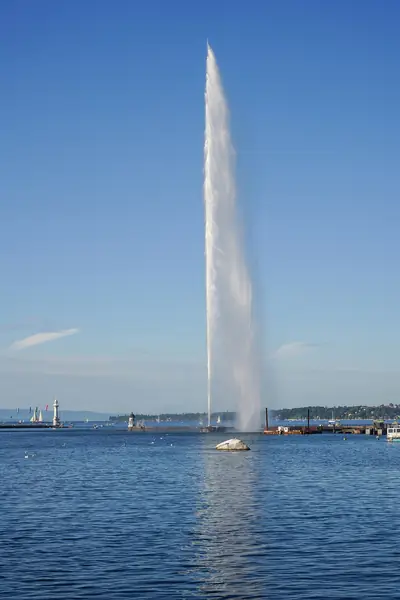
The Jet d’Eau is one of Geneva’s most recognisable landmarks on Lake Geneva. It began in 1886 as a pressure valve for a hydraulic power network. In 1891, its visual impact led the city to move it to the lakefront to celebrate the 600th anniversary of the Swiss Confederation.
The present version dates from 1951 and is powered by a pumping station below the surface. Water rises to about 140 metres, with roughly 7,000 litres suspended in the air at any moment. Two pumps send around 500 litres of water through the nozzle every second.
Musée Ariana
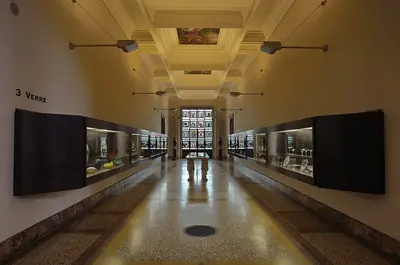
The Musée Ariana is dedicated to glass and ceramic art. Its collection contains around 20,000 objects spanning about 1,200 years, revealing the historical, geographical, artistic, and technological variety of these two materials.
The building was constructed between 1877 and 1884 in a combination of Neo-Classical and Neo-Baroque styles. Swiss collector and patron Gustave Revilliod created it for his private collection and named it after his mother, Ariane de la Rive. He later bequeathed the museum to the city of Geneva. After extensive building work, it reopened to the public in 1993.
International Red Cross and Red Crescent Museum
The International Red Cross and Red Crescent Museum examines humanitarian action through its permanent exhibition, The Humanitarian Adventure. The exhibition is organised around three current challenges: defending human dignity, restoring family links, and reducing natural risks.
Each section occupies a space created by a different architect: Gringo Cardia, Diébédo Francis Kéré, and Shigeru Ban. Twelve witnesses guide visitors through the exhibition, which combines emotional experiences with more informational content and keeps human relationships at the centre of humanitarian work.
Geneva Ethnography Museum
The Geneva Ethnography Museum, in the Plainpalais district, is one of Switzerland’s important ethnographic museums. It was established on September 25, 1901, through the work of Professor Eugène Pittard, the first holder of the Anthropology Chair at the University of Geneva.
The museum’s collections originally brought together objects from several institutions, including the Archaeology Museum, Musée Ariana, the Evangelical Missionary Society Museum, and the Geneva History Museum. Its pagoda-style building is among its most distinctive features.
Tour de l’Île
The Tour de l’Île is the last visible part of a medieval fortress that once guarded Geneva on an island in the Rhône. The original castle was completed in 1219 under Bishop Aymé de Grandson, who ruled Geneva as both bishop and prince within the Holy Roman Empire.
The site also has a connection with watchmaking. Vacheron Constantin moved into the building in 1842, replacing Geneva’s police department, and remained there until 1875. The company returned in 2012 after almost 140 years away.
Bâtiment des Forces motrices
The Bâtiment des Forces motrices began as a hydraulic power plant near the point where the Rhône leaves Lake Geneva. Built between 1883 and 1892, it helped provide water pressure for Geneva’s water supply and supported a hydraulic power network.
The building stopped producing power in 1963, although pumping equipment continued to support the city’s drinking water supply until 1988. Later converted into an entertainment venue, it reopened in 1997 as an opera house and concert hall.
Broken Chair
The Broken Chair stands in Place des Nations as a monument opposing land mines and cluster bombs. Designed by Swiss artist Daniel Berset and built by carpenter Louis Genève, the sculpture depicts a giant wooden chair with a broken left leg.
The chair is about 12 metres high and made from 5.5 tons of wood. It has stood in the square since 1997, apart from an interruption between 2005 and 2007 while the square was renovated.
Voltaire Institute and Museum
The Voltaire Institute and Museum occupies Les Délices, the house where Voltaire lived from March 1755 until October 1760. He moved there with his niece and romantic partner, Madame Marie-Louise Denis, seeking a home away from French authority.
The residence offered gardens, views, and a gallery suited to Voltaire’s theatrical interests. He and Madame Denis named the property Les Délices and improved its grounds with plants and fruit trees. Today, the museum is dedicated to Voltaire’s life and works.
Musée d’histoire des sciences
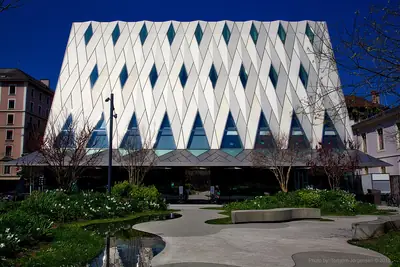
The Musée d’histoire des sciences de la Ville de Genève occupies Villa Bartholoni in La Perle du Lac park. Built in 1830 and extensively restored between 1985 and 1992, the villa is a notable example of Palladian architecture.
The museum traces the development of scientific ideas and instruments. Its interior, decorated with mythological scenes and elaborate materials, is part of the experience. The villa has housed the History of Science Museum since 1964 and is recognised as culturally significant in the Swiss Inventory.
Explore Geneva with a Free Audio Guide
Neywo has 2 walking tours, 1 bus route, and 1 bike route in Geneva:
- The old town: St Pierre and the Reformation: 1.26 km, 82 minutes, 12 narrated stops.
- The Ultimate Geneva: old town to the Palais Wilson: 4.67 km, 150 minutes, 15 narrated stops.
- From the Old Town to the Broken Chair by bus: 3.6 km, 15 minutes, 4 narrated stops.
- Lakeside Quays: Broken Chair to the Tour de l’Île by bike: 4.4 km, 22 minutes, 8 narrated stops.
The app tells the story of each place as you reach it, at your own pace, with no group and no schedule. Download Neywo and explore Geneva independently, from the Old Town and St. Pierre Cathedral to the lakefront and the Broken Chair.
Geneva is part of Switzerland, whose other cities include Bern, Interlaken, and Lucerne.
Places with an audio guide in Geneva
8 places in Geneva with a Neywo audio guide. Each one starts telling its story as you reach it.
Self-guided tours in Geneva
4 tours in Geneva, free in the Neywo app. Each stop tells its story as you reach it.
- Bike ride
Lakeside Quays: Broken Chair to the Tour de l'Île
A ride on the cycle lanes along Lake Geneva's right bank: the giant Broken Chair at the Place des Nations, the old Bartholoni villa in the Perle du Lac park, the former League of Nations palace, the Brunswick tomb, the Mont-Blanc quay, Notre-Dame basilica, the old quarter of Saint-Gervais and the medieval Tour de l'Île on the Rhône.
Broken Chair · Musée d'histoire des sciences de la Ville de Genève · Palais Wilson · Brunswick Monument · Poste du Mont-Blanc · Basilica Notre-Dame of Geneva …
Open this tour: Lakeside Quays: Broken Chair to the Tour de l'Île - Bus ride
Bus 5: From the Old Town to the Broken Chair
A real city line that ties Geneva's story together: Switzerland's oldest art museum on Place Neuve, the medieval Tour de l'Ile on the Rhone, the Neo-Gothic Notre-Dame basilica by the station, and and the giant Broken Chair on Place des Nations in the diplomatic quarter.
Musée Rath · Tour de l'Île · Basilica Notre-Dame of Geneva · Broken Chair
Open this tour: Bus 5: From the Old Town to the Broken Chair - Walk
The old town: St Pierre and the Reformation
Under a kilometre on the hill. Calvin's cathedral with the Roman and Carolingian excavations beneath it, the Reformation museum next door, the Tavel House — the oldest in Geneva — and the wall of the reformers below.
Place du Molard · Barbier-Mueller Museum · Église Saint-Germain (Geneve) · Parc des Bastions · Mur des Réformateurs · Hôtel de Ville de Genève …
Open this tour: The old town: St Pierre and the Reformation - Walk
The Ultimate Geneva: old town to the Palais Wilson
Four and a half kilometres from St Pierre and the Reformation museum down to the Jet d'Eau and along the lake to the Brunswick monument and the first home of the League of Nations.
Place du Bourg-de-Four · Reformed Church L’Auditoire · St. Pierre Cathedral · International Museum of the Reformation · Ancien arsenal et archives d'État de Genève · Tavel House …
Open this tour: The Ultimate Geneva: old town to the Palais Wilson
Walk Geneva with Neywo
Neywo turns Geneva into a self-guided audio tour. Stories arrive as you reach the place they belong to, and the route reshapes when you wander off it.

