Zermatt, Switzerland: Self-Guided Walking Tour
Things to Do in Zermatt: What to See Beneath the Matterhorn
Zermatt is a mountain village in Switzerland, known for its traditional Alpine character and its position beneath the Matterhorn. The village combines historic churches, mountaineering heritage and access to some of the highest peaks in the Alps. Neywo has a free audio guide for Zermatt with 27 narrated places, available in 11 languages.
What to See in Zermatt
The most important sights range from the village’s historic center to the high-alpine landscapes surrounding it.
Zermatt railway station and the village center
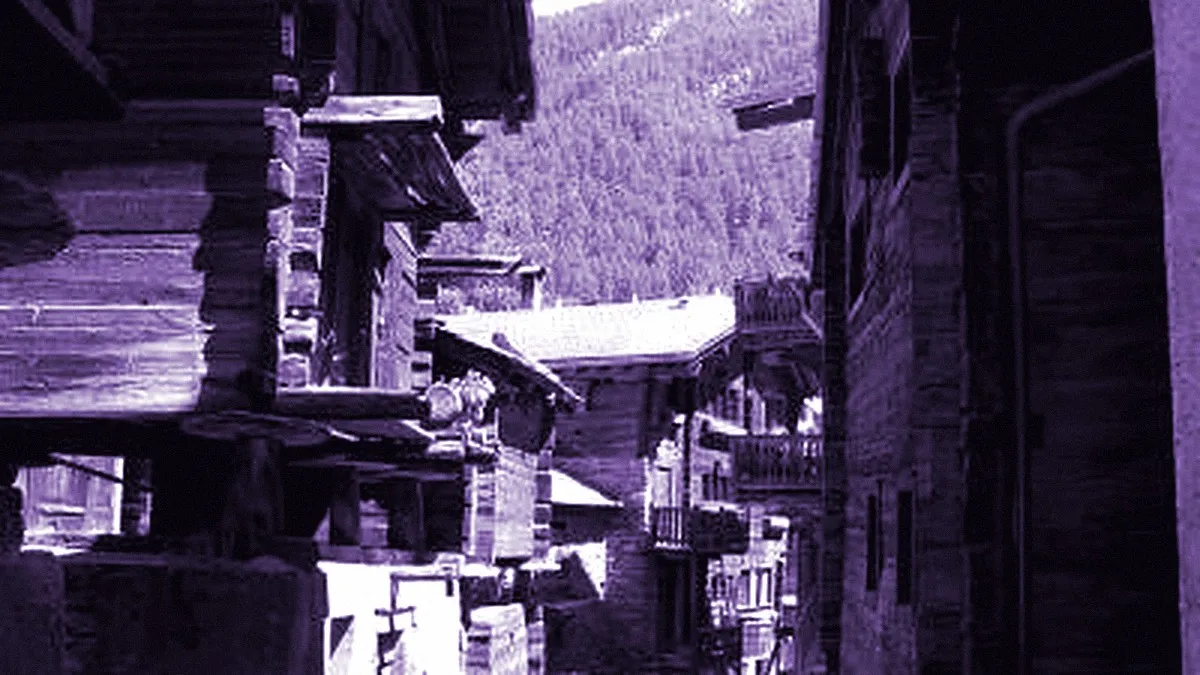
Zermatt’s railway station is the starting point for Neywo’s walk through the village. From here, the route leads into a place shaped by farming, religious life and the rise of mountaineering. The village’s historic character remains visible in its traditional buildings and quiet streets.
St Peter’s Church
St Peter’s Church is one of the stops on the village walk and reflects Zermatt’s religious heritage. Along with St. Maurice church and the Chapel of the Holy Family, it forms part of the local history preserved in the village center and surrounding quarters.
Monte Rosa Hotel
The Monte Rosa Hotel is linked to Zermatt’s mountaineering story. The Matterhorn’s first ascent on July 14, 1865, was led by Edward Whymper, together with the Zermatt guides Peter Taugwalder and his son, the French guide Michel Croz, and three British climbers: Francis Douglas, Douglas Hadow and Charles Hudson. The party reached the summit, although the descent ended in tragedy.
Triftbach
Triftbach is another stop on the walking route through Zermatt. It adds a local landscape element to a tour otherwise focused on the village’s buildings, history and mountaineering traditions.
Matterhorn Museum
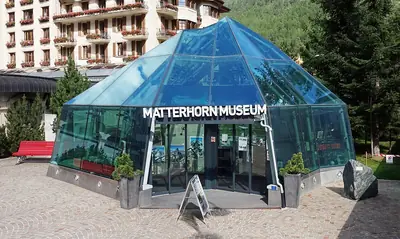
The Matterhorn Museum stands beside a fountain on Church Square, but much of the museum is underground. Inside, a reconstructed mountain village contains fourteen original buildings, including a church, hotel, mountain huts, granaries, a dairy and a stable with livestock. The reconstruction also includes the stairwell and reception of the historic Hotel Monte Rosa.
The museum tells two connected stories: Zermatt’s transformation from a farming hamlet into an international Alpine destination, and the first ascent of the Matterhorn in 1865. Its layout allows visitors to walk through the reconstructed lanes and explore the village’s changing way of life.
St. Maurice church
St. Maurice church stands in the heart of Zermatt, with views toward the Matterhorn from its entrance steps. A church was first recorded on this site in 1285. The predecessor of the present building was probably constructed in 1587 in an Italian architectural style.
Inside, the church has Baroque altars that replaced earlier Gothic ones in the eighteenth century. A notable feature is the ceiling painting Noah’s Ark, created by Paolo Parente.
Chapel of the Holy Family
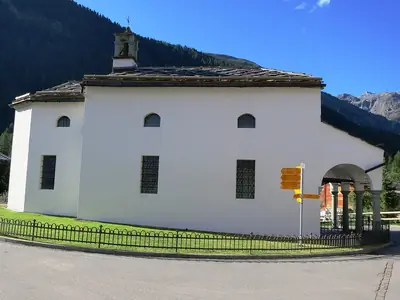
In the Winkelmatten quarter, the Chapel of the Holy Family is a small white chapel with the Matterhorn behind it. Also known locally as Kapelle Winkelmatten, it was built in 1607 as a smaller replica of Zermatt’s old village church.
The chapel’s Baroque altar was carved in 1730 by Anton Sigristen from Swiss stone pine. It features the Holy Family, gilded decoration, angels and twisting columns decorated with acanthus garlands. The chapel has also been a pilgrimage site for young couples.
High-Alpine Places Around Zermatt
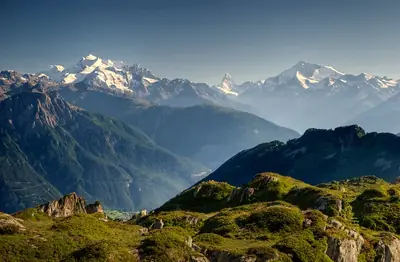
Zermatt is surrounded by the Pennine Alps, a major Alpine range forming a natural border between Switzerland and Italy. The landscape includes glaciers, ridges and numerous peaks above 4,000 meters.
Gornergrat
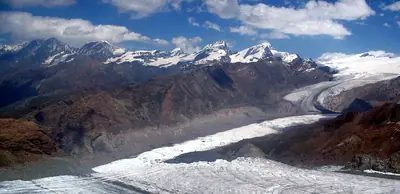
Gornergrat is a rocky ridge rising to 3,135 meters above sea level. Its panorama includes more than twenty peaks above 4,000 meters, including the Matterhorn, Monte Rosa, Lyskamm, the Dom, the Weisshorn and Dufourspitze, Switzerland’s highest summit.
The Gornergrat Bahn climbs 9.3 kilometers from Zermatt at 1,620 meters to the high-alpine station at 3,090 meters, passing through Riffelalp and Riffelberg. Near the ridge stands Kulmhotel Gornergrat, at 3,120 meters the highest mountain hotel in Switzerland. Its two towers contain astronomical observatories installed in the late 1960s.
Klein Matterhorn
Klein Matterhorn, or the Little Matterhorn, rises to 3,883 meters. It is the highest point in Europe reachable by transport, thanks to the aerial tramway. The summit forms part of Matterhorn Glacier Paradise, a year-round ski domain connecting Zermatt with Breuil-Cervinia across the Swiss-Italian border.
Klein Matterhorn is also a starting point for routes toward Breithorn, Castor and Pollux. The Theodul Glacier offers year-round ski touring.
Breithorn
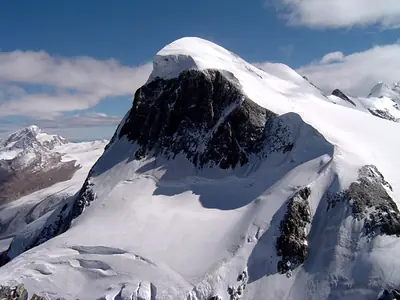
Breithorn is a heavily glaciated ridge on the border between Switzerland and Italy, reaching 4,160 meters. Its accessibility from the Klein Matterhorn cable car makes it one of the easiest four-thousand-meter peaks in the Alps to climb.
The ridge has five summits: the Western Breithorn, Central Breithorn, the western Twin, the Gendarm and Roccia Nera. The first recorded ascent took place in 1813, led by Henry Maynard with Joseph-Marie Couttet, Jean Gras and the Hérin brothers.
Monte Rosa and Dufourspitze
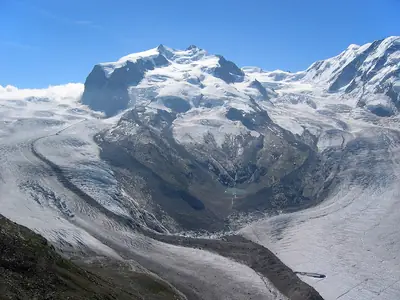
The Monte Rosa massif is the most extensive mountain range in the Alps and the second highest mountain group in the Alps and Western Europe after Mont Blanc. Its highest summit, Dufourspitze, reaches 4,634 meters.
The massif rises between Switzerland and Italy. Its north-western ice slopes and seracs feed the Gorner Glacier toward Zermatt, while its eastern side forms a granite and ice wall rising 2,400 meters above Macugnaga.
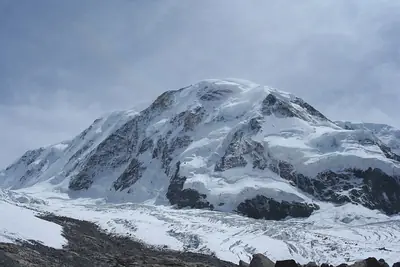
Other prominent summits visible around Zermatt include Lyskamm, a 4,532-meter ridge known for its large cornices; Parrotspitze, which reaches 4,434 meters; and Signalkuppe, or Punta Gnifetti, at 4,554 meters. Signalkuppe is home to the Margherita Hut, the highest mountain refuge in Europe.
Dent Blanche and Dent d’Hérens
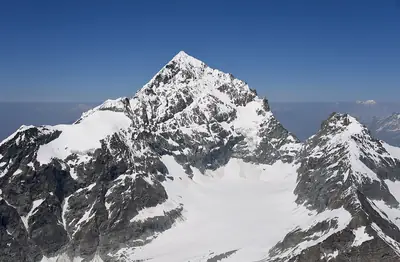
Dent Blanche rises to 4,357 meters west of Zermatt. Its largely ice-free summit reveals the rock structure behind its distinctive pyramid shape. The name means “White Tooth” in French, and the mountain lies on the language border between French- and German-speaking Upper Valais.
Dent d’Hérens is another great pyramid of rock and ice on the western horizon. Its summit stands on the border between Switzerland and Italy, a few kilometres from the Matterhorn. The mountain takes its name from the Val d’Hérens, which runs south from Sion toward the high peaks.
Ober Gabelhorn and Castor
Ober Gabelhorn rises to 4,063 meters on the ridge between the Mattertal and Val d’Anniviers. It is a serious high-Alpine objective and stands near Dent Blanche, which reaches 4,357 meters.
Castor, on the Swiss-Italian border, reaches 4,225 meters. It is the higher of the twin peaks Castor and Pollux, named after the figures from Greek and Roman mythology. The two summits are separated by the Zwillingsjoch, also called Passo di Verra.
Explore Zermatt with Neywo
Download Neywo and explore Zermatt with a self-guided walking tour: one walk covering 2.13 km in 61 minutes, with seven narrated stops. The route, Zermatt: The Village That Made Alpinism, includes Zermatt railway station, St Peter’s Church, Monte Rosa Hotel, Triftbach, the Matterhorn Museum, St. Maurice church and the Chapel of the Holy Family.
Neywo tells the story of each place as you reach it, at your own pace, with no group and no schedule. It is a free audio guide for Zermatt, with narration available in 11 languages.
Places with an audio guide in Zermatt
8 places in Zermatt with a Neywo audio guide. Each one starts telling its story as you reach it.
Self-guided tours in Zermatt
1 tour in Zermatt, free in the Neywo app. Each stop tells its story as you reach it.
- Walk
Zermatt: The Village That Made Alpinism
Stroll the car-free village where the Matterhorn was first climbed in 1865. Start at the railway station, then follow the paths of the Victorian climbers: the English church, the Monte Rosa hotel where Whymper planned his ascent, the Church Bridge view of the peak, the museum village underground and the old parish church, and end at a baroque chapel in the Winkelmatten meadows.
Zermatt railway station · St Peter’s Church · Monte Rosa Hotel · Triftbach · Matterhorn Museum · St. Maurice church …
Open this tour: Zermatt: The Village That Made Alpinism
Walk Zermatt with Neywo
Neywo turns Zermatt into a self-guided audio tour. Stories arrive as you reach the place they belong to, and the route reshapes when you wander off it.

