Bern, Switzerland: Self-Guided Walking Tour
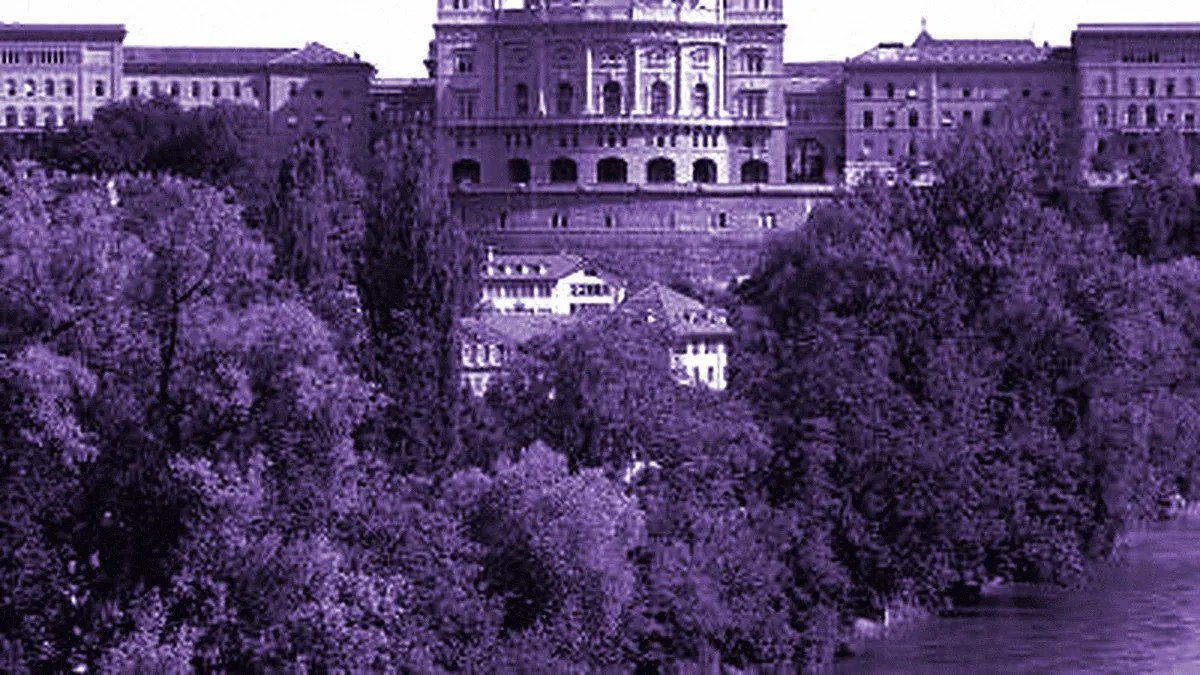
Things to do in Bern: a guide to Switzerland’s historic capital
Looking for things to do in Bern? Switzerland’s federal city brings together a UNESCO-listed Old Town, medieval towers, Renaissance fountains, important churches, museums, and views across the River Aare. Its compact historic centre makes Bern especially rewarding to explore on foot. Neywo also offers a free audio guide for Bern with 185 narrated places.
What to see in Bern
Zytglogge
The Zytglogge is Bern’s most famous medieval landmark and the city’s oldest monument. Built around 1218 as a guard tower and gateway in the first defensive walls, it later served as a prison, civic clock tower, archive, storeroom, and air-raid shelter. Today, the sandstone and limestone tower rises 54.5 metres above the Old Town.
Its astronomical clock is the main attraction. The external clock face and puppet show date from the 15th century, while the internal mechanism was completely replaced in 1530. On the east side, the Astro-Dial tracks the zodiac, the sun’s position, and the phases of the moon.
Bern Minster
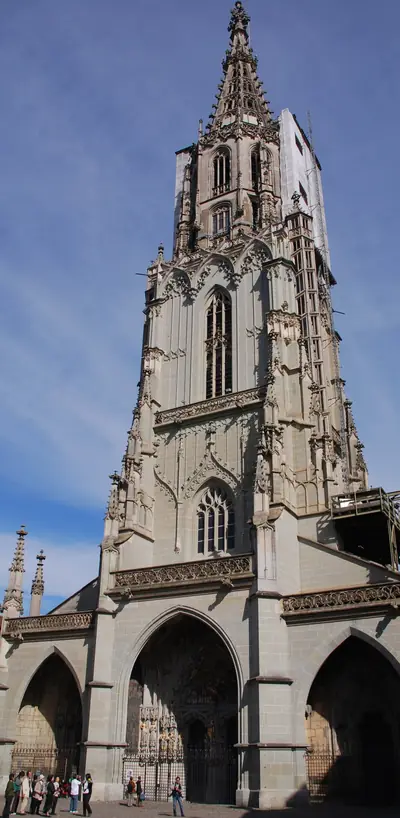
Bern Minster is the largest late medieval church in Switzerland. Construction began in 1421, although the Gothic building took centuries to complete. Its tower reached its final height of 100.6 metres in 1893, making it the tallest church tower in the country.
The west façade is dominated by a remarkable late medieval representation of the Last Judgement. Forty-seven large statues and around 170 smaller figures fill the portal, showing the righteous entering heaven and the wicked facing punishment. The sculptural ensemble survived the destruction of religious images during the Protestant Reformation in 1528.
The French Church
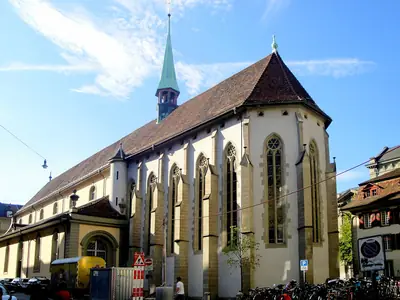
The French Church is the oldest sacred building in Bern. Dominican friars built it in 1269, and French-speaking Protestant refugees later made it their place of worship. It remains an active French-speaking Protestant congregation.
Inside, the single roof covers both the nave and chancel, while a permanent rood screen separates the former friars’ space from the congregation. Empty niches recall the Catholic chapels and statues once found there. The rood screen is decorated with paintings by the Bernese Carnation Masters, anonymous Gothic artists named for their delicate carnation motifs.
The Historical Museum of Bern
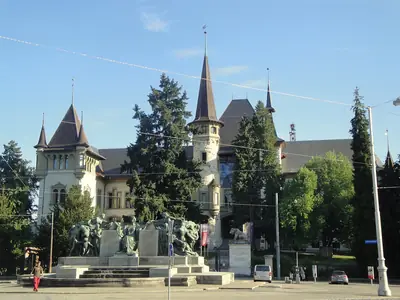
The Historical Museum of Bern is the second largest historical museum in Switzerland. The building was completed in 1894 by Neuchâtel architect André Lambert, who designed it to resemble historic Swiss castles from the 15th and 16th centuries. A modern extension was added in 2009.
The entrance hall contains The Age of History, a glass mosaic created in 1900 by Swiss painter Léo-Paul Robert. Inside, more than half a million objects cover the period from prehistory to the present day. The collections include historical room recreations, material from Bern and its region, and visual records such as Bern’s “plague drawings”.
Bern’s historic fountains
Bern’s fountains are among the most distinctive sights in the Old Town. Several of the city’s 16th-century fountains are part of the UNESCO World Heritage Site and are listed as Swiss Cultural Property of National Significance.
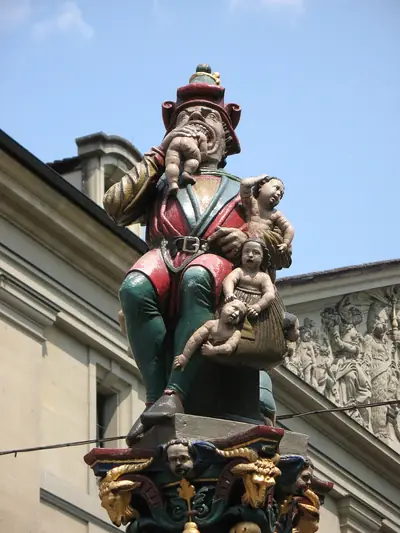
The Kindlifresserbrunnen, or Child Eater Fountain, stands in Kornhausplatz. Created by Hans Gieng between 1545 and 1546, it shows a seated ogre biting into a child while other children appear in a sack and pouch. Its meaning remains disputed, with interpretations ranging from Krampus to the Greek Titan Cronus and medieval antisemitic imagery.
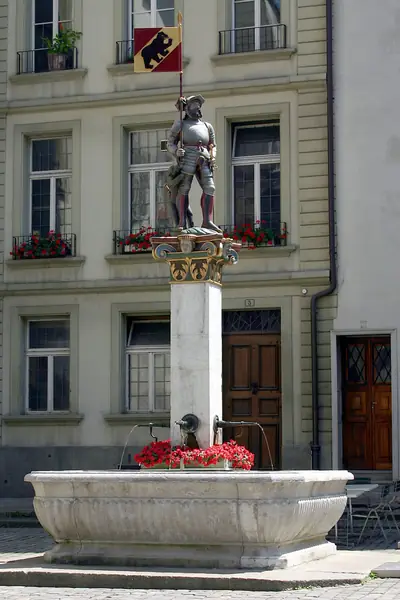
At Rathausplatz, the Fountain of the Knight Banneret dates from 1542. The armoured figure on top of the Corinthian pillar represents a Venner, a medieval military and political leader who carried a city section’s banner and could rise to the position of mayor.
The Läuferbrunnen, or Runner Fountain, features a messenger dressed in Bern’s red and grey, carrying a spear and messenger’s case. A young bear dressed as a courier walks beside him, linking the fountain to Bern’s enduring bear symbol.
The Pfeiferbrunnen, or Bagpiper Fountain, was made by Hans Gieng in 1545 and 1546, based on a woodcut by Albrecht Dürer. A golden goose and a small monkey accompany the musician, creating a lively scene associated with travelling performers. The fountain originally stood in front of a guesthouse that served minstrels.
Käfigturm and the city’s fortifications
The Käfigturm, or Prison Tower, marks the western edge of Bern’s second expansion. The Baroque tower was built in the early 1640s to replace a gate tower dating from 1256. It functioned as both a city gate and a prison, with room for between 60 and 70 inmates.
Its bell was cast in 1643 in eastern France. The prison closed in the late 19th century, after which the tower was used for state archives and other civic purposes. It remains part of the UNESCO World Heritage Site covering Bern’s Old City.
The Blood Tower, or Blutturm, once marked the northern end of the fourth western belt in the city’s historic fortifications. Its former names, Witch Tower and Harz Tower, reflect the different roles associated with it over time.
Churches beyond the Old Town
The Church of Saints Peter and Paul is the cathedral church of Switzerland’s Christian Catholic community and the first Catholic church built in Bern after the Reformation. Construction took place between 1858 and 1864, following an international competition. Its design combines Romanesque and French Gothic traditions.
St. Paul’s Church, or Pauluskirche, is one of Switzerland’s notable Art Nouveau religious buildings. Karl Moser designed it, and it was built between 1902 and 1905. The interior is decorated in blue, green, and gold, with stained-glass windows by Max Laeuger. Its 36-metre bell tower holds five bells.
The Well Pump House
The Well Pump House, or Brunnenpumphaus, was built in 1585 and formed part of Bern’s drinking-water system. Its pumps distributed water to the city’s fountains and homes. The original machinery was replaced in 1885, and the system continued operating until 1911.
After more than a century without use, the restored pump house reopened as a museum in February 2024, displaying the preserved pumping technology.
The Universal Post Monument
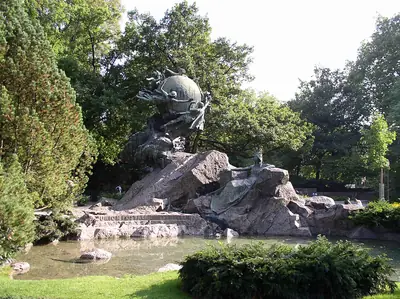
On the Kleine Schanze, the Universal Post Monument celebrates Bern as the founding city and headquarters of the Universal Postal Union, which has connected the world’s postal systems since 1874.
The bronze sculpture Autour du monde—Around the World—shows five female figures representing the continents as they pass letters around a globe. Nearby, Berna personifies the city, with her hand resting on Bern’s coat of arms. The monument was designed by French artist René de Saint-Marceaux, who won an international competition in 1903.
Old Castle Bümpliz
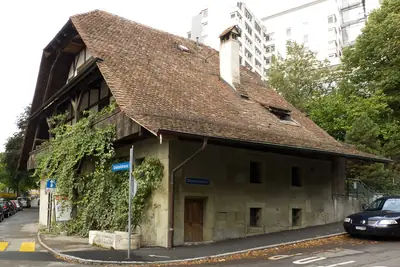
Old Castle Bümpliz, or Altes Schloss Bümpliz, stands in Bern’s Bümpliz-Oberbottigen district. Its history reaches back more than a thousand years, to a wooden royal court associated with the High Burgundian kings in the ninth century.
A water-filled moat was added in the 11th century, a stone round tower appeared in the 13th century, and the property was expanded into a castle in the 15th century. It became the “Old Castle” after a New Castle was built next door in 1742. In 1919, it was converted into a community centre with a restaurant, library, and kindergarten.
Explore Bern with a free audio guide
Neywo’s Bern audio guide includes four walking tours, one bus route, and one bike route. Together, they cover the city at different speeds and with different themes:
- Four walking tours, ranging from 1.34 to 1.95 km, taking between 75 and 106 minutes, with 10 or 12 narrated stops each.
- One 4.3 km bus route, taking 18 minutes and including 10 narrated stops.
- One 1.7 km bike route, taking 8 minutes and including 3 narrated stops.
The walks cover the fountains and historic centre, the route down to the Aare and the Bear Pit, federal Bern and the Postal Union, and the city’s museum quarter. The bus route runs from Elfenau to the Federal Palace, while the bike route connects the Rose Garden with Zentrum Paul Klee.
The app tells the story of each place as you reach it, at your own pace, with no group and no schedule. Narration is available in 11 languages. For more Swiss destinations, continue with Switzerland, or compare Bern with Geneva, Basel, or Lucerne.
Places with an audio guide in Bern
8 places in Bern with a Neywo audio guide. Each one starts telling its story as you reach it.
Self-guided tours in Bern
6 tours in Bern, free in the Neywo app. Each stop tells its story as you reach it.
- Bike ride
From the Rose Garden to Zentrum Paul Klee
Ride east from the Rose Garden's old-town view along signed cycle paths past the Schönberg country estate to Renzo Piano's wave-shaped Zentrum Paul Klee, home to the world's largest Paul Klee collection. A gentle one-way ride of a few kilometres with views over the Aare.
Rose Garden Bern · Campagne Schönberg · Zentrum Paul Klee
Open this tour: From the Rose Garden to Zentrum Paul Klee - Bus ride
Line 19: Elfenau to the Federal Palace
Bernmobil's 19 runs all day from the Elfenau district past St Ursula's, the Natural History Museum and the Kunsthalle, over the Kirchenfeld Bridge into the old town, by Theaterplatz and Bundesplatz and the Federal Palace to the Universal Postal Union monument. A cheap way to link the museum quarter and the seat of government.
St. Peter's Church · Wasserschloss · St Ursula's Church · Museum of Natural History (building) · Kunsthalle Bern · Kirchenfeldbrücke …
Open this tour: Line 19: Elfenau to the Federal Palace - Walk
Fountains, Clocks and a Patent Clerk's Home
Bern's medieval main street is lined with Renaissance fountains and crowned by the Zytglogge astronomical clock. Walk from the old prison tower through the Marksman, Child Eater, Zähringer and Samson fountains, stop at the flat where Einstein wrote his miracle-year papers, then reach Moses and the Minster and finish on the terrace high above the Aare.
Käfigturm · Anna-Seiler-Brunnen · Schützenbrunnen · Kindlifresserbrunnen · Zytglogge · Zähringerbrunnen …
Open this tour: Fountains, Clocks and a Patent Clerk's Home - Walk
Down to the Aare: Nydegg, Bear Pit and Rose Garden
Leave the Minster behind and follow the lanes down to the oldest quarter on the river bend: Bern's oldest spring system from around 1252, a Gothic church on Postgasse and the Fountain of Justice. Cross the Nydegg and Untertor bridges, pass the Felsenburg, visit the Bear Pit where Bern's heraldic animal once lived, and climb to the Rose Garden for the classic view of the old town.
Church of Saints Peter and Paul · Town Hall Courtyard Fountain · Kronenbrunnen · Church of the Antonites · Fountain of Justice · Nydegg Church …
Open this tour: Down to the Aare: Nydegg, Bear Pit and Rose Garden - Walk
Federal Bern: Station, Parliament and the Postal Union
Start at the railway station and see where Switzerland is governed. Past the Church of the Holy Ghost, the Burgerspital and the Bagpiper Fountain you reach Bärenplatz, Bundesplatz and the Federal Palace, then the Berna fountain and the monument to the Universal Postal Union, founded in Bern in 1874. End with the twin-towered Trinity Church and Bern's 1906 Moorish synagogue.
Bern railway station · Protestant Church of the Holy Ghost · Burger Hospital · Pfeiferbrunnen · Bärenplatz fountain · Bundesplatz …
Open this tour: Federal Bern: Station, Parliament and the Postal Union - Walk
Across the Kirchenfeld Bridge: Bern's Museum Quarter
Cross the Kirchenfeld Bridge to Bern's museum district: the Alpine Museum, the Kunsthalle once wrapped by Christo, a monument to the world's telecommunications pioneers, the castle-like Historical Museum, the Rifle Museum, Natural History and the National Library. End at the little Anglican church of St Ursula. A quiet, green walk for a rainy day.
Kirchenfeldbrücke · Alpine Museum building · Kunsthalle Bern · International Telecommunication Union Monument · Historical Museum of Bern · Swiss Rifle Museum …
Open this tour: Across the Kirchenfeld Bridge: Bern's Museum Quarter
Walk Bern with Neywo
Neywo turns Bern into a self-guided audio tour. Stories arrive as you reach the place they belong to, and the route reshapes when you wander off it.

