Things to Do in Da Lat, Vietnam: Walking Guide
Things to do in Da Lat: what to see in Vietnam’s highland city
The best things to do in Da Lat include exploring its distinctive temples and churches, visiting the city market and flower-inspired public spaces, and discovering unusual landmarks such as Hằng Nga Guesthouse, better known as the Crazy House. Set on the Lâm Viên Plateau in Vietnam’s Central Highlands, Da Lat combines French-period architecture, Buddhist sites, pine-covered hills, and a strong connection with flowers. Neywo has a free audio guide for Da Lat with 13 narrated places.
Da Lat is the provincial capital of Lâm Đồng and one of the main destinations in the province. Its setting brings together high plateaus, mountains, lakes, rivers, and waterfalls, while the city itself preserves traces of its development as a French colonial resort.
What to see in Da Lat
The following places offer a way to explore Da Lat’s religious heritage, architecture, markets, and central public spaces.
Hằng Nga Guesthouse, or the Crazy House
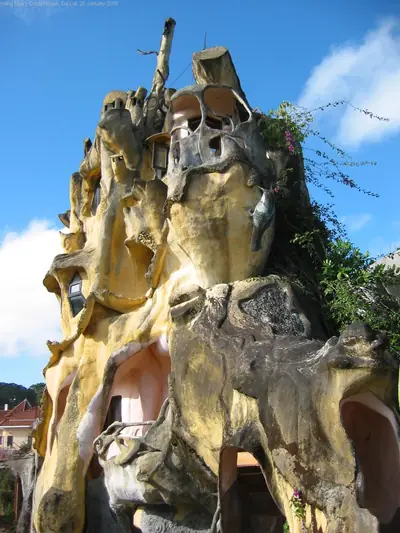
Hằng Nga Guesthouse is one of Da Lat’s most unusual buildings. Better known as the Crazy House, the complex occupies nearly 4,000 square metres at 3 Huynh Thuc Khang Street and has been open since 1990.
Its architecture has a fairy-tale quality, with an overall shape reminiscent of a giant tree. Sculpted forms inspired by animals, mushrooms, spider webs, and caves replace the straight lines and right angles found in conventional buildings. The design has appeared in numerous travel guidebooks and was named among the world’s ten most bizarre buildings in a ranking by China’s People’s Daily.
St. Nicholas Cathedral, the Chicken Church
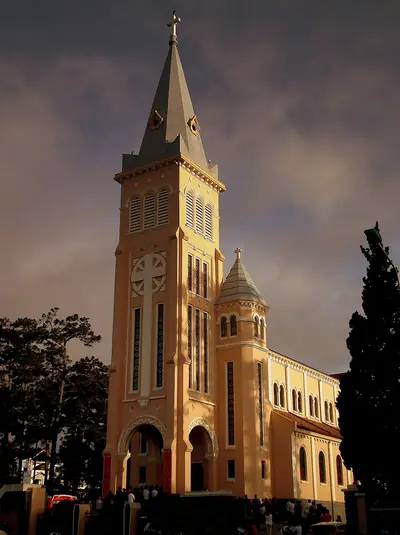
St. Nicholas Cathedral is Da Lat’s largest church and one of its oldest and most notable buildings from the French period. It is also known as the Chicken Church because of the large brass weathercock on top of its central bell tower.
The present cathedral was built by the French in 1931 and 1932 in an eclectic Romanesque style. Its parish history began with a church built in 1920, replacing an earlier one from 1917. Although the main construction was completed earlier, the interior was not finished until 1942, when the cathedral was blessed. Today, it serves as the seat of the Roman Catholic Diocese of Da Lat.
Linh Phuoc Temple, the Bottle Temple
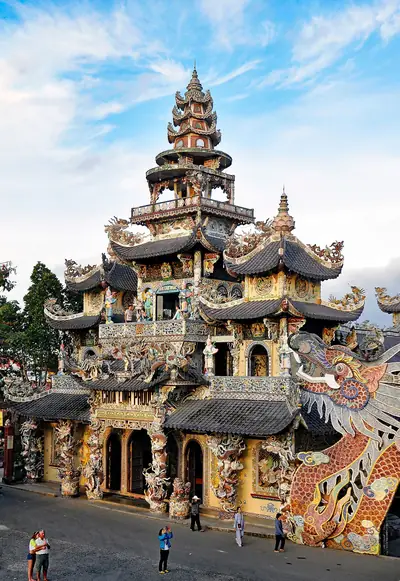
In the Trại Mát area, about eight kilometres from Da Lat city centre along Highway 20, Linh Phuoc Temple is known for its mosaic architecture. Its other name, Chùa Ve Chai or the Bottle Temple, refers to the bottles used in one of its most memorable features.
In the courtyard, a dragon stretches for 49 metres and is made from 12,000 bottles. Its head rises seven metres high, making the sculpture an especially distinctive part of the temple complex.
Van Hanh Zen Monastery
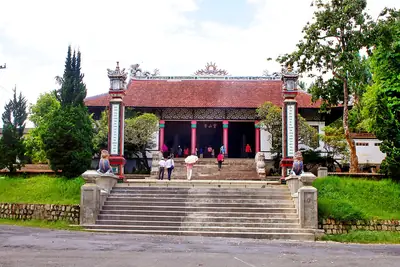
Van Hanh Zen Monastery is one of Da Lat’s well-known visitor attractions and is regarded as one of the city’s older Zen monasteries. It stands at 142 Phù Đổng Thiên Vương Street, in Lâm Viên Ward.
The monastery offers another perspective on Da Lat’s religious landscape, alongside the city’s pagodas, churches, and other places of worship.
Palace I
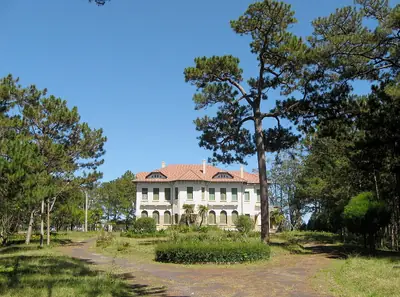
Palace I is a historic mansion set among pine forests on a hill. Built in 1940 by the French millionaire Robert Clément Bourgery, it stands at an elevation of about 1,550 metres, within grounds covering roughly 60 hectares.
Emperor Bảo Đại bought the property in 1949 and had it renovated. During the presidency of Ngô Đình Diệm, further changes added a tunnel and offices for aides and officers. After Ngô Đình Diệm was assassinated, the palace continued to serve as a retreat for successive heads of state of the Saigon regime until 1975.
Cam Ly Church
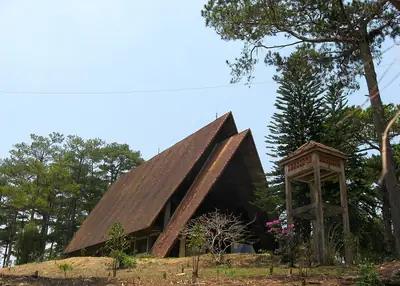
Cam Ly Church, also known as Son Cuoc Church, has a close connection with Da Lat’s ethnic minority communities. Construction took place over six years, from 1960 to 1968.
The work was led by the French priest Boutary, who had spent many years working closely with ethnic minority communities, together with the contractor Do Kieu.
Linh Sơn Pagoda
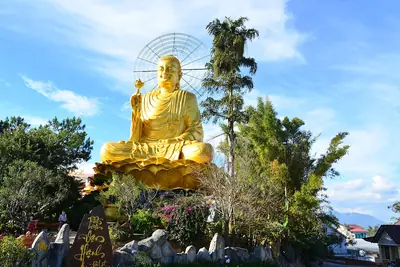
A short distance from central Da Lat, Linh Sơn Pagoda stands on a small hill surrounded by pine trees and gardens. The pagoda was built between 1938 and 1940 by the Central Vietnam Buddhist Study Association, and its complex covers about four hectares.
Rows of pine trees lead towards a courtyard with an Avalokiteshvara statue seated on a lotus. Other features include a three-storey octagonal stupa, a pond with flowers and goldfish, and dragon statues guarding the stairways to the main ceremonial hall. The building follows a simple classical Asian design, with dragons facing the roof at its corners.
Inside, a bronze statue of Gautama Buddha sits on a lotus. Cast in 1952, it weighs 1,250 kilograms. The complex also houses the offices of the Buddhist Association of Lâm Đồng Province and Da Lat, as well as Lâm Đồng Buddhist Intermediate School.
Domaine de Marie
Domaine de Marie is a Catholic convent complex belonging to the Roman Catholic Diocese of Da Lat. It brings together a chapel and two convent buildings for the Sisters of Charity of Saint Vincent de Paul, and remains connected with schooling for local children.
The complex began construction in 1940 and covers twelve hectares. Its architecture combines French and Vietnamese styles, giving the chapel and convent buildings a distinctive place in Da Lat’s cityscape.
Thiên Vương Cổ Sát
Thiên Vương Cổ Sát, also called Chùa Tàu or Chùa Phật Trầm, stands on Dragon Hill at 385 Khe Sanh Street, about five kilometres northeast of the city centre.
Its location on the hill gives the temple a setting distinct from the sites in central Da Lat. It is one of the places to include when exploring the city’s Buddhist heritage beyond the central streets.
Lâm Viên Square
Opposite Xuân Hương Lake on Trần Quốc Toản Street, Lâm Viên Square is one of Da Lat’s best-known public spaces. It is also called the Center of Da Lat, and many local people refer to it as the heart of the city of flowers.
The square is recognizable for its large flower-inspired structures, shaped like a wild sunflower and an artichoke. These forms have become symbols of Da Lat and Lâm Đồng. The square also hosts cultural and tourism events, including the Da Lat Flower Festival.
Da Lat Market
Da Lat Market, known locally as Chợ Đà Lạt, is more than a shopping area: it is considered the heart of the city and one of its main commercial and cultural centres. It stands along Nguyễn Thị Minh Khai Street and has become an important attraction for visitors.
The new market was begun in 2011 and completed between 2018 and 2019. Its central location makes it a natural place to experience an active part of Da Lat’s everyday city life.
Du Sinh Church
Du Sinh Church is a church in Da Lat and another place of worship to include when exploring the city’s religious landmarks. Its presence adds to the variety of churches, pagodas, monasteries, and temples found across Da Lat.
Exploring Da Lat and Vietnam
Da Lat offers a different urban experience from Vietnam’s larger destinations, with religious landmarks, historic buildings, public squares, and the varied landscapes of Lâm Đồng. It can also be combined with time in other Vietnamese cities, including Nha Trang, Ho Chi Minh City, Hanoi, Hue, or Hội An.
Explore Da Lat with Neywo
Neywo’s free Da Lat audio guide includes 13 narrated places. The app also offers one walking tour: Pagodas, Flowers and the Crazy House: Da Lat’s Heart.
The walk covers 5.44 kilometres, takes 111 minutes, and includes six narrated stops: Domaine de Marie, Linh Sơn Pagoda, Da Lat Market, Lâm Viên Square, St. Nicholas Cathedral, and Hằng Nga Guesthouse.
Download Neywo and explore with the story of each place playing as you reach it. Walk at your own pace, with no group and no schedule. Narration is available in 11 languages.
Places with an audio guide in Da Lat
8 places in Da Lat with a Neywo audio guide. Each one starts telling its story as you reach it.
Self-guided tours in Da Lat
1 tour in Da Lat, free in the Neywo app. Each stop tells its story as you reach it.
- Walk
Pagodas, Flowers and the Crazy House: Da Lat's Heart
Start at a pine-shaded pagoda and a French-era convent, then drop into the market that feeds the city and the flower-shaped square by Xuan Huong Lake. Finish at the Chicken Church, a 1930s cathedral topped by a brass weathercock, and at the Crazy House, a tree-shaped fairy tale of caves and spider webs. A compact tour of the hill-station city in about two hours.
Domaine de Marie · Linh Son Pagoda · Đà Lạt market · Lâm Viên square · St. Nicholas Cathedral · Hằng Nga guesthouse
Open this tour: Pagodas, Flowers and the Crazy House: Da Lat's Heart
Walk Da Lat with Neywo
Neywo turns Da Lat into a self-guided audio tour. Stories arrive as you reach the place they belong to, and the route reshapes when you wander off it.

