What to See in Ho Chi Minh City, Vietnam: Free Audio Guide
Things to Do in Ho Chi Minh City: What to See in Saigon
The best things to do in Ho Chi Minh City include exploring French-colonial landmarks, museums, temples, markets, bridges, and the historic districts of Saigon. The city brings together major chapters of Vietnamese history with lively streets, religious buildings, and striking modern architecture. Neywo offers a free audio guide for Ho Chi Minh City with 65 narrated places, so you can discover the city while walking at your own pace.
What to See in Ho Chi Minh City
Saigon Notre-Dame Basilica
Saigon Notre-Dame Basilica, officially the Cathedral Basilica of Our Lady of the Immaculate Conception, is one of Ho Chi Minh City’s most recognizable landmarks. Its red bricks were imported from Marseille, reflecting the building’s French origins. Construction began in 1877, and the cathedral opened in 1880; its two bell towers were added in 1895 and rise to about 58 metres.
The basilica was established to serve French Catholic colonists and remains the cathedral of the Archdiocese of Saigon. It stands beside the Saigon Central Post Office, making the pair a natural starting point for exploring the historic centre.
Saigon Central Post Office
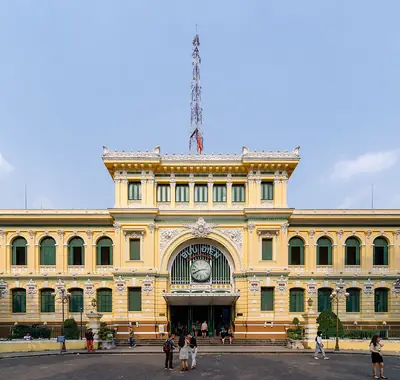
The Saigon Central Post Office is still a functioning post office and has operated continuously since the late 1880s. Built between 1886 and 1891, it combines grand neoclassical design with subtle Eastern decorative details.
Inside the main hall, two large painted maps show the telegraph lines connecting South Vietnam and Cambodia and the area around Saigon as it appeared in 1892. The building is on Paris Commune Square, immediately beside the basilica.
Independence Palace
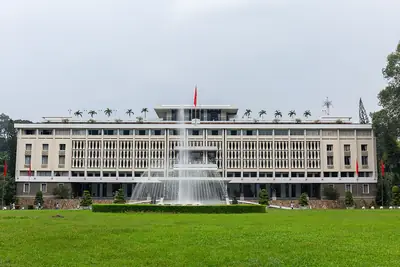
Independence Palace was the presidential residence of South Vietnam and is now a museum and convention hall. Designed by architect Ngô Viết Thụ, it occupies the former site of Norodom Palace, built by French colonists in the late nineteenth century.
The palace preserves original interiors from the 1960s and 1970s, including an underground bunker. It became internationally associated with the Fall of Saigon on 30 April 1975, when a tank crashed through its gates. For anyone interested in the history of the Republic of Vietnam, the palace offers a direct connection with the country’s wartime past.
War Remnants Museum
The War Remnants Museum documents the consequences of the First Indochina War and the Vietnam War. It opened on 4 September 1975 and now holds more than 20,000 documents, artifacts, and films, with around 1,500 items on permanent display across nine thematic exhibitions.
Outdoor displays include tanks, planes, helicopters, and artillery. Inside, the exhibitions address subjects including Agent Orange, napalm, and the prison system on Con Son Island. It is one of the most visited museums in Vietnam and a significant, often challenging, place to learn about the country’s modern history.
Museum of Ho Chi Minh City
The Museum of Ho Chi Minh City occupies the former Gia Long Palace, once the official residence of the French governor of Cochinchina and later a presidential palace for South Vietnam’s leader Ngo Dinh Diem. Its architecture combines French-colonial elegance with Vietnamese elements, including high ceilings, shuttered windows, and broad staircases suited to the tropical climate.
The museum stands on two hectares at the corner of Lý Tự Trọng and Nam Kỳ Khởi Nghĩa streets, close to Independence Palace. The building itself is an important part of the visit, reflecting the city’s transformation from colonial capital to modern metropolis.
Saigon Opera House
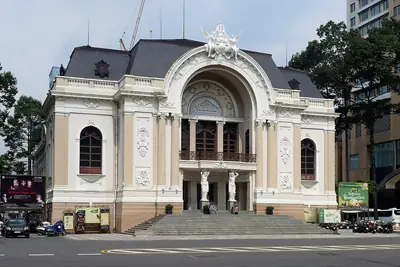
Saigon Opera House faces Lam Sơn Square and Đồng Khởi Street in the centre of the city. Built in 1900 as the Opéra de Saïgon, its Western-style façade is one of the most distinctive examples of French-colonial architecture in Ho Chi Minh City.
The 500-seat building is a municipal theatre and multi-purpose performance venue. It also played a political role: from 1956 to 1967, it housed the National Assembly, and later served as the seat of the chambers of the National Assembly of South Vietnam. Its façade was restored in 1998.
Ho Chi Minh City Hall
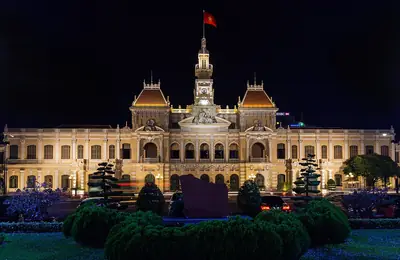
Ho Chi Minh City Hall, officially the Ho Chi Minh City People’s Council and People’s Committee Head Office, was built in French-colonial style between 1898 and 1908 and inaugurated in 1909. It served as an administrative building under successive governments and remains the seat of the city’s government.
The building faces Nguyễn Huệ Boulevard, between Pasteur, Lý Tự Trọng, Đồng Khởi, and Lê Thánh Tôn streets. A statue of Ho Chi Minh stands in the square in front of it.
Ho Chi Minh City Museum of Fine Arts
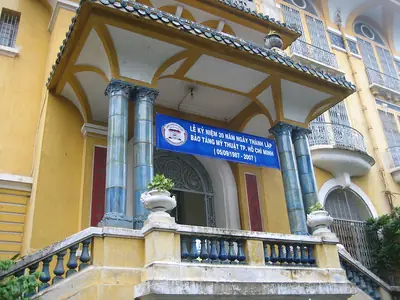
At 97 Phó Đức Chính, the Ho Chi Minh City Museum of Fine Arts introduces visitors to Vietnamese painting, sculpture, ceramics, and other works. Established in 1987 and opened in 1991, it occupies three three-storey buildings.
The main building was constructed between 1929 and 1934 as a villa for the Hua family. The collection includes oil, silk, lacquer, and woodcut paintings, as well as traditional ceramics and Buddhist art. Archaeological exhibits on the third floor include Champa and Óc Eo relics.
Ho Chi Minh City Museum of History and Hùng King Temple
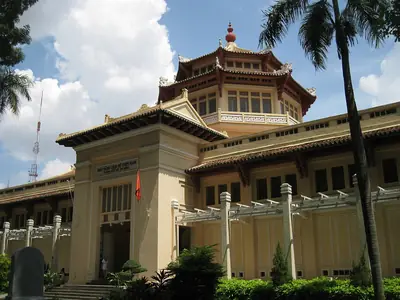
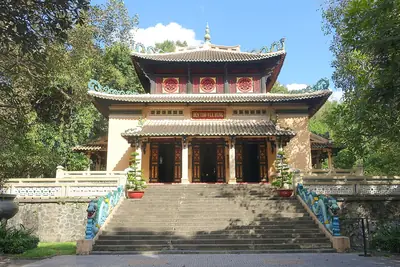
Inside Saigon Zoo and Botanical Gardens, the Ho Chi Minh City Museum of History presents Vietnam’s history across all periods through tens of thousands of artifacts. The museum opened on 1 January 1929 and was designed by French architect Auguste Delaval. It was formerly known as the Musée Blanchard de la Brosse and the National Museum of Vietnam in Saigon before adopting its current name in 1979.
Next door, Hùng King Temple is dedicated to the Hùng kings. Also designed by Auguste Delaval, it was inaugurated on the same day as the museum in 1929. The temple is also known as Đền Hùng Vương and Đền Quốc tổ Hùng Vương.
Giác Lâm Pagoda
Giác Lâm Pagoda is one of the oldest Buddhist temples in Ho Chi Minh City. Built in 1744, it is the ancestral temple of the Lâm Tế Zen sect in the southern region. The pagoda stands on Cẩm Sơn hill and is also associated with the traditional names Cẩm Đệm and Sơn Can.
Its name, Giác Lâm, means “Awakening Forest.” The temple offers a glimpse of the city’s long Buddhist tradition beyond the colonial landmarks of District 1.
Mong Bridge
Mong Bridge, or Cầu Mống, crosses the Bến Nghé Channel between District 1 and District 4. Its curved steel structure explains its local name, “Rainbow Bridge.” Originally called Pont des Messageries maritimes, it was built for the French merchant shipping company Messageries maritimes.
The bridge is about 128 metres long and 5.2 metres wide, with pedestrian sidewalks. It was dismantled during work on the East-West Boulevard and the Saigon River Tunnel in 2005, then reassembled with reinforced foundations and decorative lighting. It is now a footbridge.
Củ Chi Tunnels
About 69 kilometres northwest of central Ho Chi Minh City, the Củ Chi tunnels form an extensive underground network in An Nhơn Tây commune, Củ Chi District. Viet Minh and National Liberation Front forces dug the tunnels during the Indochina and Vietnam wars.
The complex included living quarters, hospitals, kitchens, storage areas, offices, and communication routes. It also served as a base of operations at the end of the Ho Chi Minh Trail, and forces used it to launch attacks on central Saigon during the 1968 Tết Offensive. The tunnels reveal how military operations and everyday life were organized underground.
Landmark 81
Landmark 81 rises on the western bank of the Saigon River, north of the historic centre and immediately south of Saigon Bridge. At 461.2 metres and 81 storeys, it is Vietnam’s tallest building.
The mixed-use tower forms part of Vinhomes Central Park and includes a hotel, luxury apartments, offices, cinemas, restaurants, and leisure facilities. Floors 79 to 81 contain a multi-storey observation deck, while the tower’s lower and middle levels include apartments, hotel rooms, and other urban uses.
Explore Ho Chi Minh City with a Self-Guided Audio Tour
Neywo makes it easy to turn these sights into a Ho Chi Minh City self-guided walking tour. The app tells the story of each place as you reach it, at your own pace, with no group and no schedule.
The city currently has five walking tours and one bus route:
- Saigon’s French Quarter: Basilica, Post Office and Opera — 3.1 km, 115 minutes, 8 narrated stops.
- Fall of Saigon: Palace, War Museum and Turtle Lake — 4.25 km, 104 minutes, 6 narrated stops.
- Rivers, Bridges and Temples: Mariamman to the Dragon House — 2.88 km, 77 minutes, 6 narrated stops.
- Zoo, Temple and Mosque: Saigon’s Quiet Side — 2.16 km, 71 minutes, 6 narrated stops.
- Cholon Pagodas and Churches — 4.47 km, 89 minutes, 5 narrated stops.
- Bus 31: Opera House to Tan Dinh through the French Quarter — 2.3 km, 10 minutes, 5 narrated stops.
Download Neywo to explore Ho Chi Minh City independently and hear the story of each place when you arrive. The narration is available in 11 languages, and the free audio guide lets you discover Saigon without joining a group or following a fixed schedule. After exploring the city, continue your journey through Vietnam and discover destinations such as Hanoi, Hue, or Da Nang.
Places with an audio guide in Ho Chi Minh City
8 places in Ho Chi Minh City with a Neywo audio guide. Each one starts telling its story as you reach it.
Self-guided tours in Ho Chi Minh City
6 tours in Ho Chi Minh City, free in the Neywo app. Each stop tells its story as you reach it.
- Bus ride
Bus 31: Opera House to Tan Dinh through the French Quarter
Ride city bus 31 from the Opera House past City Hall, Notre-Dame Basilica and Turtle Lake to the pink Tan Dinh church. It strings the colonial centre's best sights on one cheap ticket, and you can hop off at any of them.
Saigon Opera House · Ho Chi Minh City Hall · Saigon Notre-Dame Basilica · Hồ Con Rùa · Tan Dinh church
Open this tour: Bus 31: Opera House to Tan Dinh through the French Quarter - Walk
Saigon's French Quarter: Basilica, Post Office and Opera
Walk the boulevards the French built as the Paris of the East. Begin at the red-brick Notre-Dame Basilica and the post office beside it, then pass the Gia Long Palace museum, the ornate City Hall and the Opera House. Continue to a 1930s mosque and Bitexco's lotus-shaped tower, and finish under the clock tower of Ben Thanh Market.
Saigon Notre-Dame Basilica · Saigon Central Post Office · Bảo tàng Thành phố Hồ Chí Minh · Ho Chi Minh City Hall · Saigon Opera House · Saigon Central Mosque …
Open this tour: Saigon's French Quarter: Basilica, Post Office and Opera - Walk
Fall of Saigon: Palace, War Museum and Turtle Lake
Follow the story of South Vietnam from Gia Long Palace, the French governor's residence later used by Ngo Dinh Diem, to the Independence Palace, where a tank crashed through the gates on 30 April 1975. Continue to the War Remnants Museum and its sobering exhibits, take a coffee at Turtle Lake, and end at the pink-faced Tan Dinh church and the seven-storey Vinh Nghiem Pagoda.
Bảo tàng Thành phố Hồ Chí Minh · Independence Palace · War Remnants Museum · Hồ Con Rùa · Tan Dinh church · Vinh Nghiem Pagoda
Open this tour: Fall of Saigon: Palace, War Museum and Turtle Lake - Walk
Rivers, Bridges and Temples: Mariamman to the Dragon House
Start at a Tamil Hindu temple built by Chettiar traders, cross Ben Thanh's square to the Fine Arts Museum in a 1930s villa, then walk down to the rainbow-shaped Mong Bridge. Cross the Ben Nghe Channel to the Dragon House wharf, where the young Ho Chi Minh left Vietnam in 1911, and end at the riverside square with Tran Hung Dao's statue.
Mariamman Temple, Ho Chi Minh City · Quách Thị Trang Square · Ho Chi Minh City Museum of Fine Arts · Mong Bridge · Dragon House · Mê Linh Square
Open this tour: Rivers, Bridges and Temples: Mariamman to the Dragon House - Walk
Zoo, Temple and Mosque: Saigon's Quiet Side
Begin in Vietnam's oldest zoo and botanical garden, where a 1929 museum and the Hung King Temple share the grounds. Then walk to the first Carmelite convent in the Far East and on to the 1935 Central Mosque and the square around the Opera House.
Saigon Zoo and Botanical Gardens · Ho Chi Minh City Museum of History · Hùng King Temple · Carmelite Convent of Saigon · Saigon Central Mosque · Lam Sơn Square
Open this tour: Zoo, Temple and Mosque: Saigon's Quiet Side - Walk
Cholon Pagodas and Churches
Head west to the Chinese quarter and its mix of faiths. See a colourful seven-storey national pagoda, the An Quang Pagoda where modern Vietnamese Buddhism took shape, the Romanesque Jeanne d'Arc Church built on a Chinese cemetery, a historic mosque and Saint Francis Xavier Church.
Việt Nam Quốc Tự · An Quang Pagoda · Jeanne d'Arc Church · Cholon Jamial Mosque · Saint Francis Xavier Church
Open this tour: Cholon Pagodas and Churches
Walk Ho Chi Minh City with Neywo
Neywo turns Ho Chi Minh City into a self-guided audio tour. Stories arrive as you reach the place they belong to, and the route reshapes when you wander off it.

