Things to Do in Hue, Vietnam: Walking Guide
Things to Do in Hue, Vietnam: Imperial History, Palaces and the Perfume River
Looking for things to do in Hue? Vietnam’s former imperial capital brings together the walled citadel of the Nguyễn dynasty, royal palaces, religious landmarks and the Perfume River in a city with a richly layered history. It is one of the most rewarding places to explore in Vietnam, especially if you want to understand the country’s imperial past.
Hue was the seat of the Nguyễn dynasty from 1802 until the monarchy ended in 1945. Neywo has a free audio guide for Hue with 19 narrated places, so you can discover the city while walking at your own pace.
What to See in Hue
Huế Citadel
The story of Hue’s imperial center begins with Huế Citadel, known locally as Kinh thành Huế. Emperor Gia Long surveyed the site in 1803, construction began in 1805, and the citadel was completed in 1832 during the reign of Emperor Minh Mạng.
It served as the seat of the Nguyễn dynasty for 143 years, from 1802 to 1945. The larger citadel occupies the area of present-day Phú Xuân Ward and contains the Imperial City, also known as Đại nội Huế.
Imperial City of Hue
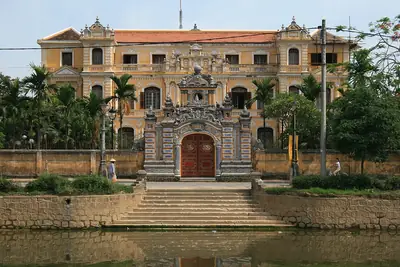
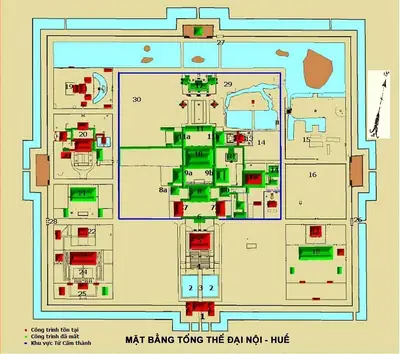
Inside the citadel stands the Imperial City, or Hoàng Thành Huế. Built in 1804 under Emperor Gia Long, it was later remodelled and enlarged in 1833. Its walls enclosed the most important palaces, imperial shrines and the Forbidden Purple City, which was reserved for the emperor and the royal family.
This was far more than a single palace. The complex included royal residences, ancestral shrines, gardens and offices used by mandarins. Its role was largely ceremonial, although it also served as an imperial residence during the period of French colonial rule.
The buildings suffered extensive damage and neglect after the end of the monarchy, particularly during the Indochina Wars and through the 1980s. The surviving complex is therefore both a royal enclosure and a place undergoing recovery.
Hall of Supreme Harmony
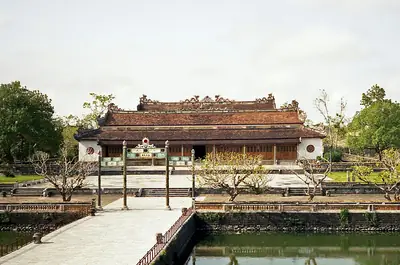
The Hall of Supreme Harmony, or Thai Hoa Hall, stands beside the Đại Triều Nghi courtyard, directly in front of the Forbidden Purple City. It was one of the most important ceremonial spaces in the Nguyễn capital.
Imperial coronations, grand court audiences, celebrations of imperial longevity and diplomatic rituals took place here. All thirteen Nguyễn emperors, from Gia Long to Bảo Đại, were enthroned in the hall. It forms part of the Complex of Huế Monuments, which UNESCO inscribed as a World Heritage Site in 1993.
Bảo tàng Cổ vật Cung đình Huế
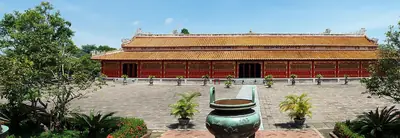
The Hue Museum of Royal Fine Arts offers a closer look at everyday life within the Nguyễn court. Its main building is Long An Palace, a wooden structure built in 1845 during the reign of Emperor Thiệu Trị.
The palace is supported by 128 valuable timber columns and decorated with carvings of the dragon, qilin, tortoise and phoenix. More than a thousand poems written in Chinese characters also appear throughout the building.
Inside, the museum displays more than 300 objects made from gold, ceramics, porcelain and Huế enamel, as well as royal clothing and objects used by the imperial household. Its collection includes a Nguyễn emperor’s throne, recognized by the Vietnamese government as a national treasure.
Long An Palace
Long An Palace was once part of the Bao Dinh Palace complex, created during the reign of Emperor Thiệu Trị. Built in 1845 on the northern bank of the Ngu Ha River, it served as a place where the emperor could rest after the spring ploughing ceremony, known as Tich Dien.
Its connection with the Hue Museum of Royal Fine Arts makes it an important surviving example of the architecture and ceremonial life of the Nguyễn court.
An Dinh Residence
Beside the An Cuu River, An Dinh Residence shows a different side of Hue’s royal architecture. Also known as An Dinh Palace, it combines Vietnamese and French architectural styles and is considered a representative example of early twentieth-century Vietnamese architecture.
The residence began as the home of Nguyen Phuc Bao Dao, the eldest son of Emperor Dong Khanh. When he became Emperor Khai Dinh in 1916, he transformed it into a more splendid palace. After Emperor Bao Dai abdicated in 1945, he lived here for a time with his family.
Tomb of Khai Dinh
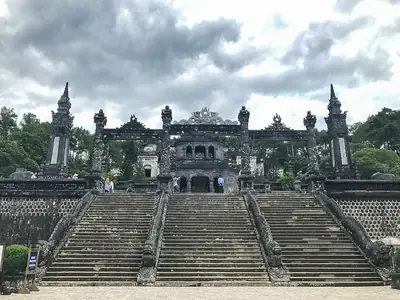
The Tomb of Khai Dinh, officially known as Ứng Mausoleum, was built for Khai Dinh, Vietnam’s twelfth Nguyễn emperor. Construction lasted eleven years and was completed in 1931.
Its most distinctive feature is the combination of Vietnamese architecture with Western styles. That meeting of traditions gives the mausoleum a character that differs from the earlier royal buildings within the citadel.
Phủ Cam Cathedral
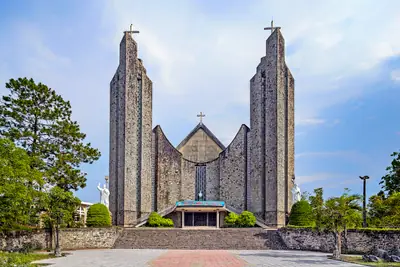
Phủ Cam Cathedral rises on Phước Quả Hill and serves as the cathedral of the Archdiocese of Huế. The present building has a distinctly modern architectural style and was designed by the architect Ngô Viết Thụ.
A Catholic church has stood on this site since the seventeenth century. The current cathedral was built over almost forty years, from 1963 to 2000, giving the site a long history of Catholic worship alongside its modern appearance.
French Annam
Hue was the historic center of French Annam, known in Vietnamese as Trung Kỳ. This French protectorate covered central Vietnam, while the Nguyễn emperor continued to reside in Hue and nominally rule Annam and Tonkin.
French officials oversaw protection and administration. In 1887, Annam became part of French Indochina alongside Tonkin, Cambodia and French Cochinchina. The protectorate disappeared as political authority passed to Vietnamese governments in the late 1940s.
Perfume River
The Perfume River, or Sông Hương, flows through the center of Hue and remains one of the city’s cultural, historical and tourism symbols. Its name is linked to the flowers that fall into the water from orchards upstream in autumn, giving the river a perfume-like aroma.
The river also shapes the city’s modern cultural landscape. The Huong River Opera House stands where the An Cuu River meets the Huong River, with the river surrounding the theatre. Its design connects a contemporary cultural venue with Hue’s riverside setting.
Trấn Hải Fortress
At the Eo Estuary, also known as Lấp Estuary and formerly Thuận An, Trấn Hải Fortress reveals Hue’s strategic coastal history. King Gia Long built it in 1813 to control ships approaching from the sea and defend the Nguyễn capital.
The fortress is part of a World Heritage site in Vietnam, and its surviving remains reflect the defensive importance of the waterways leading toward Hue.
Explore Hue with a Free Audio Guide
Neywo’s Hue audio guide includes 19 narrated places and two self-guided walking tours:
- Where the Emperors Reigned: Hue’s Forbidden Capital covers 2.11 km in 61 minutes, with 5 narrated stops: Long An Palace, the Hue Museum of Royal Fine Arts, the Imperial City of Hue, the Hall of Supreme Harmony and Huế Citadel.
- French Hue: Cathedrals, Palaces and the River covers 3.42 km in 69 minutes, with 4 narrated stops: Huong River Opera House, Phủ Cam Cathedral, Redemptorist Church and An Dinh Residence.
Download Neywo and explore Hue with the stories of each place playing as you reach it. Walk at your own pace, with no group and no schedule. Narration is available in 11 languages, making it an easy way to discover the city independently.
Places with an audio guide in Hue
8 places in Hue with a Neywo audio guide. Each one starts telling its story as you reach it.

Self-guided tours in Hue
2 tours in Hue, free in the Neywo app. Each stop tells its story as you reach it.
- Walk
Where the Emperors Reigned: Hue's Forbidden Capital
Step inside the walled city that ruled Vietnam for 143 years. You start at a poet-emperor's rest palace and the museum of royal treasures inside it, cross into the Imperial City, stand in the throne hall where thirteen emperors were crowned and finish along the great citadel walls.
Long An palace · Bảo tàng Cổ vật Cung đình Huế · Imperial City of Hue · Hall of Supreme Harmony (Imperial City of Huế) · Huế citadel
Open this tour: Where the Emperors Reigned: Hue's Forbidden Capital - Walk
French Hue: Cathedrals, Palaces and the River
A south-bank walk through the Hue the French and the last emperors left behind. Pass a modern riverside opera house, a hilltop cathedral, a Redemptorist church and the Franco-Vietnamese palace where Emperor Bao Dai stayed after he abdicated.
Huong River Opera House · Phủ Cam Cathedral · Redemptorist Church · An Dinh Residence
Open this tour: French Hue: Cathedrals, Palaces and the River
Walk Hue with Neywo
Neywo turns Hue into a self-guided audio tour. Stories arrive as you reach the place they belong to, and the route reshapes when you wander off it.

