Visiting Quito, Ecuador: Top Sights on Foot
Things to do in Quito: what to see in Ecuador’s capital
Quito, the capital of Ecuador, is an Andean city of historic churches, museums, cultural centers and mountain views. Its historic center brings together centuries of religious, political and artistic history, while places such as Ciudad Mitad del Mundo and La Capilla del Hombre show other sides of the city and the country. Neywo has a free audio guide for Quito with 75 narrated places, available in 11 languages.
What to see in Quito’s historic center
Quito’s historic center is the best place to begin exploring the city. The landmarks below follow a natural route through its plazas, churches and museums.
Plaza de la Independencia and the Cathedral of Quito
Plaza de la Independencia is framed on its southwestern side by the long façade of the Cathedral of Quito, also known as Quito Metropolitan Cathedral. It is the principal Catholic cathedral of Quito and became the Cathedral of Ecuador in 1995.
Construction began in the mid-sixteenth century, and the cathedral was completed and consecrated in 1572. After Mount Pichincha’s eruption damaged the building in 1660, reconstruction and expansion continued until 1806. The result is a mixture of Baroque, Moorish, Neoclassical and Gothic elements, reflecting the cathedral’s long history of construction and restoration.
Iglesia de El Sagrario
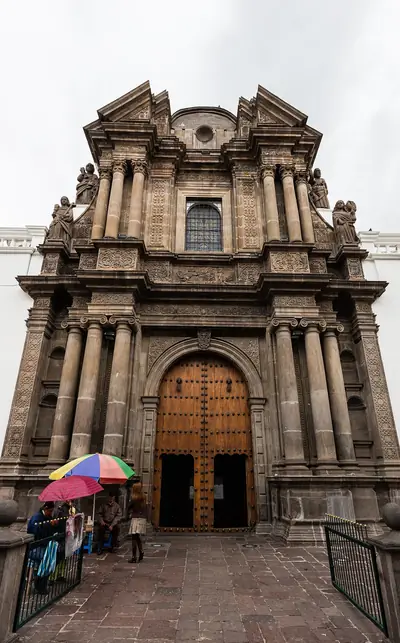
Beside the cathedral on García Moreno Street, Iglesia de El Sagrario was built as a sacramental chapel attached to a larger church. Its name means Church of the Sanctuary.
The building follows the Italian Renaissance style, while its entrance is one of Quito’s notable Baroque works. Designed by José Jaime Ortiz, the church was completed in stages: the façade was finished in 1706 and the rest of the construction in 1715. Bernardo de Legarda’s carved wooden gateway is especially rich in plant forms and architectural detail.
Centro Cultural Metropolitano
The Centro Cultural Metropolitano occupies a colonial building dating from 1622, although its façade was rebuilt in the twentieth century. The site was once home to the First Central University and later served as a jail during Ecuador’s War of Independence, when Spanish authorities executed insurgents there.
Today, the center includes the Alberto Mena Caamaño Museum and the Federico González Suárez Library. Its history connects education, conflict and Quito’s contemporary cultural life.
Alberto Mena Caamaño Museum
Located beside Palacio de Carondelet on Espejo Street, the Alberto Mena Caamaño Museum combines art, archaeology, weapons and objects linked to Quito’s history. Its collection began with a donation of more than six hundred objects from Alberto Mena Caamaño to the Municipality of Quito.
The museum occupies the former Royal Barracks of Lima. One of its most memorable spaces is the permanent room dedicated to the events of August 2, 1810, recreated with wax figures.
Casa de Sucre
Casa de Sucre is a museum associated with Marshal Antonio José de Sucre and his wife, Mariana Carcelén, Marquise of Solanda and Villarocha. The mansion’s Andalusian-style central patio and thirteen rooms provide a setting for exploring the period of Ecuadorian independence.
The displays include family portraits, original furniture, personal belongings, everyday objects, maps and documents. Military equipment and weapons appear on the ground floor, while the upper level recreates the family’s living spaces.
Church of Saint Frinci
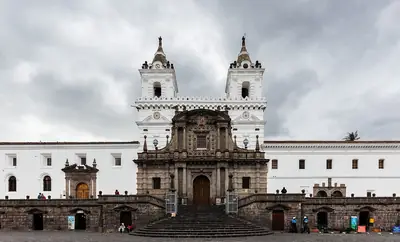
The Church and Convent of San Francisco faces San Francisco Square and forms one of Quito’s largest religious complexes. Founded in 1534, with construction beginning in 1537, the complex developed for more than 150 years.
It includes three churches, thirteen cloisters, a large atrium and around forty thousand square meters of construction. Renaissance and Baroque elements come together in the ensemble, while the concave and convex staircase leading from the square to the atrium creates a distinctive approach to the church’s Mannerist-Baroque façade.
Casa del Alabado Pre-Columbian Art Museum
Casa del Alabado is housed in a well-preserved seventeenth-century colonial building in the historic center. Its collection contains more than five thousand archaeological pieces, with around five hundred on permanent display.
The museum presents the objects as works of art, particularly ceramics connected with ceremonial and ritual use. The collection includes pieces from cultures such as Valdivia, Jama-Coaque and Chorrera, as well as other pre-Inca civilizations. Eight exhibition rooms explore different themes, while courtyards and the historic building form part of the experience.
City Museum
The City Museum occupies the former San Juan de Dios Hospital, a building that tells the story of Quito alongside four centuries of medical care. Founded in 1998 after the hospital buildings were converted for public cultural use, the museum presents the social history of Quito and its surrounding cultural area from the sixteenth through the nineteenth century.
Exhibits explore local traditions, legends, food, clothing, crafts and everyday activities. The former hospital covers 10,200 square meters and is arranged around four courtyards with stone columns, doorways and patio coverings.
Iglesia de Santo Domingo
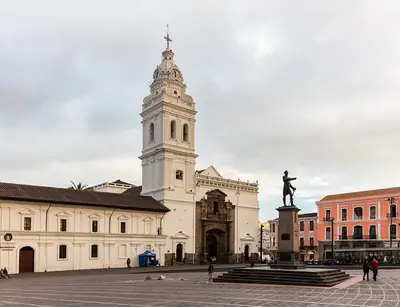
Iglesia de Santo Domingo, its convent and its chapels form a significant religious complex facing Santo Domingo Square. It is another important stop in Quito’s Historic Center, adding to the sequence of churches and plazas that define the city’s colonial core.
Museo Camilo Egas
Museo Camilo Egas combines Ecuadorian modernist art with the atmosphere of an eighteenth-century colonial house. The museum, established in 1980, is dedicated to the painter Camilo Egas.
Its collection includes paintings, sculptures and drawings representing modernism, realism and abstraction. The house itself was restored by the Central Bank of Ecuador, making the historic setting part of the visit.
Museums and cultural landmarks beyond the old town
Casa de la Cultura Ecuatoriana
The Casa de la Cultura Ecuatoriana has contributed to Ecuador’s cultural life since 1944, when it was founded by Benjamín Carrión. The building also houses Ecuador’s National Museum, known as MuNa.
The institution connects the preservation of Ecuadorian heritage with a wider cultural organization that has offices in almost every province of the country.
Itchimbía Cultural Center
At the top of Itchimbía Hill, the Itchimbía Cultural Center is known as Palacio de Cristal, or Crystal Palace. Its steel-and-glass structure stands within Itchimbía Park and is used for exhibitions and cultural events.
The transparent surfaces and visible steel framework give the building a distinctive appearance from the hilltop setting.
La Capilla del Hombre
La Capilla del Hombre, or The Chapel of Man, is a museum in Bellavista dedicated to the peoples of Latin America. Created through the initiative of Oswaldo Guayasamín, it brings together paintings, sculptures and murals in a building designed specifically for his work.
An eternal flame dedicated to human rights and peace burns at the heart of the museum. The building and its surroundings form part of the artistic interpretation, giving the visit a solemn and deliberately unified character.
A landmark outside Quito: Ciudad Mitad del Mundo
Ciudad Mitad del Mundo is a tourist and cultural complex in San Antonio parish, north of Quito. It is built around a monument dedicated to the Equator and includes a small colonial-style town and exhibition spaces.
A yellow line crosses the grounds from east to west. The monument’s four sides point toward the cardinal directions, while its central sphere and metal ring represent the Earth and the Equator. The structure rises about thirty meters and commemorates the eighteenth-century Franco-Spanish Geodesic Mission, which studied the shape of the Earth through measurements near the Equator and in Sweden.
Explore Quito with a self-guided audio tour
Neywo turns Quito into a self-guided walking tour: the app tells the story of each place as you reach it, at your own pace, with no group and no schedule. Alongside its 75 narrated places, the Quito audio guide includes five walks and one bus route:
- Plaza Grande: Gold, Wax and the Cradle of Independence — 1.21 km, 86 minutes and 9 narrated stops.
- San Francisco and the Pre-Columbian Past — 1.51 km, 83 minutes and 8 stops.
- Theatre, Art and Convent Walls: East of Plaza Grande — 1.21 km, 54 minutes and 6 stops.
- La Alameda and El Ejido: Parks, Arches and Museums — 3.1 km, 73 minutes and 6 stops.
- Beyond the Walls: Panopticon, San Diego and the Virgin of El Panecillo — 2.84 km, 61 minutes and 4 stops.
- Bus 054A: Historic Centre to Panecillo and Beyond — 17.5 km, 75 minutes and 8 stops.
Download Neywo and explore Quito independently, listening to its history as you move from the Cathedral of Quito and San Francisco to its museums, parks and viewpoints. When you continue through Ecuador, you can also compare the capital with Cuenca, Guayaquil, Otavalo or Baños de Agua Santa.
Places with an audio guide in Quito
8 places in Quito with a Neywo audio guide. Each one starts telling its story as you reach it.
Self-guided tours in Quito
6 tours in Quito, free in the Neywo app. Each stop tells its story as you reach it.
- Bus ride
Bus 054A: Historic Centre to Panecillo and Beyond
A regular Vencedores de Pichincha bus that links the south-west suburbs with the Historic Centre. Ride it past Sucre House, the cathedral, the Sucre Theater, the Casa de la Cultura and the Virgin of El Panecillo for a few cents.
Sucre House · Cathedral of Quito · Palacio del Antiguo Círculo Militar · Sucre National Theater · Casa de la Cultura Ecuatoriana · Iglesia de San Blas …
Open this tour: Bus 054A: Historic Centre to Panecillo and Beyond - Walk
Plaza Grande: Gold, Wax and the Cradle of Independence
Start at the white facade of La Merced, then stand where Ecuador declared its independence and walk the sides of Plaza Grande: the modernist town hall, the cathedral where Sucre is remembered, a church of carved wood, the Jesuit church plated in gold and the home of the Marshal of Ayacucho. Duck into museums where wax figures replay the events of 10 August 1809 and 2 August 1810.
Basilica of La Merced · Plaza de la Independencia · Palacio Municipal, Quito · Alberto Mena Caamaño Museum · Centro Cultural Metropolitano · Cathedral of Quito …
Open this tour: Plaza Grande: Gold, Wax and the Cradle of Independence - Walk
San Francisco and the Pre-Columbian Past
Begin on the stone steps of Quito's oldest and largest monastery complex, then slip down quiet colonial streets to a palace turned boutique hotel, the square of the Santa Clara convent, a museum of Pre-Columbian ceramics arranged by ideas rather than dates and a hospital turned city museum. End at the plaza and church of Santo Domingo and the pedestrian passage to Teatro Bolívar.
Church of Saint Frinci · Palacio Gangotena · Plaza de Santa Clara · Casa del Alabado Pre-Columbian Art Museum · City Museum · Plaza de Santo Domingo …
Open this tour: San Francisco and the Pre-Columbian Past - Walk
Theatre, Art and Convent Walls: East of Plaza Grande
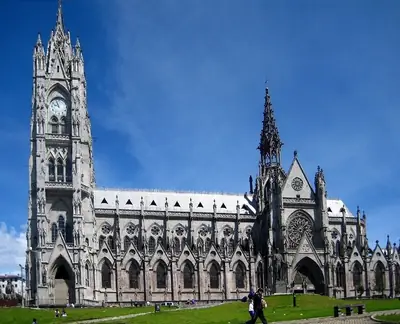
Walk through the monumental church and museum of San Agustín and a former military club to the lively Plaza del Teatro beside the grand Sucre National Theater. Continue through an eighteenth-century house with modernist art and finish at the neo-Gothic Basilica of the National Vow.
Museo de San Agustín · Palacio del Antiguo Círculo Militar · Sucre National Theater · Plaza del Teatro, Quito · Museo Camilo Egas · Basílica Católica del Voto Nacional - Parroquia Sagrado Corazón de Jesús
Open this tour: Theatre, Art and Convent Walls: East of Plaza Grande - Walk
La Alameda and El Ejido: Parks, Arches and Museums
Leave the old town for Quito's oldest park, where the astronomical observatory stands, then follow the greenery to the triumphal arch of La Circasiana, the House of Ecuadorian Culture and the museums of natural history and Indigenous cultures around El Ejido Park.
Quito Astronomical Observatory · El Belén · Casa de la Cultura Ecuatoriana · Puerta de La Circasiana · Gustavo Orcés V. Natural History Museum · Abya Yala
Open this tour: La Alameda and El Ejido: Parks, Arches and Museums - Walk
Beyond the Walls: Panopticon, San Diego and the Virgin of El Panecillo
Walk west of the old town to a former prison turned museum, the Franciscan convent of San Diego beside its cemetery and the monument to the Battle of Pichincha. Finish below the hill of El Panecillo, topped by the winged Virgin of Quito.
Templo de la Patria Museum · Panopticon · Convent of San Diego · Virgin of El Panecillo
Open this tour: Beyond the Walls: Panopticon, San Diego and the Virgin of El Panecillo
Walk Quito with Neywo
Neywo turns Quito into a self-guided audio tour. Stories arrive as you reach the place they belong to, and the route reshapes when you wander off it.

