What to See in Cobh, Ireland: Free Audio Guide
Things to Do in Cobh: A Self-Guided Walk Through Ireland’s Maritime History
Cobh is a harbour town in County Cork known for its colorful hillside houses, striking cathedral, and powerful connections with Irish emigration, the Titanic, and the RMS Lusitania. Its compact centre is easy to explore on foot, with historic waterfront landmarks and museums revealing how deeply the town’s story is shaped by the sea. Neywo has a free audio guide for Cobh with 14 narrated places, available in 11 languages.
What to See in Cobh
Cobh Railway Station and Cobh Heritage Centre
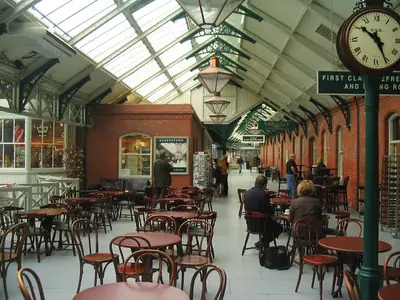
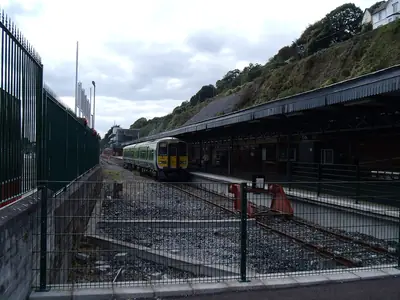
Cobh railway station stands beside the Cobh Heritage Centre in a red-brick Victorian building. The station connects Cobh with Cork and the surrounding rail network, while the heritage centre occupies a former railway station and focuses on the town’s history as Queenstown.
The Queenstown Experience explores Irish emigration, maritime disasters, and penal transportation to Australia. Between 1848 and 1950, more than six million people left Ireland, and about two and a half million departed from Cobh. Exhibits connect those large movements with the personal hopes and hardships of the people who travelled.
The building itself also has an unusual history: on May 5, 1995, a train failed to stop and crashed through its wall. Today, its restored Victorian architecture forms part of the visit.
Cobh Museum
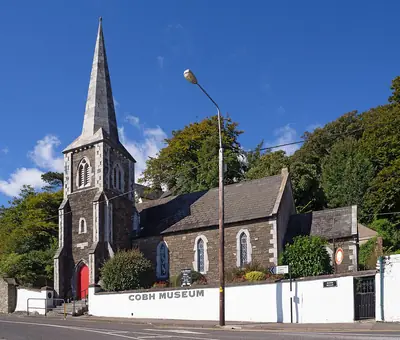
Above Cobh Train Station, Cobh Museum offers a more intimate look at the town’s social, cultural, and maritime past. Its collection covers nearly two centuries on the Great Island and includes personal stories, letters, newspaper clippings, and historical records.
Among its notable objects is a pilot’s logbook containing the last written record of the RMS Titanic before its final voyage. Displays also explore Cobh’s connection with the Lusitania. A small genealogical reference section provides material for visitors researching family links with the area.
The museum is housed in the former Scots Church, a Presbyterian church. Original features, including the pulpit, lectern, harmonium, and Bible, remain inside.
Annie Moore
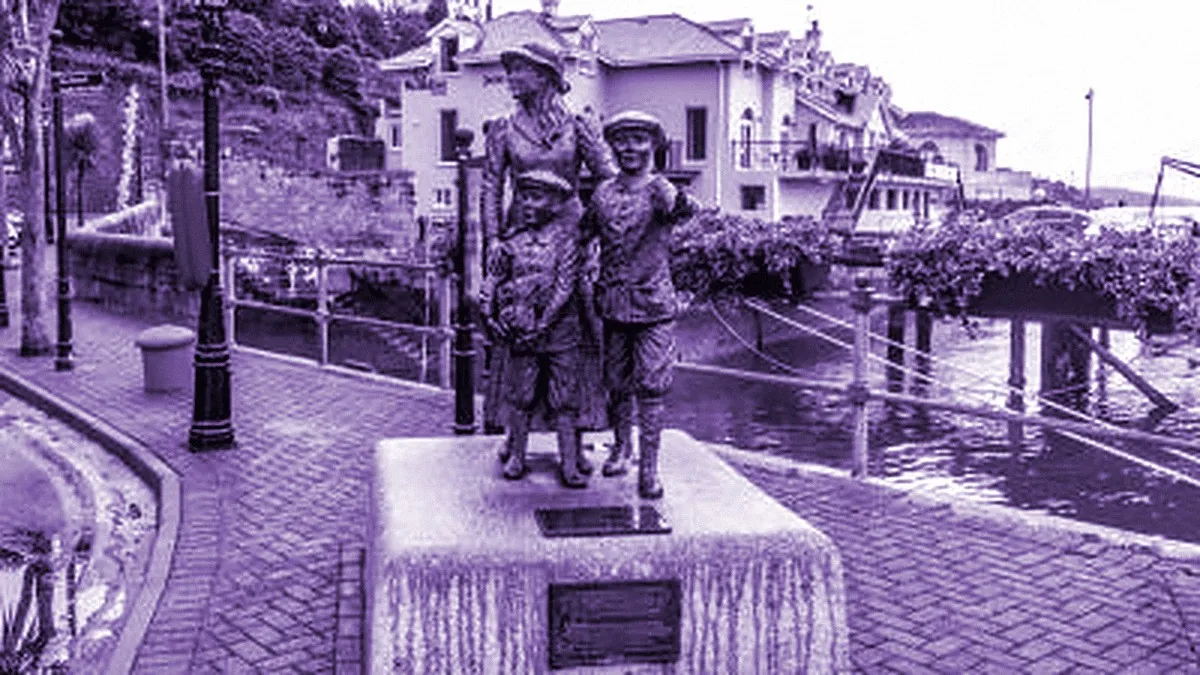
Outside the Cobh Heritage Centre, a bronze statue depicts Annie Moore with her younger brothers, Anthony and Philip. Annie was originally from County Cork and became the first immigrant processed at Ellis Island on January 1, 1892, after a twelve-day Atlantic crossing aboard the Guion Line steamship Nevada.
The sculpture, by Jeanne Rynhart, shows the family at the port then known as Queenstown. One child points towards the horizon, capturing the uncertainty and promise associated with departure. Annie’s story has become a lasting symbol of the Irish diaspora.
Lusitania Memorial
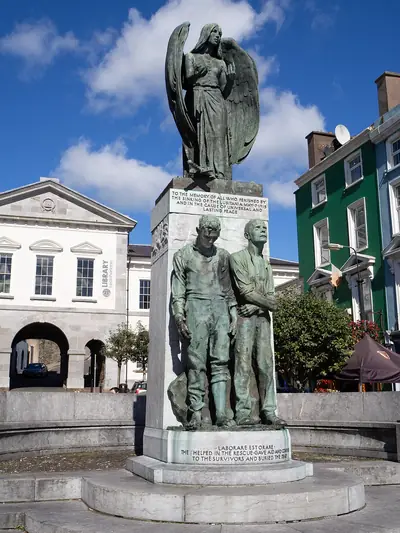
In Casement Square, the Lusitania Memorial commemorates the victims of the RMS Lusitania and the local fishermen who helped survivors in the water. At its centre, an angel with outstretched wings stands above two exhausted fishermen.
The Cunard passenger liner was travelling from New York to Liverpool when a German U-boat torpedoed it on May 7, 1915. The ship sank off the Old Head of Kinsale in just 18 minutes. Of the 1,959 people on board, 1,198 died, including 128 American citizens.
Town Hall
Casement Square is also home to the Arch Building, formerly Cobh Town Hall and earlier Queenstown Town Hall. The civic building is included in Cork County Council’s Record of Protected Structures and remains one of the town’s notable architectural landmarks.
St Colman’s Cathedral
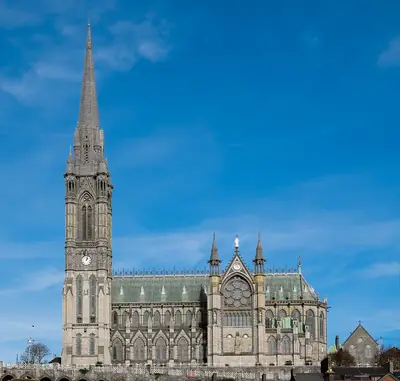
St Colman’s Cathedral, also known locally as Cobh Cathedral, rises above the town and Cork Harbour from Cathedral Place. It is the cathedral church of the Diocese of Cloyne and reaches 91.4 metres, or 300 feet, making it the tallest church in Ireland.
Construction began in 1868, but the cathedral was not completed until 1919. It is dedicated to Colmán of Cloyne, the patron saint of the Diocese of Cloyne.
The building is a detailed example of French Gothic Revival design, combining blue Dalkey granite, Mallow limestone, Belgian blue slate, rose windows, gargoyles, and carved stonework. Inside, the Victorian interior includes stained glass, ornate shrines, and a grand organ with more than 2,400 pipes. Its carillon of 49 bells is described as the largest in Ireland and the United Kingdom.
The Deck of Cards
The brightly painted houses climbing Cobh’s hillside are known as the Deck of Cards. Their tightly arranged facades create one of the town’s most recognizable views, with the cathedral rising above them and the harbour opening out below.
The houses are especially striking from across the waterfront, where their different colours form a vivid backdrop to Cobh’s maritime setting.
Old Town Hall
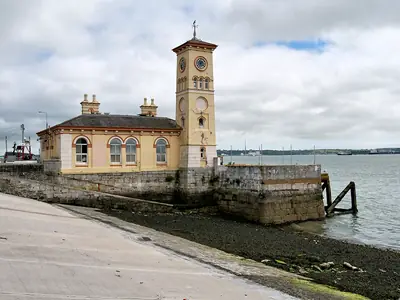
At Lynch’s Quay, also known as East Beach, the Old Town Hall faces Cork Harbour. Built in 1874 as the Cork Harbour Commissioners’ Office, it later became the Urban District Council Office.
The building has an Italianate style, with a long villa-like form, decorative render, round-headed windows, Doric-style pilasters, and a hipped slate roof. Its three-stage tower is the defining feature, with clocks set into the upper section.
Heartbreak Pier and The Navigator
Behind the White Star Line building, Heartbreak Pier recalls the many emigrants who left Cobh for America, Canada, and Australia. An estimated one million Irish men, women, and children departed from this point, and many never returned.
The pier was also the final departure point for the 123 passengers who joined the Titanic at Queenstown on April 11, 1912. They boarded the tenders PS Ireland and PS America, which carried them to the ship anchored off Roche’s Point. Only 44 of those 123 passengers survived the sinking three days later.
The Navigator artwork at Heartbreak Pier reflects this history of departure and loss. The pier has suffered from erosion, storm damage, and weathering, and a conservation project is working to preserve it for future visitors.
Titanic Memorial
J.F. Kennedy Pier carries another important connection with the Titanic. Cobh was the ship’s final port of call before its Atlantic crossing. The pier was built in the 1860s and was previously known as Victoria Pier and Admiralty Pier before being dedicated to U.S. President John F. Kennedy in the 1960s.
Its T-shaped plan, limestone walls, cobbled surfaces, and cast-iron railings reflect nineteenth-century engineering. The pier was also where survivors of the Lusitania were brought ashore in 1915. Today, it remains part of Cobh’s working waterfront and serves visitors travelling to Spike Island and local fishermen.
Titanic Experience
The Titanic Experience occupies the original White Star Line Ticket Office, where the last 123 passengers boarded the RMS Titanic in what was then Queenstown.
The visit begins with a boarding pass representing one of those passengers. Interactive exhibits, replicas of first-class and third-class accommodation, and personal accounts show the contrasting conditions on board. At the end, visitors discover what happened to the person named on their boarding pass, turning a famous historical event into an individual story.
John F. Kennedy Memorial Park
John F. Kennedy Memorial Park is a green waterfront space with harbour views, gardens, lawns, benches, a pavilion, and ornamental cannons. It is also known locally as “Da Boggy” and includes a playground.
The park is dedicated to U.S. President John F. Kennedy, who visited the area in June 1963, just months before his assassination. It offers a quieter place to pause after exploring Cobh’s museums, memorials, and waterfront.
Cove Fort and Christ Church
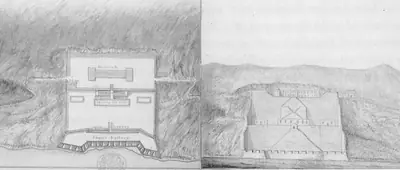
Cove Fort is a coastal battery built in 1743 to defend Cork Harbour and protect the naval yards at Haulbowline. Its original layout included gun emplacements facing the harbour and landward galleries for musketry. By the 1830s, it was used mainly for military and naval hospital services.
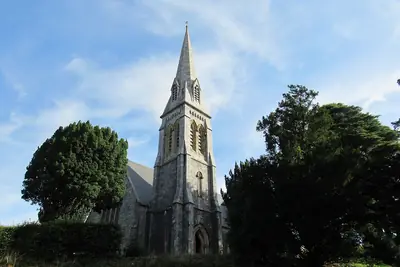
Christ Church is another of Cobh’s places of worship and forms part of the town’s historic streetscape.
Explore Cobh with Neywo
Neywo’s Cobh: The Last Port of Call is a self-guided walking tour covering 2.36 km in about 71 minutes, with 8 narrated stops. The route includes Cobh railway station, Cobh Heritage Centre, Cobh Museum, the Lusitania Memorial, Town Hall, St Colman’s Cathedral, Old Town Hall, Cobh, and Cove Fort.
Download Neywo and explore without joining a group or following a schedule. The app tells the story of each place as you reach it, at your own pace, with each story playing at the location. It is a free audio guide for discovering Cobh independently. For more ideas across Ireland, continue your trip with a visit to Cork or explore other Irish cities such as Galway and Killarney.
Places with an audio guide in Cobh
8 places in Cobh with a Neywo audio guide. Each one starts telling its story as you reach it.
Self-guided tours in Cobh
1 tour in Cobh, free in the Neywo app. Each stop tells its story as you reach it.
- Walk
Cobh: The Last Port of Call
Follow the road millions of Irish emigrants took to America. Start at the old railway station that became the Heritage Centre, then visit Cobh Museum in a former Scots Church. Walk the waterfront to the Lusitania Memorial, climb to the soaring spire of St Colman's Cathedral and finish at the harbour fort and its Titanic Memorial Garden.
Cobh railway station · Cobh Heritage Centre · Cobh Museum · Lusitania Memorial · Town Hall · St Colman's Cathedral …
Open this tour: Cobh: The Last Port of Call
Walk Cobh with Neywo
Neywo turns Cobh into a self-guided audio tour. Stories arrive as you reach the place they belong to, and the route reshapes when you wander off it.

