What to See in Dublin, Ireland: Free Audio Guide
Things to Do in Dublin: What to See in Ireland’s Capital
Dublin is Ireland’s capital, a city where medieval cathedrals, Georgian buildings, museums, literary landmarks and former military sites tell the story of the country. From Dublin Castle and St Patrick’s Cathedral to Kilmainham Gaol and the Guinness Storehouse, there is plenty to see on foot. Neywo has a free audio guide for Dublin with 133 narrated places, so you can explore the city while its stories play as you arrive.
What to See in Dublin
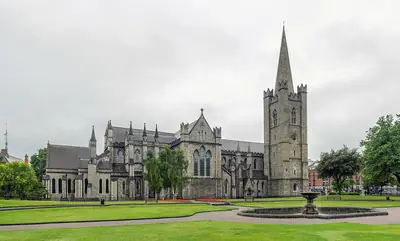
St Patrick’s Cathedral
St Patrick’s Cathedral is Dublin’s oldest and tallest church. A Celtic cross in the nave marks the place traditionally associated with Saint Patrick baptising converts, while the cathedral itself stretches 90 metres and has a 45-metre tower containing Ireland’s largest peal of bells.
The interior includes carved helmets and swords above the choir stalls, an unusual reminder of the building’s connection with medieval conflict. Although the cathedral’s origins reach back to a structure from 1191, a fire in the 14th century and later restorations—particularly during the Victorian era—shaped much of what visitors see today. Outside, the peaceful park and the marker for the former Holy Well offer a quieter place to pause.
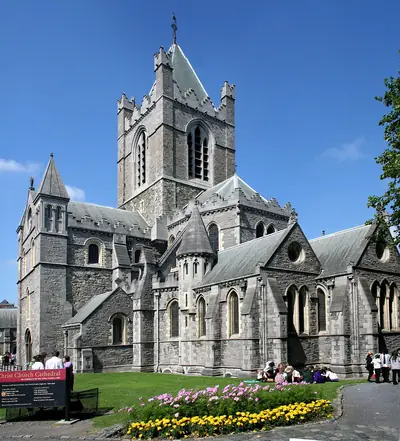
Christ Church Cathedral
Christ Church Cathedral is the older of Dublin’s two medieval cathedrals. It was founded in the early 11th century under the Viking king Sitric Silkenbeard, rebuilt in stone under Strongbow in the late 12th century, and enlarged in the early 13th century.
The building was later affected by a partial collapse and extensively renovated in the late 19th century. Its tower, flying buttresses and covered footbridge belong to the form that visitors see today. The grounds preserve traces of earlier buildings, including a ruined 13th-century chapter house. Inside, a knight’s tomb has lost its nose, while a local tradition identifies it with Strongbow—even though historians say his original tomb was destroyed in a 1562 collapse.
Dublin Castle
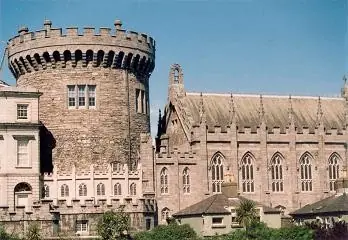
Dublin Castle stands just off Dame Street and has been an important centre of government for centuries. A castle has occupied the site since the time of King John, when the original motte-and-bailey was built at the highest point of central Dublin. Much of the complex was rebuilt from the late 17th century onwards as a Georgian palace, with many present buildings dating from the 18th century.
The castle served as the seat of English and later British government in Ireland until 1922. After the Anglo-Irish Treaty, it was ceremonially handed over to the Provisional Government led by Michael Collins. Today, it hosts the inauguration of each President of Ireland.
St Audoen’s Church
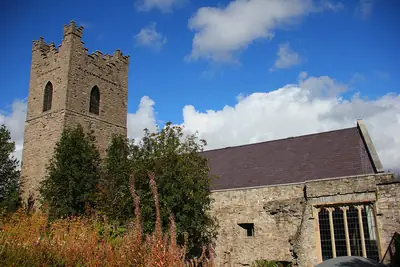
St Audoen’s Church is Dublin’s oldest parish church still used as a place of worship. Built in 1190, around two decades after the arrival of the Anglo-Normans, it is dedicated to Saint Ouen, a seventh-century bishop of Rouen and patron saint of the Normans.
The older Norman section contains medieval grave slabs set into part of the floor, offering a direct connection with Dublin’s medieval parish life.
Kilmainham Gaol
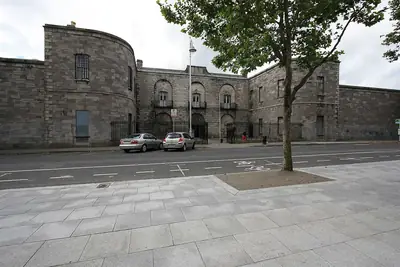
Kilmainham Gaol is a former prison and museum closely associated with Ireland’s struggle for independence. Opened in the late 18th century, it held many Irish revolutionaries and became particularly linked with the 1916 Easter Rising.
Patrick Pearse, James Connolly, Tom Clarke, Seán Mac Diarmada, Joseph Plunkett, Éamonn Ceannt and Thomas MacDonagh were imprisoned there, and several were executed in the prison. A memorial in the courtyard commemorates the leaders of the rising who were executed at Kilmainham.
The prison continued to hold inmates until it closed in 1924. After years of disrepair, it was restored from the 1960s onwards and became a museum and national memorial. The prison itself is visited as part of a guided tour.
Magazine Fort and Phoenix Park
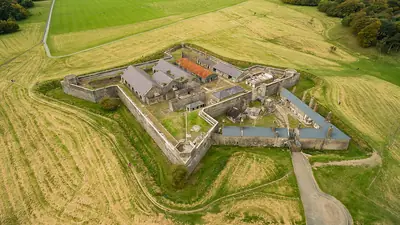
Magazine Fort is a star-shaped bastion fort inside Phoenix Park, surrounded by dry moats. Built in 1735, it was occupied by the British Armed Forces until 1922 and then handed over to the Irish Defence Forces. The Irish Army continued to use it as an ammunition store through the middle of the 20th century, before it was fully demilitarised by the 1980s.
Its military purpose explains the name: the fort was used as a storehouse for arms under British rule and later under the Irish Free State.
The Guinness Storehouse
The Guinness Storehouse at St James’s Gate Brewery presents the history of Guinness inside a seven-floor building arranged around a glass atrium shaped like a pint. The ground floor introduces the beer’s four ingredients—water, barley, hops and yeast—and the brewery’s founder, Arthur Guinness.
Higher floors explore Guinness advertising and include interactive experiences. At the top, the Gravity Bar offers views over Dublin, with a pint of Guinness included in most admission tickets. The Connoisseur Experience focuses on four varieties: Draught, Original, Foreign Extra Stout and Black Lager.
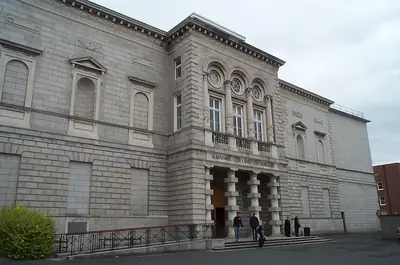
National Gallery of Ireland
The National Gallery of Ireland, founded in 1854 and opened ten years later, houses a national collection of Irish and European painting. It is particularly strong in Irish art, Italian Baroque and Dutch masters.
The collection includes around 2,500 paintings, 5,000 drawings and 5,000 prints, as well as a small amount of sculpture. Irish highlights include paintings by Jack B. Yeats, portraits by William Orpen and John Lavery, and modern landscapes by Gerard Dillon. European works include Velázquez’s Kitchen Maid with the Supper at Emmaus, Vermeer’s Woman Writing a Letter, with her Maid and Caravaggio’s The Taking of Christ.
National Library of Ireland
On Kildare Street, the National Library of Ireland preserves and makes accessible Ireland’s documentary and intellectual record. Its collections include books, maps, manuscripts, music, newspapers, periodicals and photographs, along with material published by private and government publishers.
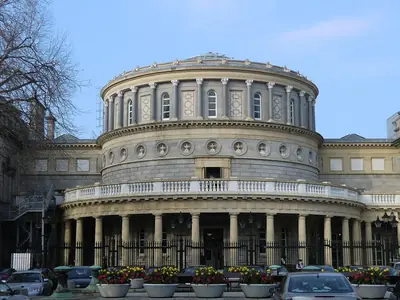
The building was designed by Thomas Newenham Deane and stands beside Leinster House, close to the archaeology branch of the National Museum of Ireland. A lower-ground-floor exhibition space includes long-term displays, while the first-floor Reading Room has ornate bookcases and a frieze of cherubs associated with Joyce’s Ulysses.
National Museum of Ireland
The Kildare Street branch of the National Museum of Ireland specialises in Irish and other antiquities from the Stone Age to the Late Middle Ages. Its collections include prehistoric Ireland, bog bodies and Iron Age material.
The building was designed by Thomas Newenham Deane and Thomas Manly Deane. Its rotunda faces the matching rotunda of the National Library of Ireland across the front of Leinster House.
On Merrion Street, the National Museum of Ireland’s Natural History branch is known as the “Dead Zoo”. Built in 1856, it has retained much of its Victorian character. The ground floor focuses on native Irish wildlife and includes the skeleton of an 11,000-year-old deer; upstairs, animals from around the world are arranged according to 19th-century taxonomic groupings.
14 Henrietta Street
14 Henrietta Street is a social history museum, also known as the Tenement Museum. Opened in September 2018, it tells the story of the building as it changed from a Georgian house into tenements and records the many people who lived there.
James Joyce Centre
The James Joyce Centre occupies a restored 18th-century Georgian townhouse at 35 North Great George’s Street. Founded in 1982, it promotes the life and work of James Joyce as well as Irish literature, culture and history.
The house was built in 1784 for Valentine Browne, 1st Earl of Kenmare. Its later history includes a dance studio on the ground floor and meetings connected with the Dublin Vigilance Committee. During the revolutionary period, British Army officers held dances there while Irish republicans used the building as a clandestine meeting place.
Explore Dublin with a Free Audio Guide
Neywo offers 8 walking tours, 1 bus route and 1 bike route in Dublin, covering 133 narrated places. Walks range from 0.81 to 5.9 km and from 50 to 204 minutes; the bus route covers 5.7 km in 24 minutes, and the bike route covers 2.7 km in 14 minutes. The tours include routes through Kilmainham and the Guinness Storehouse, Merrion Square, Smithfield and Christ Church, Parnell Square, Dublin Castle and Temple Bar, Trinity College and the Liffey, as well as Phoenix Park.
Download Neywo and explore Dublin at your own pace. The app tells the story of each place as you reach it, with no group and no schedule, and narration is available in 11 languages. If you are continuing through Ireland, you can also discover cities such as Galway, Cork and Kilkenny.
Places with an audio guide in Dublin
8 places in Dublin with a Neywo audio guide. Each one starts telling its story as you reach it.
Self-guided tours in Dublin
11 tours in Dublin, free in the Neywo app. Each stop tells its story as you reach it.
- Bike ride
Phoenix Park by Bike: Obelisk, Deer and Tower House
Cycle one of Europe's largest enclosed city parks on its separated cycle tracks. Start at the 62-metre Wellington Monument, the largest obelisk in Europe, ride along tree-lined avenues where wild fallow deer graze, and finish at Ashtown Castle, a 15th-century tower house found hidden inside a Georgian lodge.
Wellington Monument · Phoenix Park · Ashtown Castle
Open this tour: Phoenix Park by Bike: Obelisk, Deer and Tower House - Bus ride
G1: Dublin's Old Town and the Liffey Quays
Dublin Bus G1 follows the Liffey from the Docklands to the medieval heart of the city. Ride past the Jeanie Johnston famine ship, the Abbey Theatre, O'Connell Bridge and the Ha'penny Bridge, then up to Christ Church Cathedral, St Audoen's and the churches of the Liberties on the way to St James's, with a last stop at St Michael's in Inchicore.
Jeanie Johnston · Famine Memorial · Abbey Theatre · O'Connell Bridge · Ha'penny Bridge · Smock Alley Theatre …
Open this tour: G1: Dublin's Old Town and the Liffey Quays - Bus ride
Bus 13 · Thomas Street to O'Connell Street
Board at Emmet Rd, Richmond Park, alight at #45 Drumcondra Road, Clonturk Park. 12 narrated places along the way: St. Michael's Church, Dublin, St James' Church, Dublin, St Catherine's Church, John's Lane Church, St Audoen's Church, Dublin, Christ Church Cathedral, Dublin, City Hall, Irish Whiskey Museum, O'Connell Monument, Spire of Dublin, Gate Theatre, Dublin Writers Museum.
St. Michael's Church, Dublin · St James' Church, Dublin · St Catherine's Church · John's Lane Church · St Audoen's Church, Dublin · Christ Church Cathedral, Dublin …
Open this tour: Bus 13 · Thomas Street to O'Connell Street - Walk
Kilmainham and the Guinness Storehouse
West along the Liffey: the gaol where the 1916 leaders were executed, the Royal Hospital's formal garden and the modern art museum inside it, the Wellington obelisk in the Phoenix Park, and the seven floors of the Guinness Storehouse.
St. Michael's Church, Dublin · Kilmainham Gaol · Islandbridge · Wellington Monument · The Formal Garden at The Royal Hospital Kilmainham · Irish Museum of Modern Art …
Open this tour: Kilmainham and the Guinness Storehouse - Walk
Merrion Square: the national museums and the gallery
Georgian Dublin's best square, ringed by the state's collections — archaeology with the bog bodies and the Tara brooch, natural history's 'dead zoo', the National Gallery and the National Library — plus parliament and Wilde's statue.
Royal Irish Academy · National Museum of Ireland, Kildare Street · Huguenot cemetery, Dublin · National Museum of Ireland, Merrion Street · Leinster House · National Library of Ireland …
Open this tour: Merrion Square: the national museums and the gallery - Walk
Smithfield to Christ Church
From the Jameson distillery and St Michan's mummified crypt, over the river past the Brazen Head, to St Audoen's — the only surviving medieval parish church — and Christ Church Cathedral.
Church of St Mary of the Angels, Church Street, Dublin · Old Jameson Distillery · St. Michan's Church · The Brazen Head · Franciscan Friary and Hall · Church of the Immaculate Conception, Dublin …
Open this tour: Smithfield to Christ Church - Walk
Parnell Square: Joyce, the Hugh Lane and Henrietta Street
North inner-city Dublin, and the literary city. The Writers Museum and the Hugh Lane facing the Garden of Remembrance, the Joyce Centre, and 14 Henrietta Street, a Georgian townhouse turned tenement and kept as a museum of both.
14 Henrietta Street · St. Marys Chapel of Ease, Dublin · Hugh Lane Gallery · Dublin Writers Museum · Garden of Remembrance · Gate Theatre …
Open this tour: Parnell Square: Joyce, the Hugh Lane and Henrietta Street - Walk
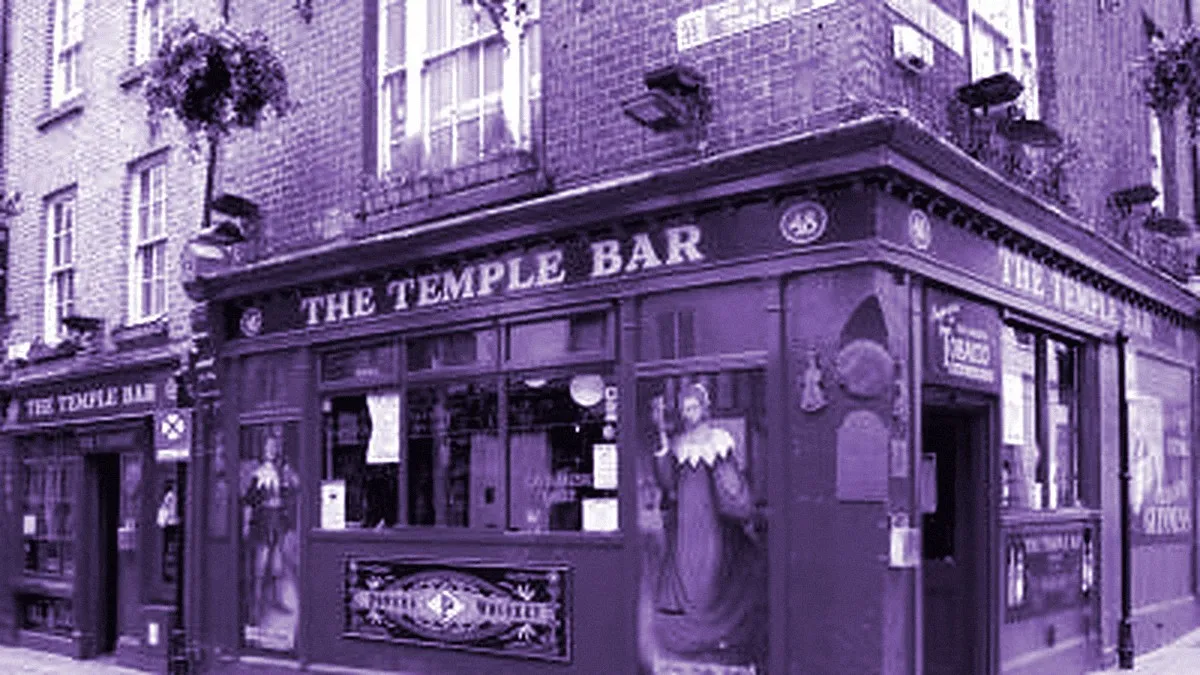
Dublin Castle, the Chester Beatty and Temple Bar
Two kilometres from the castle and the Chester Beatty Library's Islamic and East Asian manuscripts — free, and the best museum in the city — through the theatres into Temple Bar and up to Molly Malone.
Chester Beatty Library · Dublin Castle · City Hall · Olympia Theatre · Smock Alley Theatre · Grattan Bridge …
Open this tour: Dublin Castle, the Chester Beatty and Temple Bar - Walk
Trinity College, O'Connell Street and the Custom House
The Book of Kells and the Long Room at Trinity, then over O'Connell Bridge to the Abbey Theatre and along the quays to Gandon's Custom House, burnt out in 1921 and rebuilt.
Old Library · Campanile (Trinity College, Dublin) · Trinity College Chapel · The National Wax Museum Plus · O'Connell Bridge · O'Connell Monument …
Open this tour: Trinity College, O'Connell Street and the Custom House - Walk
St Stephen's Green and the literary museums
A kilometre round the Green: the Little Museum of Dublin, the Museum of Literature Ireland with Joyce's first copy of Ulysses, Newman's Byzantine university church, and the hidden Iveagh Gardens behind the concert hall.
National Concert Hall · Iveagh Gardens · Museum of Literature Ireland · Newman University Church · Saint Stephen's Green · Little Museum of Dublin
Open this tour: St Stephen's Green and the literary museums - Walk
The Ultimate Dublin: Guinness Storehouse to St Patrick's
Three and a third kilometres taking in the Storehouse, St Audoen's, Christ Church, City Hall, Dublin Castle, the Chester Beatty and St Patrick's Cathedral. The best single line through the city.
St James' Church, Dublin · Guinness Storehouse · St Catherine's Church · John's Lane Church · St Audoen's Church, Dublin · St Audoen's …
Open this tour: The Ultimate Dublin: Guinness Storehouse to St Patrick's
Walk Dublin with Neywo
Neywo turns Dublin into a self-guided audio tour. Stories arrive as you reach the place they belong to, and the route reshapes when you wander off it.

