Visiting Trieste, Italy: Top Sights on Foot
Things to Do in Trieste: What to See in the Adriatic City
The best things to do in Trieste range from grand Habsburg squares and Roman ruins to maritime museums, historic cafés, and Miramare Castle on the Gulf of Trieste. The city’s distinctive character comes from its position between the Adriatic, Central Europe, and the Karst landscape. Neywo’s free audio guide for Trieste covers 94 narrated places, helping you discover the city as you walk.
What to See in Trieste
Piazza Unità d’Italia and Palazzo del Governo
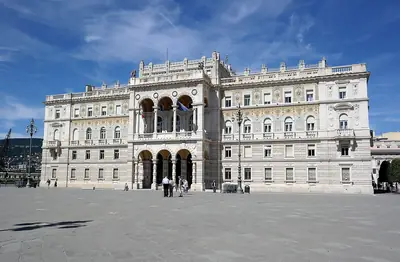
Piazza Unità d’Italia is Trieste’s monumental square by the sea. Its buildings reflect the city’s long association with the Habsburg Empire, including Palazzo del Governo, constructed between 1901 and 1905 as the seat of the imperial lieutenancy. Designed by Austrian architect Emil Artmann, the palace combines late historicist grandeur with Renaissance and Baroque-inspired details. Its symmetrical façade, ornate balconies, sculpted decoration, and central clock tower make it one of the square’s most prominent buildings.
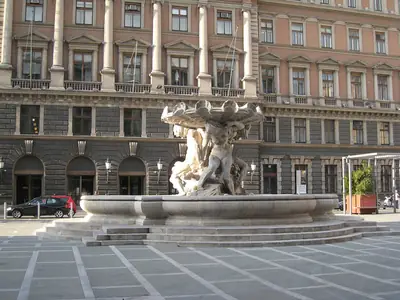
The square is also close to the waterfront and several other historic landmarks, including the former Palazzo del Lloyd Triestino, Casa Stratti, Palazzo Modello, and the Teatro Lirico Giuseppe Verdi.
San Michele al Carnale and Trieste Cathedral
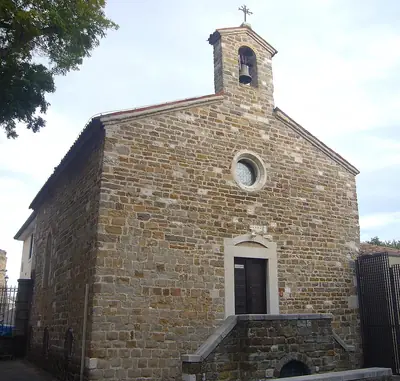
San Giusto Hill has been sacred ground since Roman times. A Capitoline Temple dedicated to Jupiter, Juno, and Minerva once stood here, and parts of the ancient shrine were reused in the first Christian church on the site.
The present cathedral emerged in the 14th century, when two earlier basilicas were joined together. Its Romanesque façade and Gothic rose window are among its most recognisable features. Roman blocks were also reused in the bell tower, connecting the church visibly with Trieste’s ancient past.
The Roman Theatre of Trieste
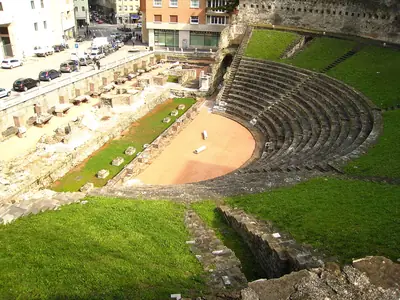
At the foot of San Giusto Hill, the Roman Theatre is one of the city’s most important ancient remains. It was first built at the end of the first century BC and expanded at the beginning of the second century AD, during the reign of Emperor Trajan.
The theatre was constructed into the natural slope of the hill, with the stage facing the shoreline. In antiquity, the sea lay directly beyond it. Inscriptions found at the site associate its development with Quinto Petronio Modesto, a procurator and priest of Trajan.
Miramare Castle
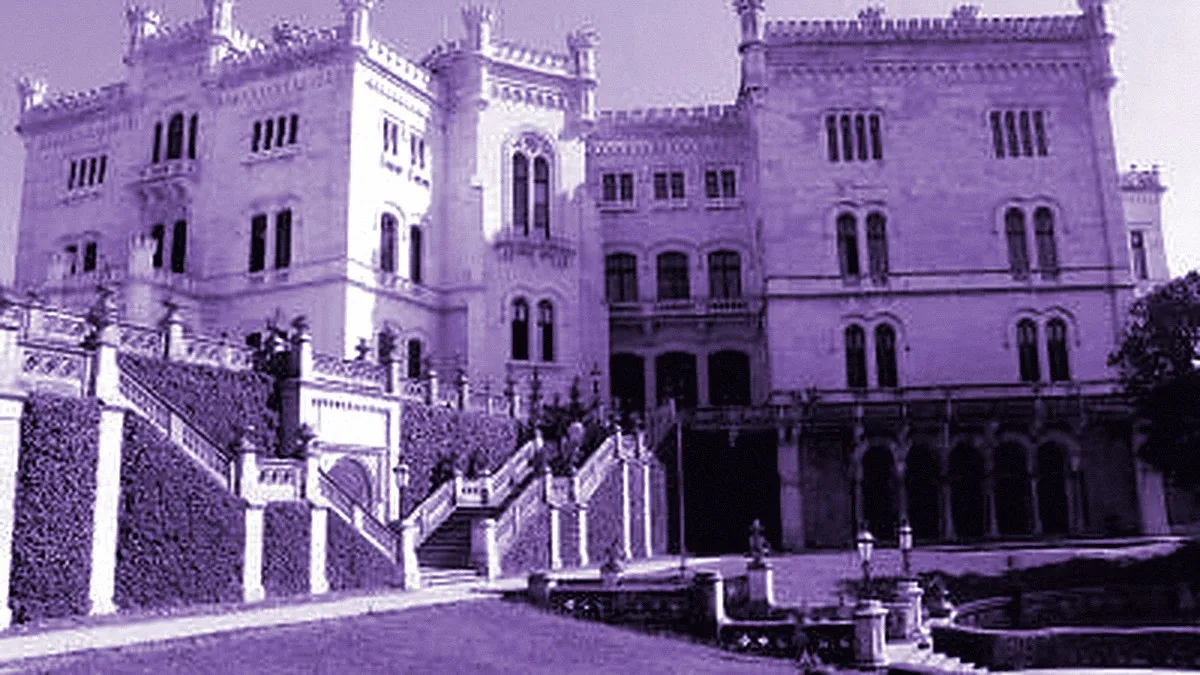
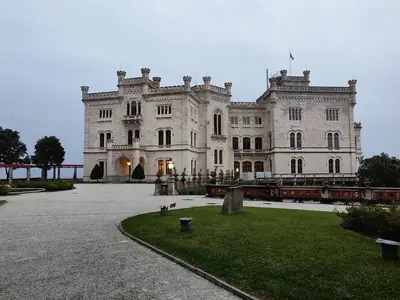
Miramare Castle stands on a rocky cliff between Barcola and Grignano, on the Gulf of Trieste. This 19th-century residence was designed in 1856 by Austrian architect Carl Junker, and construction was completed in 1860. Its eclectic style draws on Austrian, German, and English architecture.
The castle was commissioned by Ferdinand Maximilian, younger brother of Emperor Franz Joseph of Austria and Commander-in-Chief of the Imperial Navy. The site had made an impression on him after he took shelter there during a storm in the 1850s. He named the residence Miramare after a property belonging to a relative in Portugal.
Ferdinand Maximilian later became Emperor Maximilian I of Mexico, while his wife, Charlotte of Belgium, became Empress Carlota of Mexico. The castle’s setting above the gulf remains one of the most memorable places to visit around Trieste.
The Postal and Telegraphic Museum of Central Europe
In the Borgo Teresiano district, near Trieste Centrale railway station, the Postal and Telegraphic Museum of Central Europe occupies the Palazzo delle Poste. Built in 1894 by Viennese architect Friedrich Setz, the building was originally the headquarters of the Imperial and Royal Post and Telegraph Administration.
The museum traces postal and telegraphic history through the Austrian and Italian periods. The building still houses local Poste Italiane offices, so it continues to serve a role connected with its original purpose. Its entrance opens onto Piazza Vittorio Veneto, one of the central squares of the Borgo Teresiano neighbourhood.
Rittmeyer Palace
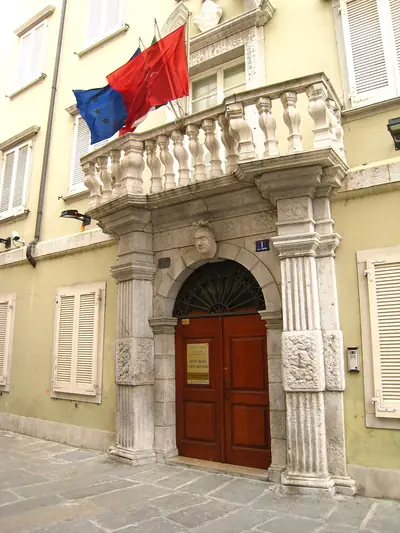
Rittmeyer Palace stands on Via Carlo Ghega and dates from the 19th century. Today it houses the Giuseppe Tartini Conservatory, allowing this historic building to remain part of Trieste’s active musical and cultural life.
The Museums by the Sea
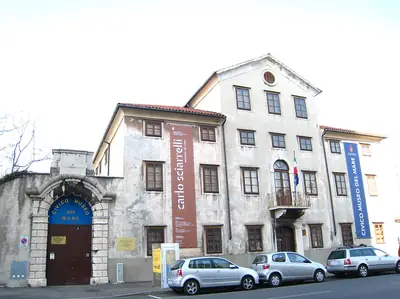
Trieste’s relationship with the sea is explored through several museums near the waterfront. The Museo del Mare, founded in 1904, contains documents and objects connected with the city’s port and seafaring traditions.
The Public Marine Aquarium of Trieste occupies the former central fish market in an early-20th-century building. Its 25 tanks recreate marine environments, mainly featuring species from the Adriatic, including jellyfish, mollusks, echinoderms, crustaceans, and other marine life. A large octagonal tank contains sharks and rays, while the first floor has a vivarium with amphibians, reptiles, and freshwater fish.
The Trieste Campo Marzio Railway Museum occupies the former Campo Marzio railway station, designed in 1906 and inaugurated in 1908. Once part of the Austro-Hungarian railway network, the station connected Trieste with Vienna and other parts of the empire. The museum displays steam engines, diesel locomotives, passenger carriages, signals, uniforms, and railway tools.
Civico Museo d’Arte Orientale
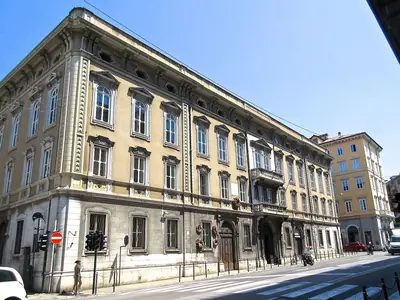
Housed in the 18th-century Palazzo Leo, the Civic Museum of Oriental Art explores the art and archaeology of East and Southeast Asia. Its collections include Japanese ukiyo-e prints, samurai armour, Chinese porcelain from the Ming and Qing dynasties, Buddhist statues, lacquerware, textiles, paintings, sculptures, and ceramics.
The museum’s collection reflects Trieste’s history as a port city. Many objects entered the city through donations and acquisitions made during the late 19th and early 20th centuries, when maritime connections brought Asian works and objects to Trieste.
Museo Sartorio
Museo Sartorio occupies an elegant urban villa that was once the home of the Sartorio family, a wealthy merchant family with origins in Sanremo. The family opened a trading branch in Trieste in 1775.
The villa preserves the atmosphere of a private residence, with original furnishings, family portraits, and decorative arts. Its collections include ceramics, majolica, porcelain, glassware, silver, and tapestries. The building and its contents offer an intimate view of the lifestyle of Trieste’s mercantile elite.
The Jewish Museum and the Risorgimento Memorial
The Jewish Museum Carlo e Vera Wagner, on Via del Monte, documents the history and daily life of Trieste’s Jewish community. Its collection includes silverware, furnishings, and historical documents. The museum was created through the initiative of the Jewish community of Trieste together with Mario Stock and the support of the Wagner-de Polo family.
The Museo del Risorgimento e sacrario di Oberdan covers the period from the revolutionary uprisings of 1848 to the First World War. Its memorial shrine is dedicated to Guglielmo Oberdan, a patriot associated with the Italian irredentist movement who was executed by the Austro-Hungarian authorities in 1882.
The Civic Museum of Natural History
Founded in 1846, the Civic Museum of Natural History holds more than two million specimens from botany, zoology, mineralogy, geology, and paleontology. Its most notable object is Antonio, a nearly complete fossil of a Tethyshadros insularis discovered on the nearby Karst plateau.
The museum also contains marine fossils, minerals, botanical collections, and preserved mammals, birds, and insects from around the world.
Explore Trieste with Neywo
Neywo offers a Trieste self-guided walking tour experience through five walking tours, one bus route, and one bike route. Together, the routes cover the city’s Roman, Habsburg, Jewish, maritime, and scientific heritage.
The five walks range from 1.42 to 2.5 km and last between 70 and 89 minutes, with between 7 and 12 narrated stops each. The bus route covers 5.4 km in 23 minutes and has 10 stops. The bike route covers 3.2 km in 16 minutes and has 5 stops.
The app tells the story of each place as you reach it, at your own pace, with no group and no schedule. Narration is available in 11 languages. Download Neywo and explore Trieste independently, from Roman Tergeste and San Giusto Hill to the waterfront, Borgo Teresiano, and the city’s museums.
Places with an audio guide in Trieste
8 places in Trieste with a Neywo audio guide. Each one starts telling its story as you reach it.
Self-guided tours in Trieste
7 tours in Trieste, free in the Neywo app. Each stop tells its story as you reach it.
- Bike ride
Waterfront Cycle Lane from Campo Marzio to the Science Centre
A flat ride on Trieste's seafront cycle infrastructure. It starts at the old railway terminus, passes the baron's museum and the main square and ends at the interactive science museum.
Trieste Campo Marzio Railway Museum · Revoltella Museum · Palazzo del Governo · Museo teatrale Carlo Schmidl · Immaginario Scientifico
Open this tour: Waterfront Cycle Lane from Campo Marzio to the Science Centre - Bus ride
Line 17: Through the Old Port and Borgo Teresiano
A regular city bus that runs from the museums at Campo Marzio past the Revoltella palace and Piazza della Borsa into the Teresian grid. Ride it to sample the harbour front and the Serbian church without a single hill.
Rittmeyer Palace · Postal and Telegraphic Museum of Central Europe · Palazzo del Governo · Public marine aquarium of Trieste · Trieste Campo Marzio Railway Museum · Museo del Mare …
Open this tour: Line 17: Through the Old Port and Borgo Teresiano - Walk
Roman Tergeste and the Hill of San Giusto
Climb from the old Roman town to the hill where Trieste began. You pass the Arch of Riccardo, the Roman theatre and the basilica ruins, then reach the cathedral built from two older churches and the Habsburg-era fortress above the Adriatic.
Paleochristian basilica · Tempio anglicano · Arco di Riccardo · Santa Maria Maggiore · Ancient Roman architecture in Trieste · Roman Theatre of Trieste …
Open this tour: Roman Tergeste and the Hill of San Giusto - Walk
Unity of Italy Square: the Habsburg Port Opens to the Sea
Start on the pier that grew from a shipwreck and step into Europe's largest square open to the sea. Palaces of the imperial shipping line, the lieutenancy and the town hall frame it, with the opera house and the old stock exchange a few steps behind.
Molo Audace · Palazzo del Lloyd Triestino · Piazza Unità d'Italia · Grand Hotel Duchi d'Aosta · Palazzo del Governo · Trieste City Hall …
Open this tour: Unity of Italy Square: the Habsburg Port Opens to the Sea - Walk
Maria Theresa's New Town: Canal Grande to the Square of Liberty
Trieste's 18th-century grid grew around a canal where ships unloaded at the doors of the merchants. Walk from the red skyscraper and the Serbian church with its blue domes to the grand neoclassical church, then on through the railway-era palaces to the empress Sisi's monument.
Palazzo Carciotti · Palazzo Aedes · Museo teatrale Carlo Schmidl · Saint Spyridon Church · Sant'Antonio Taumaturgo, Trieste · Palazzo delle Ferrovie dello Stato …
Open this tour: Maria Theresa's New Town: Canal Grande to the Square of Liberty - Walk
Coffee, Faith and Wartime Tunnels
Trieste's literary and Jewish heart lies east of the station. Start at an Art Nouveau corner house and the small Jewish museum, see the second largest synagogue in Europe, drink where Joyce and Svevo wrote at Caffè San Marco, descend into the Second World War tunnels of Kleines Berlin and finish at the grand Politeama theatre.
Casa Terni-Smolars · Jewish Museum Carlo e Vera Wagner · Piazza Guglielmo Oberdan · Kleines Berlin · Synagogue of Trieste · Caffè San Marco …
Open this tour: Coffee, Faith and Wartime Tunnels - Walk
Museums by the Sea: Trains, Ships and Merchant Villas
Follow the waterfront from the old railway terminus to the city's museum quarter. Ships, trains and caves come first, then the baron's palace on Piazza Venezia, a merchant's villa full of Tiepolo drawings and a small museum of Asian art.
Trieste Campo Marzio Railway Museum · Speleovivarium · Museo del Mare · Public marine aquarium of Trieste · Piazza Venezia · Revoltella Museum …
Open this tour: Museums by the Sea: Trains, Ships and Merchant Villas
Walk Trieste with Neywo
Neywo turns Trieste into a self-guided audio tour. Stories arrive as you reach the place they belong to, and the route reshapes when you wander off it.

