Things to Do in Viterbo, Italy: Walking Guide
Things to Do in Viterbo: A Guide to the City of the Popes
Viterbo is a historic city in Lazio, known for its medieval old town, papal monuments, Romanesque churches, fountains and Etruscan heritage. The city is worth visiting for its concentration of historic buildings, from the Palazzo dei Papi and Viterbo Cathedral to the civic palaces and museums around its central squares. Neywo offers a free audio guide for Viterbo with 53 narrated places, available in 11 languages.
What to See in Viterbo
The best way to discover Viterbo is on foot, moving between the monuments of the historic centre. These are some of the most important places to include.
Palazzo dei Papi di Viterbo
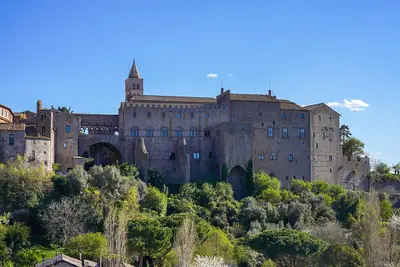
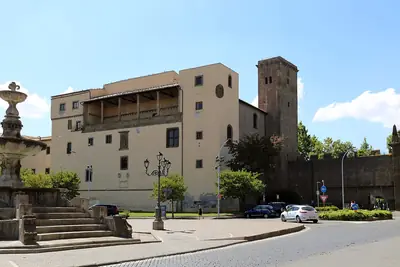
The Palazzo dei Papi stands beside the cathedral in Piazza San Lorenzo and was the seat of the papacy for nearly a quarter of a century. In 1257, Pope Alexander IV moved the Papal Curia from Rome to Viterbo. The former bishop’s palace was then enlarged, with Raniero Gatti commissioning a grand audience hall and the loggia that overlooks the city street.
The palace’s massive façade is topped with square merlons, while a broad staircase leads to the entrance. On the right, the Loggia dei Papi has a roofless seven-bay arcade supported by paired slender columns. Its fountain is made from materials of varied origins, adding another layer to this important papal monument.
Viterbo Cathedral
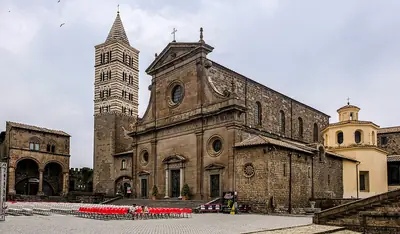
Also known as the Cattedrale di San Lorenzo, Viterbo Cathedral is the city’s principal church and the seat of its bishop. The building is a Romanesque structure dating from the twelfth century, positioned high on the hill of the city.
Its façade has a Renaissance appearance because of a sixteenth-century reconstruction that removed much of the church’s earlier decoration. In 1940, Pope Pius XII elevated the cathedral to the dignity of a minor basilica. The church also contains the mortal remains of Pope Alexander IV.
Palazzo dei Priori
Palazzo dei Priori occupies a central position in Piazza del Plebiscito and remains the seat of Viterbo’s municipality. Built in the thirteenth century, it was formerly known as the Palazzo della Commune or Comunale.
The palace’s interior rooms are open to visitors, as is the Museo dei Portici below. The museum contains two altarpieces by Sebastiano del Piombo: a Pietà and a Flagellation. An arch over Via Filippo Ascenzi connects the building with the Palazzo del Podestà.
Palazzo del Podestà and the Torre dell’Orologio
The Palazzo del Podestà, also called the Palazzo del Governatore, is another thirteenth-century civic building in Piazza del Plebiscito. Its position behind an arch over Via Filippo Ascenzi reflects the way Viterbo’s historic government buildings were connected.
A tall bell tower rises behind the palace. Known today as the Torre dell’Orologio and formerly as the Torre dei Monaldeschi, it has a clock that was added in the fifteenth century. Its largest bell originally came from the church of Santa Maria della Verità.
Sant’Angelo in Spatha
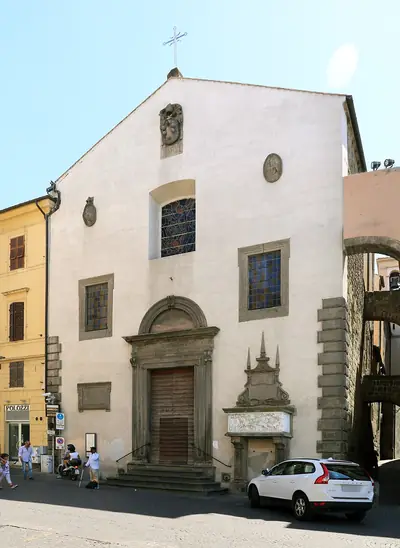
Sant’Angelo in Spatha stands on Piazza del Plebiscito, making it easy to find while exploring the city’s central historic area. The church is one of the landmarks surrounding this important civic square.
San Francesco
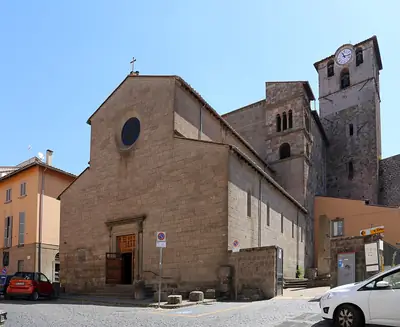
The Basilica of San Francesco alla Rocca is a minor basilica and parish church on Piazza San Francesco, near the Porta Fiorentina. Its historical importance is especially clear inside: the church contains the tombs of Pope Clement IV and Pope Adrian V.
Pope Pius XII elevated San Francesco to the rank of minor basilica in 1949. Its location also makes it a natural stop when walking between the historic centre and the Rocca Albornoz.
Rocca Albornoz and the National Etruscan Museum
The Rocca Albornoz is a medieval fortress built on Viterbo’s old city walls. Gil de Albornoz, a military commander and papal legate serving Pope Clement VI, commissioned the original castle after defeating Giovanni di Vico in 1354.
The fortress was demolished and rebuilt several times, so the present structure reflects different phases of construction and restoration. It now houses the National Etruscan Museum, Viterbo’s main archaeological museum, which focuses primarily on Etruscan archaeology. Below the castle, a fountain carved from peperino stone was designed by the architect Vignola.
Fontana di Piazza del Gesù and San Silvestro
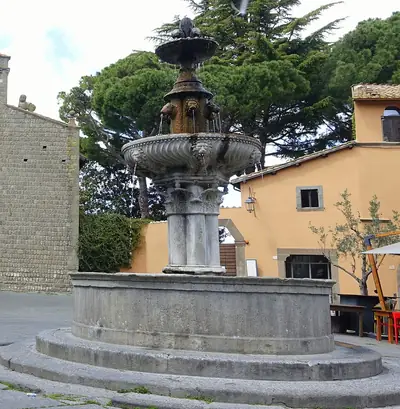
Piazza del Gesù brings together a Renaissance fountain and the small Romanesque church of San Silvestro. A fountain has stood here since at least 1450, when it was recorded in public documents.
The present fountain was built in 1915 using reused pieces from the fountain of the convent of San Domenico. Designed by Giovanni Pizzichetti, it has a lower basin decorated with lion heads, the symbol of Viterbo. The upper basin rests on a tree decorated with alternating lion heads, oxen, horses and sheep.
San Sisto
San Sisto is a Romanesque church beside the old Porta Romana. Its historic name, San Sisto fuori la Porta Romana, literally identifies it as the church outside the Roman Gate. The building’s solid Romanesque form makes it a notable stop along the city walls.
Santa Maria della Salute
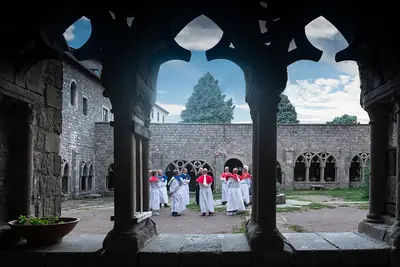
On Via della Pescheria, Santa Maria della Salute is a small Gothic church with a new cultural role. Once a Roman Catholic church, it has been deconsecrated and is now used as an exhibition hall and venue for cultural events.
Church of Santa Rosa
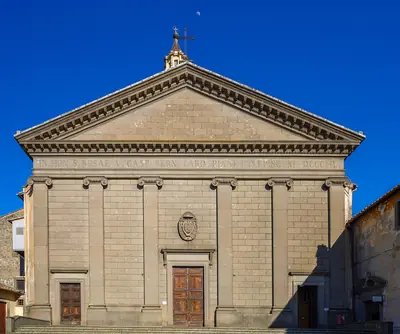
The Church of Santa Rosa is a Catholic place of worship in the heart of Viterbo. It also belongs to the story of the Macchina di Santa Rosa, the elaborate processional machines carried through the city.
That tradition can be explored at the Museo del Sodalizio dei Facchini di Santa Rosa. Housed in a medieval building on Via San Pellegrino, the museum displays scale models of the different Macchine di Santa Rosa and film footage of past transports. Its rooms extend across two floors.
Museo civico
The Museo civico occupies a former twelfth-century convent beside Santa Maria della Verità on Piazza Francesco Crispi. Founded in 1955, it contains archaeological finds from Ferento and other sites around Viterbo.
The museum also has a picture gallery with works dating from the twelfth to the nineteenth century, bringing together the area’s archaeological and artistic heritage.
Museo del Colle del Duomo
The Museo del Colle del Duomo is located in Piazza San Lorenzo, beside the cathedral. Founded for the Jubilee of 2000, it was created through cooperation between the bishopric of Viterbo and the Presidency of the Council of the Italian Republic.
The museum forms part of the Colle del Duomo monumental complex, which also manages visits to the Palazzo dei Papi and parts of San Lorenzo Cathedral that are not normally accessible to the public.
Santi Faustino e Giovita
In Piazza San Faustino, the small church of Santi Faustino e Giovita presents a simple Romanesque character. It is dedicated to Faustinus and Jovita, two early Christian martyrs, and has been refurbished over the years.
A Viterbo Self-Guided Walking Tour with Neywo
Neywo’s Viterbo audio guide includes 4 walking tours and 1 bus route, covering the city at different scales:
- The City of the Popes: 1.83 km, 99 minutes and 11 narrated stops.
- Saint Rose and the Machine: 2.13 km, 89 minutes and 10 narrated stops.
- Villa Lante and the Village of Bagnaia: 0.6 km, 29 minutes and 4 narrated stops.
- Hidden Churches of the Old Town: 1.97 km, 76 minutes and 9 narrated stops.
- Circolare B: Around Viterbo’s Walls: a 3.5 km bus route lasting 15 minutes, with 6 narrated stops.
The app tells the story of each place as you reach it, at your own pace, with no group and no schedule. Download Neywo to explore Viterbo with a free audio guide, whether you want a walking tour through the papal centre, a route focused on Santa Rosa, a visit to Villa Lante and Bagnaia, or a ride around the city walls.
Viterbo is also a natural stop on a wider journey through Italy, with Rome, Tivoli and Civitavecchia among the other destinations in the region.
Places with an audio guide in Viterbo
8 places in Viterbo with a Neywo audio guide. Each one starts telling its story as you reach it.
Self-guided tours in Viterbo
5 tours in Viterbo, free in the Neywo app. Each stop tells its story as you reach it.
- Bus ride
Circolare B: Around Viterbo's Walls
A local circular bus that loops around the medieval walls of Viterbo. Ride it past the Albornoz fortress, the provincial palace, the sanctuary of Saint Rose, the Civic Museum, the Romanesque church of San Sisto at Porta Romana and Santa Maria in Gradi, and hop off wherever a gate invites you in.
Rocca Albornoz · Province of Viterbo · Santa Rosa · Museo civico · San Sisto · Santa Maria in Gradi
Open this tour: Circolare B: Around Viterbo's Walls - Walk
The City of the Popes
In the 13th century Viterbo was the seat of the papacy, and its medieval centre still shows it. Climb from a fortress and a basilica holding two papal tombs through fountains and civic palaces to the Palace of the Popes, where the longest conclave in history was locked in until the roof came off.
San Francesco, Viterbo · Rocca Albornoz · Piazza San Faustino · Palazzo dei Priori · Palazzo del Podestà · Sant'Angelo in Spatha …
Open this tour: The City of the Popes - Walk
Saint Rose and the Machine
Follow the story of Viterbo's patron saint, Rose, and the 'Macchina di Santa Rosa', the towering float carried through these narrow streets every September. Visit the facchini's museum, the Romanesque church at the Roman Gate, the Civic Museum with its Etruscan finds, the church where Rose was first buried and her own sanctuary, and finish at the nineteenth-century Teatro Unione.
Museo del sodalizio dei facchini di santa Rosa · San Pellegrino · San Sisto · Santa Maria in Gradi · Santa Maria della Verità · Museo civico …
Open this tour: Saint Rose and the Machine - Walk
Villa Lante and the Village of Bagnaia
A short trip to Bagnaia, a village a few kilometres from Viterbo. Wander its small churches and finish at Villa Lante, one of the great Mannerist gardens of surprise in Italy, attributed to Vignola.
Sant'Antonio Abate · San Giovanni Battista · Chiesa di Santa Maria · Villa Lante
Open this tour: Villa Lante and the Village of Bagnaia - Walk
Hidden Churches of the Old Town
Leave the main squares for the quieter side of medieval Viterbo: the sanctuary of the Madonna Liberatrice, a deconsecrated Gothic church turned exhibition hall, Baroque oratories and small Romanesque churches tucked along Corso Italia and the lanes beyond.
Santissima Trinità · Santa Maria della Salute · Santa Maria del Suffragio · Sant'Ignazio · Casa Poscia · Santi Giuseppe e Teresa …
Open this tour: Hidden Churches of the Old Town
Walk Viterbo with Neywo
Neywo turns Viterbo into a self-guided audio tour. Stories arrive as you reach the place they belong to, and the route reshapes when you wander off it.

