What to See in Cinque Terre, Italy: Free Audio Guide
Things to Do in Cinque Terre: What to See in the Five Villages
Cinque Terre is a rugged stretch of the Ligurian coast where five villages cling to steep hillsides above the sea: Monterosso al Mare, Vernazza, Corniglia, Manarola, and Riomaggiore. Terraced slopes, historic churches, castles, colorful houses, and dramatic coastal views make the area worth exploring on foot. Neywo’s free audio guide for Cinque Terre brings 20 narrated places to life as you visit them.
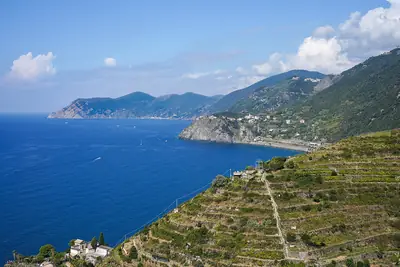
Cinque Terre means “Five Lands”. From north to south, the villages form a sequence along the coast, each with its own setting and character. The landscape reflects centuries of work, with terraces built into the steep hillsides for vineyards and other cultivation. Cinque Terre lies in Liguria, on the coast of Italy.
What to See in Cinque Terre
The most important places to visit in Cinque Terre are its five villages, along with the churches, fortifications, sanctuaries, and viewpoints woven through the coastal landscape.
Monterosso al Mare
Monterosso al Mare is the northernmost of the five villages. Among its notable sights is the Statua del Gigante, also known as the Statua di Nettuno, a distinctive statue in the town.
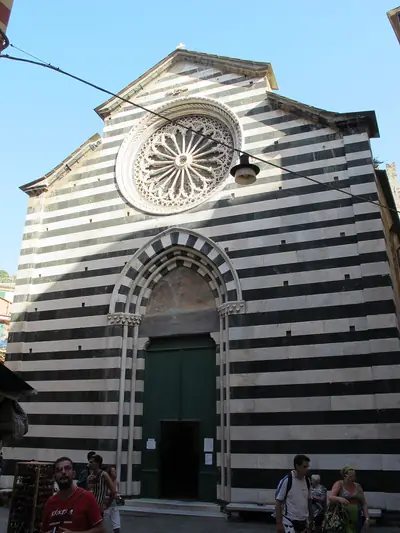
The village is also home to San Giovanni Battista Church in Piazza Don Giovanni Minzoni. Built between the thirteenth and fourteenth centuries in the Genoese Gothic style, it has a black-and-white striped façade and a large rose window. The façade dates from 1307, while the fresco above the entrance depicts the Baptism of Jesus and dates from the eighteenth century. The bell tower began as a watchtower and formed part of the defensive works established by the Republic of Genoa in the thirteenth century.
Castello dei Fieschi is another historic sight in Monterosso al Mare. On the hillside, San Francesco Church belongs to a former Franciscan complex. The seventeenth-century church has a simple design, a single nave, and four small chapels decorated with stucco. The former convent beside it now houses the town hall, while other parts are used for exhibitions, music, and theatre performances.
Vernazza
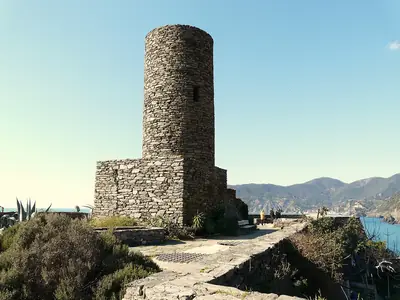
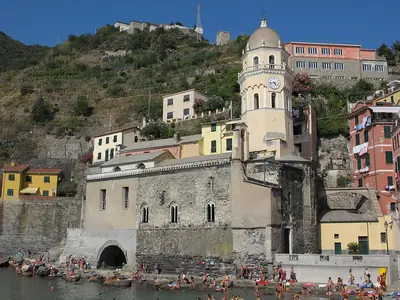
Vernazza is arranged around a harbour on the coast. Its historic fortification, Vernazza Castle—also known as Castello Doria—stands on a rocky promontory about seventy metres above the sea. The castle’s history reaches back to the eleventh century, and its cylindrical tower, restored in the twentieth century, is considered its oldest surviving part. During the Second World War, the fortress was used as an air-defence station by Nazi German soldiers.
The Church of Santa Margherita stands on Via Ettore Vernazza. Its origins are medieval: historical records place its foundation in the eleventh or twelfth century, when it was built in the Romanesque style. Later extensions changed the façade, and the interior was remodelled in the Baroque style during the eighteenth century.
Vernazza’s San Francesco Church forms part of another historic Franciscan complex. Built in the seventeenth century, it has a single nave and four small chapels. The former convent now serves partly as the town hall, and a section of the convent wall remains visible on the western side.
Corniglia
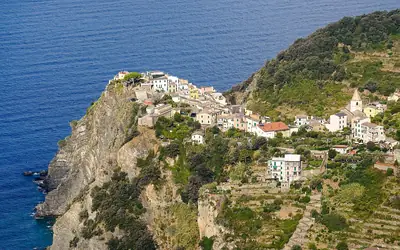
Corniglia is the only one of the five villages that does not sit directly beside the sea. It occupies the top of a promontory about one hundred metres high, with vineyards and terraces on three sides and a steep drop towards the water.
The approach to the village includes the Lardarina, a brick staircase made up of 33 flights and 383 steps. Corniglia’s houses line Fieschi Road, facing the road on one side and the sea on the other. The settlement is known for its narrow lanes and its lower houses, which give it a character closer to inland villages.
A terrace cut into the rock offers a way to understand Corniglia’s position within Cinque Terre: the other four villages can be seen from there, with two on one side and two on the other. In the village piazza, the Oratorio dei Disciplinati is a small eighteenth-century oratory dedicated to Saint Catherine of Alexandria. Its gabled façade has a circular window and a niche with a statue of the saint, while the interior contains an eighteenth-century frescoed ceiling depicting her martyrdom.
Manarola
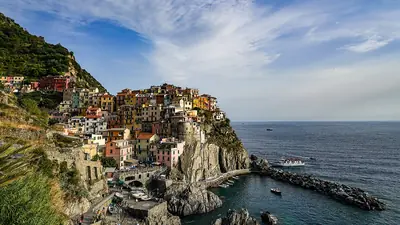
Manarola is one of the most recognizable Cinque Terre villages. Brightly colored houses give this small settlement a distinctive appearance as it rises around the coast. Manarola is a frazione, or smaller settlement, belonging to the municipality of Riomaggiore, and is one of the five communities traditionally known as the Five Lands.
Riomaggiore
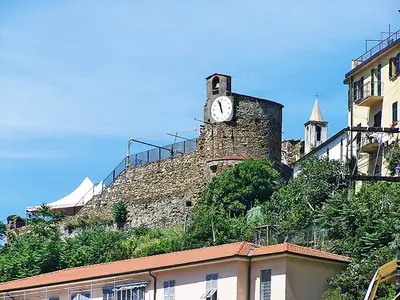
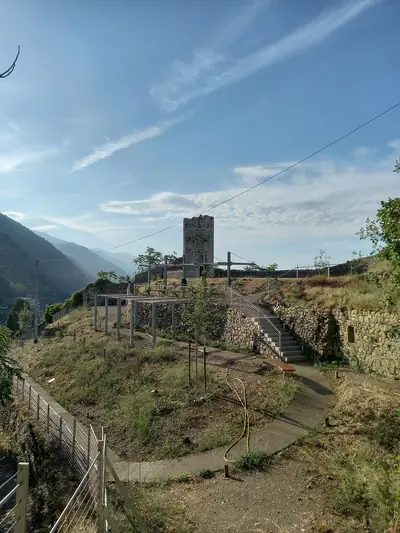
Riomaggiore forms the southern end of the traditional sequence of the five villages. In the upper part of its historic centre stands the Castle of Riomaggiore, or Castello di Riomaggiore. First built for defence in 1260, it was replaced by a new castle on the hill during the fifteenth and sixteenth centuries under the Republic of Genoa. Later, during the period of Napoleon Bonaparte’s rule and the Ligurian Republic, it served as a cemetery. Restored at the end of the twentieth century, it is now used as a meeting room and cultural centre.
The sanctuaries above the villages
The hills and terraces above Cinque Terre contain several historic sanctuaries. The Nostra Signora della Salute Sanctuary in Volastra dates from the twelfth century and was built in the Romanesque style. Its façade is made from local stone, and the Madonna statue inside dates from 1891.
The Sanctuary of Nostra Signora di Montenero stands at 340 metres above sea level and can be reached by a mule track from Provincial Road 370. Its history reaches back to 790, although its earliest written record dates from 1335. The present three-aisled building reflects rebuilding carried out in 1740 and 1847.
Beyond Vernazza, a paved trail leads through the terraces to the Nostra Signora di Reggio Sanctuary. The walk is about two kilometres from the railway station, passing small chapels that mark the stations of the Via Crucis. The sanctuary stands in a church square surrounded by centuries-old trees and preserves an image of the Black Madonna with the Child.
On the slopes of Mount Soviore, the Nostra Signora di Soviore Sanctuary stands among woods and terraced fields within Cinque Terre National Park. Located in the municipality of Monterosso al Mare, along the road between Monterosso and Levanto, it has a history reaching back to the twelfth century.
A Cinque Terre Self-Guided Walking Tour with Neywo
Neywo offers three walking tours in Cinque Terre, with 20 narrated places in total:
- Monterosso: Striped Churches, a Giant and a Capuchin Hill — 1.33 km, 39 minutes, and four stops.
- From Vernazza’s Harbour Castle to Corniglia’s Hilltop Lanes — 4.14 km, 89 minutes, and six stops.
- Manarola to Riomaggiore: Vineyard Sanctuaries and Painted Houses — 4.15 km, 89 minutes, and six stops.
The app tells the story of each place as you reach it, at your own pace, with no group and no schedule. Narration is available in 11 languages, making it a practical way to follow a free walking tour in Cinque Terre while exploring independently.
Download the Neywo Audio Guide for Cinque Terre
Download Neywo to explore Cinque Terre with a free audio guide and three self-guided walking tours. Listen to the stories of the villages, churches, castles, statues, and sanctuaries as you arrive at each stop, without having to follow a group or keep to a schedule. After Cinque Terre, continue exploring the Ligurian coast with La Spezia or Levanto.
Places with an audio guide in Cinque Terre
8 places in Cinque Terre with a Neywo audio guide. Each one starts telling its story as you reach it.
Self-guided tours in Cinque Terre
3 tours in Cinque Terre, free in the Neywo app. Each stop tells its story as you reach it.
- Walk
Monterosso: Striped Churches, a Giant and a Capuchin Hill
Monterosso al Mare is the biggest and flattest of the five villages. Start at the sea-god statue known as the Giant, then climb to the castle ruins of the Fieschi, the Capuchin friary on San Cristoforo Hill and the black-and-white striped Genoese Gothic church of San Giovanni Battista.
Statua del Gigante · Castello dei Fieschi · San Francesco Church · San Giovanni Battista Church
Open this tour: Monterosso: Striped Churches, a Giant and a Capuchin Hill - Walk
From Vernazza's Harbour Castle to Corniglia's Hilltop Lanes
Two villages, one hike. Wander Vernazza's medieval churches and climb to the Doria castle above the harbour. Then follow the coastal path to Corniglia, the only village that does not touch the sea, and explore its marble-faced church and the oratory of Saint Catherine.
Santa Margherita Church · San Francesco Church · Vernazza Castle · Corniglia · Oratorio dei Disciplinati, Corniglia · San Pietro Church
Open this tour: From Vernazza's Harbour Castle to Corniglia's Hilltop Lanes - Walk
Manarola to Riomaggiore: Vineyard Sanctuaries and Painted Houses
Start at the Romanesque sanctuary above the vines at Volastra, then drop into Manarola's colourful houses and sandstone church. Continue to Riomaggiore for its Gothic rose window, the old castle and the sanctuary of Montenero high on the hillside.
Nostra Signora della Salute Sanctuary · San Lorenzo Church · Manarola · San Giovanni Battista · Castle of Riomaggiore · Nostra Signora di Montenero
Open this tour: Manarola to Riomaggiore: Vineyard Sanctuaries and Painted Houses
Walk Cinque Terre with Neywo
Neywo turns Cinque Terre into a self-guided audio tour. Stories arrive as you reach the place they belong to, and the route reshapes when you wander off it.

