Things to Do in Ikaruga, Japan: Walking Guide
Things to Do in Ikaruga: Ancient Temples and Quiet Heritage
The best things to do in Ikaruga are connected with its ancient Buddhist temples, Shinto traditions, and peaceful historic landscape. The town in Nara is home to Hōryū-ji, one of Japan’s oldest Buddhist sites, as well as Hokki-ji and other places associated with Prince Shōtoku. Neywo offers a free audio guide for Ikaruga with 4 narrated places, helping you explore the area at your own pace.
What to See in Ikaruga
Hōryū-ji Temple
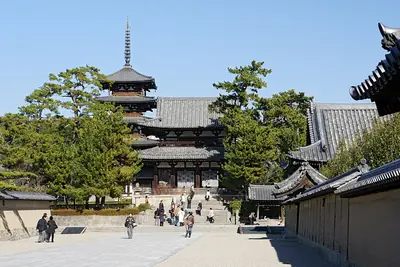
Hōryū-ji is Ikaruga’s defining landmark and one of Japan’s oldest Buddhist sites. Traditionally founded in 607 by Prince Shōtoku, it was originally known as Ikaruga-dera and also as Hōryū Gakumonji, or the Learning Temple of the Flourishing Law. The complex served both as a seminary and as a monastery.
The temple is divided into two distinct areas. The Western Precinct is centered on the Kondō, or main hall, and the five-story pagoda. It is recognized as the world’s oldest surviving group of wooden buildings, while the Kondō, rebuilt more than 1,300 years ago, is widely recognized as the world’s oldest wooden building.
The Eastern Precinct is organized around the Yumedono, or Dream Hall. Together, the two areas preserve the form of an ancient Buddhist institution and offer a direct view of early Japanese wooden architecture.
The temple’s history also includes destruction and rebuilding. According to the Nihon Shoki, lightning caused the buildings to burn in 670, after which reconstruction began. Hōryū-ji remains closely associated with Prince Shōtoku and is central to Ikaruga’s religious and cultural identity.
Ikaruga Shrine
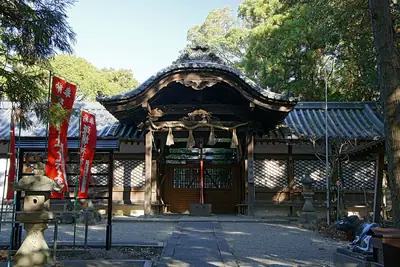
Ikaruga Shrine, also known as 斑鳩神社, is a Shinto shrine on Tenma Mountain, northeast of Hōryū-ji Temple. Its position links the shrine with both the temple and the surrounding landscape.
The setting provides a different perspective on Ikaruga’s heritage. Rather than being part of the Buddhist temple complex, Ikaruga Shrine represents the area’s Shinto traditions while remaining closely connected to its best-known historic site.
Hokki-ji Temple
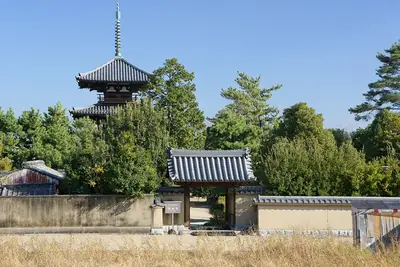
Hokki-ji Temple stands in the Okamoto neighborhood and is best known for its distinctive three-story pagoda. Rising 24 meters, it is regarded as Japan’s oldest pagoda of this type and is described as the country’s second-largest three-story pagoda, after the East Pagoda of Yakushi-ji.
The pagoda gives Hokki-ji much of its visual character, but the temple’s religious history is equally significant. Its principal object of worship is an eleven-faced statue of Avalokitesvara, and the temple was built in honor of this Buddhist figure.
Hokki-ji has also been known as Okamoto-dera and Ikejiri-dera. It is sometimes counted among the seven great temples associated with Prince Shōtoku, although it was completed several decades after his death. In 1993, it was registered with the Buddhist Monuments in the Hōryū-ji Area as a UNESCO World Heritage Site.
Aizu Yaichi Poem Monument
The Aizu Yaichi poem monument, known in Japanese as 会津八一歌碑, is a quieter stop within Ikaruga’s historic landscape. It offers a brief opportunity to pause between the area’s larger religious sites.
The monument is included on the walking route between Hōryū-ji and Hokki-ji, making it part of a broader journey through Ikaruga rather than an isolated attraction.
Why Visit Ikaruga?
Ikaruga brings together Buddhist temples, a Shinto shrine, historic monuments, and a landscape closely tied to Prince Shōtoku. Hōryū-ji provides the most extensive encounter with ancient wooden architecture, while Hokki-ji adds a distinctive pagoda and another important chapter in the region’s religious history.
For travellers exploring Nara, Ikaruga offers a quieter setting in which to experience some of Japan’s earliest Buddhist heritage. It is also a useful destination for anyone interested in temples, traditional architecture, and the relationship between religious sites and their surrounding landscape.
Explore Ikaruga with Neywo
Neywo’s Ikaruga self-guided walking tour covers 2.54 km in 74 minutes and includes 4 narrated stops: the Aizu Yaichi poem monument, Hōryū-ji Temple, Ikaruga Shrine, and Hokki-ji Temple. There is also a 1.2 km bike route that takes around 6 minutes and includes 2 stops, Ikaruga Shrine and Hokki-ji Temple.
The app tells the story of each place as you reach it, at your own pace. There is no group and no schedule, so you can explore independently and pause whenever you want. Download Neywo to discover Ikaruga with a free audio guide, and continue exploring the wider Japan destination collection.
Places with an audio guide in Ikaruga
3 places in Ikaruga with a Neywo audio guide. Each one starts telling its story as you reach it.
Self-guided tours in Ikaruga
2 tours in Ikaruga, free in the Neywo app. Each stop tells its story as you reach it.
- Bike ride
Ikaruga Shrine to Hokki-ji by Bike
A short, flat ride on the cycle lane that links Ikaruga Shrine with Hokki-ji, the temple of the oldest three-story pagoda in Japan. Easy to combine with a day of temple-hopping around Horyu-ji.
Ikaruga Shrine · Hokki-ji Temple
Open this tour: Ikaruga Shrine to Hokki-ji by Bike - Walk
In the Footsteps of Prince Shotoku: Horyu-ji to Hokki-ji
Walk the quiet lanes of Ikaruga, where Japan's first Buddhist temples were raised in the Asuka period. Pause at Aizu Yaichi's poem monument, enter Horyu-ji with the world's oldest surviving wooden buildings, then climb to its guardian shrine and finish at Hokki-ji and its 24-metre three-story pagoda, the oldest of its kind in Japan.
Hōryū-ji Temple · Ikaruga Shrine · Hokki-ji Temple
Open this tour: In the Footsteps of Prince Shotoku: Horyu-ji to Hokki-ji
Walk Ikaruga with Neywo
Neywo turns Ikaruga into a self-guided audio tour. Stories arrive as you reach the place they belong to, and the route reshapes when you wander off it.

