Visiting Putrajaya, Malaysia: Top Sights on Foot
Things to Do in Putrajaya: What to See in Malaysia’s Planned Capital
Looking for things to do in Putrajaya? Malaysia’s federal administrative capital is a purpose-built city of monumental government buildings, Islamic-inspired architecture, royal palaces, formal squares and landscaped public spaces. Its principal landmarks are concentrated around Putrajaya Lake and the civic district, making the city especially rewarding to explore on foot. Neywo has a free audio guide for Putrajaya with 12 narrated places.
Putrajaya was developed across formerly undeveloped land from the mid-1990s and was officially established in 2001. Today, its broad avenues, bridges, gardens and domes form a carefully designed urban landscape quite different from older Malaysian cities. If you are exploring Malaysia, Putrajaya offers a distinctive look at the country’s modern administration, royal life and architectural ambitions.
What to see in Putrajaya
The best way to experience Putrajaya is to move through its civic centre, where squares, palaces, mosques and monuments appear in a planned sequence. These are the main places to include in your visit.
Putra Mosque
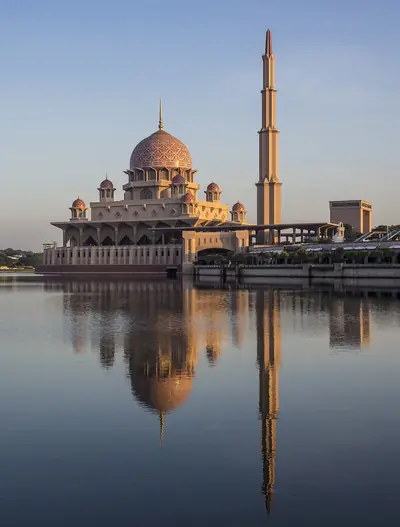
Putra Mosque, also known as Masjid Putra, is one of Putrajaya’s defining landmarks. Its rose-tinted granite and distinctive pink dome have earned it the popular nickname “Pink Mosque”. The mosque stands beside the man-made Putrajaya Lake, with part of the building extending over the water and creating the impression that it is floating.
The complex is arranged around three main areas: the prayer hall, the Sahn courtyard and facilities for learning and functions. Construction began in 1997 and was completed in 1999. The mosque can accommodate up to 15,000 worshippers at one time.
Putra Square
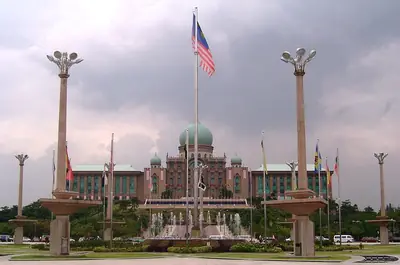
Putra Square, or Dataran Putra, is a circular city square in Precinct 1. It brings together several of Putrajaya’s most prominent landmarks, including Putra Mosque, Perdana Putra and Putra Bridge.
A tall flagpole carrying Malaysia’s national flag stands at the centre, surrounded by the flags of the country’s states. The square provides broad views across the civic district: Perdana Putra lies to the north, Putra Mosque to the east, and Putra Bridge faces the square. The Promenade Shopping Mall forms another boundary of this expansive public space.
Perdana Putra
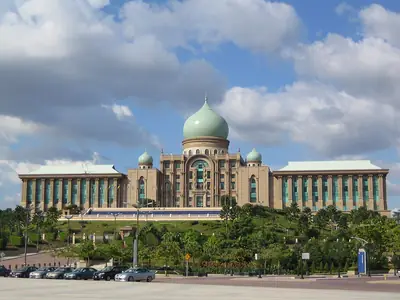
Perdana Putra is the office complex of Malaysia’s Prime Minister and one of the most recognisable buildings on the Putrajaya skyline. It stands on the city’s main hill and is faced with natural stone.
Its large onion-shaped dome is surrounded by four smaller domes, giving the building a distinctive profile. Construction took place between 1997 and early 1999, and it was first used in April 1999, when departments of the Prime Minister’s Office moved from Kuala Lumpur to Putrajaya.
Istana Melawati
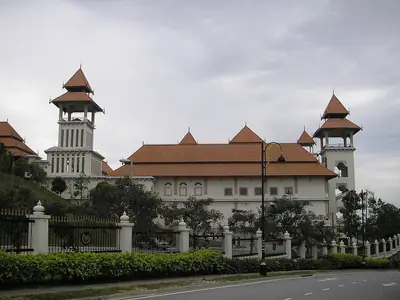
Istana Melawati is Malaysia’s second national palace and a royal retreat for the Yang di-Pertuan Agong, Malaysia’s king. Its design is notable for adapting traditional Malay royal architecture to a modern palace.
The most distinctive feature is the perabung lima roof, a five-ridge roof form strongly associated with the Malay world. The palace adds a royal dimension to Putrajaya’s administrative and ceremonial centre.
Putrajaya Landmark
Putrajaya Landmark, also known as Mercu Tanda Putrajaya, marks the beginning of the city’s development as the federal administrative centre. It was established in 1995 at the highest point of Precinct 1, inside Putra Perdana Park.
The monument’s time-capsule structure symbolises Putrajaya’s origins. Its design combines a high-technology theme with contemporary and traditional motifs. Around it, Plaza Mercu is landscaped with trees and fountains, while pedestrian walkways connect the site with Entrance Plaza, Cascade Plaza, the Fragrant Garden, gazebos and pergolas.
National Heroes Square
National Heroes Square, or Dataran Pahlawan Negara, is a monument and war memorial dedicated to Malaysia’s fallen heroes. It was completed in 2013 and replaced Tugu Negara as the venue for Hari Pahlawan, Malaysia’s annual Heroes’ Day observance.
The main gateway is inspired by a fortress or defensive stronghold. Memorial stones stand in rows on either side, while the names of heroes who died while serving are carved into large pieces of black marble. A parade ground and fountains complete the memorial setting, creating a solemn space for remembrance and national ceremonies.
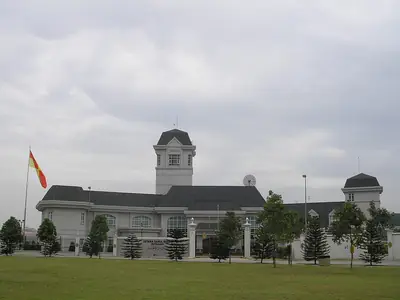
Istana Darul Ehsan
Istana Darul Ehsan, or the Abode of Sincerity Palace, stands beside Putrajaya Lake and faces Seri Wawasan Bridge. Visitors cannot enter, but the palace remains a memorable sight because of its imposing Tudor-style design.
Its high, deep-grey façade, dark-blue roof and semicircular entrance give it a distinctive appearance. Construction began after Sultan Salahuddin Abdul Aziz Shah became Malaysia’s eleventh Yang di-Pertuan Agong in 1999. He died in 2001, before the six-storey palace was fully completed.
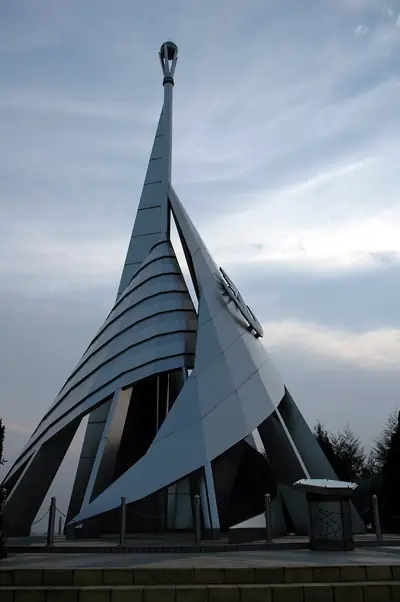
Millennium Monument
The Millennium Monument, also known as Monumen Alaf Baru or Tugu Millennium, rises from a 25-hectare park in Precinct 2. The 68-metre obelisk represents important moments in Malaysia’s history and was the second national monument built in Putrajaya, after Putrajaya Landmark.
Etched surfaces mark significant periods and milestones in the country’s story. Its rising walkway is divided into four sections representing Malaysia before independence, the years from 1957 to 1970, the period from 1971 to 2020, and the future from 2020 onward. From above, the monument is designed to resemble Malaysia’s national flower, the hibiscus.
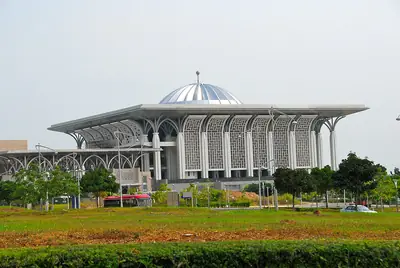
Tuanku Mizan Zainal Abidin Mosque
Tuanku Mizan Zainal Abidin Mosque, also known as Masjid Besi or the Iron Mosque, is Putrajaya’s second principal mosque. It stands in Precinct 3, opposite the Palace of Justice and beside the Islamic Complex Putrajaya.
Stainless steel forms the dome, while glass surrounds much of the building. This metallic architecture allows light and air to pass through, producing an open appearance. The approach to the prayer area uses a gas-based cooling system rather than fans or conventional air conditioning.
Construction began in April 2004 and was completed in August 2009. The mosque was officially opened on 11 June 2010 by the 13th Yang di-Pertuan Agong, Tuanku Mizan Zainal Abidin, whose name it bears.
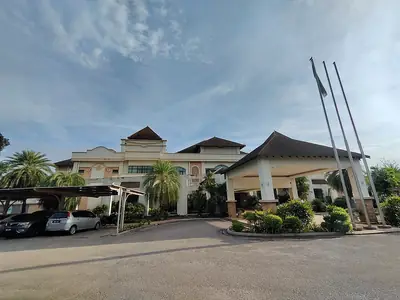
Perdana Leadership Foundation
The Perdana Leadership Foundation preserves documents, speeches and writings connected with Malaysia’s prime ministers. Its library and research resources are intended to help visitors understand the country through the policies, strategies and plans associated with its national leadership.
The foundation was established in early 2003. The Perdana Library opened on 29 April 2004, and the foundation was officially launched by Prime Minister Abdullah Ahmad Badawi on 10 May 2005.
Natural History Museum Putrajaya
The Natural History Museum Putrajaya is a former natural history museum. It is now defunct, so the site is associated with its past role rather than an active exhibition experience.
Dataran Putrajaya
Dataran Putrajaya is another square in the city’s planned civic landscape. Its open space provides a simple pause between the larger landmarks and reflects Putrajaya’s formal approach to public areas.
Explore Putrajaya with a free audio guide
A Putrajaya self-guided walking tour lets you discover the city without joining a group or following a fixed timetable. Neywo offers two walking tours, with 11 languages available for narration:
- Putrajaya’s Power Axis: Palaces, a Pink Mosque and Heroes — 4.06 km, 96 minutes and 7 narrated stops. The route includes Istana Darul Ehsan, Putra Mosque, Putra Square, Perdana Putra, Putrajaya Landmark, Istana Melawati and National Heroes Square.
- Obelisk and Iron Mosque: Putrajaya’s Modern Monuments — 3.02 km, 63 minutes and 4 narrated stops. It visits Millennium Monument, Tuanku Mizan Zainal Abidin Mosque, Dataran Putrajaya and Perdana Leadership Foundation.
Download Neywo and explore Putrajaya at your own pace. The app tells the story of each place as you reach it, so you can walk independently, with no group and no schedule.
Places with an audio guide in Putrajaya
8 places in Putrajaya with a Neywo audio guide. Each one starts telling its story as you reach it.
Self-guided tours in Putrajaya
2 tours in Putrajaya, free in the Neywo app. Each stop tells its story as you reach it.
- Walk
Putrajaya's Power Axis: Palaces, a Pink Mosque and Heroes
Walk the ceremonial heart of Malaysia's planned capital. Start by the lake at the grey Tudor-style palace of the Sultan of Selangor, pass the floating Pink Mosque and the vast Putra Square, look up at the Prime Minister's onion dome, and climb to the hilltop Istana Melawati before ending at the white memorial of National Heroes Square.
Istana Darul Ehsan · Putra Mosque · Putra Square · Perdana Putra · Putrajaya Landmark · Istana Melawati …
Open this tour: Putrajaya's Power Axis: Palaces, a Pink Mosque and Heroes - Walk
Obelisk and Iron Mosque: Putrajaya's Modern Monuments
A southern loop around the lake precincts: the 68-metre Millennium Monument shaped like a hibiscus, the stainless-steel dome of the Iron Mosque, an open civic square and the library-institute of the Perdana Leadership Foundation. Wide pavements and little shade, so go early or at dusk.
Millennium Monument · Tuanku Mizan Zainal Abidin Mosque · Dataran Putrajaya · Perdana Leadership Foundation
Open this tour: Obelisk and Iron Mosque: Putrajaya's Modern Monuments
Walk Putrajaya with Neywo
Neywo turns Putrajaya into a self-guided audio tour. Stories arrive as you reach the place they belong to, and the route reshapes when you wander off it.

