Visiting Kota Kinabalu, Malaysia: Top Sights on Foot
Things to do in Kota Kinabalu: the best places to see in Sabah’s capital
Looking for things to do in Kota Kinabalu? Sabah’s capital is a coastal city on the northwest coast of Borneo, facing the South China Sea and serving as one of the main gateways to Sabah and the island of Borneo. Its history, religious landmarks, museums and connections to Mount Kinabalu make it a rewarding place to explore. Neywo has a free audio guide for Kota Kinabalu with 23 narrated places, available in 11 languages.
Kota Kinabalu was once known as Jesselton and has also been associated with the earlier names Api-api and Dondoung. A settlement developed opposite Gaya Island in 1899, later growing into a trading port connected to the North Borneo Railway. Much of the town was destroyed during the Second World War, then rebuilt under the British Crown. When North Borneo became Sabah, Jesselton was renamed Kota Kinabalu in 1967; the name combines the Malay word for city with Mount Kinabalu.
For more context, explore Malaysia as a whole, or compare Kota Kinabalu with other Malaysian cities such as Kuching and George Town.
What to see in Kota Kinabalu
Atkinson Clock Tower
The Atkinson Clock Tower is the oldest surviving structure in Kota Kinabalu. Built in 1905 as a memorial to Francis George Atkinson, Jesselton’s first district officer, the wooden tower stands 15.24 metres high on a rectangular base.
It is one of only three pre-Second World War buildings still intact in the Kota Kinabalu district. Clock faces appear on three sides, and a bell sounds every hour. The tower once helped with navigation, but land reclamation around Jesselton harbour moved the coastline farther away and it stopped serving that purpose by the end of the 1950s. In 2017, it was gazetted as one of Sabah’s 24 State Heritage Sites.
Malaysia Monument
Near Kota Kinabalu City Hall, Deasoka Square is home to the Malaysia Monument, also known as Tugu Peringatan Malaysian. The monument commemorates the formation of Malaysia in 1963 and was sponsored by the local Chinese community. It remains part of Malaysia Day celebrations.
Sacred Heart Cathedral
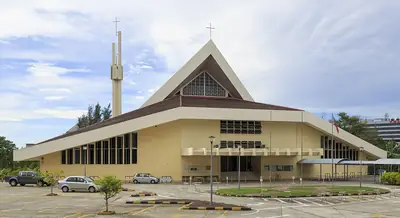
Sacred Heart Cathedral is an important Catholic landmark and the cathedral of the Roman Catholic Archdiocese of Kota Kinabalu. The present building was constructed between 1979 and 1981, with its dedication taking place on 21 November 1981.
Kota Kinabalu City Mosque
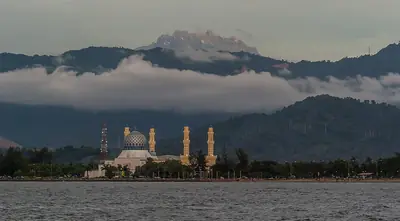
Set along the waterfront, Kota Kinabalu City Mosque is one of the city’s most distinctive landmarks. Almost 70% of the mosque area is surrounded by water, giving the building a particularly striking setting.
Known in Malay as Masjid Bandaraya Kota Kinabalu, it is the city’s second main mosque after the Sabah State Mosque in Sembulan. The mosque officially opened on 18 February 2000, following Kota Kinabalu’s declaration as a city. Its design includes features inspired by the Prophet’s Mosque, or Masjid Nabawi, and the building can accommodate up to 12,000 worshippers at one time.
Sabah State Mosque
The Sabah State Mosque, or Masjid Negeri Sabah, is the state mosque of Sabah. It stands at Bulatan Sembulan on Jalan Tunku Abdul Rahman, in Kota Kinabalu.
Sabah Museum and Heritage Village
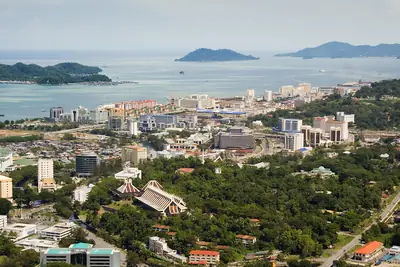
The Sabah Museum occupies a 17-hectare site at Bukit Istana Lama and brings together the natural, cultural and historical heritage of the state. Its collections cover ethnography, archaeology, history, numismatics, art history, botany, zoology and mineralogy.
The museum’s galleries include displays on Islamic civilisation, archaeology, history, natural history, and ceramic and brass objects. The wider complex also contains the Sabah State Museum and Heritage Village, an ethnobotanical garden and a zoo. Together, these spaces show how the institution collects, preserves, conserves and documents Sabah’s heritage.
Sabah Islamic Civilisation Museum
The Sabah Islamic Civilisation Museum is housed in a two-storey building on Menteri Street in Kota Kinabalu District. It offers a dedicated place to explore Islamic civilisation in Sabah.
Sabah Art Gallery
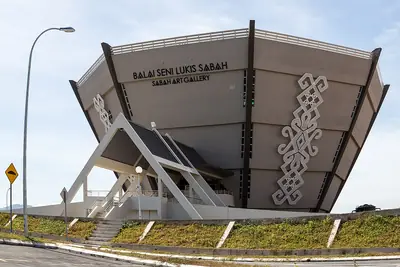
Known in Malay as Balai Seni Lukis Sabah, the Sabah Art Gallery brings together art from Sabah and beyond the region. Its role extends beyond exhibiting works: it collects, stores, conserves and interprets artworks by local and foreign artists.
Bajau Sama Cultural Centre
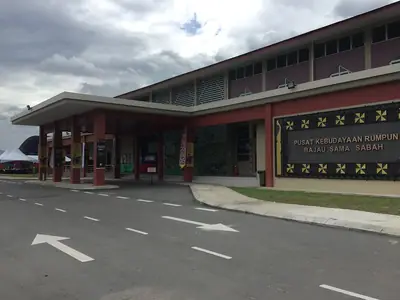
The Bajau Sama Cultural Centre, also called the Sabah Bajau Sama Cultural Centre, is dedicated to the culture of the Bajau Sama community in Sabah. It provides a place to learn about one of the communities whose traditions form part of the state’s cultural heritage.
Mari Mari Cultural Village
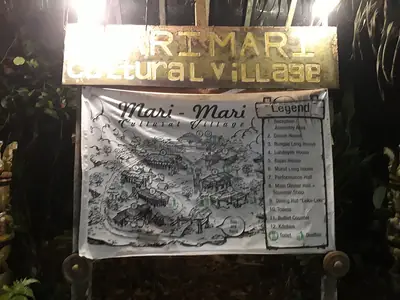
Mari Mari Cultural Village is an open-air museum created to preserve the traditions, culture and history of Sabah’s indigenous communities. The setting is dedicated to cultural discovery and offers an introduction to the heritage of northern Borneo.
Mount Kinabalu and Kinabalu Park
Mount Kinabalu
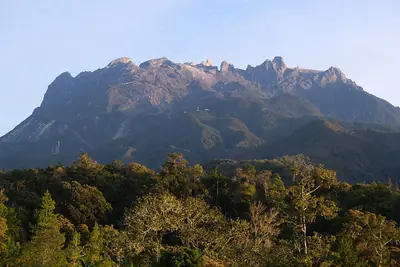
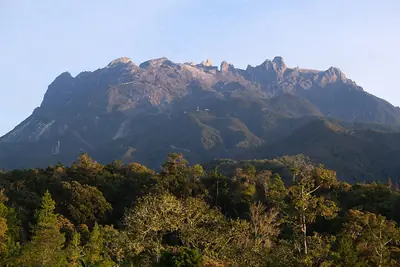
Mount Kinabalu, known in Malay as Gunung Kinabalu, rises to 4,095 metres and is the highest mountain in Malaysia and Maritime Southeast Asia. It stands in Sabah, on the island of Borneo, and its summit is known as Low’s Peak.
For local Dusun communities, the mountain has deep spiritual meaning. It is regarded as a place where the spirits of the dead come to rest and is associated with strength, determination and the unity of Sabah’s people.
Low’s Peak can be climbed by someone in good physical condition on the main route without mountaineering equipment. National park regulations require climbers to be accompanied by accredited guides, and altitude sickness is a possible risk.
Kinabalu Park
Kinabalu Park, also known as Taman Kinabalu, surrounds Mount Kinabalu on Sabah’s west coast. Established in 1964, it was one of Malaysia’s first national parks and became Malaysia’s first UNESCO World Heritage Site in December 2000.
The park covers about 754 square kilometres and includes an extraordinary range of elevations and habitats: lowland tropical areas, tropical rainforest, montane forest, subalpine forest and high-altitude shrub vegetation. Its plant life reflects influences associated with the Himalayas, China, Australia, Malaysia and tropical regions around the world.
The park is one of Sabah’s most important natural sites and shows the sharp environmental changes that occur between the coast and the mountain landscape. It also explains why Kota Kinabalu is such an important base for discovering Sabah.
Explore Kota Kinabalu with a free audio guide
Download Neywo and follow a Kota Kinabalu self-guided walking tour through the city’s history and landmarks. The route, “Old Jesselton to Sembulan: Kota Kinabalu’s Memory Trail,” is one walking tour covering 5.18 km, lasting 114 minutes, with 8 narrated stops.
The walk connects places including Atkinson Clock Tower, Malaysia Monument, Sacred Heart Cathedral, Kota Kinabalu, the Sabah Islamic Civilization Museum, Sabah State Museum and Heritage Village, and Sabah State Mosque. Each story plays as you reach the place, at your own pace: no group and no schedule.
Places with an audio guide in Kota Kinabalu
8 places in Kota Kinabalu with a Neywo audio guide. Each one starts telling its story as you reach it.
Self-guided tours in Kota Kinabalu
1 tour in Kota Kinabalu, free in the Neywo app. Each stop tells its story as you reach it.
- Walk
Old Jesselton to Sembulan: Kota Kinabalu's Memory Trail
Kota Kinabalu was almost entirely destroyed in the Second World War, so its few survivors matter. Start at the 1905 wooden Atkinson Clock Tower, pass the monuments of the city park and the cathedral, then climb to the Sabah museums and finish at the state mosque and the memorial to the 1976 Double Six crash.
Atkinson Clock Tower · Malaysia Monument · Tugu Peringatan Perang Borneo Utara · Sacred Heart Cathedral, Kota Kinabalu · Sabah Islamic Civilization Museum · Sabah State Museum & Heritage Village …
Open this tour: Old Jesselton to Sembulan: Kota Kinabalu's Memory Trail
Walk Kota Kinabalu with Neywo
Neywo turns Kota Kinabalu into a self-guided audio tour. Stories arrive as you reach the place they belong to, and the route reshapes when you wander off it.

