Visiting Marrakesh, Morocco: Top Sights on Foot
Things to Do in Marrakesh: What to See in Morocco’s Red City
The best things to do in Marrakesh include exploring the historic medina, discovering richly decorated palaces and madrasas, and experiencing the atmosphere of Jemaa el-Fnaa. The city brings together centuries of Moroccan architecture, religious history, craftsmanship and contemporary culture. Neywo offers a free audio guide for Marrakesh with 36 narrated places, so you can explore while hearing the story of each site.
What to See in Marrakesh
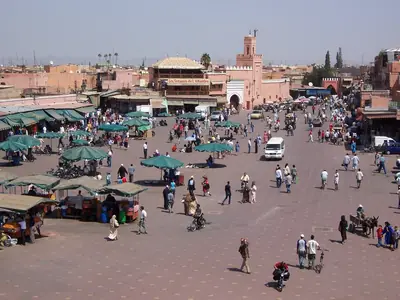
Jemaa el-Fnaa
At the heart of the medina, Jemaa el-Fnaa is Marrakesh’s historic square and market. Locals and visitors gather here, and its atmosphere changes throughout the day. The square is recognized both as a UNESCO World Heritage site and as intangible cultural heritage of humanity.
Jemaa el-Fnaa began as an open market east of the Kasbah, the royal palace and fortress associated with the city’s foundation. It continued as Marrakesh’s main trading area through periods of decline and renewal. One traditional explanation of its name is “destroyed mosque” or “mosque of extinction”, referring to a mosque that was begun in the late sixteenth century but never completed.
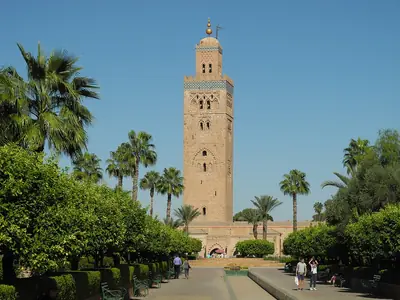
Koutoubia Mosque
The Koutoubia Mosque is the largest mosque in Marrakesh and one of the defining landmarks of the city. Located near Jemaa el-Fnaa, it is surrounded by spacious gardens and crowned by a distinctive minaret decorated with geometric arches, a metal spire and orbs.
Construction began in 1147 after the Almohad conquest of the city. A second version was built around 1158, and the minaret was completed under Yaqub al-Mansur in the late twelfth century. Its silhouette later inspired towers including the Giralda in Seville and the Hassan Tower in Rabat.
Dar el Bacha
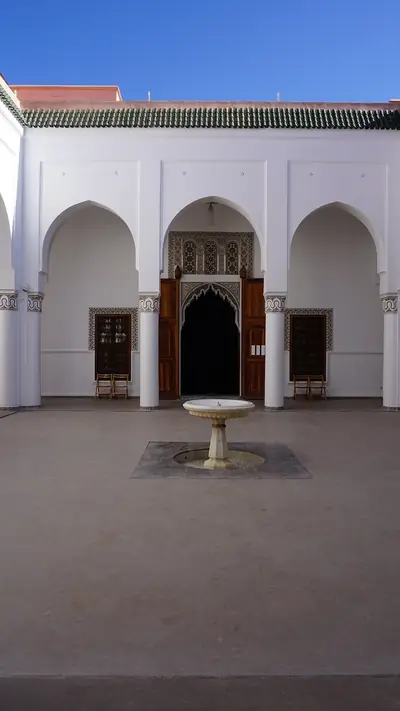
Dar el Bacha, or “House of the Pasha”, was the residence of Thami El Glaoui, the influential Pasha of Marrakesh during the French protectorate. The palace became a museum in 2017 and now houses the Museum of Confluences.
Its name reflects its history, while its architecture preserves the elegance of a private aristocratic residence in the old medina.
Ben Youssef Madrasa
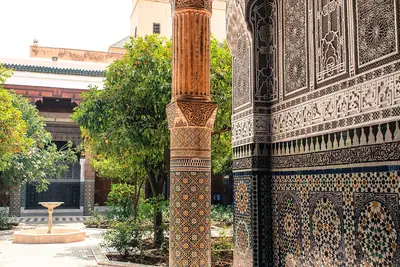
The Ben Youssef Madrasa is one of Marrakesh’s most impressive historic monuments. Founded in 1346 by the Marinid sultan Abu al-Hasan al-Marinid, it was later enlarged and redecorated by the Saadian sultan Abdallah al-Ghalib in 1564–65.
For four centuries, the madrasa welcomed students from across the region. Its 132 rooms once provided lodging, while theology was among the subjects taught there. Today, the central courtyard, southern mihrab iwan and richly decorated architectural details reveal the skill of Moroccan craftsmen.
Marrakech Museum
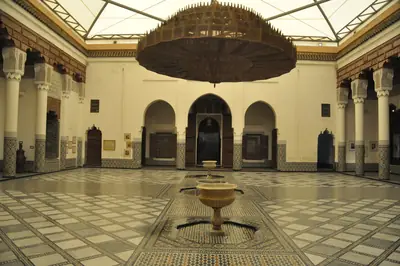
Near the Ben Youssef Madrasa, the Marrakech Museum occupies a historic palace built in 1898 for El Mehdi M’Nebhi, minister of war under Sultan Moulay Hassan I. Its large courtyard is an example of Moorish art, while the first-floor salon features Hispano-Moorish decoration and original cedar furnishings.
The museum presents hammered copperware, Berber weapons, jewellery and clothing from mountain villages. Since 1995, it has also hosted temporary exhibitions devoted to contemporary art and Moroccan cultural heritage, alongside concerts, theatre, dance, film screenings, lectures and workshops.
Dar Cherifa
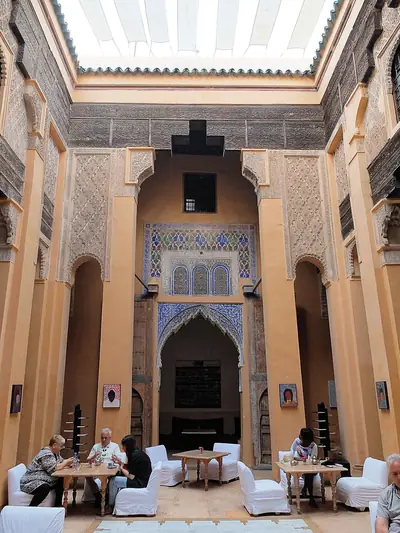
Dar Cherifa is a restored historic house in the Mouassine neighbourhood. Dating from the late sixteenth century, it is one of the few well-preserved Saadian-era residences still standing in the medina.
Originally known as Dar Ijimi, after the family that lived there, the house follows the traditional Moroccan-Andalusian riad style. After its restoration in the early 2000s, it became a café, art gallery and cultural space.
Mouassine Museum
The Mouassine Museum, also known as the Museum of Music, occupies a traditional Moroccan house in the historic Mouassine quarter. The building dates from the sixteenth and seventeenth centuries and includes an upper-floor apartment known as a douiria.
Its permanent and temporary exhibitions explore the musical heritage of the region, making it a different kind of cultural stop within the medina.
Bahia Palace
Bahia Palace is a major monument of nineteenth-century Moorish-Islamic architecture. Construction began in the 1860s under Si Musa, grand vizier to Sultan Muhammad ibn Abd al-Rahman. His son, Si Ba Ahmed ibn Musa, expanded it between 1894 and 1900 for Sultan Moulay Abdelaziz.
The palace covers roughly eight hectares and contains around 150 rooms arranged around courtyards and riad gardens. Painted wood ceilings, sculpted stucco and zellij tilework are among its most notable features. The artisans working on the palace were chosen for their skill, and the building’s decoration reflects the refinement of Moroccan craftsmanship.
Dar Si Said Museum
Dar Si Said Museum occupies a late-nineteenth-century palace built between 1894 and 1900 for Si Saïd, brother of the grand vizier Ba Ahmed. It became a museum in 1932.
The collection focuses on Moroccan woodcraft and includes the National Museum of Weaving and Carpets, with objects from Marrakesh and southern regions such as Tensift, Souss, Haut Atlas, Anti-Atlas, Bani and Tafilalet. An early eleventh-century marble basin is among the archaeological pieces displayed there.
Slat Al Azama Synagogue
In the historic Mellah, Slat Al Azama Synagogue is regarded by Marrakesh’s Jewish community as the oldest synagogue in the city. Its origins are associated with 1492, when Jews were expelled from Spain under the Alhambra decree, although the present buildings date from the turn of the nineteenth and twentieth centuries.
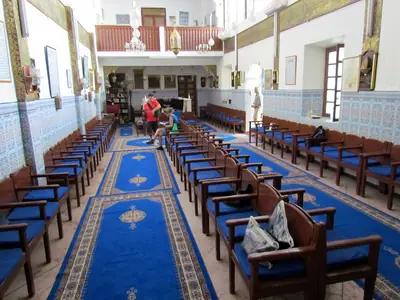
The synagogue is arranged around a large central patio. Inside, four columns divide the main space into two naves, while a yeshiva and charitable cafeteria are located above the main floor.
Majorelle Garden
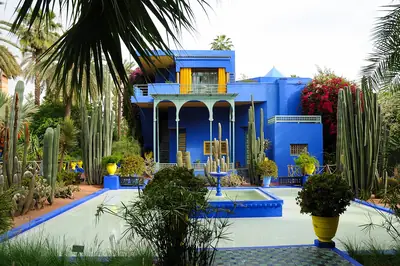
The Majorelle Garden offers a calm contrast to the busy streets of Marrakesh. Its vivid blue walls surround collections of cacti, desert plants, water lilies and palms, with paths leading around an Art Deco villa painted in the garden’s characteristic Majorelle blue.
French painter Jacques Majorelle developed the garden over several decades from the 1920s. In 1980, Yves Saint-Laurent and Pierre Bergé acquired the property and restored it while preserving its original layout and expanding its botanical diversity.
Plan a Marrakesh Self-Guided Walking Tour with Neywo
Neywo lets you explore Marrakesh independently with three walking tours, each built around a different part of the city:
- Souks, Saints and Saadian Secrets: 2.27 km, 96 minutes and 11 narrated stops.
- Palaces, Minarets and the Old Mellah: 4 km, 95 minutes and 7 narrated stops.
- Majorelle Blue and the Western Medina: 3.63 km, 85 minutes and 6 narrated stops.
The tours include landmarks such as Jemaa el-Fnaa, Dar Cherifa, Dar el Bacha, Ben Youssef Madrasa, Koutoubia Mosque, Bahia Palace, Slat Al Azama Synagogue and Majorelle Garden. Each story plays as you reach the place, at your own pace, with no group and no schedule. Narration is available in 11 languages.
Download Neywo to explore Marrakesh with a free audio guide that turns a walk through the medina, palaces and gardens into a self-guided experience. If you are continuing through Morocco, you can also discover cities such as Essaouira, Rabat and Fes.
Places with an audio guide in Marrakesh
8 places in Marrakesh with a Neywo audio guide. Each one starts telling its story as you reach it.
Self-guided tours in Marrakesh
3 tours in Marrakesh, free in the Neywo app. Each stop tells its story as you reach it.
- Walk
Souks, Saints and Saadian Secrets
Start in the roar of Jemaa el-Fnaa, then slip into the quiet lanes of the Mouassine quarter, where a mosque named for a cat, Saadian houses and a music museum hide behind plain doors. End at the madrasa and museums around Ben Youssef, the intellectual heart of the old medina.
Jemaa el-Fnaa · Al-Qita Mosque · Dar Cherifa · Mouassine Museum · Al-Shorafaa Mosque · Dar el Bacha …
Open this tour: Souks, Saints and Saadian Secrets - Walk
Palaces, Minarets and the Old Mellah
Begin beneath the Koutoubia minaret that inspired towers in Seville and Rabat, then walk south to the grand viziers' palaces of Bahia and Dar Si Said and the Jewish quarter's oldest synagogue. Finish with the Marinid minaret of Ibn Salah and the tanners' gate.
Koutoubia Mosque · Dar Si Said Museum · Tiskiwin Museum · Bahia Palace · Slat Al Azama Synagogue · Ibn Salah Mosque …
Open this tour: Palaces, Minarets and the Old Mellah - Walk
Majorelle Blue and the Western Medina
Wander the cobalt-blue Majorelle Garden with its Berber Museum and the Yves Saint Laurent Museum next door, then head through Guéliz past the only Catholic church in the region to the western gates of the medina and the Saadian mosque of Bab Doukkala.
Majorelle Garden · Musée Berbère · Musée Yves Saint Laurent · Church of the Saints Martyrs · Bab Nkob · Bab Doukkala Grand Mosque
Open this tour: Majorelle Blue and the Western Medina
Walk Marrakesh with Neywo
Neywo turns Marrakesh into a self-guided audio tour. Stories arrive as you reach the place they belong to, and the route reshapes when you wander off it.

