What to See in Casablanca, Morocco: Free Audio Guide
Things to Do in Casablanca: What to See in Morocco’s Atlantic City
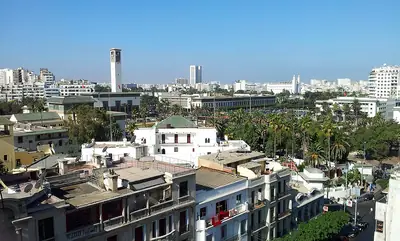
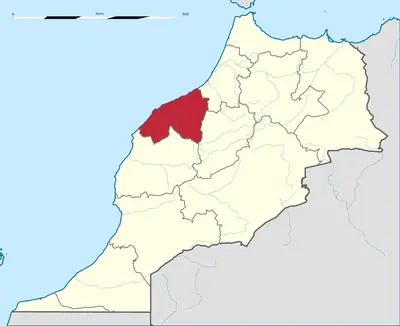
Looking for things to do in Casablanca? Morocco’s largest city combines Atlantic landmarks, religious architecture, museums, football history and modernist buildings shaped by its commercial importance. From the Hassan II Mosque to the city’s churches, squares and museums, Casablanca is best explored as a place of contrasts. Neywo has a free audio guide for Casablanca with 23 narrated places.
What to See in Casablanca
Hassan II Mosque
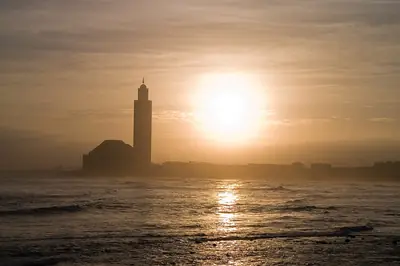
The Hassan II Mosque is Casablanca’s defining landmark, partly built over the Atlantic and partly on land. Commissioned by King Hassan II and designed by French architect Michel Pinseau, it officially opened on August 30, 1993.
Moroccan engineers, craftsmen and traditional artisans from across the country contributed to the building. Its design combines Moroccan and Andalusian elements with marble, zellige mosaics, carved wood and finely worked plaster. The minaret rises 210 metres, with a laser light at its summit directed towards Mecca.
The mosque’s scale is remarkable: its prayer hall can hold around 25,000 worshippers, while the surrounding outdoor spaces can accommodate about 80,000 more. A retractable roof adds another distinctive feature to the vast prayer space.
Museum of Moroccan Judaism
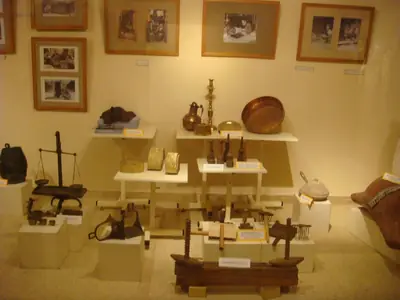
The Museum of Moroccan Judaism is dedicated to the history and living traditions of Morocco’s Jewish communities. Established in 1997, it is described as the first museum in the Arab world devoted to Jewish culture and the only museum of its kind there.
Its collections cover more than two thousand years of Jewish history and tradition in Morocco, with particular attention to Casablanca. Exhibits include Torah scrolls, mezuzot, menorot, synagogue benches, Hebrew-inscribed coins, books and plaques written in Moroccan Judeo-Arabic, Haketia and Judeo-Berber.
Wedding and festival clothing, photographs and videos of Jewish communities across Morocco add a personal dimension to the museum’s account of Jewish life and its contribution to Moroccan society.
United Nations Square
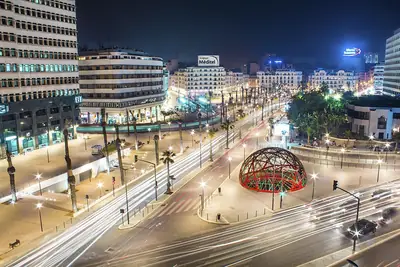
United Nations Square, also known as Place des Nations-Unies, is one of central Casablanca’s best-known public spaces. It has played a central role in the city’s history and provides a useful starting point for understanding Casablanca’s urban centre.
Mohammed V Square
Mohammed V Square is one of the places where Casablanca’s architectural legacy is particularly visible. The city’s French colonial period brought new roads, civic buildings, industrial areas and port facilities, helping establish Casablanca as Morocco’s commercial centre. Art Deco façades and monumental civic buildings around Mohammed V Square reflect that transformation.
Casablanca Cathedral
Just west of Arab League Park stands the Church of the Sacred Heart, commonly known as Casablanca Cathedral. Designed by French architect Paul Tournon from 1930, the building combines Gothic-inspired forms with Art Deco elements.
Despite its popular name, it was never technically a cathedral, as no bishop held a seat there. It was a Catholic church that stopped functioning as a place of worship after Morocco’s independence in 1956, when the colonial community left.
Notre-Dame-de-Lourdes Church
Notre-Dame-de-Lourdes Church is a modernist Catholic church built in 1954. Architect Achille Dangleterre and engineer Zimmer designed the building, which remains connected with the Roman Catholic Archdiocese of Rabat.
Its construction is part of Casablanca’s mid-twentieth-century religious and architectural history. The church is regarded as the city’s second church after the Church of the Sacred Heart.
Russian Orthodox Church in Casablanca
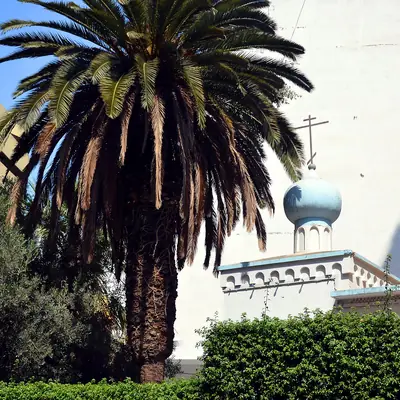
Also known as the Église orthodoxe russe de la Dormition, the Russian Orthodox Church is a distinctive religious building in Casablanca. Its presence adds another layer to the city’s varied architectural and cultural landscape.
Al-Quds Mosque
In Casablanca’s Roches Noires neighborhood, Al-Quds Mosque illustrates how the city’s religious buildings have changed over time. The building was originally constructed as a Neo-Gothic church known as Église de Sainte Marguerite, or Saint Margaret’s Church.
After Morocco’s independence, it was converted into a mosque and became Al-Quds Mosque.
Sunnah Mosque
At the junction of Boulevard 2 Mars and Boulevard Modibo Keïta, Sunnah Mosque—also known as Assunna Mosque—makes a strong modernist statement. Completed in 1966, it uses raw exposed concrete and combines modernist design with brutalist architectural elements.
Abderrahman Slaoui Museum
The Abderrahman Slaoui Museum, or Musée de la Fondation Abderrahman Slaoui, is built around the collection of Moroccan businessman and art collector Abderrahman Slaoui, who died in 2001. Created by the Abderrahman Slaoui Foundation, the museum opened in May 2012.
Its displays include Moroccan gold jewelry, old posters, figurative paintings by Muhammad Ben Ali Rabati, landscapes by Jacques Majorelle and crystal objects. Changing exhibitions and artistic workshops make the museum more than a static collection.
Mohammed V Stadium
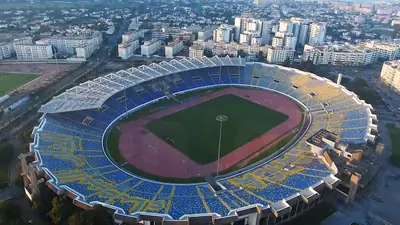
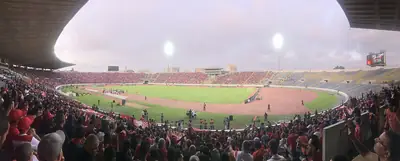
Mohammed V Stadium, known locally as Donor, is one of Casablanca’s most important football venues. Located in the western part of the Maârif neighborhood, it is associated with Morocco’s national team and the city’s two major rival clubs, Wydad AC and Raja CA.
The stadium opened on March 6, 1955, as Stade Marcel Cerdan, named after the Franco-Moroccan world champion boxer. A year later it became Stade d’Honneur, or Stadium of Honor, before adopting its current name for the 1983 Mediterranean Games held in Casablanca.
It forms part of the Mohammed V sports complex, which also includes an indoor arena, a covered Olympic swimming pool, a hotel, media and conference facilities, a care centre and an anti-doping centre. The venue also hosted the final of the 1988 Africa Cup of Nations, when Cameroon defeated Nigeria one goal to nil.
Ain-Diab Circuit
Casablanca’s Ain-Diab area once hosted international motor racing on a temporary road course. Built in 1957, the Ain-Diab Circuit measured about 7.6 kilometres and used the coastal road and the main road linking Casablanca and Azemmour, passing through the Sidi Abderrahman forest.
The circuit hosted a non-championship Formula One race in 1957. On October 19, 1958, it held the Moroccan Grand Prix, the final round of that season’s Formula One championship. The race ended tragically when Stuart Lewis-Evans crashed after the engine of his Vanwall seized; he died in hospital in England eight days later.
Explore Casablanca with a Self-Guided Walking Tour
A Casablanca self-guided walking tour is a practical way to connect the city’s religious landmarks, museums and historic squares without following a group. Neywo’s app tells the story of each place as you reach it, at your own pace, with no group and no schedule.
The Casablanca audio guide includes two walking tours:
- Three Faiths and a Pigeon Square: Casablanca’s Heart: 5.13 km, 115 minutes and 7 narrated stops.
- Squares, a Modernist Church and a Russian Dome: 2.65 km, 58 minutes and 4 narrated stops.
Together, the tours cover 11 narrated stops, while the complete free audio guide for Casablanca includes 23 narrated places. Narration is available in 11 languages.
Download Neywo and Explore Casablanca at Your Own Pace
Download Neywo to explore Casablanca with two walking tours and 23 narrated places. The app plays each story as you reach the location, so you can walk at your own pace, without a group or a schedule.
Continue planning your trip through Morocco, or compare Casablanca with Rabat, Essaouira or El Jadida.
Places with an audio guide in Casablanca
8 places in Casablanca with a Neywo audio guide. Each one starts telling its story as you reach it.
Self-guided tours in Casablanca
2 tours in Casablanca, free in the Neywo app. Each stop tells its story as you reach it.
- Walk
Three Faiths and a Pigeon Square: Casablanca's Heart
Begin at the Atlantic's great mosque, then slip into the medina where a mosque, a synagogue and a church sit within a few steps of each other. Pass the stained glass of Temple Beth-El, a collector's museum and French-protectorate squares.
Hassan II Mosque · Ettedgui Synagogue · Ould Al Hamra Mosque · Cinéma Vox · Temple Beth-El · Musée de la Fondation Abderrahman slaoui …
Open this tour: Three Faiths and a Pigeon Square: Casablanca's Heart - Walk
Squares, a Modernist Church and a Russian Dome
Leave the old centre for the protectorate-era squares and the churches of the Casablanca that Europeans built. Start where the great Cinéma Vox once stood, cross the pigeon-filled Muhammad V Square, then walk south to the modernist Notre-Dame de Lourdes and the Russian Orthodox church of the Dormition.
United Nations Square · Muhammad V Square · Notre-Dame-de-Lourdes Church · Russian Orthodox Church in Casablanca
Open this tour: Squares, a Modernist Church and a Russian Dome
Walk Casablanca with Neywo
Neywo turns Casablanca into a self-guided audio tour. Stories arrive as you reach the place they belong to, and the route reshapes when you wander off it.