Things to Do in Fes, Morocco: Walking Guide
Things to do in Fes: what to see in Morocco’s historic city
The best things to do in Fes are concentrated around its historic medina, where ornate religious buildings, former merchants’ inns, palaces, craft quarters and city gates reveal the depth of Morocco’s cultural heritage. From the decorated courtyards of its madrasas to the views from its hilltop forts, Fes is a city to explore on foot and at your own pace. Neywo offers a free audio guide for Fes with 39 narrated places in 11 languages.
Fes is one of the essential stops on a trip through Morocco, especially if you want to experience a city whose religious, educational and architectural history remains visible in its streets.
What to see in Fes
Fes el-Bali and Bab Boujloud
Fes el-Bali is the historic medina and one of the city’s defining experiences. Its network of narrow lanes leads through markets, workshops, religious buildings and traditional homes, creating a dense pedestrian district where everyday life unfolds among centuries-old architecture.
Bab Boujloud, also written Bab Bou Jeloud or Bab Boujeloud, is one of the principal entrances to the medina. Its present structure was built in 1913 by the French colonial administration, while the gate’s origins likely reach back to the twelfth century. Its decorated façade makes it one of the most recognizable sights in Fes.
Bou Inania Madrasa
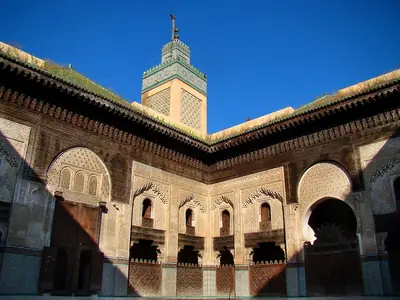
The Bou Inania Madrasa combines a place of learning with a congregational mosque. Built between 1350 and 1355 on the orders of the Marinid sultan Abu Inan Faris, it is arranged around a courtyard with arcaded galleries and student rooms above.
Its decoration brings together carved stucco, colorful zellij tiles and intricate woodwork. Two classroom chambers open from the courtyard towards the prayer hall. The madrasa is part of Fes’s UNESCO World Heritage site and is regarded as one of Morocco’s foremost religious institutions. A water clock once stood across the street, although its original mechanism remains unexplained.
Funduq al-Najjariyyin and Seqqaïa Nejarine
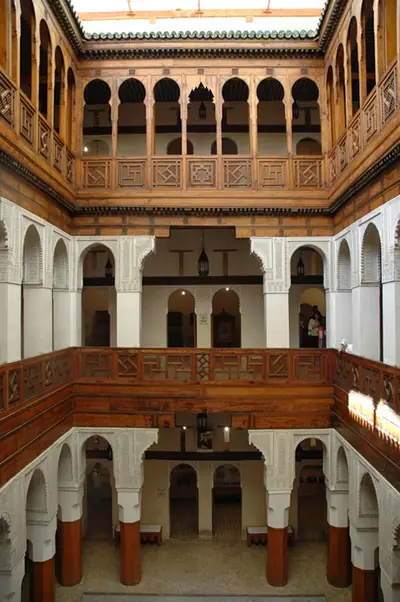
On Nejjarine Square, the Funduq al-Najjariyyin recalls the commercial life of the old medina. This three-story traditional inn once provided accommodation, storage and rest for merchants arriving from inland regions. Built in the eighteenth century for fodder traders and luxury-goods merchants, it is now home to the Nejjarine Museum of Wooden Arts & Crafts.
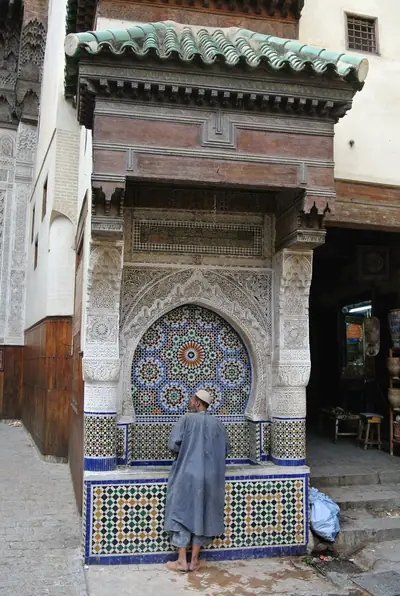
The building was declared a national monument in 1916 and later included within the UNESCO World Heritage site of Fez. Its wooden galleries offer a closer look at the craftsmanship used in Moroccan daily life. Beside it, Seqqaïa Nejarine is a traditional public fountain and a Moroccan cultural heritage site. Together, the funduq and fountain form one of the medina’s most striking ensembles.
University of al-Qarawiyyin
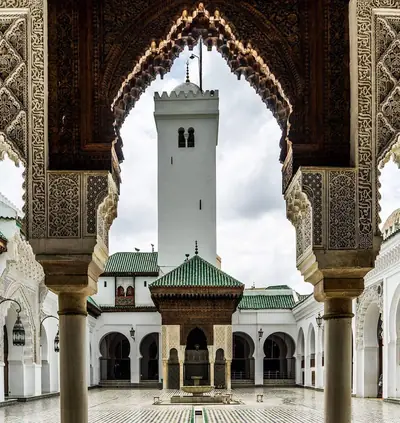
The University of al-Qarawiyyin began as a mosque founded by Fatima al-Fihri in 859 CE. UNESCO and Guinness World Records recognize it as the oldest continually operating university in the world. Teaching began after the mosque was completed, and its history is associated with the development of academic chairs and degrees.
Today, its curriculum focuses on Islamic religious and legal sciences, Classical Arabic grammar and Maliki Sharia, with courses also offered in French and English. The mosque complex displays layers of Moroccan and Islamic architecture from different periods. Women were admitted to the university in the 1940s, and in 1963 it became part of Morocco’s modern state university system.
Al-Attarine Madrasa
Near the Al-Qarawiyyin Mosque and the historic Souk al-Attarine, the Al-Attarine Madrasa offers a compact but richly decorated example of Marinid architecture. Sultan Uthman II Abu Said commissioned it between 1323 and 1325 as a place of learning and worship.
The central courtyard contains a delicate water basin, while cedar wood, stone, zellij tilework and carved plaster cover the surrounding surfaces. The complex also includes a prayer hall, an ablution facility and modest rooms that once housed students and teachers. Its decoration shows how much detail could be achieved within a relatively small space.
Andalusian Mosque
The Andalusian Mosque stands in the part of Fes el-Bali historically associated with immigrants from Andalusia. Founded in 859–860 by Maryam al-Fihriya, it is one of the few surviving Idrisid-era monuments in the city.
Its minaret was added in 956, while the main building was largely rebuilt between 1203 and 1207 under Almohad rule. The Marinids later added a courtyard fountain and a library, and Moulay Ismail ordered another renovation under the Alaouite dynasty. The mosque’s original tenth-century minbar is now displayed at the Dar Batha Museum in Fes.
El Glaoui Palace and Dar Moqri
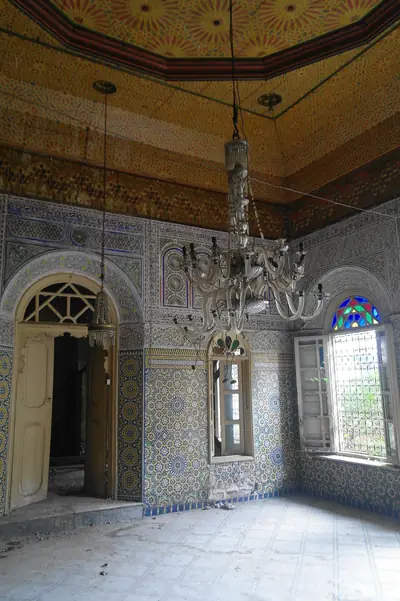
The winding lanes of Fes el-Bali also lead to palaces that reflect the city’s aristocratic history. El Glaoui Palace, or Dar Glaoui, is a late nineteenth- and early twentieth-century residence associated with the influential Glaoui family. Its best-known members included Grand Vizier Madani and his brother Thami, Pasha of Marrakesh.
Dar Moqri consists of two grand mansions built side by side by different branches of the Moqri family during the late nineteenth and early twentieth centuries. The older palace includes a spacious terraced garden, while the younger one is known for its long courtyard, where Italianate details meet traditional Moroccan motifs. Although constructed independently, the two buildings share a wall and form a distinctive architectural ensemble.
Riad Ba Mohamed Chergui
Dar Ba Mohammed Chergui, also known as Dar al-Aman, is a historic riad in the heart of the old medina. Recognized as a Moroccan cultural heritage site, it follows the Andalusian Moroccan riad style and reflects the architecture of Fes’s historic homes.
The building was originally designed as a guesthouse, offering travelers a form of Moroccan hospitality shaped by the city’s traditional domestic architecture.
Bab Sidi Boujida
Bab Sidi Boujida is one of the historic gates that once guarded Fes. It has carried several names over time, including Bab Abi Sufyan and Bab Bani Masafir, before adopting its current name. The gate is recognized as a Moroccan cultural heritage site and offers another perspective on the city’s historic entrances beyond Bab Boujloud.
Borj Nord and the Museum of Arms
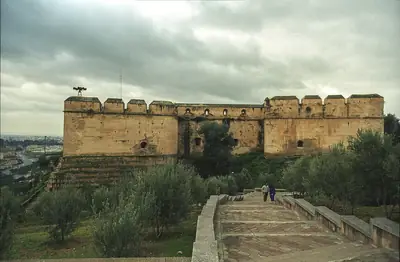
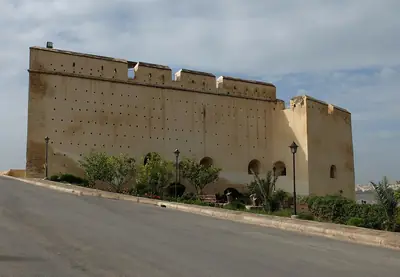
On the northern outskirts of Fes, Borj Nord overlooks the city from a powerful sixteenth-century fortification. Sultan Ahmed al-Mansur of the Saadi dynasty ordered its construction in 1582, and its design was modeled on Portuguese forts of the period.
The fort now houses the Museum of Arms. Its collection includes around five thousand pieces, from stone weapons, swords and spears to iron shields, French and Portuguese rifles and heavy cannons. Among the notable pieces are the Saadi cannon al-Maynuna, a Swedish cannon gifted by King Gustav II and the Moroccan Naft cannon dating from 1571.
Southern Tower
Borj Sud, or the Southern Tower, was also established around 1582 by the Saadian dynasty. It stands on the southern hills opposite Borj Nord, overlooking Fes el-Bali from across the valley.
The tower is a lookout point with views over the old city. A prayer place beside it is used by the local community for Eid al-Fitr and Eid al-Adha prayers. Together, Borj Sud and Borj Nord show how the Saadian rulers positioned forts on the hills around Fes.
Other historic gates and heritage sites
Bab Sidi Boujida is not the only gate worth seeking out. The old city’s historic entrances and surrounding quarters reveal how Fes developed as a fortified urban center. The city’s heritage also includes Seqqaïa Nejarine, the Andalusian Mosque and the palaces and riads scattered throughout Fes el-Bali.
For travellers comparing destinations in the region, Meknes offers another important Moroccan historic city, while Rabat presents the country’s capital from a different perspective.
Explore Fes with a self-guided walking tour
Neywo turns Fes into a self-guided walking experience through four walking tours, with a total of 39 narrated places. The routes are:
- Gates, Clocks and Palaces of Old Fes: 2.09 km, 90 minutes and 12 stops.
- The Oldest University and the Craftsmen’s Quarter: 1.27 km, 73 minutes and 11 stops.
- Andalusian Fes and the Southern Hills: 3.52 km, 90 minutes and 8 stops.
- Saadian Forts and Marinid Tombs: 2.58 km, 80 minutes and 8 stops.
With the Neywo app, each story plays as you reach the place it describes. You can explore at your own pace, without a group and without a schedule, while listening to the history of Fes’s gates, palaces, madrasas, mosques and forts.
Download Neywo for free and discover Fes through its four walking routes. You can also continue exploring Morocco with Marrakesh, Essaouira or Chefchaouen.
Places with an audio guide in Fes
8 places in Fes with a Neywo audio guide. Each one starts telling its story as you reach it.
Self-guided tours in Fes
4 tours in Fes, free in the Neywo app. Each stop tells its story as you reach it.
- Walk
Gates, Clocks and Palaces of Old Fes
Enter Fes el-Bali through its monumental western gates, then follow Tala'a Kebira and Tala'a Seghira, the two main streets of the medina. On the way you pass the palace-turned-museum of Dar Batha, the Bou Inania madrasa with its famous water clock opposite, and the Mnebhi palace where the Treaty of Fes was signed in 1912.
Place Bou Jeloud · Bab Mahrouk · Bab Chorfa · Bou Jeloud Mosque · Dar Batha · Bou Inania Madrasa …
Open this tour: Gates, Clocks and Palaces of Old Fes - Walk
The Oldest University and the Craftsmen's Quarter
Walk into the heart of the medina around al-Qarawiyyin, the world's oldest continually operating university, founded in 859 by Fatima al-Fihri. Pass the carved wooden funduq, the shrine of Moulay Idris II, the school of the rope makers and the copper workshops of Place Seffarine.
Funduq al-Najjariyyin · Seqqaïa Nejarine · Zawiya of Moulay Idris II · Cherratine Madrasa · Al-Attarine Madrasa · Al-Diwan Mosque …
Open this tour: The Oldest University and the Craftsmen's Quarter - Walk
Andalusian Fes and the Southern Hills
Cross to the eastern, Andalusian side of the medina where the river Oued Fes once ran under mosques. Visit two merchant palaces, the mosque founded by Fatima al-Fihri's sister, the site of the oldest mosque of Fes and the great gate of Bab Ftouh and the Marinid mosque of Lalla Ghariba, then climb to the Saadian Southern Tower for views over the whole city.
El Glaoui Palace · Dar Moqri · Al-Wad School Mosque · Andalusian Mosque · Al Anwar Hanging Mosque · Bab Ftouh …
Open this tour: Andalusian Fes and the Southern Hills - Walk
Saadian Forts and Marinid Tombs
Climb the northern hills for the best viewpoint over Fes: Borj Nord, the Saadian fort that now holds a museum of five thousand weapons, and the ruined Marinid royal tombs. Then walk down through Bab Guissa to Palais Jamai near the old city walls, and cut back through the quiet mosques and the Mnebhi palace of the northern medina.
Borj Nord · Marinid Tombs · Bab Guissa · Bab Al-Kissa Mosque · El-Jamai Palace · Ain Al Khail Mosque …
Open this tour: Saadian Forts and Marinid Tombs
Walk Fes with Neywo
Neywo turns Fes into a self-guided audio tour. Stories arrive as you reach the place they belong to, and the route reshapes when you wander off it.

