What to See in Ciutadella de Menorca, Spain: Free Audio Guide
Things to do in Ciutadella de Menorca
The best things to do in Ciutadella de Menorca include exploring its Gothic cathedral, historic bastions, museums, harbour fortifications and prehistoric monuments. The former capital of Menorca combines a compact old town with a coastline shaped by lighthouses, quarries and centuries of island history. Neywo offers a free audio guide for Ciutadella de Menorca with 14 narrated places, available in 11 languages.
Ciutadella stands on Menorca’s western coast and remains the capital of its municipality. Its historic centre is built around the Cathedral Square, while the port opens towards the sea below. For a wider itinerary around the islands, you can also explore the Balearic Islands or compare Ciutadella with Mahón, Menorca’s other major city.
What to see in Ciutadella de Menorca
Cathedral of Minorca
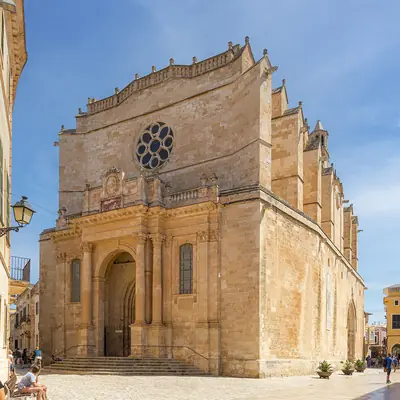
The Cathedral of Minorca, or Santa Maria de Ciutadella, is one of the city’s most important Gothic landmarks. It stands in the old town at Cathedral Square and is an example of Catalan Gothic architecture. Construction began during the thirteenth and fourteenth centuries, after the conquest of Menorca in 1287, following orders from Alfonso the Third of Aragon.
The church became a cathedral in 1795, and Pope Pius the Twelfth granted it the title of minor basilica in 1953. It also serves as the seat of the Diocese of Menorca. Behind the cathedral, Carrer de ses Voltes begins, leading into one of the characteristic streets of the old centre.
Museu Diocesà de Menorca
The Museu Diocesà de Menorca occupies the former Augustinian monastery in Ciutadella. Its collections cover Menorca’s prehistoric past, religious art and the island’s history through objects, maps and works of art.
The seventeenth-century monastery was built in the Baroque style, and its cloister has semicircular arches supported by sturdy columns. The museum route also includes Els Socors, a Renaissance church decorated with eighteenth-century wall paintings. Exhibits include prehistoric finds, models of the city, maps, liturgical objects and religious goldsmith’s work from the seventeenth to the twentieth century.
Museu Municipal de Ciutadella
The Museu Municipal offers an introduction to the history of Ciutadella and Menorca through archaeology, local history and ethnology. Since November 2018, it has been based at Can Saura Miret. Before that, it occupied the Bastió de sa Font from 1995 until October 2018.
The museum is owned and managed by the municipality and depends on Ciutadella Town Council. Its collections connect archaeological discoveries with the development of the town and the material evidence of local life.
Teatre des Born
The Teatre des Born is a historic theatre in the centre of Ciutadella. It was built between 1873 and 1875 and opened on 10 November 1875. In 1881, the Cercle Artístic de Ciutadella acquired the theatre and built its headquarters beside it.
After several renovations, the theatre has seating for 454 spectators. Its history reflects the cultural life that developed around the city’s central squares and historic buildings during the nineteenth century.
Obelisk of Ciutadella
In the centre of Plaça des Born stands the Obelisk of Ciutadella, known locally as “sa piràmide”, or “the pyramid”. This 22-metre neoclassical monument commemorates the three-hundredth anniversary of the Year of the Disaster.
The monument recalls the invasion of Ciutadella on 9 July 1558 by troops led by Mustafá Piali. Designed following a project by the historian Rafael Oleo y Quadrado and built by Josep Mas i Llufriu, it remains one of the most recognizable features of the old town.
Bastió de sa Font
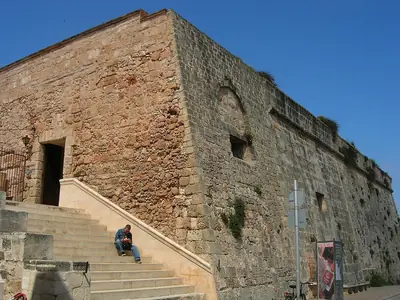
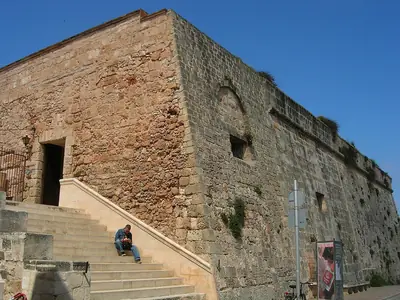
The Bastió de sa Font is an old defensive bastion and a listed cultural property. When it lost its military function in 1869, it was given new roles: first as a water reservoir and later as a gas factory.
The bastion underwent extensive restoration between 1995 and 2018 and served as the home of the Municipal Museum for 23 years. It is now used as storage space and as a place for researchers.
Sant Nicolau Castle
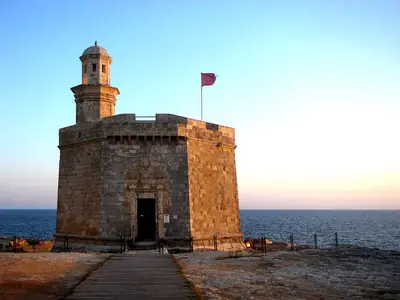
At the mouth of Ciutadella’s port, Sant Nicolau Castle guards the entrance to the harbour. Built between 1680 and 1682 to a design by the military engineer Josep Castellón, it served as a defensive and surveillance structure.
The compact tower has an unusual octagonal plan, a surrounding moat, ornamental details around the entrance and a small turret at the top. Its shape distinguishes it from many other Menorcan watchtowers, which were circular and built later. The tower was restored in 1960 and again in 1990, when its missing crowning turret was reconstructed.
Torre d’en Quart
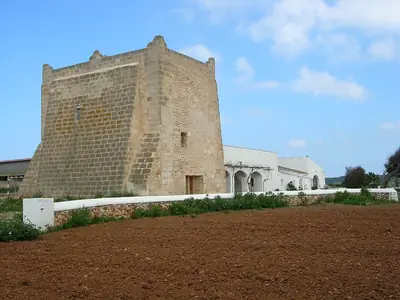
Torre d’en Quart is a cultural property in Ciutadella. It forms part of the city’s collection of historic defensive structures and offers another reminder of the importance of fortifications in Menorca’s past.
Naveta d’Es Tudons
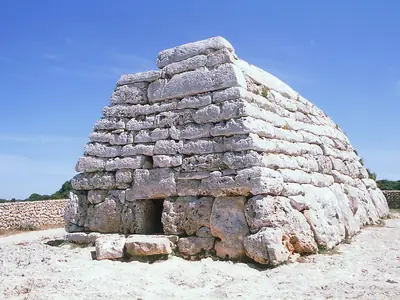
The Naveta d’Es Tudons is one of Menorca’s best-preserved prehistoric constructions. Its distinctive form resembles an upturned ship, and it served as a collective tomb during several stages of the Bronze and Iron Ages.
Excavations in the 1950s uncovered the remains of at least 100 people, together with bronze bracelets, bone buttons and pottery. The monument was restored in 1959. Built using the cyclopean technique, it measures about 13.5 metres long and 6.4 metres wide. Its two internal chambers are arranged one above the other and covered with flat stone slabs.
Grave of Son Olivaret
The Grave of Son Olivaret, or Sepulcre de Son Olivaret, is a protected archaeological site in the southwest of the municipality, within the military battery of the same name.
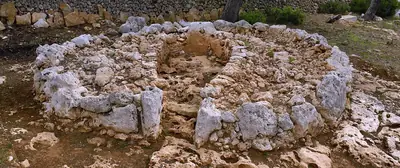
It is a collective funerary construction of the protonaveta type, also described as a tomb with triple walls. Its form lies between a dolmen and a naveta, making it one of the best-preserved examples of this megalithic structure on Menorca. Excavations revealed human remains, pottery and bone objects.
s’Hostal quarries
The s’Hostal quarries, also known as Lithica or Pedreres de s’Hostal, combine a stone landscape with a garden. The site contains two contrasting quarrying environments: large, geometric spaces created by mechanical extraction and older hand-worked quarries shaped into a maze of stone and vegetation.
Both areas supplied marès, the traditional stone used in Menorcan construction. Quarrying ended in 1994, and Líthica has since given the excavated spaces a new life while preserving their character as both labyrinth and garden. The vertical walls, enclosed spaces and vegetation create one of the most unusual landscapes near Ciutadella.
Punta Nati Lighthouse
About five kilometres north of Ciutadella, Punta Nati Lighthouse stands on the island’s northwestern cape. It was built after repeated maritime accidents along the coast, particularly following the sinking of the French passenger ship Général Chanzy on 9 February 1910.
Construction began on 5 July 1912, and the light began operating on 1 September 1913. The tower rises 19 metres, with residential buildings arranged in a U shape around it. Its signal consists of three white flashes followed by a fourth every 20 seconds, and its light can be seen across 16 nautical miles.
Ciutadella Lighthouse
The Ciutadella Lighthouse stands at Punta de Sa Farola, on the northwestern tip of Menorca at the entrance to the harbour. Known locally as Far de Ciutadella, it marks the approach to the port and provides a maritime counterpart to Sant Nicolau Castle on the opposite side of the harbour entrance.
Cap d’Artrutx Lighthouse
At the southwestern tip of Menorca, Cap d’Artrutx Lighthouse, also called Far d’Artrutx or Faro de Artrutx, marks the cape that gives it its name. It is one of the coastal viewpoints connected with Ciutadella’s maritime setting.
Explore Ciutadella with a free audio guide
A Ciutadella de Menorca self-guided walking tour is an easy way to connect the city’s monuments without joining a group. Neywo’s walk, “Ciutadella: From the Old Bastion to the Harbour Tower”, covers 2.97 km in 82 minutes and includes 8 narrated stops: Bastió de sa Font, Museu Municipal, Teatre des Born, Obelisk of Ciutadella, Cathedral of Minorca, Museu Diocesà de Menorca, Sant Nicolau Castle and Ciutadella Lighthouse.
Download Neywo and explore Ciutadella at your own pace. The app tells the story of each place as you reach it, with no group and no schedule. It is a free Ciutadella de Menorca audio guide for discovering the city while you walk. When planning a wider trip through Spain, you can also use Neywo to explore other destinations such as Ibiza or Palma de Mallorca.
Places with an audio guide in Ciutadella de Menorca
8 places in Ciutadella de Menorca with a Neywo audio guide. Each one starts telling its story as you reach it.
Self-guided tours in Ciutadella de Menorca
1 tour in Ciutadella de Menorca, free in the Neywo app. Each stop tells its story as you reach it.
- Walk
Ciutadella: From the Old Bastion to the Harbour Tower
Start on the bastion that went from fortress to gas factory to museum, then cross the old town through Plaça des Born, with its obelisk and nineteenth-century theatre, to the Gothic cathedral and the Baroque monastery museum. Finish down at the harbour mouth, where an octagonal watchtower and the lighthouse guard the port.
Bastió de sa Font · Museu Municipal · Teatre des Born · Obelisk of Ciutadella · Cathedral of Minorca · Museu Diocesà de Menorca …
Open this tour: Ciutadella: From the Old Bastion to the Harbour Tower
Walk Ciutadella de Menorca with Neywo
Neywo turns Ciutadella de Menorca into a self-guided audio tour. Stories arrive as you reach the place they belong to, and the route reshapes when you wander off it.

