Palma de Mallorca, Spain: Self-Guided Walking Tour
Things to do in Palma de Mallorca: the essential sights and stories
The best things to do in Palma de Mallorca are concentrated around a historic center shaped by Roman, Muslim, medieval, Gothic, and modernist influences. From the seafront cathedral and royal palace to circular Bellver Castle, old convents, churches, and harbor defenses, Palma rewards slow exploration. Neywo offers a free audio guide for Palma de Mallorca with 91 narrated places.
What to see in Palma de Mallorca
Palma Cathedral
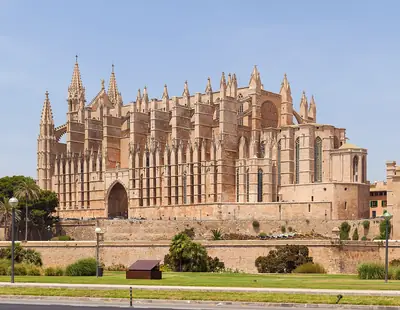
Known locally as La Seu, Palma Cathedral is the city’s defining landmark, standing beside the Mediterranean between the Royal Palace of La Almudaina and the Episcopal Palace. Construction began in 1229, after James I of Aragon conquered Mallorca, and the cathedral was consecrated in 1346 by his grandson, James III. Work and restorations continued for centuries.
The building is a striking example of Catalan, or Levantine, Gothic architecture. Its main nave rises about 44 metres, while the cathedral measures roughly 120 metres long and 40 metres wide. The façade’s rose window is one of its most recognisable features. The cathedral also occupies the site of a mosque from the period of Muslim rule, adding another layer to its long history.
Royal Palace of La Almudaina
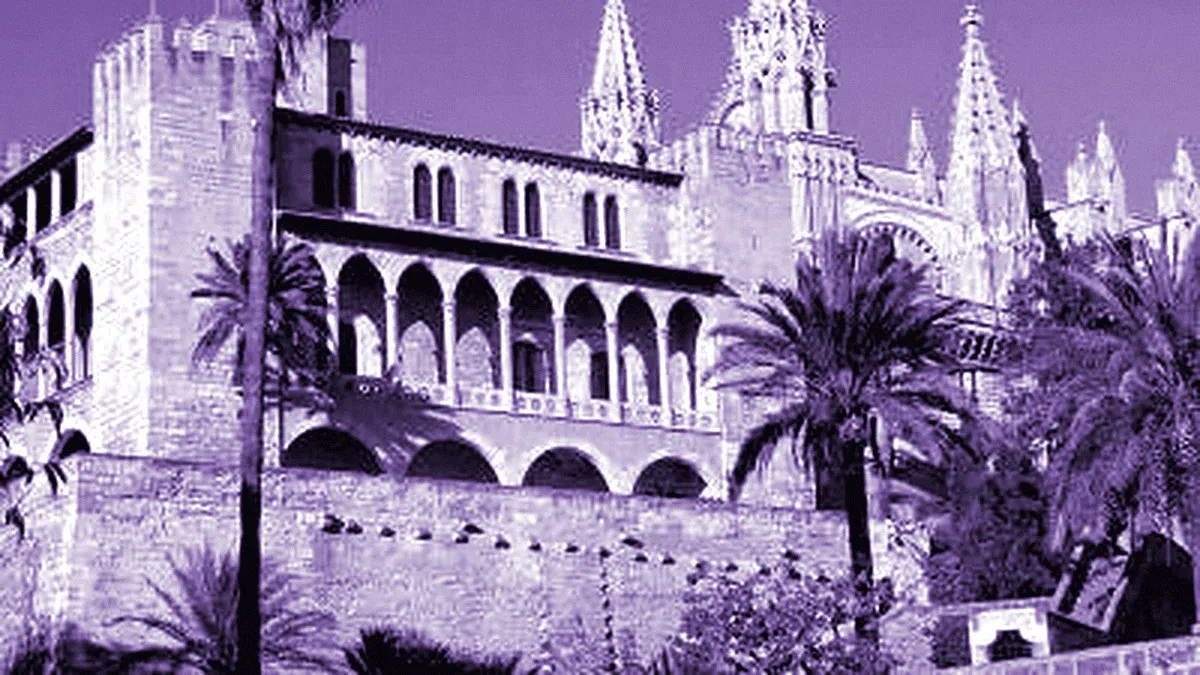
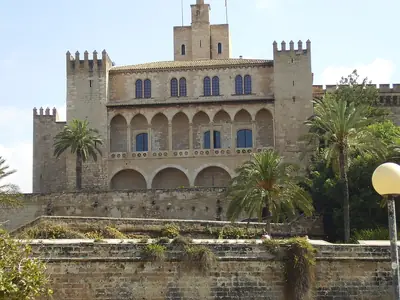
Opposite the cathedral, the Royal Palace of La Almudaina reveals the transition from Muslim fortress to medieval royal residence. The present palace began taking shape in 1281 under King Jaume II, with work continuing through the reigns of Sancho I and Jaume III until 1343.
The site incorporates still older foundations, including Roman remains, and reflects the island’s history before and after the Christian conquest. It served as the seat of the Mallorcan kingdom for a century before passing to the Crown of Aragon in 1349. Today, it is one of the official residences of the Spanish royal family and is cared for by Patrimonio Nacional.
Church de Santa Eulàlia
Church de Santa Eulàlia stands on its own square in Palma’s historic centre. Built shortly after the Catalan conquest of 1229 on the site of a former Muslim mosque, it was documented in 1236 as one of Mallorca’s four original parishes.
The Gothic church hosted important ceremonies in the 13th century, including the 1256 privilege oath and voting-rights treaty for the Kingdom of Mallorca, as well as the coronation of James II in 1276. Its Santa Lucia chapel was completed in 1414, while the roof was not finished until 1570.
El Temple
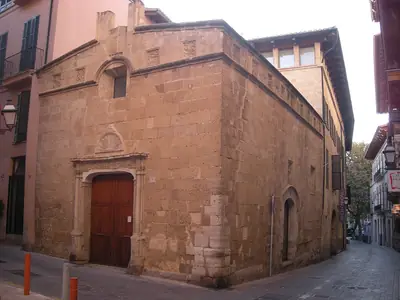
El Temple, also known as Castell del Temple, preserves traces of an Islamic fortification that once guarded Palma’s eastern approach. The surviving elements include a late Romanesque chapel, sections of the original wall, and the gate towers known as Torres del Temple.
The complex dates from the 12th century, after the Pisa-Catalan crusade of 1114. Following James I’s conquest of Mallorca in 1229, the site was given to the Knights Templar, who converted the mosque into a chapel. After the order was dissolved in 1311, the Knights Hospitaller took over. The site later served as a prison, housed the Inquisition, became a military barracks, and was gradually dismantled in the 19th century.
Església de Santa Creu
Església de Santa Creu is one of Palma’s oldest parish churches and the city’s second most important parish after Santa Eulàlia. Built in the Catalan Gothic style, it has a rib-vaulted nave and a ribbed vault over the presbytery.
The church dates from the 14th century and contains the crypt of Sant Llorenç beneath the presbytery. The crypt was once part of the old parish museum.
Gran Hotel
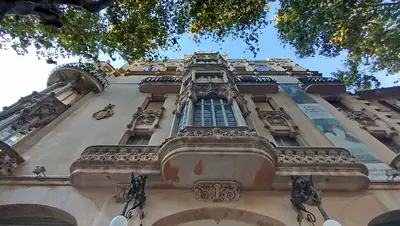
On Plaza Weyler, the Gran Hotel provides a change of architectural mood. Designed by Lluís Domènech i Montaner, it opened on 9 February 1903 as Palma’s most luxurious hotel and was regarded as the finest in Spain until the Madrid Ritz opened.
Its modernist façade combines sculpture and ceramics. The building also featured its own electricity generators, hot water, heating, and an elevator—remarkable conveniences for the period. After closing in 1941, it was taken over by the state and substantially altered. Today, it houses the CaixaForum cultural centre.
Bellver Castle
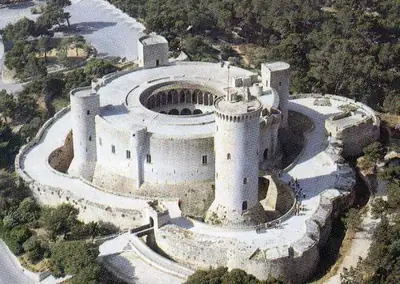
A short distance southwest of the centre, Bellver Castle stands on a hill overlooking Palma, its harbour, and the Tramuntana mountains. Built in the early 14th century under King James II of Mallorca, it is notable for its perfectly circular plan, an unusual feature among European castles. Its name comes from the medieval Catalan bell veer, meaning “beautiful view.”
The castle began as a royal residence and later became a military prison, a role it retained from the 18th century through the mid-20th century. Its architecture combines Romanesque arcades on the lower level with a Gothic colonnade above. Three towers rise from the circular structure, while a separate Torre de l’Homenatge is connected by a small bridge. The castle now houses Palma’s History Museum.
Convents and quieter historic corners
Palma’s historic centre also rewards visitors who look beyond its major monuments. The Convent de les Caputxines, founded in 1662, remains an active religious community and occupies a quiet site in the Sant Jaume parish.
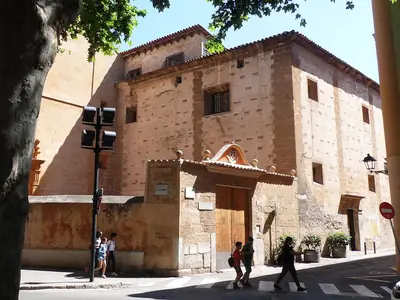
The Convent de Santa Teresa was founded by Leonor Ortiz in 1613. Its church, completed in 1648, has a Latin-cross plan, a barrel-vaulted nave, and a dome divided into eight segments. A cloister and chapter house offer a glimpse of the complex’s contemplative daily life.
Further streets reveal the Oratori de Sant Feliu, Sant Antoni de Viana, and Sant Jeroni. Sant Antoni de Viana dates from 1230, when it belonged to the Antonians, an order that cared for the sick and needy. Sant Jeroni began as a 15th-century convent for Jeronymite nuns and remains one of Palma’s best-preserved conventual sites.
Torre de Paraires and the harbor defenses
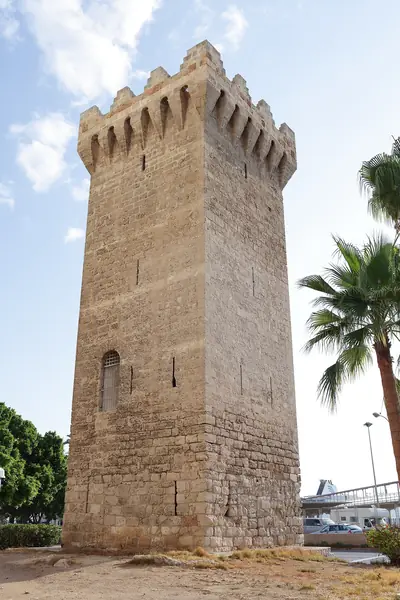
Torre de Paraires once helped defend the entrance to Palma’s old harbour alongside Torre de Portopí. A heavy chain could be used to close the harbour mouth between the two towers. The tower is first mentioned in 14th-century documents and became a quarantine station around 1470, a function reflected in its name.
Its square structure contains arrow slits on several levels, with a stairway built into the wall leading to the upper floors. After Fortaleza de Sant Carles was built in the 17th century, Torre de Paraires gradually lost its military importance. It was declared a historic-artistic monument in 1876.
Exploring Palma with a self-guided audio tour
A Palma de Mallorca self-guided walking tour is a practical way to connect the city’s landmarks without following a group. Neywo’s six walks cover the cathedral and the Kings of Mallorca, merchant mansions and Modernista Palma, bastions and contemporary art, convents and cloisters, the Calatrava district and the Templars, and Bellver Castle and the Portopí coast.
The routes range from 1.15 to 4.52 kilometres and from 59 to 116 minutes. There is also one bus route and one bike route, so you can combine historic streets with Palma’s waterfront and harbour.
Download Neywo and explore Palma at your own pace
Neywo includes six walking tours, one bus route, and one bike route in Palma de Mallorca. The walks range from 1.15 to 4.52 km and take 59 to 116 minutes, with between 6 and 12 narrated stops each. The 5.6 km bus route takes 24 minutes and has 6 stops, while the 4.1 km bike route takes 20 minutes and has 3 stops.
The app tells the story of each place as you reach it, at your own pace, with no group and no schedule. Download Neywo and explore Palma independently, from La Seu and La Almudaina to Bellver Castle, the old convents, and the waterfront. You can also continue discovering the Balearic Islands, or compare Palma with Mahón, Ibiza, and Ciutadella de Menorca.
Places with an audio guide in Palma de Mallorca
8 places in Palma de Mallorca with a Neywo audio guide. Each one starts telling its story as you reach it.
Self-guided tours in Palma de Mallorca
8 tours in Palma de Mallorca, free in the Neywo app. Each stop tells its story as you reach it.
- Bike ride
Passeig Marítim by Bike: Bay Cycle Path to the Old Walls
Pedal the flat seafront cycle lanes of Palma's bay from Es Molinar to the old town. Finish at the Consolat de Mar and the Es Baluard bastion, with the cathedral rising over the harbour.
Teatre del Mar · Consolat de Mar de Palma · Es Baluard
Open this tour: Passeig Marítim by Bike: Bay Cycle Path to the Old Walls - Bus ride
EMT Line 35: From the Cathedral to the Aquarium Shore
Palma's municipal bus 35 leaves Plaça de la Reina beside the Cathedral, passes the Calder mobile, old-town mansions and the Gran Hotel, then follows the seafront to the Aquàrium. Ride it to see the old town and the beach neighbourhoods in one go.
Monument a la dona · Can Solleric · Gran Hotel · Convent de Santa Teresa · Rei en Jaume I · Teatre del Mar
Open this tour: EMT Line 35: From the Cathedral to the Aquarium Shore - Walk
La Seu and the Kings of Mallorca
Start with a Calder mobile swaying in the royal gardens, then visit the palace of the Mallorcan kings, the Palau March and the seafront cathedral that took four centuries to build. Cross to the Palau del Consell and Plaça de Cort, the heart of the old town, with its 600-year-old olive tree. Wander on through courtyards, a contemporary art museum in a noble house, the Museu de Mallorca, Gothic churches built over former mosques and the Franciscan basilica.
Monument a la dona · Royal Palace of La Almudaina · Can March · Palma Cathedral · Museu Diocesà · Palau del Consell …
Open this tour: La Seu and the Kings of Mallorca - Walk
Merchant Mansions and Modernista Palma
Follow the old merchants' streets from Can Solleric's patio to the Gran Hotel, Palma's first modernista landmark. Along the way you pass baroque mansions, a Gothic church and the Principal theatre, then the Juan March museum, and finish among the palaces of Can Vivot, Can Catlar, Can Olesa and Can Oleo.
Can Solleric · Can Balaguer · Església de Sant Nicolau · Can Berga · Gran Hotel · Teatre Principal …
Open this tour: Merchant Mansions and Modernista Palma - Walk
Bastions, Sailors and Contemporary Art
Walk the western edge of the old town where the Renaissance walls meet the sea. See the Gothic merchants' exchange, a Knights of Malta church and the Es Baluard bastion, now a museum of modern art with views over the bay.
Sant Joan de Malta church · Consolat de Mar de Palma · PALMA · Església de Santa Creu · Sense Titol · Device to root out evil …
Open this tour: Bastions, Sailors and Contemporary Art - Walk
Convents, Cloisters and the Basilica of St Michael
Explore the quieter north of the old town, where convents and churches shape the streets. Visit the Gothic Església de la Sang, Concepció and La Misericòrdia, then Capuchin and Carmelite houses, a basilica from the 13th century, and churches named for Saint Philip Neri and Saint Margaret.
Església i monestir de la Concepció · Església de La Sang · La Misericòrdia · Convent de Santa Magdalena · Convent de les Caputxines · Convent de Santa Teresa …
Open this tour: Convents, Cloisters and the Basilica of St Michael - Walk
Calatrava, Templars and Convents of the East Side
Cross the Calatrava quarter toward the city's eastern edge. Pass the old grain and straw squares, the site of the Templars' fortress and a string of quiet convents and churches.
Plaça de la Quartera · Plaça del Pes de la Palla · El Temple · Convent del Socors · Església i Monestir de Santa Elisabet · Església de Santa Fe de Palma …
Open this tour: Calatrava, Templars and Convents of the East Side - Walk
Bellver Castle and the Portopí Coast
Begin at the round Gothic castle of Bellver above the bay, drop into lively Plaça Gomila, then follow the shore to the old harbour entrance: the Torre de Paraires watchtower, the Portopí Lighthouse, Fort San Carlos and the royal summer residence of Marivent.
Bellver Castle · Plaça Gomila · Torre de Paraires · Portopí Lighthouse · Fort San Carlos · Palace of Marivent
Open this tour: Bellver Castle and the Portopí Coast
Walk Palma de Mallorca with Neywo
Neywo turns Palma de Mallorca into a self-guided audio tour. Stories arrive as you reach the place they belong to, and the route reshapes when you wander off it.