Mahón, Spain: Self-Guided Walking Tour
Things to Do in Mahón: What to See in Menorca’s Historic Capital
Looking for things to do in Mahón? Menorca’s capital is a harbor city shaped by military history, religious communities, trade, and several centuries of architectural change. Its old town brings together elegant civic buildings, churches, cloisters, museums, and historic houses, while important archaeological sites lie just beyond the centre. Neywo has a free audio guide for Mahón with 25 narrated places.
Mahón is also a useful base for discovering the wider island. To put the city in context, you can explore more of the Balearic Islands or compare Mahón with Ciutadella de Menorca, Menorca’s other important historic city.
What to see in Mahón
The best way to explore Mahón is to move through its historic centre, then continue towards the sites that explain the island’s prehistoric and military past.
Town Hall of Maó
The Town Hall, also known as the Casa Consistorial, is one of Mahón’s most distinguished civic monuments. Its elegant arches, wrought-iron balconies, and clock tower combine neoclassical restraint with Baroque details.
The building originated in 1613, while its present appearance was shaped largely by a major renovation in 1789 led by the military engineer Francisco Fernández de Angulo. The clock was ordered from London in 1731 and later installed as a gift from Governor Richard Kane, a reminder of Mahón’s British interlude. Inside are the Noble Hall and a gallery dedicated to distinguished Menorcans.
Church and Cloister of Sant Francesc
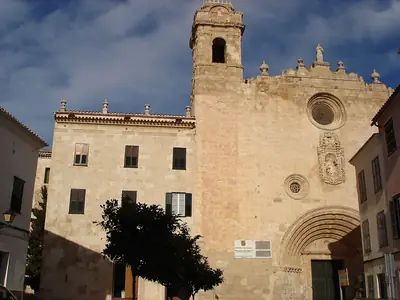
The Church and Cloister of Sant Francesc form a Baroque complex built between 1719 and 1792 over an earlier Gothic temple. That earlier church, dedicated to Santa Maria de Jesús de Natzaret, was destroyed after the Turkish attack on Mahon in 1535.
The present church has a solid façade, a Romanesque-style portal, a single nave, Baroque decoration, and a Chapel of the Conception. Its cloister follows a square plan with four levels and a well at the centre. Part of the former convent now connects with the Museu de Menorca.
Museu de Menorca
The Museu de Menorca is housed in a former Franciscan monastery and tells the story of the island through its archaeological and historical collections. Its permanent exhibition covers the Talayotic, Roman, Byzantine, medieval, Moorish, Catalan, British, French, and modern Spanish periods.
The displays include stone tools, pottery, architectural remains, sacred art, household objects, maps, and paintings. The old cloister, galleries, and monastery wings are part of the experience, alongside restoration workshops, a library, temporary exhibition spaces, and areas for cultural programmes.
Palau Oliver
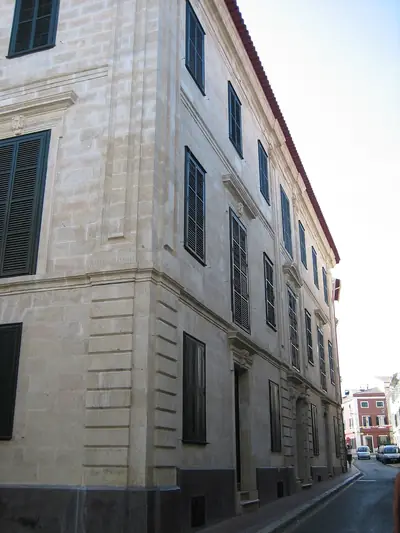
Palau Oliver, also known as Ca n’Oliver, is one of Mahón’s most important bourgeois houses. The merchant Llorenç Oliver i Morillo commissioned it in 1802, during a period when the city was expanding in an area then known as the English Cemetery.
Since 2015, the house has contained the Ca n’Oliver Art and History Centre. Its collection includes works connected with Francesc Hernández Sanz and his son, Francesc Hernández Mora, two intellectuals and artists closely associated with Menorca’s history and culture.
Church of the Concepció, the Greek Church
The Església de la Concepció is also known as the Greek Church because it was built in 1749 by Mahón’s Greek colony. Originally an Orthodox church dedicated to Saint Nicholas of Bari, it has a Greek-plan layout and Byzantine-style decoration.
The Greek community was expelled in 1782, after which the church was abandoned. In 1868 it became part of Catholic worship, and its Orthodox symbols were removed. The building still preserves traces of the Greek presence that once formed part of Mahón’s cosmopolitan character.
Church of Sant Josep
The Church of Sant Josep is a modest place of worship built in 1738 by a community of master builders, carpenters, and heating craftsmen. Its simple design consists of a single nave with small chapels on either side.
Between 1764 and 1782, the church was used for Anglican worship. After Spanish rule was restored in 1802, it returned permanently to Catholic use.
Church and Cloister of Carmen
The Church and Cloister of Carmen is Mahón’s largest religious building. Construction began in 1726 and continued until 1808, with delays caused by local rivalries, opposition from the Franciscan community, and administrative problems.
The church has a Latin-cross plan, side chapels, a central crossing, and a dome. Its exterior is plain, while the interior is broad and spacious. Beside it, the large two-level cloister has a cistern at its centre. Following the confiscation of church properties in 1835, the cloister passed into municipal hands, while the church remained under ecclesiastical ownership.
Església i convent de la Concepció
The Església i convent de la Concepció is a secluded convent built between 1616 and 1623 on the grounds of the former city wall. Its unusual position means that it has almost no exterior façade: the building opens towards the cliff above the port.
The interior is austere and sparsely decorated. Its layout includes one section with twelve rooms and another with thirteen, reflecting the practical, enclosed life once organised within the convent. Around 1804, one of its rooms was also used to teach children.
Sant Antoni de Maó and Sala Augusta
Sant Antoni de Maó is a historic church building with a neoclassical character. Documented as early as the sixteenth century, it now serves as the cultural hall of Sa Nostra.
Nearby, Sala Augusta has passed through an unusual succession of uses. Built in 1950, it was associated with children’s and youth programming, but the building had previously served as a shoe factory, garage, skating rink, dance hall, and cinema. After becoming municipal property in 1984, it hosted theatre, film cycles, carnival dances, and political, social, and cultural meetings. It has had no activity since 2003.
Trepucó
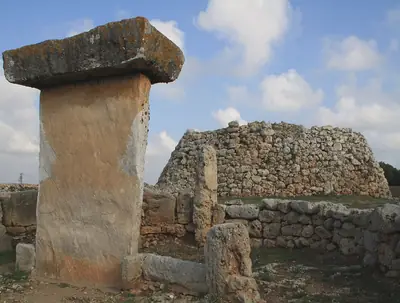
Trepucó is one of Menorca’s largest Talayotic settlements. Located along the old road to Sant Lluís, the site covers almost five thousand square metres and is centred on an enormous taula inside an approximately semicircular enclosure.
The settlement was built between about 800 and 450 BC. Its taula consists of two huge stones: an upright stone 4.20 metres high, topped by a horizontal stone. Sections of the settlement wall, two square towers, two talayots, the taula enclosure, and the remains of circular houses can still be seen.
Trepucó is particularly striking because prehistoric architecture meets later military history here. The site was partly destroyed during the eighteenth-century siege of Mahón.
Mola Fortress
Mola Fortress, also known as the Fortress of Isabel II, stands on the La Mola peninsula at the entrance to Mahón Harbour, facing San Felipe Castle across the mouth of the port. Ordered by Queen Isabel II, it was constructed between 1848 and 1875.
Its position allowed it to watch and protect the harbour entrance. The complex served as a military base, accommodation for troops, and a military and political prison. It also has a darker history: during the Spanish Civil War and the Franco period, Republicans were executed there. The fortress is near the easternmost point of Spain.
Basilica des Fornàs de Torelló
The remains of the Basilica des Fornàs de Torelló preserve the outline of a small early Christian basilica near Mahón. Built between the fifth and sixth centuries AD, during the period associated with Byzantine rule and Emperor Justinian, it has a single east–west nave.
Its mosaic floor covers almost the entire nave and combines geometric patterns with birds symbolising paradise. Two lions appear beside a palm tree: the lions represent death, while the palm evokes the tree of life. A semicircular baptismal font and the remains of the altar table also survive.
Explore Mahón with a self-guided audio tour
Neywo’s Mahón audio guide includes two walking tours, with narration available in 11 languages. Each story plays as you reach the place, at your own pace: there is no group and no schedule.
The tours are:
- A 1.95 km walk lasting 85 minutes, with 12 narrated stops. It includes the Church and Cloister of Sant Francesc, Museu de Menorca, Portal de Sant Roc, Church of Sant Josep, Teatre Principal de Maó, the Greek Church, Palau Oliver, the Church and Cloister of Carmen, the Mahón fish market, Santa Maria de Maó, Maó, and the Convent of the Concepció.
- A 3.3 km walk lasting 66 minutes, with 4 narrated stops. It covers Sant Antoni de Maó, Sala Augusta, the Claustre market, and Trepucó.
Download Neywo and explore Mahón as you walk. The app tells the story of each place when you reach it, letting you discover the city independently and at your own pace. When planning a wider trip through Spain, you can also continue with Neywo in Palma de Mallorca or Ibiza.
Places with an audio guide in Mahón
8 places in Mahón with a Neywo audio guide. Each one starts telling its story as you reach it.
Self-guided tours in Mahón
2 tours in Mahón, free in the Neywo app. Each stop tells its story as you reach it.
- Walk
Maó: British Clocks, Greek Churches and a Medieval Gate
Maó was Spanish, British, French and Spanish again, and every ruler left a mark. Walk from the Franciscan cloister to the last stone of the medieval wall, past the Greek church and an 1829 opera house, through the old fish market and under the town hall clock ordered from London, to a convent that turns its back on the street and faces the harbour.
Church and Cloister of Sant Francesc · Museu de Menorca · Portal de Sant Roc · Església de Sant Josep de Maó · Teatre Principal de Maó · Església de la Concepció …
Open this tour: Maó: British Clocks, Greek Churches and a Medieval Gate - Walk
Maó Off the Main Street: Neoclassical Church, a Cloister Market and a Talayotic Giant
Beyond the harbour-front highlights, Maó has odder corners. Visit a neoclassical church turned cultural hall, the shuttered Sala Augusta with its many lives, and the market that fills a Carmelite cloister, then take a short stroll south to Trepucó, one of Menorca's biggest Talayotic settlements and its enormous T-shaped taula.
Sant Antoni de Maó · Sala Augusta · Mercat del Claustre · Trepuco
Open this tour: Maó Off the Main Street: Neoclassical Church, a Cloister Market and a Talayotic Giant
Walk Mahón with Neywo
Neywo turns Mahón into a self-guided audio tour. Stories arrive as you reach the place they belong to, and the route reshapes when you wander off it.

