What to See in Rickmansworth, United Kingdom: Free Audio Guide
Things to Do in Rickmansworth: Historic Places and Hertfordshire Day Trips
Looking for things to do in Rickmansworth? This Hertfordshire town is a useful base for discovering historic churches, museums, ancient earthworks and remarkable estates across the surrounding area. Neywo offers a free audio guide for Rickmansworth with 398 narrated places, helping you explore the town and its region as you walk.
What to See in Rickmansworth and Nearby
The source material for Rickmansworth and its surroundings includes a wide range of places, from local religious buildings to museums and archaeological sites. Together, they reveal the long history of Hertfordshire.
Friends Meeting House
The Quaker Meeting House in Rickmansworth is a local place of worship and a quiet stop in the town. It offers a glimpse into the area’s religious heritage and community life.
St Albans Cathedral
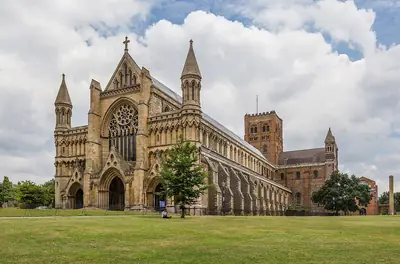
St Albans Cathedral, officially the Cathedral and Abbey Church of St Alban, has been a centre of worship for well over a thousand years. It is also known locally as the Abbey.
The history of the site reaches back to the eighth century, when King Offa of Mercia founded a Benedictine monastery on what was then called Holmhurst Hill. Archaeological remains dating to 793 have been found there. The present building is largely Norman: construction began in 1077, while Gothic additions and extensive Victorian restoration later shaped its appearance.
The monastery ended during the Dissolution in the sixteenth century. The building continued as a parish church until it became a cathedral in 1877. Today, it remains both a Church of England cathedral and a parish church. Its central religious feature is the shrine of Saint Alban.
Churches in and around St Albans
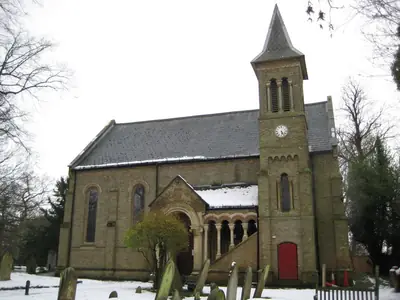
Several churches in the surrounding area add to the region’s architectural history. St Peter’s Church in St Albans is a Church of England parish church at the northern edge of the town centre. St Mark’s Church is located in Colney Heath, near St Albans.
The Church of St Peter in Watford is another Church of England parish church in the area. These buildings provide different perspectives on the religious history of Hertfordshire, from town-centre parish life to smaller local communities.
The Priory in Ware
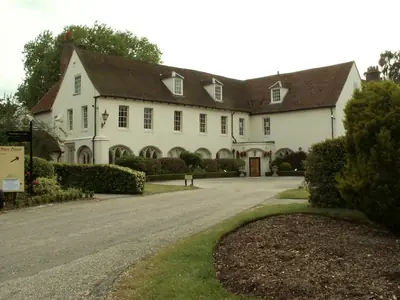
The Priory is a Grade I listed building in Ware. It now houses Ware Town Council offices and a community centre, but its origins reach much further back. The building is one of East Hertfordshire’s significant historic landmarks and is a worthwhile stop when exploring the town.
Rye House, Hertfordshire
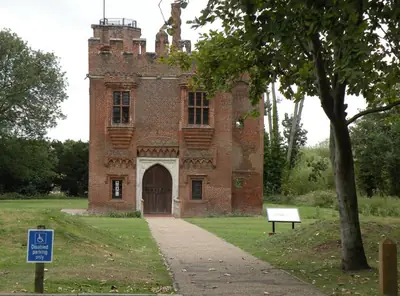
Rye House stands in Lee Valley Regional Park near Hoddesdon. Only the gatehouse survives from the fifteenth-century fortified manor house. It is a Grade I listed building and a scheduled monument, as well as a rare example of early brickwork in England, from a period when brick was still an expensive material.
The site is best known for giving its name to the Rye House Plot of 1683. The alleged conspiracy involved a plan to assassinate King Charles II and his brother James, later James II, as they returned from the races at Newmarket. Historians continue to debate how real the plot was, but several prominent figures were executed and the house was later seized by the Crown.
Knebworth House
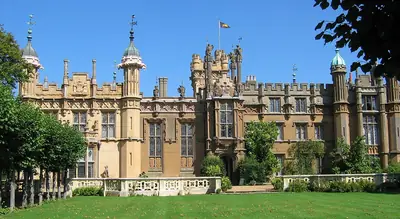
Knebworth House has been a family seat for centuries and remains a lived-in home. The house is Grade II* listed, while its gardens have the same distinction on the Register of Historic Parks and Gardens.
The grounds also contain the medieval St Mary’s Church and the Lytton family mausoleum. Knebworth’s history is not limited to architecture: since 1974, its grounds have hosted the Knebworth Festival, a major open-air rock and pop concert. Between 2009 and 2014, the gardens also hosted Sonisphere, a European hard rock festival.
Church of St Mary and St Thomas, Knebworth
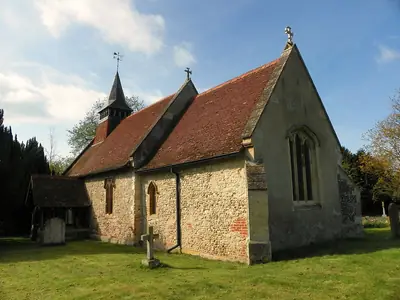
The Church of St Mary and St Thomas is one of two Anglican churches serving Knebworth. Dating from the twelfth century, it is a notable medieval survivor and has Grade I listed status, reflecting its exceptional architectural and historic interest.
Natural History Museum at Tring
The Natural History Museum at Tring began as the private museum of Lionel Walter Rothschild, the second Baron Rothschild. He created the collection on his family’s Tring Park estate, and the museum first opened to the public in 1892.
Its rooms contain mammals, birds, reptiles and insects preserved through taxidermy. For decades, it was known as the Walter Rothschild Zoological Museum. In April 2007, it officially became part of the Natural History Museum in London, securing the future of Rothschild’s extensive collection.
Ashwell Village Museum
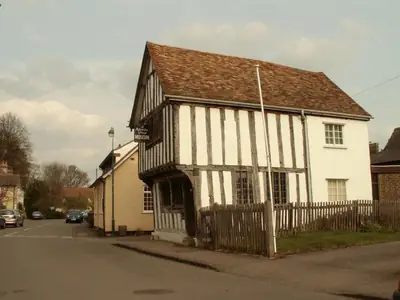
Ashwell Village Museum occupies a historic building in Ashwell, Hertfordshire. It is a small local museum focused on the village and its setting, making it a suitable stop for anyone interested in the area’s community history.
Baldock Museum and Local History Society
Baldock Museum and Local History Society explores the local history of Baldock. It is associated with Baldock Town Hall on the High Street, a municipal building that now operates as an arts and heritage centre and is recognised as a locally listed building.
Arbury Banks
Arbury Banks is an ancient hill fort southwest of Ashwell. At about 90 metres above sea level, it forms part of a line of six similar hill forts along the northern Chilterns.
The fort was probably first constructed during the late Bronze Age, between 1000 and 700 BC. Excavations in the 1850s traced its horseshoe-shaped ramparts, identified two entrances and found evidence of enclosures or buildings within the fort. It has also been suggested as one possible location for the Battle of Watling Street, in which a Roman force defeated Boudica’s army. Arbury Banks is now a scheduled monument.
Beech Bottom Dyke
Beech Bottom Dyke is a large ancient earthwork on the northern edge of St Albans. The ditch stretches for almost a mile and is flanked by banks on both sides. It measures up to 30 metres wide and 10 metres deep, making its scale striking even today.
The site is identified as an Iron Age ditch in Hertfordshire. Its exact purpose is not stated, but the surviving earthwork offers a clear impression of the labour involved in shaping this landscape.
Churches in Radwell and St Albans
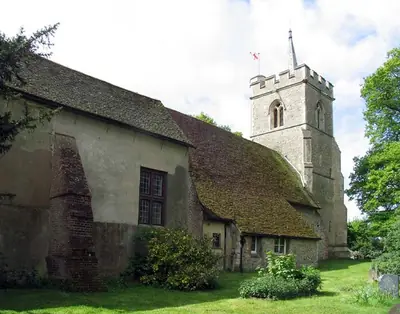
The Church of All Saints in Radwell is an Anglican parish church belonging to the Diocese of St Albans. It received Grade II* listed status in 1968, recognising its architectural and historic importance.
St Peter’s Church in St Albans and St Mark’s Church in Colney Heath complete the group of local churches described in the guide. Each reflects the religious history of a different Hertfordshire community.
Explore Rickmansworth with Neywo
If you are looking for a Rickmansworth self-guided walking tour or a Rickmansworth audio guide, download Neywo and explore at your own pace. The app includes five walking tours and one bike route in the area, with narration available in 11 languages.
The tours include walks in St Albans, Hatfield, Hertford, Watford and Ware, plus a cycling route through Roman Verulamium:
- Roman Verulamium to Abbey Hill: Two Thousand Years of St Albans — 3.89 km, 119 minutes and 9 narrated stops.
- Tudor Hatfield: Where Elizabeth Became Queen — 3.46 km, 89 minutes and 8 narrated stops.
- Hertford: County Town on the River Lea — 3.23 km, 89 minutes and 8 narrated stops.
- Watford: Market Town, Bentley’s Church and the Vic — 4.18 km, 110 minutes and 10 narrated stops.
- Ware: Scott’s Grotto and the Malting Town — 2.48 km, 68 minutes and 6 narrated stops.
- Cycling Through Roman Verulamium — 1.6 km, 8 minutes and 4 narrated stops.
Neywo tells the story of each place as you reach it, at your own pace, with no group and no schedule. It is a practical way to discover Rickmansworth and continue exploring England during the same trip.
Places with an audio guide in Rickmansworth
8 places in Rickmansworth with a Neywo audio guide. Each one starts telling its story as you reach it.
Self-guided tours in Rickmansworth
6 tours in Rickmansworth, free in the Neywo app. Each stop tells its story as you reach it.
- Bike ride
Cycling Through Roman Verulamium
A short, flat ride from the cathedral down into Verulamium Park, along the permitted cycle path past the Roman museum, the old city walls and the underfloor heating of a Roman house. Cyclists must give way to walkers and dismount on paths where cycling is not allowed.
St Albans Cathedral · Verulamium Museum · Verulamium · The Hypocaust
Open this tour: Cycling Through Roman Verulamium - Walk
Roman Verulamium to Abbey Hill: Two Thousand Years of St Albans
Start by the railway station and walk into the old heart of St Albans: the market that has traded on the same street for centuries, the medieval clock tower built as a protest against the abbey, and the Norman cathedral that holds Britain's first Christian martyr. Finish among the Roman ruins of Verulamium, where a Saxon church sits on top of the old forum and a Roman family's underfloor heating still survives.
Church of SS Alban and Stephen · Church of St. Peter, St. Albans · St Albans Market · Clock Tower · St Albans Cathedral · Verulamium Museum …
Open this tour: Roman Verulamium to Abbey Hill: Two Thousand Years of St Albans - Walk
Tudor Hatfield: Where Elizabeth Became Queen
Walk from the modern town centre to the old village of Hatfield, where the young Tudor children grew up in a red-brick bishop's palace. See the Jacobean mansion that replaced it, the fountain in its grounds, the church that served both, and finish at a working watermill that has kept turning for three centuries.
Hatfield · Church of St Luke · Roman Catholic Church of Marychurch · Parish Church of St Etheldreda, Old Hatfield · The Old Palace · Hatfield House …
Open this tour: Tudor Hatfield: Where Elizabeth Became Queen - Walk
Hertford: County Town on the River Lea
Explore the county town of Hertfordshire, where a ford on the Lea drew fortified settlements in 913. Visit the Tudor gatehouse of the royal castle, a town house museum with a Jacobean knot garden and five thousand toothbrushes, Hertfordshire's biggest parish church, and cross to Bengeo to find the oldest building in town, a Norman church from about 1120.
Hertford · All Saints' Church · Friends Meeting House · Hertford Museum · Hertford Castle · Church of St Andrew …
Open this tour: Hertford: County Town on the River Lea - Walk
Watford: Market Town, Bentley's Church and the Vic
A walk through Watford from its museum and fire brigade collection to the High Street church that has watched over the town for eight hundred years. See a Grade I church by the architect of Westminster Cathedral, an Edwardian theatre, the concert hall where Callas and Pavarotti sang, and the football ground where Elton John's name is on a stand.
Watford Museum · Hertfordshire Fire Brigade Museum · Pump House Theatre and Arts Centre · Vicarage Road · Holy Rood Church · St Mary's Church …
Open this tour: Watford: Market Town, Bentley's Church and the Vic - Walk
Ware: Scott's Grotto and the Malting Town
A short stroll through the market town of Ware, from the Priory and the parish church of St Mary to the Victorian Christ Church, ending at Scott's Grotto, the most extensive shell grotto in the United Kingdom, which Samuel Johnson once visited by candlelight.
Ware · Ware Museum · The Priory (ware Town Council Offices And Community Centre) · Church of St Mary · Christ Church Ware · Scott's Grotto
Open this tour: Ware: Scott's Grotto and the Malting Town
Walk Rickmansworth with Neywo
Neywo turns Rickmansworth into a self-guided audio tour. Stories arrive as you reach the place they belong to, and the route reshapes when you wander off it.

