Conwy, United Kingdom: Self-Guided Walking Tour
Things to Do in Conwy: A Self-Guided Walk Through a Medieval Fortress Town
The best things to do in Conwy revolve around its castle, medieval town walls, historic bridges and the River Conwy. This compact town brings together an exceptionally well-preserved fortified centre, important engineering landmarks and layers of Welsh history. Neywo also has a free audio guide for Conwy, with 17 narrated places to discover as you walk.
Conwy is an excellent place to begin exploring Wales, especially if you are interested in castles, historic streets and the relationship between a town and its river. The main sights are close enough to connect on foot, making a self-guided visit particularly rewarding.
What to see in Conwy
Conwy Railway Bridge
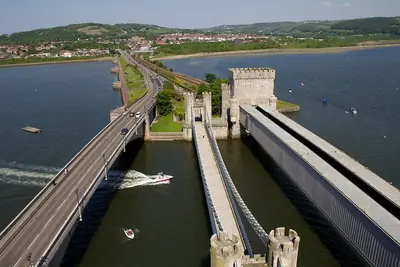
The Conwy Railway Bridge carries the North Wales coast railway line across the River Conwy between Llandudno Junction and Conwy. Designed by Robert Stephenson with William Fairbairn and Eaton Hodgkinson, it is a wrought-iron tubular structure in which the railway runs through the inside of the bridge.
The bridge opened in 1849. Its ends were given a fortified appearance by architect Francis Thompson, with crenellated turrets, arrow slits and bartizans that echo the nearby castle. It is now both a Grade I listed structure and a scheduled monument.
Conwy Suspension Bridge
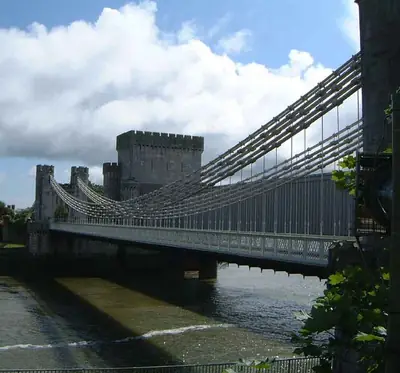
Beside the castle, Conwy Suspension Bridge offers a very different example of bridge engineering. Designed by Thomas Telford, it opened in 1826 as part of the road between Chester and Bangor. It is now reserved for pedestrians and is a Grade I listed structure.
Telford shaped its towers to resemble those of Conwy Castle, creating a deliberate visual link between the newer crossing and the medieval fortress. The bridge carried road traffic until 1958, when a nearby replacement bridge diverted motor vehicles.
Conwy Castle
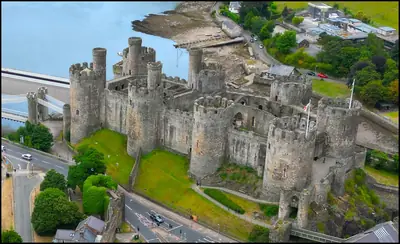
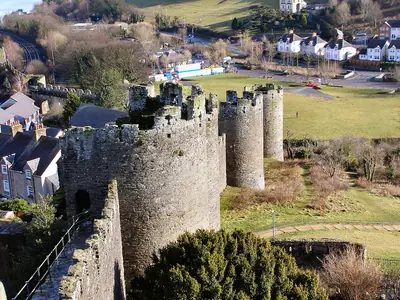
Conwy Castle is the town’s defining landmark. Edward the First built it between 1283 and 1287 as part of his plan to establish a fortified town during his conquest of Wales. The castle occupies a coastal ridge beside the River Conwy, overlooking an important crossing point.
Its unusual linear design follows the rocky ridge rather than forming a series of concentric rings. Eight great towers, connecting walls and two barbicans protect the Inner and Outer Wards. A postern gate leads towards the river, allowing supplies to arrive by sea.
The castle also preserves some remarkable details. Conwy has the earliest surviving stone machicolations in Britain, as well as a particularly well-preserved group of medieval private royal chambers. The fortress was built on the site of Aberconwy Abbey, which Edward required the monks to leave so that the castle and town could be constructed.
Aberconwy Abbey and St Mary and All Saints
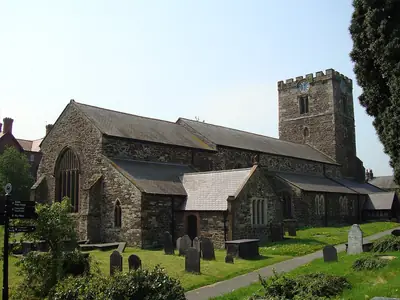
Aberconwy Abbey was once the most important abbey in northern Wales. The Cistercian foundation moved to Conwy in the late twelfth century, and in 1199 Llywelyn the Great granted it extensive lands. At its height, the abbey held more than forty thousand acres and was considered the wealthiest Welsh abbey.
Its history changed when Edward the First required the monks to move to Maenan in 1283. The former abbey church survives as St Mary and All Saints, Conwy’s parish church, while the original monastic buildings are thought to have occupied land now associated with the castle.
Conwy Civic Hall
Conwy Civic Hall, also known as the Library and Civic Hall, is a former civic hall and arts centre in the town. It adds a more recent civic layer to a walk otherwise dominated by medieval and Elizabethan buildings.
The Smallest House in Great Britain
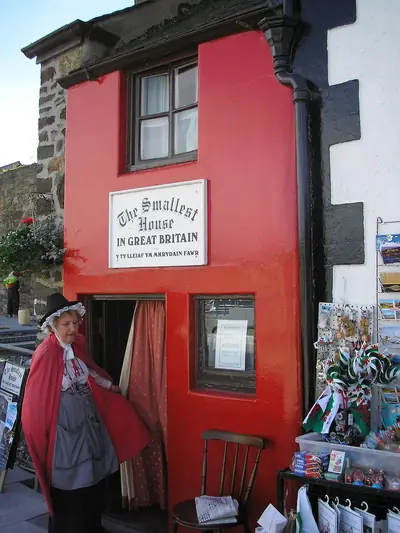
On Conwy’s quay stands the Smallest House in Great Britain, also known as the Quay House. It is reputed to be the smallest inhabitable house in the United Kingdom and is also known by its Welsh name, Y Tŷ Lleiaf ym Mhrydain Fawr.
Its tiny scale makes it one of Conwy’s most unusual sights. The building offers a simple reminder that the town’s historic character is not limited to grand fortifications and major monuments.
Plas Mawr and the Royal Cambrian Academy of Art
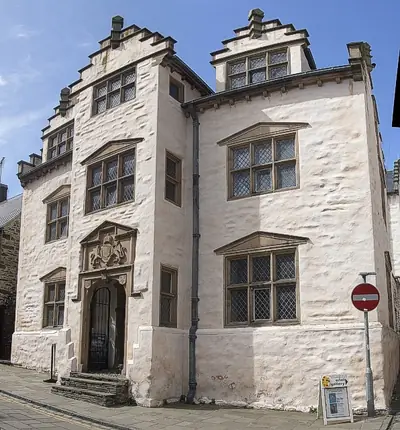
Plas Mawr, whose name means “great hall” in Welsh, is a remarkably complete Elizabethan townhouse. Robert Wynn built it in three phases between 1576 and 1585, combining continental Renaissance ideas with local North Wales influences.
The house retains much of its original plasterwork, including symbols, badges and heraldry. Its preserved design has led historians to describe it as one of the finest surviving town houses of the Elizabethan era and an important memorial to Elizabethan Wales.
Plas Mawr later became the headquarters of the Royal Cambrian Academy of Art, known in Welsh as Academi Frenhinol Gymreig. The academy gave the building a later artistic life while preserving its connection with Conwy’s architectural history.
Conwy Town Walls
Conwy Town Walls formed an integrated defensive system with the castle. Built between 1283 and 1287, they extend for 1.3 kilometres and include 21 towers and three gatehouses.
Walking beside the walls gives a clear sense of how completely Edward’s town was enclosed. The fortifications were slightly damaged during the rebellion of Owain Glyndŵr in 1401, but much of the circuit survives. Together with Conwy Castle, the walls form part of a UNESCO World Heritage Site administered by Cadw.
The River Conwy
The River Conwy shapes the town’s setting and connects it with the landscapes of North Wales. It begins on the Migneint moor, where streams gather in Llyn Conwy, and travels for about 34 miles, or 55 kilometres, to Conwy Bay.
Along the way, the river is joined by the Machno, Lledr, Llugwy, Afon Crafnant, Afon Porth-llwyd and Afon Ddu. In Conwy, the local quay called Cei Cae Gwyn sits on its riverbank. During spring tides, the river becomes tidal as far inland as Tan-lan near Llanrwst.
More places to discover around Conwy
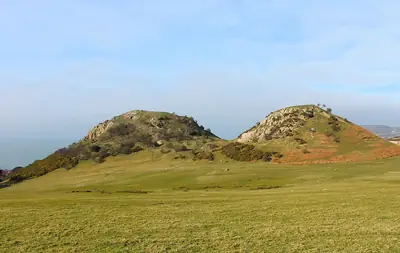
The wider area adds several smaller historic sites to the town’s main landmarks. On the hill above Deganwy, the remains of Deganwy Castle occupy the Vardre, a limestone hill rising to about 110 metres above the mouth of the River Conwy. The site was an important stronghold of Gwynedd and protected a strategic river crossing. Its occupation may extend back to an earlier hillfort and possibly the Roman period.
In Deganwy, All Saints Church overlooks the Conwy estuary. South of Conwy, in Gyffin, St Benedict’s Church stands on the south bank of the Afon Gyffin. The active parish church is a Grade I listed building, and the present structure dates from around 1300, although it may have earlier origins.
Llandudno Junction has several places of worship connected with local community life: Caersalem, a Calvinistic Methodist chapel; Capel Coffa, an independent chapel; and Preswylfa, a Wesleyan chapel.
Explore Conwy with a self-guided walking tour
Neywo’s “Edward’s Fortress Town: Bridges, Castle and Walls” is a 1.07-kilometre walking tour lasting 81 minutes, with nine narrated stops. It includes Conwy Railway Bridge, Conwy Suspension Bridge, Conwy Castle, Aberconwy Abbey, Conwy Civic Hall, Aberconwy House, the Smallest House in Great Britain, Academi Frenhinol Gymreig and Conwy Town Walls.
The app tells the story of each place as you reach it, at your own pace, with no group and no schedule. Narration is available in 11 languages. Download Neywo and explore Conwy as a free walking tour that lets the town’s bridges, castle, abbey and walls unfold around you.
Places with an audio guide in Conwy
8 places in Conwy with a Neywo audio guide. Each one starts telling its story as you reach it.
Self-guided tours in Conwy
1 tour in Conwy, free in the Neywo app. Each stop tells its story as you reach it.
- Walk
Edward's Fortress Town: Bridges, Castle and Walls
Conwy is one of Europe's best-preserved medieval walled towns. Cross Telford's and Stephenson's rival bridges, climb into Edward I's castle on the site of a Welsh abbey, and wander the quay, Britain's smallest house and an Elizabethan townhouse before closing the circuit on the town walls.
Conwy Railway Bridge · Conwy Suspension Bridge · Conwy Castle · Aberconwy Abbey · Conwy Civic Hall · Aberconwy House …
Open this tour: Edward's Fortress Town: Bridges, Castle and Walls
Walk Conwy with Neywo
Neywo turns Conwy into a self-guided audio tour. Stories arrive as you reach the place they belong to, and the route reshapes when you wander off it.

