Visiting Wrexham, United Kingdom: Top Sights on Foot
Things to Do in Wrexham: Historic Sites, Football and Borderland Landscapes
Looking for things to do in Wrexham? Wales’s newest city combines medieval churches and castles, industrial-era engineering, country-house history and one of football’s most historic stadiums. It is also a useful base for discovering the landscapes and heritage of north-east Wales, close to the border with England.
Neywo has a free audio guide for Wrexham, with 61 narrated places. Its stories bring the city and surrounding sites to life as you explore.
What to See in Wrexham
The most important places to visit are spread across Wrexham and the nearby Dee and Ceiriog valleys. Together, they reveal the area’s medieval past, industrial ambition and enduring local identity.
Queen’s Square and Wrexham’s historic centre
Queen’s Square, or Sqwâr y Frenhines in Welsh, is a lively public space in the city centre. Wrexham received official city status in 2022, but its history reaches back before the eleventh century, when it developed as a medieval market town and regional centre for trade and administration.
During the seventeenth century, Wrexham was regarded as the largest settlement in Wales. Later, coal and lead mining, iron and steel production, leatherworking and brewing shaped the surrounding valley and the city’s industrial character.
St Giles’ Church
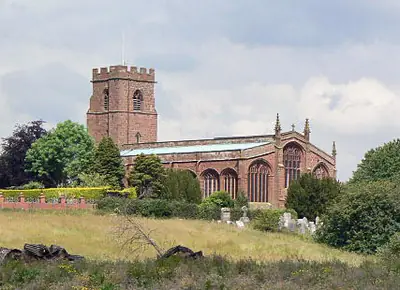
St Giles’ Church rises above Wrexham’s historic centre and is described in the audio guide as a fine Tudor church. Its tower is one of the defining features of the city skyline and makes it a natural starting point for discovering the older heart of Wrexham.
Racecourse Ground
For football fans, the Racecourse Ground—Y Cae Ras in Welsh—is one of Wrexham’s essential sights. Wrexham AFC has played here since 1872, while the site itself opened in 1807 for horse racing and cricket. Football arrived in 1864.
The stadium hosted Wales’s first home international on 5 March 1877, when Wales played Scotland. It is recognised by Guinness World Records as the oldest stadium still hosting international football. The Football Association of Wales continues to use it for home matches, and the Kop End terraces date from 1952.
Wrexham County Borough Museum and Football Museum of Wales
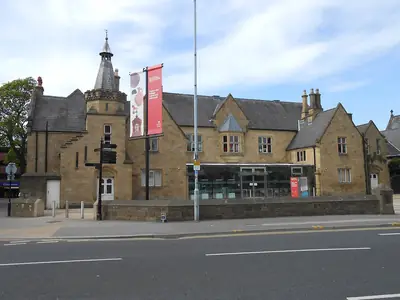
The Wrexham County Borough Museum is housed in County Buildings, a Grade II listed structure designed by Thomas Penson and built between 1857 and 1858. The building began as a militia barracks, later becoming a police station and Magistrates’ court before serving part of a local art college.
The museum combines local history collections with Wales’s first national football museum. That pairing reflects Wrexham’s two intertwined stories: the development of the county and the city’s deep football heritage.
Wrexham Cathedral
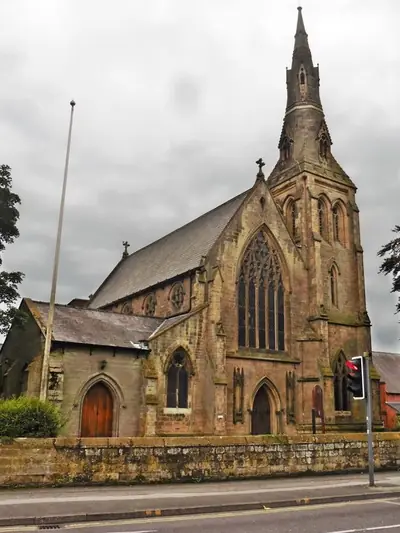
Wrexham Cathedral, the Cathedral Church of Our Lady of Sorrows, is the mother church of the Roman Catholic Diocese of Wrexham. The building began in 1857 as a parish church commissioned by industrialist Richard Thompson as a memorial to his wife, Ellen. Her grave is inside the cathedral.
Edward Welby Pugin designed the church in a revived Gothic style based on thirteenth-century buildings. It stands on the site of Wrexham’s first Catholic chapel, which was established secretly in 1828. The church later became a pro-cathedral and then the cathedral of the Diocese of Wrexham.
Erddig Hall
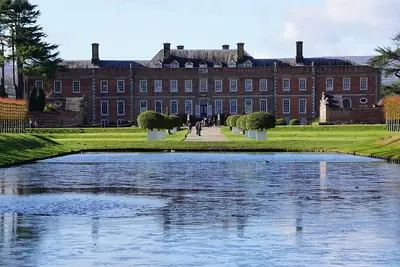
Erddig Hall is a country house known not only for its architecture and furniture, but also for the relationship between the Yorke family and the household staff who maintained the estate.
The central block was built between 1684 and 1687 for Joshua Edisbury, while the flanking wings were added in the 1720s by John Meller. The estate passed to Simon Yorke in 1733 and remained with the Yorke family for more than two centuries. In 1973, the family gave Erddig to the National Trust.
Inside, the collection includes seventeenth-century furniture and a notable state bed: a lit à la duchesse canopy bed with its original hangings and silk satin bed cover.
Pontcysyllte Aqueduct
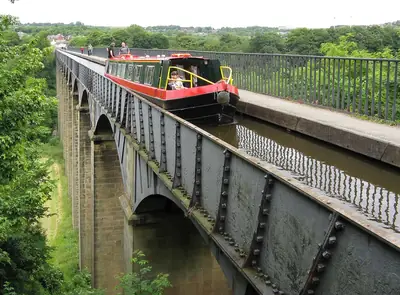
The Pontcysyllte Aqueduct carries the Llangollen Canal over the River Dee on nineteen arches. The stone-and-cast-iron structure stretches for more than a thousand feet across the valley, with the canal 126 feet above the river.
Its iron trough was a pioneering design, only twelve feet wide—enough for a single narrowboat. A towpath runs along one side, allowing visitors to walk across the full length and look through the open arches.
The aqueduct opened in 1805 after ten years of design and construction. It was intended as the centrepiece of the Ellesmere Canal, a commercial waterway planned to connect the River Severn with the Port of Liverpool. The route was chosen partly because it passed through the coalfields of north-east Wales.
Chirk Aqueduct
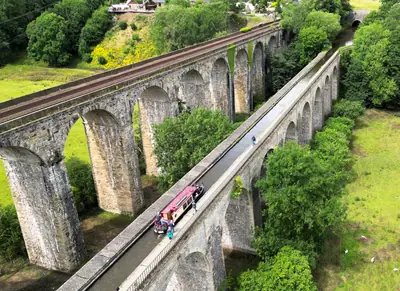
Chirk Aqueduct carries the navigable Llangollen Canal across the Ceiriog Valley, on the border between England and Wales. Boats still cross the structure, which stretches 710 feet above the valley floor. The waterway sits 70 feet above the river, supported by a line of stone arches.
Chirk Castle
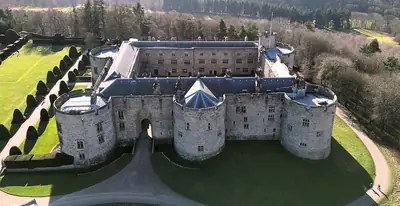
Chirk Castle, known in Welsh as Castell y Waun, is a Grade I listed medieval fortress cared for by the National Trust. It stands in the parkland of the Y Waun Estate, a designated conservation area.
The castle’s gardens belong to the same historic landscape, combining formal design with the natural contours of the surrounding land. Its location and long history make it a strong choice for visitors interested in castles and Welsh heritage.
Holt Castle and St Chad’s Church
Across the borderland around the River Dee, Holt Castle survives as weathered sandstone foundations beside the river. Construction began in the late thirteenth century after Edward I granted the land to John de Warenne, Earl of Surrey. The fortress had a distinctive pentagonal plan, with a round tower at each corner and a moat fed directly from the Dee.
Nearby, St Chad’s Church has stood in Holt since the late thirteenth century. The Grade I listed building was substantially rebuilt and extended at the end of the fifteenth century by Sir William Stanley. Musket-ball marks from the English Civil War can still be seen in the stonework at the west end. A Victorian restoration between 1871 and 1873 gave the church much of its present form.
Farndon Bridge
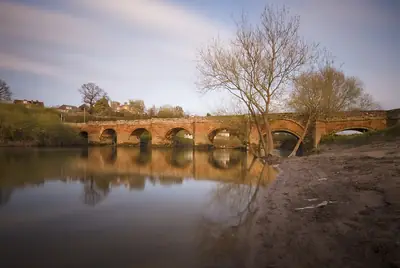
Farndon Bridge is a medieval crossing over the River Dee between England and Wales. It was built in 1339 from locally quarried red sandstone by St Werburgh’s Abbey in Chester. The original bridge had ten arches and a gate tower; eight arches remain today.
The bridge was the scene of a skirmish during the English Civil War in 1643 and remained a toll crossing until 1866. Its location makes it a particularly evocative place to experience the historic relationship between the two sides of the border.
Cadwgan Castle
Cadwgan Castle is a grassy medieval motte rather than a stone fortress. The steep-sided mound was built as a defensive earthwork and was once surrounded by a deep ditch. Unlike many mottes, it did not have a bailey, or enclosed courtyard.
The site rises to about 130 metres above sea level and lies four kilometres from Wrexham town centre. The land is flatter to the north-east, while hills rise to the south-west and woodland covers the ground to the east. It is now a peaceful place, but the views explain its defensive importance.
Explore Wrexham with Neywo
Neywo offers three walking tours in Wrexham, with no group and no schedule:
- Wrexham’s Crown Jewels: Tower, Cathedral and the Oldest Pitch — 5.43 km, 111 minutes and 6 narrated stops, including St Giles’ Church, Wrexham Cathedral, the museum, Racecourse Ground and Erddig Hall.
- Where Wales Meets England: Holt Castle and the Dee Bridge — 1.17 km, 43 minutes and 4 narrated stops, including Holt Castle, St Chad’s Church and Farndon Bridge.
- Rhos: A Miners’ Village and the Theatre It Saved — 0.67 km, 30 minutes and 4 narrated stops, including Stiwt Theatr and three local churches.
Each story plays as you reach the place, at your own pace. The app lets you explore independently, without a group or fixed schedule, and narration is available in 11 languages.
Download Neywo and turn your visit into a self-guided walk through Wrexham’s churches, castles, aqueducts, museums and football history. When planning a wider trip around the country, you can also explore the United Kingdom, or continue to other Welsh destinations such as St Davids and Tenby.
Places with an audio guide in Wrexham
8 places in Wrexham with a Neywo audio guide. Each one starts telling its story as you reach it.
Self-guided tours in Wrexham
3 tours in Wrexham, free in the Neywo app. Each stop tells its story as you reach it.
- Walk
Wrexham's Crown Jewels: Tower, Cathedral and the Oldest Pitch
A compact loop through the centre of north Wales's biggest town. See the medieval tower of St Giles that inspired a Yale college, a red-brick Presbyterian landmark, Pugin's cathedral and the County Buildings. The walk ends at the Racecourse Ground, the world's oldest international football stadium still in use. From there it runs on to Erddig, the National Trust country house famed for honouring its servants.
St Giles' Church · Trinity English Presbyterian Church · Wrexham County Borough Museum · Wrexham Cathedral · Racecourse Ground · Erddig Hall
Open this tour: Wrexham's Crown Jewels: Tower, Cathedral and the Oldest Pitch - Walk
Where Wales Meets England: Holt Castle and the Dee Bridge
A short riverside stroll over the border. Walk the sandstone footings of a pentagonal castle whose stones built Eaton Hall, step into a church still marked by Civil War musket balls, and cross the fourteenth-century bridge between Holt and Farndon.
Holt Castle · Holt English Presbyterian Church · St Chad's Church · Farndon Bridge
Open this tour: Where Wales Meets England: Holt Castle and the Dee Bridge - Walk
Rhos: A Miners' Village and the Theatre It Saved
Rhosllanerchrugog was a coal village, and its chapels and institute show how miners built their own culture. See the Stiwt, a theatre paid for by a penny a ton and saved from demolition, and the Welsh chapels and church around it.
Stiwt Theatr · St David's Welsh Church · Penuel Baptist Church · Chapel Mawr
Open this tour: Rhos: A Miners' Village and the Theatre It Saved
Walk Wrexham with Neywo
Neywo turns Wrexham into a self-guided audio tour. Stories arrive as you reach the place they belong to, and the route reshapes when you wander off it.

