Bath, United Kingdom: Self-Guided Walking Tour
Things to Do in Bath: Roman Baths, Georgian Architecture and Historic Churches
The best things to do in Bath include exploring the Roman Baths, Bath Abbey, Pulteney Bridge and the city’s elegant Georgian streets. Bath brings Roman history, natural hot springs, art and centuries of religious architecture together in a compact city that is rewarding to explore on foot. Neywo offers a free audio guide for Bath with 82 narrated places.
What to See in Bath
The Roman Baths
The Roman Baths are Bath’s defining historic site, built around the only natural hot springs in the United Kingdom. The water rises at a constant 46 degrees Celsius after being heated underground and passing through limestone faults.
The Romans developed the site into Aquae Sulis. A temple dedicated to Sulis Minerva was built here between 60 and 70 AD, combining a local Celtic deity with the Roman goddess of wisdom. The complex grew to include a temple, heated bathing rooms, a large pool and the sacred spring, where visitors left offerings.
For almost four centuries, people came to bathe, worship and seek healing. Although the baths fell into ruin after Roman rule ended, the remains still reveal the scale of the ancient settlement and its religious importance.
Bath Abbey
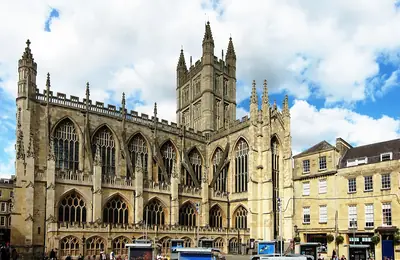
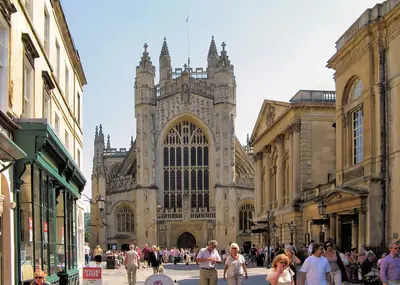
Bath Abbey stands at the heart of the city and has more than thirteen centuries of history. A convent was established on the site in the seventh century, followed by a Benedictine monastery in the tenth century and a large rebuilding in the twelfth century.
The present church is largely the work of the sixteenth century and was the last great medieval church built in England before the Reformation. Its most striking feature is the nave ceiling, with fan vaults spreading across the roof in one of the finest examples of Perpendicular Gothic architecture in the West Country.
The building suffered after the monastery’s dissolution in 1539 and was later restored in the Victorian period. In the 1860s, Sir George Gilbert Scott completed the nave vaulting, replaced the roof and restored the interior.
Abbey Churchyard
Abbey Churchyard sits above more than two thousand years of history. The Roman Baths are beneath this central area, where the thermal waters still rise as they did when Roman soldiers encountered them.
The square is also a useful starting point for seeing several of Bath’s central landmarks together: Bath Abbey, the Roman Baths, the Grand Pump Room and the route towards the Cross Bath.
The Cross Bath
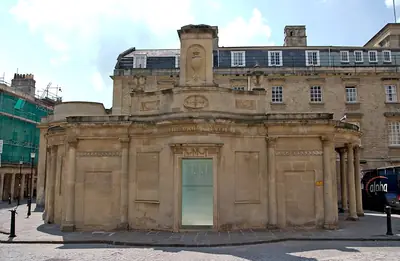
The Cross Bath is a small historic bathing pool on Bath Street, fed by the same natural hot springs that made the city famous. Its present structure is a refined neoclassical design associated with Robert Adam and completed by Thomas Baldwin by 1784. John Palmer remodelled it in 1789.
The building is Grade I listed and was restored in the 1990s. Compared with the large Roman complex nearby, the Cross Bath has a more intimate character and shows how Bath’s bathing tradition continued into the Georgian period.
Pulteney Bridge
Pulteney Bridge crosses the River Avon while carrying shops across its full span. Completed in 1774, it was designed by Robert Adam in a Palladian style and is one of only four bridges in the world lined with shops on both sides.
Adam had seen the Ponte Vecchio and the Rialto Bridge in Italy, but his Bath design was not a direct copy. Instead, it was based on a rejected design by Andrea Palladio for the Rialto. Later alterations changed the original appearance, and floods in 1799 and 1800 damaged the bridge’s north side before it was rebuilt by John Pinch.
The bridge remains one of Bath’s most distinctive sights, combining a river crossing, a shopping street and an important piece of eighteenth-century architecture.
Victoria Art Gallery
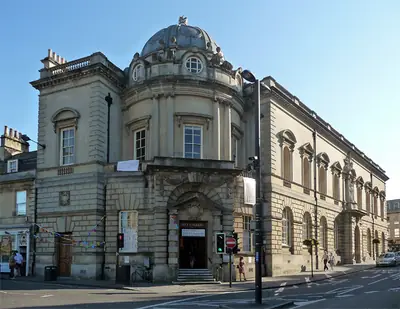
Beside the Guildhall, the Victoria Art Gallery opened in 1900 to mark Queen Victoria’s Diamond Jubilee. The building itself was completed in 1897 and designed by John McKean Brydon.
Its façade includes a statue of Queen Victoria by Andrea Carlo Lucchesi, Ionic columns and classical figures by George Anderson Lawson. Inside, the collection contains more than 1,500 works, with British oil paintings from 1700 onward forming its core.
The ground floor was originally a public library. The building became entirely focused on displaying art in 1990, making it one of Bath’s key cultural stops.
St Swithin’s Church
St Swithin’s Church stands on The Paragon in Bath’s Walcot district. A place of worship has existed on this ground since the tenth century, with remains of the earlier building beneath the crypt.
The current church was designed by John Palmer and erected between 1777 and 1790. Its distinctive spire was added to the square tower by Thomas Bonner in 1848, while the east wall includes a stained-glass depiction of the Ascension from the 1840s.
The church’s cemetery gates are also notable, with classical detailing including inverted torches, pilasters and an entablature.
Bath’s Other Historic Churches
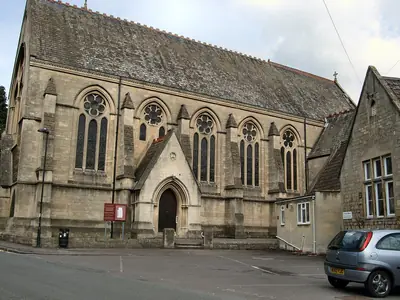
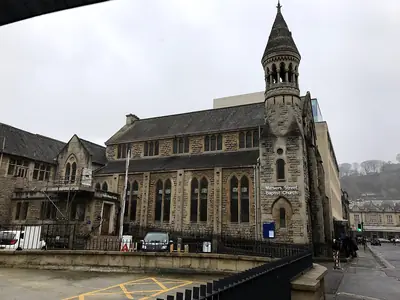
Bath’s religious heritage extends beyond the abbey. St Michael’s Church is a Church of England parish church dating from 1837, with a spire that rises above the north side of the city centre. It is also known as St Michael’s Without, reflecting its historic position outside the old city walls.
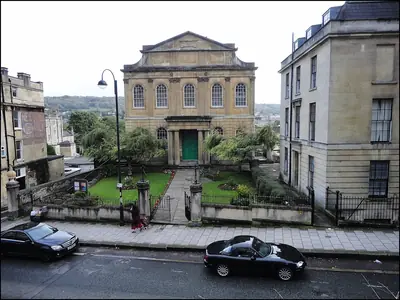
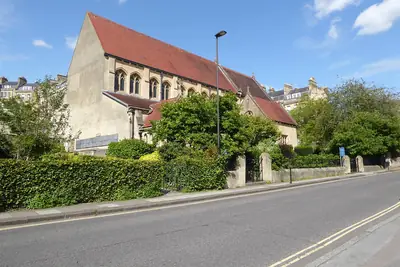
Other churches to encounter while exploring the city include Christ Church, Bath, a privately built proprietary chapel on Julian Road; the Church of St John the Baptist in Bathwick; Manvers Street Baptist Church; St Mary’s; St Stephen’s Church; the Seventh-Day Adventist Church; Nexus Methodist Church, also known as the Walcot Building; and Elim Pentecostal Church, also known as Bath Elim Church.
A Bath Self-Guided Walking Tour with Neywo
Neywo’s Bath audio guide includes four walking tours, one bus route and one bike route. Together, they cover the city’s Roman remains, Georgian architecture, museums, bridges, parks and churches.
- Springs, Abbey and a Bridge of Shops: 1.02 km, 91 minutes and 10 narrated stops, including Pulteney Bridge, Bath Abbey, the Roman Baths and the Cross Bath.
- Jane Austen’s Georgian Bath: 2.11 km, 83 minutes and 10 stops, including Queen Square, the Jane Austen Centre, Bath Assembly Rooms and the Royal Crescent.
- Across the River to Bathwick: 1.23 km, 49 minutes and 5 stops, including Holburne Museum, Sydney Gardens and the Church of St John the Baptist.
- Behind the Postcard: Walcot’s Workshops and Chapels: 1.06 km, 54 minutes and 6 stops, including Christ Church, Bath; Museum of Bath Architecture; St Swithin’s Church; and Nexus Methodist Church.
- Up Lansdown Hill: Abbey to Beckford’s Tower: a 4.1 km, 18-minute bus route with 7 stops.
- Royal Victoria Park and the Georgian Terraces: a 1 km, 5-minute bike route with 4 stops.
The app has 82 narrated places in Bath, and narration is available in 11 languages. Each story plays as you reach the place, at your own pace, with no group and no schedule. That makes it a practical alternative to a conventional free walking tour in Bath: you choose the route and explore independently while the app explains what is in front of you.
Download Neywo and Explore Bath at Your Own Pace
Download Neywo to explore Bath with a free audio guide covering 82 narrated places. Choose from four walking tours, one bus route and one bike route, or use the app to discover individual sites as you reach them. The stories play at your own pace, with no group and no schedule, and are available in 11 languages.
Bath is part of England in the United Kingdom, making it easy to continue discovering other destinations across the country after your visit.
Places with an audio guide in Bath
8 places in Bath with a Neywo audio guide. Each one starts telling its story as you reach it.
Self-guided tours in Bath
6 tours in Bath, free in the Neywo app. Each stop tells its story as you reach it.
- Bike ride
Royal Victoria Park and the Georgian Terraces
A gentle loop on the paved paths of Royal Victoria Park, beneath the Royal Crescent, with a short roll to St James's Square.
The Destructor Bridge · Royal Victoria Park · No. 1 Royal Crescent · St James's Square
Open this tour: Royal Victoria Park and the Georgian Terraces - Bus ride
Up Lansdown Hill: Abbey to Beckford's Tower
Route 620 climbs from the bus station past Bath Abbey, the museums of Walcot and St Stephen's Church to Lansdown, ending at William Beckford's eccentric tower with views over the city. A cheap way to see the hills that frame Bath.
Manvers Street Baptist Church · Bath Abbey · St Michael's Church, Bath · Oasis Hub · Museum of Bath at Work · St Stephen's Church, Bath …
Open this tour: Up Lansdown Hill: Abbey to Beckford's Tower - Walk
Springs, Abbey and a Bridge of Shops
Start on Robert Adam's Pulteney Bridge, one of the few bridges in the world lined with shops, then follow the river into the Roman heart of Bath. You pass the abbey with its fan vaults, the Pump Room, the only hot springs in Britain at the Roman Baths and the intimate Cross Bath. A compact first look at why Bath is a World Heritage city.
Pulteney Bridge · Victoria Art Gallery · East Gate · Rebekah Fountain · Bath Abbey · Abbey Green …
Open this tour: Springs, Abbey and a Bridge of Shops - Walk
Jane Austen's Georgian Bath
Walk the stage set of Georgian Bath: a house where Uranus was discovered, the squares and circus of the Woods, the Assembly Rooms where Austen's characters danced, and the Royal Crescent facing its park. Every honey-coloured facade has a story of balls, scandal or science.
Herschel Museum of Astronomy · Bath Royal Literary and Scientific Institution · Queen Square · Jane Austen Centre · Museum of East Asian Art · Bath Assembly Rooms …
Open this tour: Jane Austen's Georgian Bath - Walk
Across the River to Bathwick
Cross Pulteney's river to the Georgian suburb of Bathwick. See Bath's first public art gallery, the only surviving eighteenth-century pleasure garden in England, and the quiet churches and follies tucked behind Great Pulteney Street.
Holburne Museum · Sydney Gardens · Saint Mary's Bathwick · Pinch's Folly · Church of St John the Baptist
Open this tour: Across the River to Bathwick - Walk
Behind the Postcard: Walcot's Workshops and Chapels
Leave the crowds for Walcot, the working side of Georgian Bath. A chapel turned architecture museum, a glass theatre, Victorian workshops and the churches where the city's ordinary residents worshipped.
Christ Church, Bath · Museum of Bath at Work · Museum of Bath Architecture · Bath Aqua Theatre of Glass · Church of St Swithin, Bath · Nexus Methodist Church (Walcot Building)
Open this tour: Behind the Postcard: Walcot's Workshops and Chapels
Walk Bath with Neywo
Neywo turns Bath into a self-guided audio tour. Stories arrive as you reach the place they belong to, and the route reshapes when you wander off it.

