Things to Do in Tucson, United States: Walking Guide
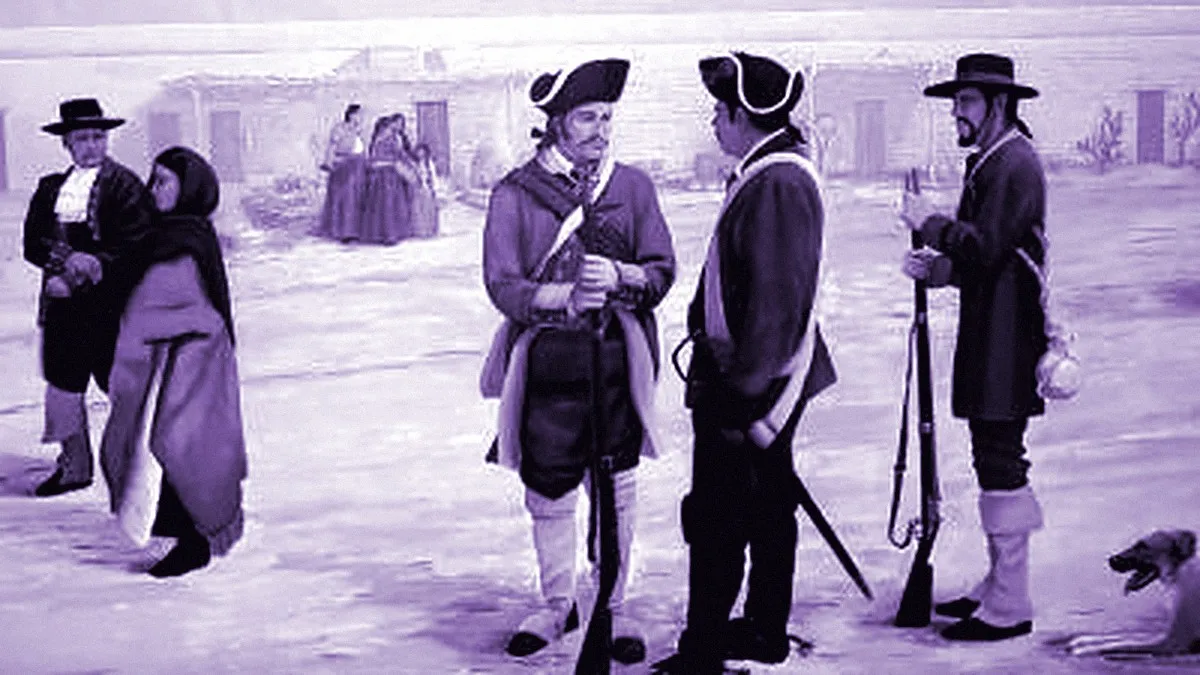
Things to Do in Tucson: Historic Districts, Museums, and Local Stories
The best things to do in Tucson include exploring historic neighborhoods, visiting museums devoted to art, culture, aviation, and railroads, and discovering the city’s distinctive architecture. In southern Arizona, Tucson brings together Indigenous heritage, Spanish colonial history, railroad-era growth, and a lively contemporary arts scene. Neywo offers a free audio guide for Tucson with 60 narrated places, available in 11 languages.
What to See in Tucson
La Casa Cordova and the Old Town Artisans district
La Casa Cordova stands in the heart of downtown Tucson’s Old Town Artisans district. The block once contained stables and part of the old fort’s north wall before becoming a neighborhood for clerks, nurses, grocers, and other workers.
Today, historic rooms and shaded courtyards sit alongside jewelers, a bakery, a record shop, galleries, a tattoo parlor, and pubs. Some studios host live demonstrations and community events, making this a place where Tucson’s past and creative present meet.
Tucson Museum of Art and Historic Block
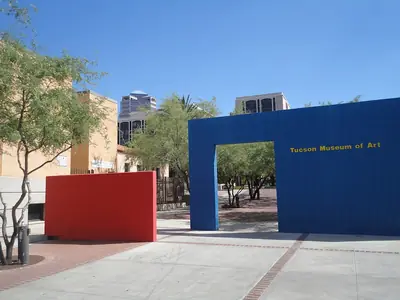
The Tucson Museum of Art occupies a four-acre block in the Presidio District, where contemporary galleries share space with some of the city’s oldest surviving homes. It is the largest visual arts institution in Southern Arizona, with 74,000 square feet of exhibition space and a permanent collection of more than 12,000 works.
Art of the American Southwest is at the collection’s core, alongside Latin American, Asian, Modern, and Contemporary holdings. The historic block itself is part of the experience: La Casa Cordova, built in 1848, is one of the buildings incorporated into the museum complex.
Cathedral of Saint Augustine
The Cathedral of Saint Augustine is the cathedral and mother church of the Catholic Diocese of Tucson. Its history reaches back to a chapel founded in 1776 at the Real Presidio de San Agustín.
The present appearance reflects a major transformation in 1928, when the brick structure received a Mexican Baroque façade inspired by the Cathedral of Querétaro in Mexico. Its towers, sculpted niches, and carved details also echo Mission San Xavier del Bac. The coat of arms of Pope Pius the Eleventh appears above the central doorway.
Presidio and downtown historic buildings
Tucson’s early history is visible in the buildings around its downtown and Presidio districts. The Arizona Daily Star Building, completed in 1883, is a two-story Italianate landmark designed by Alexander P. Petit. It offers a glimpse of the city’s nineteenth-century architecture.
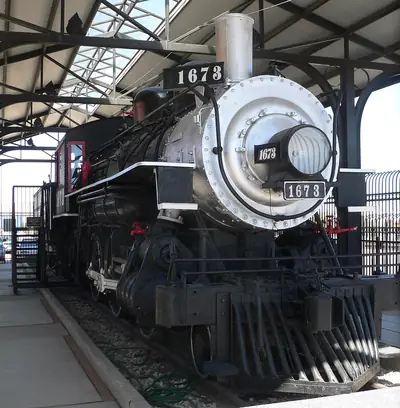
The Southern Arizona Transportation Museum occupies the former records vault of the historic Southern Pacific Depot. Its central object is Southern Pacific locomotive number 1673, a 2-6-0 M-4b Mogul built by the Schenectady Locomotive Works of New York in November 1900. The railroad reached Tucson on March 20, 1880, connecting the city to markets, goods, and new possibilities.
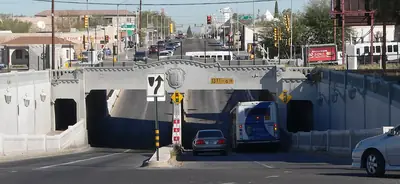
Stone Avenue Underpass, or Lake Elmira
The Stone Avenue Underpass carries traffic beneath the Union Pacific railroad tracks. Completed in January 1936, it became known locally as Lake Elmira because heavy monsoon rains once caused it to fill rapidly.
The nickname refers to a 1937 incident in which thirteen-year-old Elmira Doakes swam across the flooded underpass. A zinc plaque installed in the 1980s recounts the story in English and Spanish, including the route from the Toole Avenue landing to the northern shore.
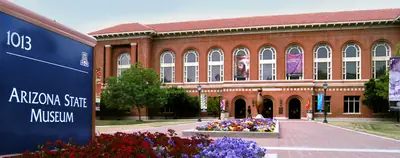
Arizona State Museum
On the University of Arizona campus, the Arizona State Museum explores the cultural heritage and history of the American Southwest. Founded in 1893 under the authority of the Arizona Territorial Legislature, it began as a repository for archaeological resources and now supports collections, exhibitions, education, and research.
The Pottery Project is one of its notable attractions, bringing together ancient and contemporary Native American pottery from the Southwest. Other displays address textiles, jewelry, mining in Arizona, food, agriculture, and the relationship between the environment and Native American communities.
J. Knox Corbett House
The J. Knox Corbett House is a Mission Revival home completed in 1907. Its stucco walls, arched openings, original furnishings, and European art reflect the tastes and lifestyle of one of Tucson’s prominent early families.
The house also had one of the area’s earliest air-conditioning systems. Guided visits take place on Sundays, and the property is not open for drop-in visits, so it is a destination to plan rather than simply pass through.
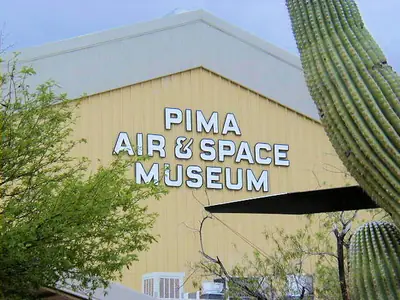
Pima Air & Space Museum
The Pima Air & Space Museum presents nearly 400 aircraft across an 80-acre desert campus. The entire site covers 127 acres, making it one of the world’s largest aviation museums.
Historic neighborhoods
Several Tucson neighborhoods add architectural and urban context to a city visit. The Miracle Mile Historic District follows a corridor along North Stone Avenue, Drachman Street, Oracle Road, and Miracle Mile; it was listed on the National Register of Historic Places in 2017.
The Pie Allen and San Clemente Historic Districts preserve distinct residential areas within the city. Aldea Linda, developed around 1947, is characterized by large lots, curving cul-de-sacs, and homes set back from the street. Its 75 acres contain 22 large lots and examples of Ranch, Modern, Sonoran Revival, and Spanish Colonial Revival architecture.
Colonia Solana, listed on the National Register of Historic Places in January 1989, reflects Tucson’s changing residential character through a mixture of architectural styles. Two of its homes stand out for their Pueblo Revival design, with thick adobe walls and rounded corners.
Explore Tucson with a self-guided audio tour
A Tucson self-guided walking tour lets you discover the city without joining a group or following a fixed timetable. Neywo’s free Tucson audio guide includes three walking tours and one bus route:
- Presidio and Barrio: Where Tucson Began — 3.7 km, 91 minutes, 8 narrated stops
- Rails, Marquees and Dillinger: Downtown Tucson — 1.9 km, 75 minutes, 10 narrated stops
- Old Main to Bear Down: A University of Arizona Stroll — 2.37 km, 70 minutes, 8 narrated stops
- Sun Tran 3: Downtown Tucson by Local Bus — 13.5 km, 58 minutes, 6 narrated stops
The tours cover places including the Cathedral of Saint Augustine, Tucson Museum of Art, Arizona State Museum, Stone Avenue Underpass, Arizona Daily Star Building, and Southern Arizona Transportation Museum. With Neywo, the app tells the story of each place as you reach it, at your own pace, with no group and no schedule.
Download the Neywo audio guide for Tucson
Download Neywo to explore Tucson with an audio guide that follows your route. Choose from three walks or the bus route, and let each story play when you arrive at the next stop. It is a flexible way to experience Tucson’s historic districts, museums, university landmarks, and railroad history independently.
Tucson is also a starting point for discovering other destinations in the United States, including Phoenix, Tempe, Tombstone, and Yuma.
Places with an audio guide in Tucson
8 places in Tucson with a Neywo audio guide. Each one starts telling its story as you reach it.
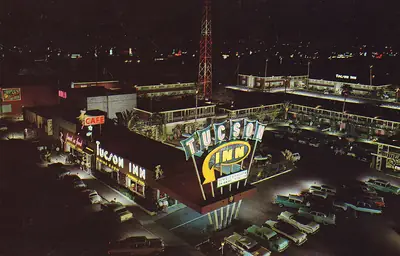
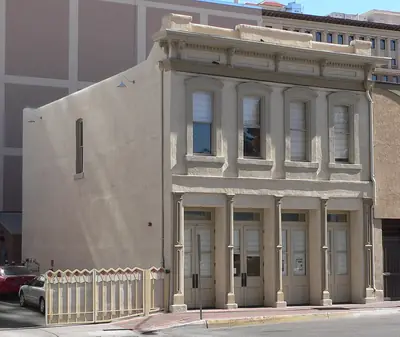
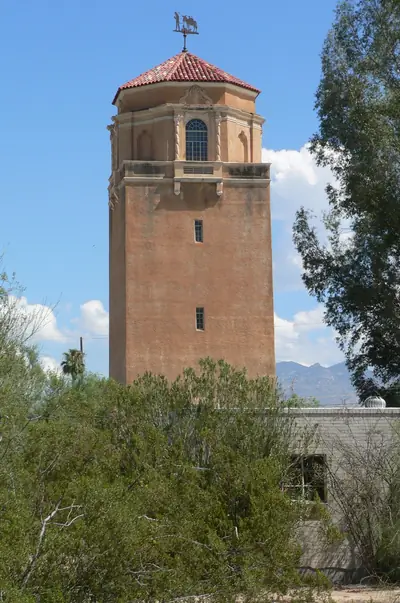
Self-guided tours in Tucson
4 tours in Tucson, free in the Neywo app. Each stop tells its story as you reach it.
- Bus ride
Sun Tran 3: Downtown Tucson by Local Bus
A regular Sun Tran city bus through the historic core: the adobe Sosa-Carrillo-Fremont House, the Tucson Museum of Art block, the Arizona Daily Star Building, the triangular MacArthur Building and the legendary Lake Elmira underpass. Cheap and easy way to link downtown's sights.
Sosa-Carrillo-Fremont House · Tucson Museum of Art · Arizona Daily Star Building · MacArthur Building, Tucson · Stone Avenue Underpass · Haynes Building
Open this tour: Sun Tran 3: Downtown Tucson by Local Bus - Walk
Presidio and Barrio: Where Tucson Began
Start at the largest adobe building in Arizona, then follow the old Spanish presidio quarter north: a wishing shrine for a sinner, a century-old Spanish-language theatre, a Mexican Baroque cathedral and adobe houses. It ends on the historic block of the Tucson Museum of Art and the county courthouse that Dillinger once knew.
Santa Cruz Catholic Church · El Tiradito · Teatro Carmen · Museum of Contemporary Art · Cathedral of Saint Augustine · Sosa-Carrillo-Fremont House …
Open this tour: Presidio and Barrio: Where Tucson Began - Walk
Rails, Marquees and Dillinger: Downtown Tucson
Walk Congress Street and the old railroad district, from a flooded underpass with its own legend to the hotel where John Dillinger's gang hid in 1934. Vaudeville and movie palaces, a triangular hotel built for train passengers and a locomotive you can climb: downtown's 20th-century boom in one easy loop.
Stone Avenue Underpass · Arizona Daily Star Building · Pima County Courthouse · Fox Tucson Theatre · James A. Walsh United States Courthouse · J. C. Penney–Chicago Store Building …
Open this tour: Rails, Marquees and Dillinger: Downtown Tucson - Walk
Old Main to Bear Down: A University of Arizona Stroll
Walk across the oldest campus in Arizona, from the Islamic Center and the university's art and anthropology museums to Old Main, the student union, the gym that played the Nerds and the Wildcats' stadium and arena. Stories of 1891 beginnings, 1969 sit-ins and a famous last wish.
Mosque Tucson · Museum of Art · Arizona State Museum · University of Arizona · Student Union Memorial Center · Bear Down Gym …
Open this tour: Old Main to Bear Down: A University of Arizona Stroll
Walk Tucson with Neywo
Neywo turns Tucson into a self-guided audio tour. Stories arrive as you reach the place they belong to, and the route reshapes when you wander off it.

