Visiting Peoria, United States: Top Sights on Foot
Things to Do in Peoria, Illinois
Looking for things to do in Peoria? This Illinois city combines a riverfront museum, historic churches, public art, cultural venues, and buildings that preserve important chapters of its past. Neywo’s free Peoria audio guide narrates 15 places as you explore the city.
Peoria is also a good place to discover on foot. Its downtown sights bring together local history, religious landmarks, theatre, and public art, while the Illinois River provides an important setting for several of the city’s most distinctive places.
What to See in Peoria
Peoria Riverfront Museum
Begin with the Peoria Riverfront Museum, a multidisciplinary museum beside the Illinois River in downtown Peoria. Its collections and exhibitions bring together art, science, history, and achievement. The museum has five major galleries and more than 30 smaller display spaces, with exhibitions ranging from international blockbusters to objects from a permanent collection of 18,000 items.
The building also offers two ways to look beyond the galleries: a 40-foot Digistar 7 dome planetarium and a 70-foot Giant Screen Theater. The museum opened on October 20, 2012, succeeding the Lakeview Museum of Arts and Sciences.
Lakeview Museum of Arts and Sciences
The former Lakeview Museum of Arts and Sciences is part of the story behind Peoria’s current museum scene. It operated from 1965 until 2012 as a public museum of science and culture. When it closed, its assets were transferred to the Peoria Riverfront Museum, carrying its legacy into the newer institution.
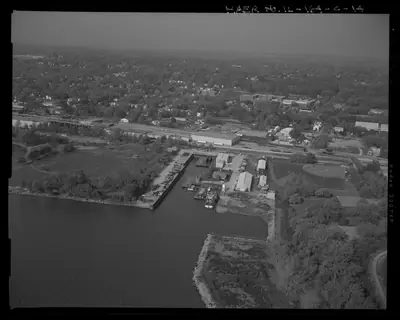
Illinois Waterway Project Office
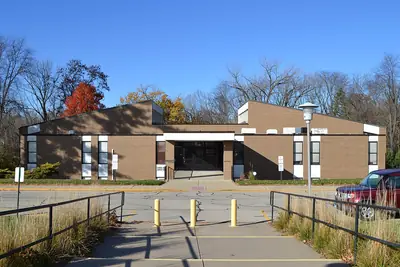
Along the west bank of the Illinois River stands the Illinois Waterway Project Office, a working riverside complex connected to the system of rivers and canals linking the Mississippi River with Lake Michigan.
The U.S. Army Corps of Engineers established the office in 1913 to house and maintain its boats. During the 1920s and 1930s, it developed into the project office and maintenance complex seen today. Most of the buildings date from that later period, and five are recognized as contributing buildings within the historic district.
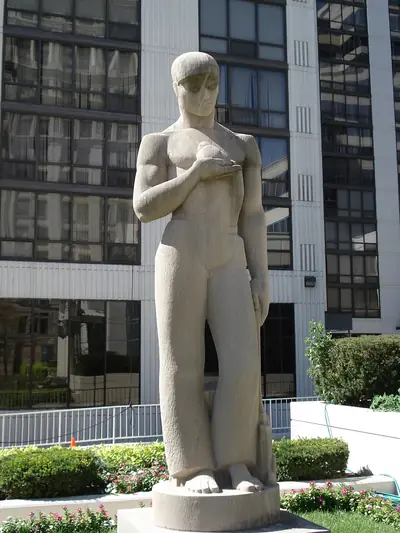
Peace and Harvest
At the corner of Jefferson and Main Streets, two limestone figures stand in front of the Becker Building. Known as Peace and Harvest, the statues were created by Chicago artist Mary Andersen Clark as part of the Works Progress Administration’s Federal Art Project.
The eight-foot figures represent peace and harvest. Created in 1938 and 1939, they have occupied several locations in Peoria, including the former Peoria Municipal Tuberculosis Sanitarium and Peoria Courthouse Plaza. They were placed at their current location in June 1992 and were added to the National Register of Historic Places in 1988.
Madison Theatre
The Madison Theatre recalls Peoria’s moviegoing history. The former movie theatre opened on October 16, 1920, as a silent picture theatre. Its history makes it a notable stop for anyone interested in the buildings and venues that shaped the city’s cultural life.
Cumberland Presbyterian Church
Built in 1856 as the First Cumberland Presbyterian Church, this is the oldest standing church building in Peoria. Although it is no longer a church, the building later served various churches and a synagogue. In 1913, American Federation of Musicians Local 26 purchased it.
First United Methodist Church
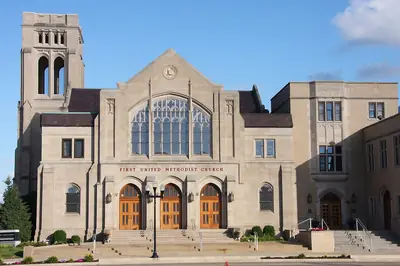
First United Methodist Church is the oldest Protestant church in Peoria. Its congregation was established in the early 1800s, linking the church with the city’s earliest years of development.
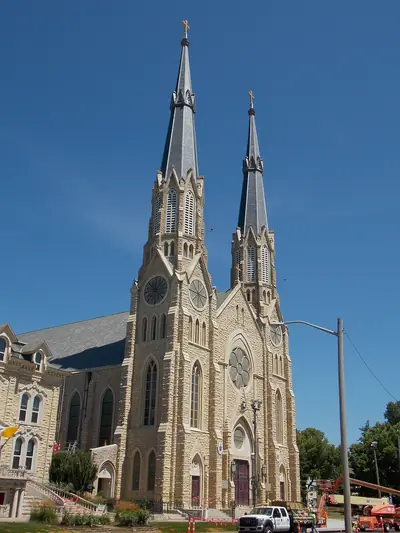
Cathedral of Saint Mary of the Immaculate Conception
The Cathedral of Saint Mary of the Immaculate Conception is the seat of the Diocese of Peoria and one of the city’s important historic landmarks. Catholic mass was celebrated in Peoria as early as 1839, and the Church of Saint Mary was founded in 1846.
The present cathedral was designed by Chicago architect Casper Mehler, using Saint Patrick’s Cathedral in New York as his model. Its cornerstone was laid on June 28, 1885, by Bishop John Lancaster Spalding, and construction was completed in 1889.
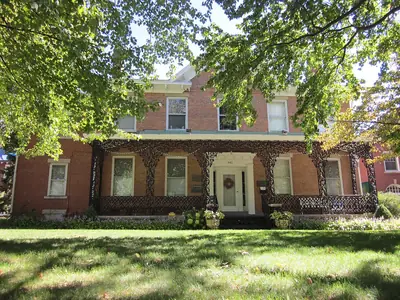
John C. Flanagan House Museum
The John C. Flanagan House Museum, also known as the Judge John C. Flanagan Residence, offers a look at a preserved part of Peoria’s past. The historic house was added to the National Register of Historic Places in 1975 and is operated as a museum by the Peoria Historical Society.
Hartmann Center for the Performing Arts
At Bradley University, the Hartmann Center for the Performing Arts is dedicated to theatre and is the exclusive home of the university’s Department of Theatre Arts. Named for benefactors Jack and Mary Hartmann, the center contains two performance spaces: the 300-seat Meyer Jacobs Theatre and the 75-seat Laboratory Theatre, a black box studio and classroom.
Congregation Anshai Emeth
Congregation Anshai Emeth has been part of Peoria’s Jewish community since 1859. It is the second-oldest Jewish congregation in Illinois and, as of 2019, had the largest membership of any Jewish congregation in Peoria.
St. Paul’s Episcopal Church
St. Paul’s Episcopal Church is an Episcopal parish church with a broader connection to the area’s religious history. Before becoming a parish church, it served as the cathedral of the Diocese of Quincy.
Saint Vincent de Paul Church, St. Bernard Parish, and Grace Presbyterian Church
Peoria’s religious landmarks also include Saint Vincent de Paul Church and St. Bernard Parish, a Roman Catholic church parish. Grace Presbyterian Church is a Protestant congregation affiliated with the Presbyterian Church in America and has about 1,500 members.
Explore Peoria with a Self-Guided Walking Tour
For a Peoria self-guided walking tour, download Neywo and explore at your own pace. The app offers one walking tour in the city: Downtown Peoria: Riverfront, Stage and Steeples, covering 3.57 km in about 93 minutes with seven narrated stops.
The route includes the Peoria Riverfront Museum, Peace and Harvest, Madison Theatre, Cumberland Presbyterian Church, First United Methodist Church, Cathedral of Saint Mary of the Immaculate Conception, and John C. Flanagan House Museum. Each story plays as you reach the place, with no group and no schedule. Narration is available in 11 languages.
Peoria is part of Illinois in the United States. If you are continuing through the state, you can also explore Galesburg, Naperville, or Chicago.
Places with an audio guide in Peoria
8 places in Peoria with a Neywo audio guide. Each one starts telling its story as you reach it.


Self-guided tours in Peoria
1 tour in Peoria, free in the Neywo app. Each stop tells its story as you reach it.
- Walk
Downtown Peoria: Riverfront, Stage and Steeples
Peoria's story runs from the Illinois River bluffs to a cathedral modelled on New York's. Walk from the riverfront museum through public art, a 1920 picture palace and the oldest church buildings in the city, ending at a judge's historic house.
Peoria Riverfront Museum · Peace and Harvest · Madison Theatre · Cumberland Presbyterian Church · First United Methodist Church (Peoria, Illinois) · Cathedral of Saint Mary of the Immaculate Conception …
Open this tour: Downtown Peoria: Riverfront, Stage and Steeples
Walk Peoria with Neywo
Neywo turns Peoria into a self-guided audio tour. Stories arrive as you reach the place they belong to, and the route reshapes when you wander off it.

