Chicago, United States: Self-Guided Walking Tour
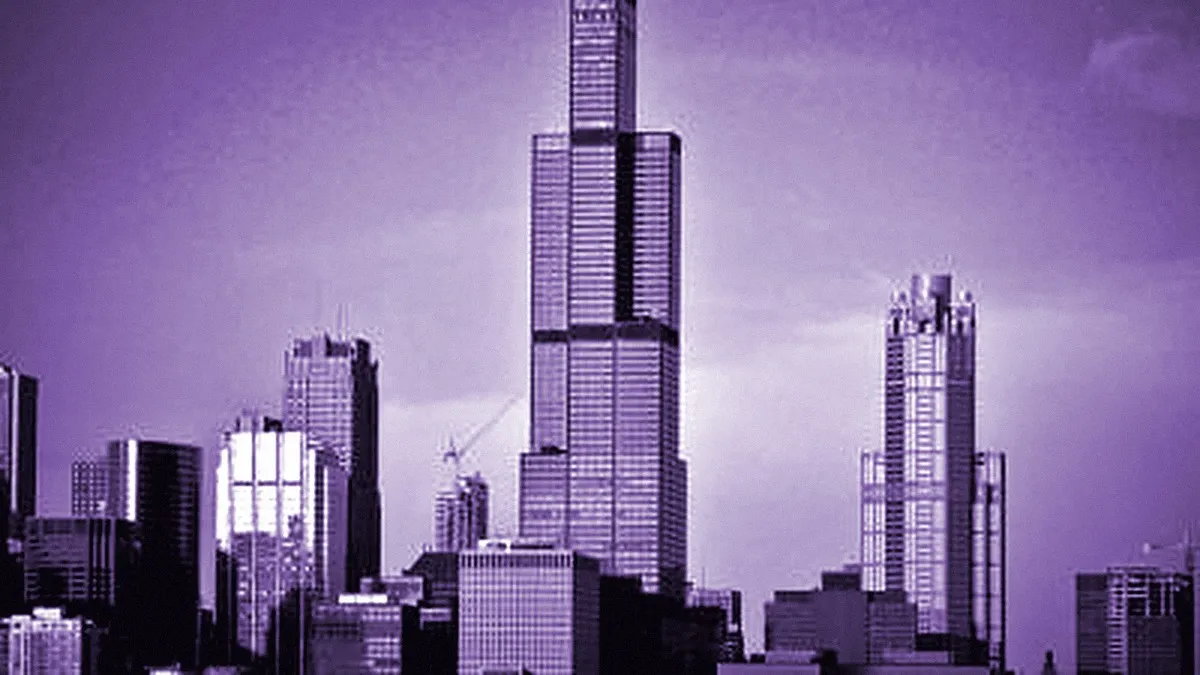
Things to Do in Chicago: What to See on a Self-Guided Walking Tour
The best things to do in Chicago include exploring its architecture, museums, historic churches, and lakefront landmarks. The city’s most compelling sights range from the Art Institute of Chicago and the Chicago Theatre to the Robie House, U-505, and the skyscrapers of the Loop and Magnificent Mile. Neywo’s free Chicago audio guide narrates 132 places across the city.
Chicago is part of Illinois, in the United States, and its neighbourhoods reveal very different sides of the city. You can follow the story of modern architecture through the Loop, encounter major cultural collections in Grant Park and Hyde Park, or explore historic buildings in South Shore, Grand Boulevard, and Kenwood.
What to see in Chicago
Art Institute of Chicago
In Grant Park, the Art Institute of Chicago combines a major art museum with the School of the Art Institute of Chicago. Its collections include nearly 300,000 works, with particular strength in Impressionist and Post-Impressionist painting.
Among its notable works are Caillebotte’s Rue de Paris, temps de pluie, Renoir’s Les Deux Sœurs, and one of Van Gogh’s versions of La Chambre de Van Gogh à Arles. The museum also holds works by Monet, including paintings from the Nymphéas series, Un Pont japonais, Waterloo Bridge, and Meules de foin. More than 30 special exhibitions are added each year.
Chicago Theatre
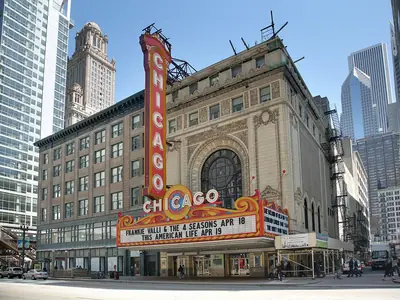
The Chicago Theatre is one of the city’s most recognisable landmarks. Its tall illuminated “CHICAGO” sign and marquee have become an unofficial emblem of the city, appearing in film, television, artwork, and photography.
Built in 1921 for the Balaban and Katz theatre group, the building combines neo-classical and neo-baroque elements. Its architects were Rapp and Rapp. The theatre was added to the National Register of Historic Places in 1979 and designated a Chicago Landmark in 1983.
875 North Michigan Avenue
875 North Michigan Avenue, still often called the John Hancock Center or “Big John”, rises above the Magnificent Mile. The 100-story tower reaches 1,128 feet, or 344 metres, and its antenna masts extend to 1,500 feet, or 457 metres.
When it was completed in 1968, it was the tallest building in Chicago and the second-tallest building in the world. The tower contains offices, restaurants, and around 700 condominiums. Its 360 Chicago observatory offers panoramic views of the city and Lake Michigan.
Robie House
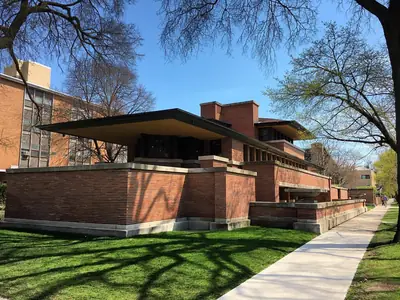
The Robie House is one of Frank Lloyd Wright’s best-known Prairie-style buildings. Designed for manufacturing executive Frederick Carlton Robie and his family, it is organised around two large, offset rectangular forms that create an open floor plan.
Roman brick, concrete trim, cut-stone details, and art glass windows shape the exterior. Several terraces and outward-projecting roofs give the house a layered profile. Inside, communal rooms occupy one section while service spaces fill the other. The building is one of the key stops on a tour of the University of Chicago and its surroundings.
U-505
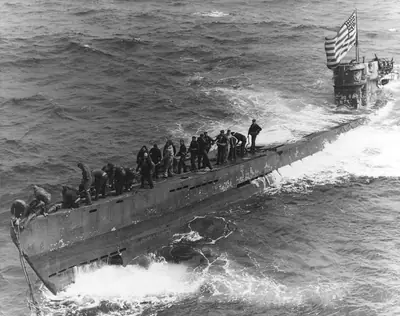
At the Museum of Science and Industry, U-505 is a German World War II submarine preserved as a museum ship. It is described as the most heavily damaged U-boat to successfully return to port.
On June 4, 1944, United States Navy Task Group 22.3 captured the submarine after an engagement with American destroyers. Its logbook and secret code materials were taken, while all but one of the crew were rescued by the task group. U-505 was towed secretly to Bermuda, and its crew was interned in an American prisoner-of-war camp. In 1954, the submarine was donated to the Museum of Science and Industry.
Kenneth C. Griffin Museum of Science and Industry
The Kenneth C. Griffin Museum of Science and Industry, commonly called the Griffin Museum of Science and Industry or MSI, occupies the former Palace of Fine Arts in Jackson Park. The building originally formed part of the 1893 World’s Columbian Exposition.
The museum opened in 1933 during the Century of Progress Exposition. Its Palace of Fine Arts was designed by Charles B. Atwood. Unlike the other buildings of the exposition’s “White City”, its original façade was made from brick covered with plaster. The exterior was later redone in limestone when the building became a science museum.
Nuclear Energy
On the University of Chicago campus, Henry Moore’s bronze sculpture Nuclear Energy marks the site of Chicago Pile-1. On December 2, 1942, scientists led by Enrico Fermi created the first human-made self-sustaining nuclear chain reaction here.
The sculpture was created between 1964 and 1966. Its abstract form is intended to suggest both a human skull and a mushroom cloud. It stands in a granite-paved quadrangle, with radiating paving stones and memorial plaques. The original experiment took place in a squash court beneath the stands of the former Stagg Field.
St. Thomas Church and Convent
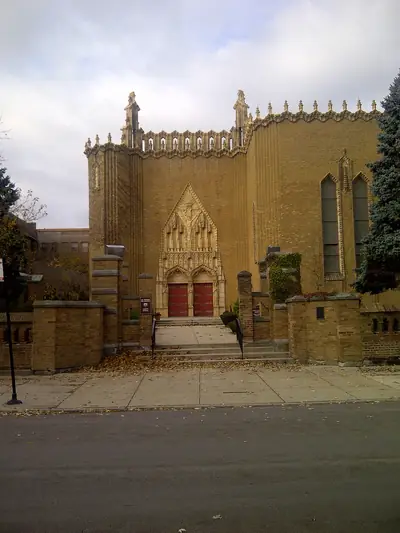
St. Thomas Church and Convent, also known as Saint Thomas the Apostle Catholic Church, is a historic Roman Catholic site in Hyde Park. The church was designed by Barry Byrne, a former student of Frank Lloyd Wright, and combines ideas associated with the Prairie School with modernist design.
The convent was built in 1919, while the church was constructed later during a period of liturgical renewal in the United States. Its projecting altar and lack of interior columns are often cited as anticipating reforms associated with the Second Vatican Council. The site was added to the National Register of Historic Places in 1978.
Stony Island Trust and Savings Bank Building
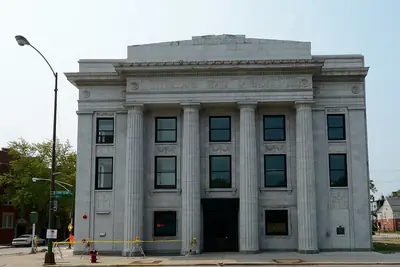
In South Shore, the Stony Island Trust and Savings Bank Building has been transformed from a neighbourhood bank into an arts space. The building opened in 1923 at 6760 S. Stony Island Avenue for a bank founded in 1917.
Architect William Gibbons Uffendell designed it in the Neoclassical style. Its granite façade features a temple front with four Doric columns, an entablature, and a parapet. After the bank folded in 1931, the building passed through other uses and periods of vacancy. Since 2013, when it was added to the National Register of Historic Places, it has been home to the Stony Island Arts Bank, an art gallery and library.
Ebenezer Missionary Baptist Church Building
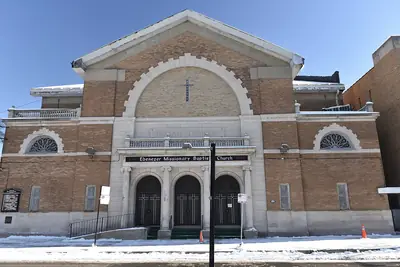
The Ebenezer Missionary Baptist Church Building in Grand Boulevard began as a synagogue. Built in 1899 for the Isaiah Temple congregation, it was designed in the Neoclassical style by Dankmar Adler, who also collaborated with Louis Sullivan on early Chicago skyscrapers.
As African-American settlement changed the neighbourhood’s demographics, the Isaiah Temple congregation sold the building to Ebenezer Missionary Baptist Church in 1921. A gospel choir was formed there in 1931, and the church’s orchestra later hosted performances by rock and roll pioneer Bo Diddley.
Kenwood Evangelical Church
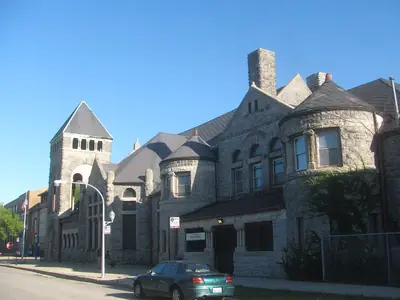
Kenwood Evangelical Church, now known as Kenwood United Church of Christ, is a Romanesque church constructed in 1887. Its historical importance was recognised when it was added to the National Register of Historic Places in 1991 and designated a Chicago Landmark in 2011.
Field Museum of Natural History
The Field Museum of Natural History stands on Museum Campus in the southeast corner of Grant Park, beside Lake Michigan. Its origins go back to the 1893 World’s Columbian Exposition, when it was established to house materials collected for the fair.
The museum opened on September 16, 1893, as the Columbian Museum of Chicago and was renamed in 1905 in honour of Marshall Field. Daniel Burnham and Graham, Anderson, Probst & White designed the building in the Neoclassical style associated with the exposition, including architectural references to Greek temples.
Stephen A. Douglas Tomb and Memorial
The Stephen A. Douglas Tomb and Memorial combines the final resting place of the U.S. senator with the history of the Civil War era in Chicago. The land originally belonged to Douglas’s estate before being sold to the state of Illinois. It later became Camp Douglas, first a Union training ground and then a prisoner-of-war camp.
The memorial is a 96-foot granite structure with three circular bases and an octagonal mausoleum containing Douglas’s sarcophagus. Bronze allegorical figures represent Illinois, History, Justice, and Eloquence, while a statue of Douglas stands above a white marble column.
Union Stock Yard Gate
The Union Stock Yard Gate is the only significant structural element of the former Union Stock Yards to survive. Designed by Burnham and Root around 1875, the gate was once the entrance to the stock yards. It was designated a National Historic Landmark in 1981.
John W. Griffiths Mansion
The John W. Griffiths Mansion is a historic house at 3806 S. Michigan Avenue in Chicago’s Douglas community area. It forms part of the city’s architectural and residential history beyond the better-known skyscrapers of the central districts.
Explore Chicago with a free audio guide
Neywo offers seven walking tours, one bus route, and one bike route in Chicago, with narration available in 11 languages. The walks range from 0.79 to 4.38 km and take between 41 and 151 minutes; the bus route covers 3.9 km in 17 minutes, and the bike route covers 6.9 km in 35 minutes.
The routes include:
- Millennium Park and the Art Institute — 2.68 km, 111 minutes, 12 narrated stops
- The Loop: where the skyscraper was invented — 2.16 km, 100 minutes, 12 stops
- Hyde Park: the Museum of Science and Industry — 2.56 km, 69 minutes, 4 stops
- University of Chicago and the Robie House — 0.89 km, 46 minutes, 5 stops
- Chinatown — 0.79 km, 41 minutes, 6 stops
- The river: Wrigley Building, Tribune Tower, Marina City — 1.84 km, 60 minutes, 8 stops
- The Ultimate Chicago: Willis Tower to the Chicago Theatre — 4.38 km, 151 minutes, 10 stops
- Bus 151: Loop Skyscrapers to the Magnificent Mile — 3.9 km, 17 minutes, 9 stops
- Lakefront Trail: Shedd Aquarium to Oak Street Beach — 6.9 km, 35 minutes, 4 stops
Neywo tells the story of each place as you reach it, at your own pace, with no group and no schedule. Download the app and explore Chicago through its architecture, museums, historic neighbourhoods, and lakefront landmarks.
Places with an audio guide in Chicago
8 places in Chicago with a Neywo audio guide. Each one starts telling its story as you reach it.
Self-guided tours in Chicago
11 tours in Chicago, free in the Neywo app. Each stop tells its story as you reach it.
- Bike ride
Lakefront Trail: Shedd Aquarium to Oak Street Beach
Ride the car-free Lakefront Trail along Lake Michigan, from the Shedd Aquarium on the Museum Campus through Maggie Daley Park to the Navy Pier waterfront and Oak Street Beach, with the skyline on one side and the lake on the other.
Shedd Aquarium · Maggie Daley Park · Polk Bros Park · Oak Street Beach
Open this tour: Lakefront Trail: Shedd Aquarium to Oak Street Beach - Bike ride
Dearborn Street protected lane · Loop skyscrapers by bike
5 narrated places along the way: Manhattan Building, Monadnock Building, Inland Steel Building, Richard J. Daley Center, Marina City.
Manhattan Building · Monadnock Building · Inland Steel Building · Richard J. Daley Center · Marina City
Open this tour: Dearborn Street protected lane · Loop skyscrapers by bike - Bus ride
Bus 151: Loop Skyscrapers to the Magnificent Mile
CTA bus 151 is a cheap sightseeing ride through the birthplace of the skyscraper. It starts among the Loop's early towers, crosses the Chicago River on Michigan Avenue Bridge past the Tribune Tower, and climbs the Magnificent Mile to the Water Tower and the Palmolive Building.
Willis Tower · Federal Reserve Bank of Chicago · Monadnock Building · Reliance Building · Carbide & Carbon Building · Michigan Avenue Bridge …
Open this tour: Bus 151: Loop Skyscrapers to the Magnificent Mile - Bus ride
Bus 151 · Union Station to Lincoln Park
Board at Jackson & Franklin, alight at Michigan & Oak. 10 narrated places along the way: Willis Tower, Federal Reserve Bank of Chicago, Monadnock Building, Reliance Building, Millennium Monument, Carbide & Carbon Building, Michigan Avenue Bridge, Tribune Tower, Chicago Water Tower, Palmolive Building.
Willis Tower · Federal Reserve Bank of Chicago · Monadnock Building · Reliance Building · Millennium Monument · Carbide & Carbon Building …
Open this tour: Bus 151 · Union Station to Lincoln Park - Walk
Millennium Park and the Art Institute
Cloud Gate, the Crown Fountain, Gehry's bandshell and the Lurie Garden, with the Art Institute's Impressionist and American collections on the south side of the park and the restored Chicago Theatre at the north end.
Aon Center · Jay Pritzker Pavilion · BP Pedestrian Bridge · Lurie Garden · Art Institute of Chicago · Crown Fountain …
Open this tour: Millennium Park and the Art Institute - Walk
The Loop: where the skyscraper was invented
A kilometre and a half of architectural history — the Rookery, the Monadnock, the Marquette, the Manhattan Building, the Board of Trade — ending at the Willis Tower and its glass ledge, 412 metres up.
Manhattan Building · Harold Washington Library · Old Colony Building · Fisher Building · Monadnock Building · Sullivan Center …
Open this tour: The Loop: where the skyscraper was invented - Walk
Hyde Park: the Museum of Science and Industry
The last surviving building of the 1893 World's Fair, now holding a captured German U-boat you can walk through, with the site of the first self-sustaining nuclear reaction a few streets north.
Nuclear Energy · St. Thomas Church and Convent · Kenneth C. Griffin Museum of Science and Industry · U-505
Open this tour: Hyde Park: the Museum of Science and Industry - Walk
University of Chicago and the Robie House
A kilometre of Gothic quadrangles, Rockefeller Chapel, the ancient Near East collections, and Frank Lloyd Wright's Robie House — the Prairie School at its most complete.
Midway Plaisance · Rockefeller Chapel · Institute for the Study of Ancient Cultures, West Asia & North Africa · Robie House · Hutchinson Commons
Open this tour: University of Chicago and the Robie House - Walk
Chinatown
Eight hundred metres around Wentworth and Chinatown Square: the Nine Dragon Wall, the Pui Tak Center in the 1928 On Leong building, and the small but good Chinese American Museum.
Chinatown Square · Nine Dragon Wall · Pui Tak Center · St. Therese Chinese Catholic Church · Chinese American Museum of Chicago · Chinese Christian Union Church
Open this tour: Chinatown - Walk
The river: Wrigley Building, Tribune Tower, Marina City
Both banks at the Michigan Avenue Bridge, where Chicago was founded — the white terracotta Wrigley Building, the Gothic Tribune Tower with fragments of world monuments set into its walls, and the corncob towers of Marina City.
Tribune Tower · Wrigley Building · Michigan Avenue Bridge · London Guarantee Building · Carbide & Carbon Building · Marina City …
Open this tour: The river: Wrigley Building, Tribune Tower, Marina City - Walk
The Ultimate Chicago: Willis Tower to the Chicago Theatre
Four and a half kilometres through the Loop's founding skyscrapers, Grant Park, the Art Institute and Cloud Gate. Architecture is the subject and this is the densest line through it.
Willis Tower · Federal Reserve Bank of Chicago · Rookery Building · Old Colony Building · Manhattan Building · Grant Park …
Open this tour: The Ultimate Chicago: Willis Tower to the Chicago Theatre
Walk Chicago with Neywo
Neywo turns Chicago into a self-guided audio tour. Stories arrive as you reach the place they belong to, and the route reshapes when you wander off it.

