Dubuque, United States: Self-Guided Walking Tour
Things to Do in Dubuque: Historic Landmarks, River Views and Hilltop Churches
The best things to do in Dubuque include exploring its Mississippi River waterfront, historic downtown, distinctive architecture and hilltop churches. From a working steam-powered dredge and one of the last remaining shot towers in the United States to a historic funicular and an art museum with works by Grant Wood, Dubuque offers plenty to see in a compact, characterful city. Neywo has a free audio guide for Dubuque with 18 narrated places, available in 11 languages.
What to See in Dubuque
National Mississippi River Museum & Aquarium and William M. Black
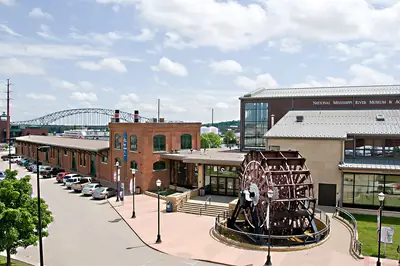
The National Mississippi River Museum & Aquarium is a riverfront museum made up of the Mississippi River Center and the National River Center. It began in 1982 as the Fred W. Woodward Riverboat Museum before expanding into the institution it is today.
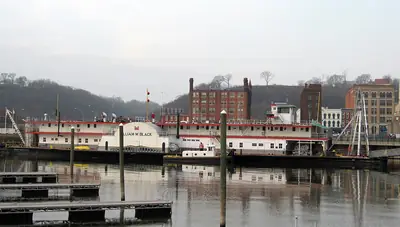
Its campus also includes the William M. Black, a working vessel with a second life as a museum ship. Built in 1934, this steam-powered sidewheel dustpan dredge is one of only four surviving dredges built for the United States Army Corps of Engineers. It is open for tours as part of the museum.
Shot Tower
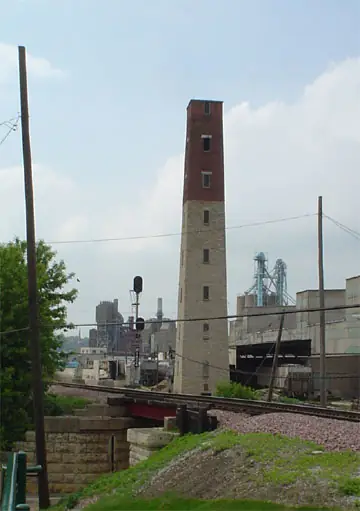
Near the Mississippi River, the Shot Tower is one of Dubuque’s most recognizable landmarks. Rising 120 feet and 5 inches—about 36.7 metres—it is one of the last remaining shot towers in the United States and can be seen from the riverwalk.
The tower is listed on the National Register of Historic Places. Extensive renovations began in 2004 to help preserve the unusual structure.
Old Main Street Historic District
Old Main Street Historic District preserves Dubuque’s earlier commercial centre in a streetscape of brick buildings, generally three or four storeys high. Its location near the ferry and riverboat landings once made it the city’s main business district.
After 1860, larger retailers, banks and professional offices moved farther north along Main Street, while wholesale businesses took over the older area. The district is known for its concentration of nineteenth-century commercial architecture. Notable buildings include Bishop’s Block, completed in 1887, and the German Bank, completed in 1901.
Dubuque County Jail
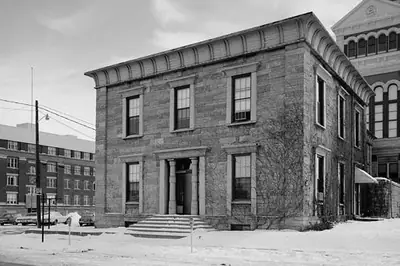
At 36 East 8th Street, the Dubuque County Jail stands out for its rare Egyptian Revival design. Completed in 1858, it served as a jail for more than a century and was designated a National Historic Landmark in 1987.
The building became a museum in 1975 before being converted into county offices in 2016. Its changing uses form an unusual part of Dubuque’s architectural history.
Dubuque Museum of Art
The Dubuque Museum of Art occupies the former Statesman Bank building and holds a collection of more than 2,500 works. One of its particular strengths is its collection of works by Grant Wood.
Founded in 1987, the museum grew out of the Dubuque Art Association, which had operated intermittently since 1874. It is a useful stop for understanding the city’s artistic life as well as the wider collection.
Five Flags Center
The Five Flags Center is a multi-purpose downtown venue also known as the Five Flags Theater. Its name refers to the five flags that have flown in Dubuque: the Royal French Flag, the Royal Flag of Spain, the Union Jack of Great Britain, the flag of the French Republic and the flag of the United States.
The sequence reflects the city’s changing political history, including the Royal French Flag from 1673 to 1763, the Spanish period from 1763 to 1803, and the continuing presence of the United States flag from 1803.
St. Raphael’s Cathedral
St. Raphael’s Cathedral serves the Archdiocese of Dubuque. Its parish is the oldest congregation of any Christian denomination in the state of Iowa, making the cathedral an important religious landmark in the city.
Fenelon Place Elevator
The Fenelon Place Elevator, also called the Fourth Street Elevator, is an unusual funicular railway running along a narrow-gauge track. The track is only three feet, or 914 millimetres, wide.
Its distinctive engineering and place in Dubuque’s history earned it a listing on the National Register of Historic Places in 1978. It is one of the city’s most memorable ways to experience the steep transition between downtown and the bluff.
Andrew-Ryan House
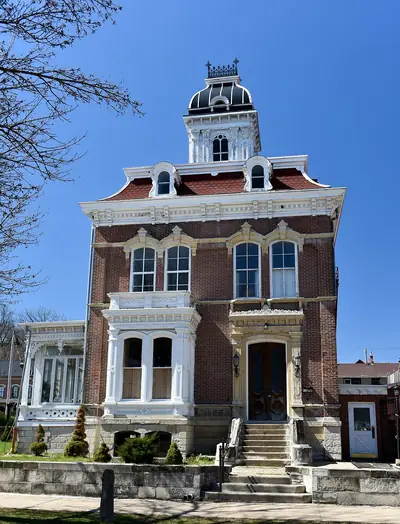
The Andrew-Ryan House is one of Dubuque’s finest examples of Second Empire architecture and is also considered one of the best examples of the style in Iowa. Designed by Dubuque architect Fridolin J. Herr Senior, the two-storey brick house is marked by a mansard roof, arched windows, tall chimneys and a prominent belvedere.
Classical mouldings appear on its pilasters, belt courses and stonework. The house was moved between 1885 and 1890, and its south-side porches may have been added around that time. It was listed individually on the National Register of Historic Places in 1985 and became part of the Jackson Park Historic District the following year.
Dubuque’s Historic Churches
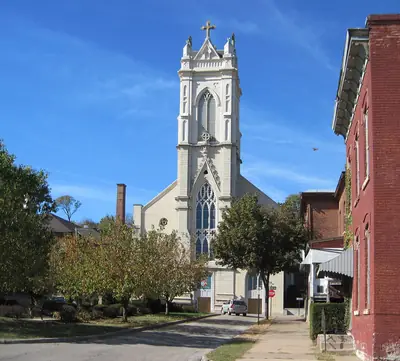
Dubuque’s hilltop churches create one of the city’s most distinctive skylines. Sacred Heart Catholic Church is especially easy to recognize because of its two spires, visible from several miles away. The eastern spire rises more than 200 feet and contains four large clocks, while the western spire is about 130 feet tall. The church was also one of the Dubuque locations used for filming F.I.S.T., starring Sylvester Stallone.
Holy Ghost Catholic Church forms part of a historic parish group that includes the church, school, rectory and convent. Together, these buildings were listed as a historic district on the National Register of Historic Places in 2011.
Saint Joseph the Worker Catholic Church was created in 1949 by Archbishop Rohlman and became Dubuque’s tenth Catholic parish. It is part of the Archdiocese of Dubuque.
Eagle Point Park
Eagle Point Park occupies 164 acres on a bluff above the Mississippi River in the northeast corner of Dubuque. Its elevated position gives it views across the river and toward Lock and Dam Number 11.
Owned and operated by the city, the park is both a broad public landscape and a historic district. It was listed on the National Register of Historic Places in 2017; the district included 34 resources at the time of its nomination.
Julien Dubuque Monument
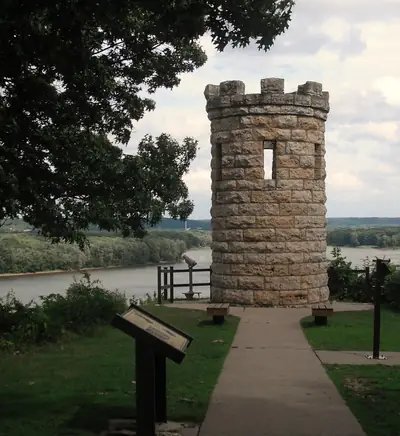
The Julien Dubuque Monument stands in a valley in Dubuque County, surrounded by a mostly flat landscape largely covered by farmland. Its rural setting offers a contrast to the city’s riverfront, downtown streets and elevated bluffs.
Explore Dubuque with a Self-Guided Audio Tour
A Dubuque self-guided walking tour lets you explore the city without joining a group or following a fixed schedule. Neywo’s free Dubuque audio guide includes two walking tours and one bus route:
- Riverboats, Funiculars and Egyptian Jails: Dubuque’s Riverfront to the Bluff — a 3.64 km walk lasting 101 minutes, with 8 narrated stops.
- Steeples and Mansard Roofs: Dubuque’s Hilltop Churches — a 4.87 km walk lasting 108 minutes, with 7 narrated stops.
- The Jule Green Line: Five Churches and an Egyptian Jail — a 22.3 km bus route lasting 96 minutes, with 5 narrated stops.
The tours cover places including the Shot Tower, William M. Black, Old Main Street Historic District, Dubuque County Jail, Fenelon Place Elevator, Andrew-Ryan House and several churches. Each story plays as you reach the place, at your own pace, with no group and no schedule.
Download Neywo and Explore Dubuque at Your Own Pace
Download Neywo to explore Dubuque with a free audio guide that brings the city’s landmarks to life as you reach them. Choose between two walks and one bus route, covering 18 narrated places in total, and discover the riverfront, historic streets, funicular, museums and hilltop churches on your own.
Dubuque is in Iowa, in the United States. If you are continuing through the state, you can also explore Cedar Rapids, Waterloo or Le Claire.
Places with an audio guide in Dubuque
8 places in Dubuque with a Neywo audio guide. Each one starts telling its story as you reach it.

Self-guided tours in Dubuque
3 tours in Dubuque, free in the Neywo app. Each stop tells its story as you reach it.
- Bus ride
The Jule Green Line: Five Churches and an Egyptian Jail
Ride The Jule's Green Line through Dubuque's neighbourhoods, from Holy Ghost in the north to the Egyptian Revival county jail and Saint Patrick's near downtown. A cheap, local way to see how the city's parishes and public buildings spread across the bluffs.
Holy Ghost Catholic Church · Saint Mary's Catholic Church · Sacred Heart Catholic Church · Dubuque County Jail · Saint Patrick's Church
Open this tour: The Jule Green Line: Five Churches and an Egyptian Jail - Walk
Riverboats, Funiculars and Egyptian Jails: Dubuque's Riverfront to the Bluff
Start at the old lead shot tower, step down to a 1934 steam dredge on the Mississippi harbour, then walk into Old Main Street's brick warehouses. Pass the Egyptian Revival jail, the museum in a former bank, the theatre named for five flags and the oldest congregation in Iowa, and finish by riding the world's shortest, steepest little railway up the bluff.
Shot Tower · William M. Black · Old Main Street Historic District · Dubuque County Jail · Dubuque Museum of Art · Five Flags Center …
Open this tour: Riverboats, Funiculars and Egyptian Jails: Dubuque's Riverfront to the Bluff - Walk
Steeples and Mansard Roofs: Dubuque's Hilltop Churches
Climb away from the river into the historic neighbourhoods where Dubuque's Irish, German and Yankee settlers built their showpieces. A Second Empire mansion with a belvedere, a handful of landmark churches and the twin spires of Sacred Heart show how the city looked at the height of its Victorian prosperity.
Fenelon Place Elevator · Andrew-Ryan House · St. John's Episcopal Church · Saint Patrick's Church · Saint Mary's Catholic Church · Sacred Heart Catholic Church …
Open this tour: Steeples and Mansard Roofs: Dubuque's Hilltop Churches
Walk Dubuque with Neywo
Neywo turns Dubuque into a self-guided audio tour. Stories arrive as you reach the place they belong to, and the route reshapes when you wander off it.

