What to See in Grand Rapids, United States: Free Audio Guide
Things to Do in Grand Rapids: Museums, Architecture, and Public Art
The best things to do in Grand Rapids include exploring museums along the Grand River, discovering historic churches and houses, and experiencing the city’s strong public-art tradition. From Gerald Ford’s presidential history to Frank Lloyd Wright’s Prairie School architecture, Grand Rapids offers plenty to see on foot. Neywo also has a free audio guide for Grand Rapids with 46 narrated places.
What to See in Grand Rapids
Gerald R. Ford Presidential Museum
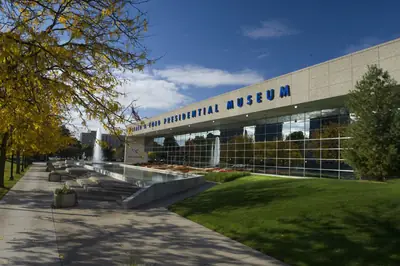
On the west bank of the Grand River, the Gerald R. Ford Presidential Museum explores the life and presidency of America’s 38th president. Its exhibits follow Gerald Ford from childhood and college through his presidency from 1974 to 1977, while also highlighting Betty Ford’s contributions as First Lady.
The collection includes Ford’s Eagle Scout memorabilia, college football jersey, and objects from his 1976 presidential campaign. Visitors can also see a reconstructed Oval Office, the weapon used in the 1975 assassination attempt in Sacramento, and a holographic experience featuring Ford’s international travels. The museum is also the final resting place of Gerald and Betty Ford.
The building is notable in its own right: a two-story triangular structure completed in 1981 with support from more than 14,000 donations. It stands in a 20-acre park complex near the Pew Campus of Grand Valley State University, alongside the Public Museum of Grand Rapids.
Public Museum of Grand Rapids
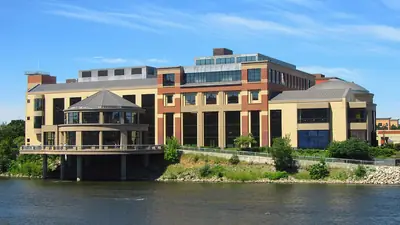
The Public Museum of Grand Rapids brings science, history, and culture together across three floors of exhibits. Founded in 1854 as the Grand Rapids Lyceum of Natural History, it is one of the oldest history museums in the United States.
Its collection contains more than 250,000 artifacts. Exhibits explore the region’s natural habitats, local geology, and cultural history, including the story of the Anishinabek people, the Native Americans of West Michigan. Reconstructed environments make the past especially tangible, including an 1890s Grand Rapids street and an early twentieth-century furniture factory.
A 1928 Spillman carousel stands in a pavilion over the Grand River, accompanied by a Wurlitzer number 157 Band Organ with 165 rolls of music. It is one of the museum’s most distinctive experiences.
Grand Rapids Art Museum
The Grand Rapids Art Museum traces artistic traditions from the Renaissance to modern times, with European and American works represented across several centuries. Its collection includes thousands of pieces, among them more than 3,500 prints, drawings, and photographs. Richard Diebenkorn’s 1963 painting Ingleside is one of its notable works.
The museum began in 1910 as the Grand Rapids Art Gallery. After occupying a residence and later the historic Federal Building on Pearl Street, it moved into its present building in 2004. The 125,000-square-foot structure is an architectural landmark designed with sustainability in mind and received LEED Gold certification.
La Grande Vitesse
Between City Hall and the Kent County Building, La Grande Vitesse is one of Grand Rapids’s best-known landmarks. American artist Alexander Calder created the immense red steel sculpture, which locals often call “The Calder.”
Installed in 1969, it rises 43 feet high, stretches 54 feet long, and is 30 feet wide. Weighing 42 tons, it was fabricated in Tours, France and shipped in 27 pieces before being assembled in Grand Rapids. Its abstract design initially provoked strong debate, but the sculpture endured and came to represent the city’s commitment to public art and cultural innovation.
Cathedral of Saint Andrew
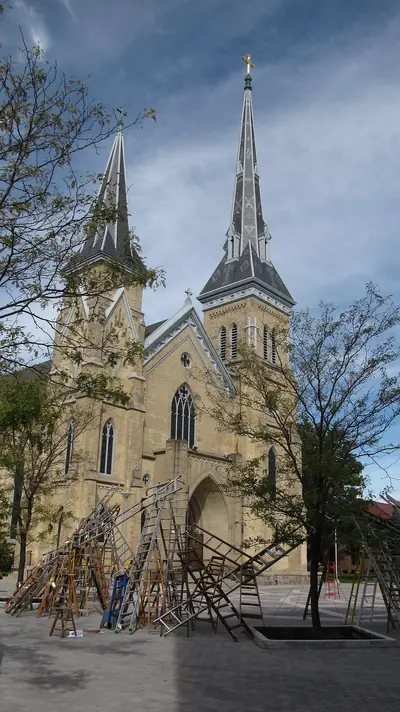
The Cathedral of Saint Andrew is the seat of the Diocese of Grand Rapids. Its Gothic Revival design includes pointed-arch entrances, towers of unequal height, and a north tower and spire rising 192 feet above the city.
The present cathedral was built in 1903 after an earlier church was destroyed by fire in 1901. Its cruciform plan is constructed from pale yellowish-white Milwaukee brick. Inside, stained-glass windows from studios including F. X. Zettler of Munich, Mayer and Company of Munich, add to the richly decorated interior.
First (Park) Congregational Church
Also known as Park Church, First (Park) Congregational Church is one of downtown Grand Rapids’ historic landmarks. The congregation began in 1836 as a Presbyterian congregation and reorganized three years later as the First Congregational Church of Grand Rapids.
The present Gothic building was constructed between 1868 and 1869. It is the second-oldest church building in Grand Rapids and was added to the National Register of Historic Places in 1982. Its white-yellow brick façade, stone trim, corner tower, octagonal belfry, and stained-glass collection make it worth a closer look.
Meyer May House
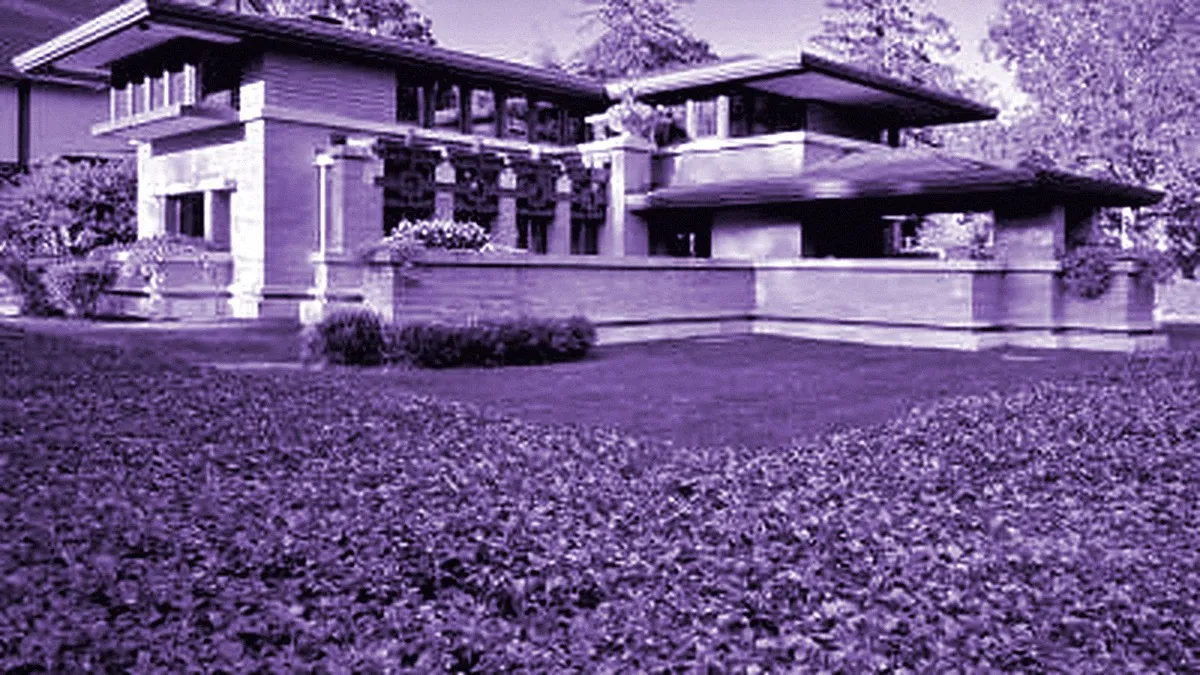
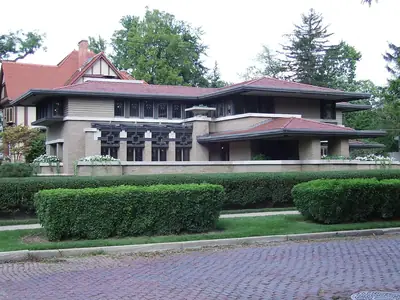
In the Heritage Hill Historic District, the Meyer May House offers an intimate introduction to Frank Lloyd Wright’s Prairie School style. Built between 1908 and 1909 for clothier Meyer S. May and his wife, Sophie, it was a clear departure from the Victorian-era houses around it.
The low-pitched roof, strong horizontal lines, block-like forms, and extensive leaded glass reflect Wright’s vision of organic architecture. Inside, 108 windows and skylights fill the house with natural light. The living room is especially striking, with clerestory windows and skylights creating changing patterns of light and shadow. Reproduced furnishings and recreated leaded-glass designs help restore the atmosphere of the early twentieth century.
Wealthy Theatre and the Avenue for the Arts
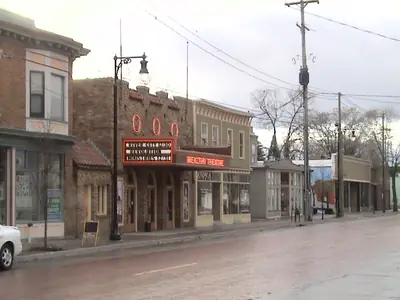
Wealthy Theatre is a lively performance space offering films, live music, theatre, and dance. Nearby, the Avenue for the Arts Artposts brings art into the surrounding streetscape, encouraging visitors to pause and experience creative work as part of the city.
The same area also includes Fountain Street Church. Founded in 1869 as Fountain Street Baptist Church, the congregation later became independent, non-denominational, and liberal as its religious identity changed.
Cultivate
At 540 Wealthy Street, Cultivate occupies a beautifully restored American Craftsman house. Built in 1875 by Henry Fairchild, the property was carefully restored in 2017 after decades of neglect.
Its exterior features a detailed façade, layered roofline, bay windows, embellished gables, and three porches. Inside, ten-foot ceilings, full-height windows, refinished oak floors, geometric woodwork, ornate hinges, and sliding doors reveal the care taken during the restoration. Even smaller details stand out, including a house number set into the vestibule floor tile and a stylized floral carving on the newel post.
More places to explore
The Grand Rapids African American Museum and Archives offers another cultural stop in the city. Families can explore hands-on exhibits at the Grand Rapids Children’s Museum, including the Little Grand Rapids area, a bubble room, robotics, sensory zones, and a real beehive.
John Ball Zoo occupies ravines and bluffs on the western edge of its property and is home to more than 2,000 individual animals representing over 200 species. On the city’s west side, the Basilica of St. Adalbert reflects the Polish origins of the parish’s first worshippers. The present basilica was built between 1907 and 1913 and became a minor basilica in 1979.
Grand Rapids Self-Guided Walking Tour
A Grand Rapids self-guided walking tour is a practical way to connect the city’s museums, landmarks, and historic buildings. Neywo’s two walks cover different sides of the city:
- Furniture City: River, Art and Civic Pride — 3.34 km, 99 minutes, and 11 narrated stops. The route includes the Gerald R. Ford Presidential Museum, Public Museum of Grand Rapids, Grand Rapids Blue Bridge, Grand Rapids Art Museum, La Grande Vitesse, First (Park) Congregational Church, and other civic landmarks.
- Heritage Hill: Mansions, Wright and a Boyhood Home — 3.77 km, 85 minutes, and 7 narrated stops. Stops include the Cathedral of Saint Andrew, Meyer May House, and the President Gerald R. Ford, Jr. Boyhood Home.
Together, the walks provide a focused introduction to Grand Rapids’ riverfront history, public art, civic architecture, and residential heritage.
Explore Grand Rapids with Neywo
Download Neywo to explore Grand Rapids with two walking tours covering 7.11 km in total, with 184 minutes of narration and 18 narrated stops across both routes. The app tells the story of each place as you reach it, at your own pace, with no group and no schedule. Narration is available in 11 languages.
Grand Rapids is part of Michigan, in the United States. To continue exploring the state, you can also discover Holland, Lansing, Detroit, or Ann Arbor.
Places with an audio guide in Grand Rapids
8 places in Grand Rapids with a Neywo audio guide. Each one starts telling its story as you reach it.
Self-guided tours in Grand Rapids
2 tours in Grand Rapids, free in the Neywo app. Each stop tells its story as you reach it.
- Walk
Furniture City: River, Art and Civic Pride
Start at the Ford presidential museum on the Grand River, cross the sky-blue railway bridge and climb into the downtown core. Pass a Calder sculpture, a Maya Lin plaza, a theatre rescued by local philanthropy and a Gothic church with Tiffany windows.
Gerald R. Ford Presidential Museum · Public Museum of Grand Rapids · Grand Rapids Blue Bridge · Van Andel Arena · Grand Rapids Art Museum · Rosa Parks Circle …
Open this tour: Furniture City: River, Art and Civic Pride - Walk
Heritage Hill: Mansions, Wright and a Boyhood Home
Wander Heritage Hill, one of America's largest urban historic districts. See a Gothic cathedral, Victorian mansions built by furniture barons, a Frank Lloyd Wright Prairie house and the home where Gerald Ford grew up.
Cathedral of Saint Andrew · Ladies' Literary Club · McCabe-Marlowe House Historical Marker · Voight House Historical Marker · The Castle Historical Marker · Meyer May House …
Open this tour: Heritage Hill: Mansions, Wright and a Boyhood Home
Walk Grand Rapids with Neywo
Neywo turns Grand Rapids into a self-guided audio tour. Stories arrive as you reach the place they belong to, and the route reshapes when you wander off it.

