Visiting Detroit, United States: Top Sights on Foot
Things to Do in Detroit: What to See in the Motor City
The best things to do in Detroit range from world-class museums and remarkable Art Deco architecture to Motown history, automotive landmarks, military sites, and the Detroit River waterfront. Detroit is a city shaped by industry and reinvention, with important stories to discover in its downtown streets, Midtown institutions, historic neighborhoods, and Belle Isle Park. Neywo offers a free audio guide for Detroit with 156 narrated places.
What to See in Detroit
Guardian Building
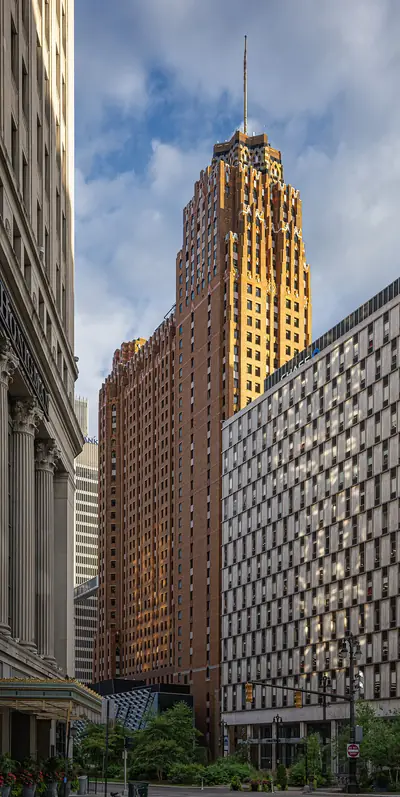
The Guardian Building is one of Detroit’s most striking landmarks. Completed in 1929 as the Union Trust Building, it is a spectacular example of Art Deco design and was designated a National Historic Landmark in 1989. Its exterior combines brickwork, terra cotta, limestone, and tile, while sculptures and Indian-inspired motifs reflect the importance of commerce to Detroit.
The main entrance opens beneath a colorful semi-circular dome. Inside, the lower lobby has an almost cathedral-like atmosphere, with vivid tile decoration and colorful lamps continuing through the elevator lobby. The building rises forty-three stories and is topped by a large American flag.
The Guardian Building features prominently on the Downtown Detroit audio walking tour — but instead of an internal link here, take your own pace through the city with Neywo’s tour below.
Detroit Institute of Arts
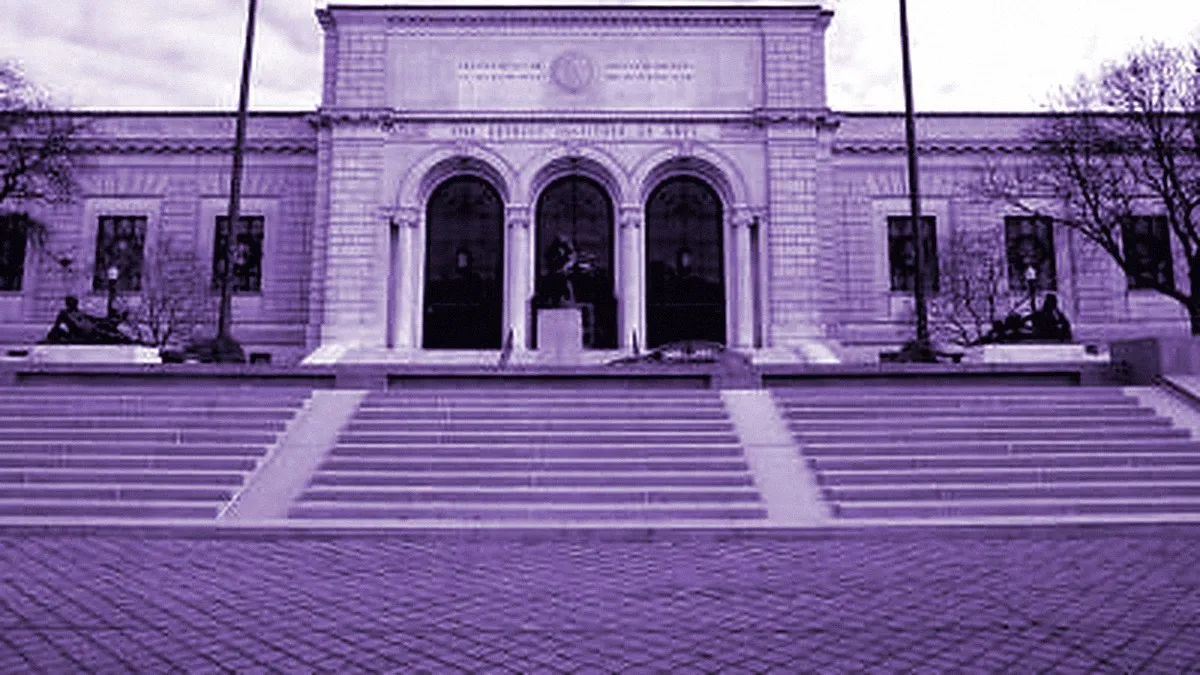
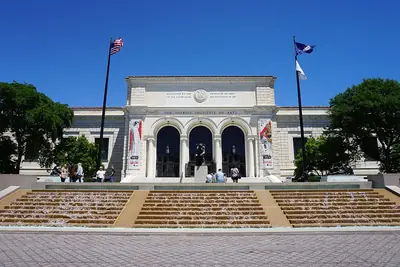
The Detroit Institute of Arts is one of the largest and most significant art museums in the United States. Its collection covers ancient Egyptian, European, and contemporary art, with more than 65,000 works displayed across over 100 galleries. In 2023 and 2024, USA Today readers voted it the number one art museum in the country.
The museum opened in 1885, after receiving its first painting in 1883. Its original building was designed by Paul Philippe Cret, and the north and south wings are faced in white marble. The museum forms part of Detroit’s Cultural Center Historic District, which is listed in the National Register of Historic Places. A renovation and expansion completed in 2007 added 58,000 square feet.
Charles H. Wright Museum of African American History
The Charles H. Wright Museum of African American History, known as The Wright, is one of the world’s oldest and largest independent African American museums. Located in Midtown’s Cultural Center, it occupies 125,000 square feet and holds more than 35,000 artifacts.
Its permanent collection is described as the world’s largest collection of African American culture. The museum’s “And Still We Rise” exhibition uses 22,000 square feet to explore African American experiences through history and culture.
Dr. Charles H. Wright founded the museum in 1965 after being inspired by a World War II memorial in Denmark. It began in a modest house on West Grand Boulevard, moved twice, and settled on Warren Avenue in 1997.
Detroit Historical Museum
The Detroit Historical Museum presents more than 300 years of Detroit-area history. Its displays include cobblestone streets, nineteenth-century storefronts, fur trading, toy trains, and an auto assembly line, showing how the city developed through commerce, industry, and everyday life.
The museum’s origins go back to a collection donated by attorney and historian Clarence M. Burton in 1914. The present building, designed by William Edward Kapp, was dedicated on July 24, 1951, during Detroit’s 250th-anniversary celebrations. Changing and traveling exhibitions, local history presentations, documentary screenings, and educational programs add to the permanent displays.
Ford Piquette Avenue Plant
The Ford Piquette Avenue Plant is one of the essential places to visit for anyone interested in Detroit’s automotive history. Built in 1904, it was Ford Motor Company’s second automobile production center after the Mack Avenue plant.
The factory hosted early experiments with a moving assembly line and became the first factory where more than one hundred cars were assembled in a single day. Most importantly, Ford created and first produced the Model T here. The car is credited with beginning the mass use of automobiles in the United States.
The plant remained a Ford production center until 1910, when manufacturing moved to the larger Highland Park Ford Plant. Its Victorian brick design resembles the textile mills of New England.
Hitsville U.S.A.
Hitsville U.S.A. is the first headquarters and recording studio of Motown. Berry Gordy bought the former photographers’ studio at 2648 West Grand Boulevard in 1959 and transformed it into Motown’s administrative offices and recording studio. Since 1985, the property has been home to the Motown Museum.
Inside, Studio A recalls where some of Motown’s first hits were recorded. The Control Room retains its original recording equipment, while the restored upper flat shows where Berry Gordy once lived. The main exhibition changes regularly and explores different parts of Motown’s era and legacy.
Fort Wayne
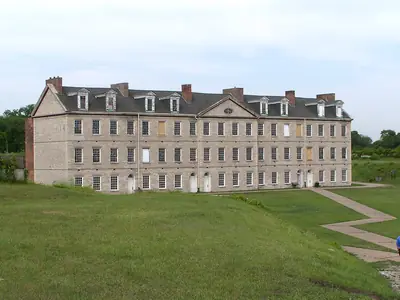
Fort Wayne is a historic military site on the Detroit River in the Delray neighborhood. From here, the Ontario shore is less than half a mile away. The fort was built in 1845 as an artillery post intended to face possible British attacks launched from Canada.
Although that was its original purpose, Fort Wayne remained peaceful for much of its history. It later served as an infantry garrison and as a principal entry point for troops from the area heading into American conflicts from the Civil War through the Vietnam War.
The original fort still stands, including renovations made in 1863 with an exterior brick facing. The nearby limestone barracks date from 1848, with later brick additions. In 1948, the fort and original barracks were given to Detroit’s Historical Commission to serve as a military museum.
Detroit River
The Detroit River separates Detroit from Windsor, Ontario, and connects two of the Great Lakes. It links Lake Michigan, Lake Huron, and Lake Superior with Lake Erie, and continues through connections to Lake Ontario, the St. Lawrence Seaway, and the Erie Canal.
The riverfront includes the Detroit International Riverfront and William G. Milliken State Park and Harbor. Several major connections cross or pass beneath the river, including the Ambassador Bridge, the Detroit Windsor Tunnel, the Gordie Howe International Bridge, and the Michigan Central Railway Tunnel.
The Detroit River is designated both an American Heritage River and a Canadian Heritage River. It is the only river with both designations.
Ambassador Bridge
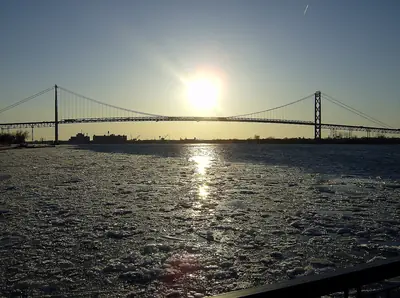
The Ambassador Bridge spans the Detroit River between Detroit and Windsor, Ontario. Also known as the Ambassador International Bridge, it is one of the major connections between the United States and Canada.
The suspension bridge was designed by the McClintic-Marshall company and built between 1927 and 1929. Its structure and position across the river make it one of Detroit’s most recognizable pieces of infrastructure.
Dossin Great Lakes Museum
On Belle Isle Park, the Dossin Great Lakes Museum explores Detroit’s role in Great Lakes shipping, commerce, and history. The 16,000-square-foot museum holds one of the world’s largest collections of ship models.
Its displays include the bow anchor from the SS Edmund Fitzgerald, which sank in a storm in 1975, and the pilot house from the SS William Clay Ford. Visitors can also see the restored Gothic Room from the SS City of Detroit III and Miss Pepsi, a hydroplane raced by the Dossin family in the 1950s.
Manoogian Mansion
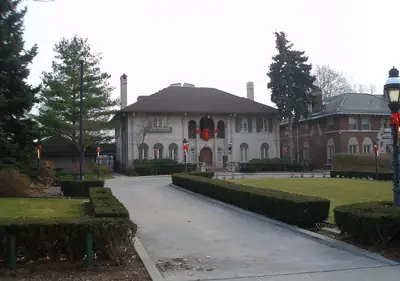
The Manoogian Mansion is a riverside residence in Detroit’s Berry Subdivision Historic District and the official home of Detroit’s mayor. Built in 1928, the house was bought by Alex Manoogian in 1939. Manoogian, an Armenian immigrant and founder of Masco, gave the mansion to the city in 1966.
The residence stands on Detroit’s east side and backs onto the Detroit River. Its Spanish Colonial architecture includes a terracotta roof, while the interior has long windows overlooking the river and grounds. The house contains fifteen rooms, including a library, two dining rooms, four bedrooms, and two additional bedrooms for servants.
Other historic buildings
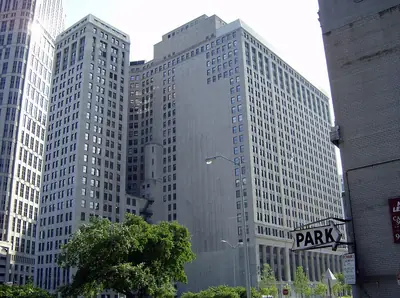
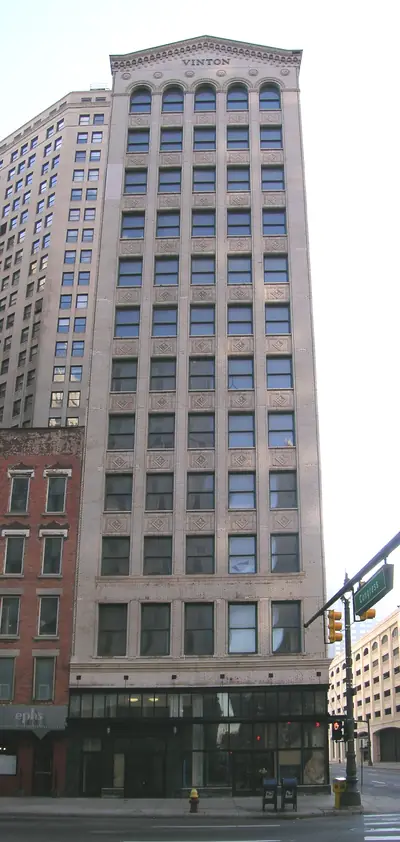
Detroit’s Financial District includes several important historic buildings. The First National Building was built in 1922 and designed by Albert Kahn in the Neoclassical style. The Vinton Building, a residential high-rise at Woodward Avenue and Congress Street, was designated a Michigan State Historic Site in 1982 and added to the National Register of Historic Places in 1983.
Other landmarks add to the city’s architectural and civic history. First Congregational Church, also known as the First Congregational Living Museum, received official historic recognition at state and national levels. The Detroit Naval Armory, also known as the R. Thornton Brodhead Armory, became a Michigan State Historic Site in 1980 and was added to the National Register of Historic Places in 1994.
Explore Detroit with a self-guided audio tour
Neywo’s free Detroit audio guide includes five walking tours, one bus route, and one bike route, covering 156 narrated places. The walks range from 1.5 to 5.03 km and from 84 to 104 minutes, while the bus route covers 7.7 km in 33 minutes and the bike route covers 4.1 km in 20 minutes.
The available routes include:
- Downtown Detroit: From Campus Martius to the Riverfront — 1.5 km, 84 minutes, 11 stops
- Theatre District: Opera, Fox and Stadium Lights — 3.14 km, 104 minutes, 12 stops
- Midtown Cultural Center: Art, History and Science — 2.46 km, 96 minutes, 12 stops
- Greektown and Detroit’s Oldest Churches — 4.06 km, 97 minutes, 8 stops
- Motown, Model T and the Fisher Building — 5.03 km, 101 minutes, 6 stops
- Woodward Avenue on the DDOT 04 — 7.7 km, 33 minutes, 12 stops
- Belle Isle by Bike: Fountain, Carillon and Lighthouse — 4.1 km, 20 minutes, 5 stops
Each story plays as you reach the place, at your own pace, with no group and no schedule. Narration is available in 11 languages.
Download Neywo and explore Detroit while the city tells its story around you. You can also continue discovering Michigan, Ann Arbor, or Grand Rapids.
Places with an audio guide in Detroit
8 places in Detroit with a Neywo audio guide. Each one starts telling its story as you reach it.
Self-guided tours in Detroit
7 tours in Detroit, free in the Neywo app. Each stop tells its story as you reach it.
- Bike ride
Belle Isle by Bike: Fountain, Carillon and Lighthouse
Ride Detroit's island park on its perimeter bike lanes. Start at the huge James Scott fountain, pass the Peace Carillon and America's oldest conservatory, then cross the island to the white marble Livingstone Lighthouse facing Lake St. Clair.
James Scott Memorial Fountain · Nancy Brown Peace Carillon · Belle Isle Conservatory · Belle Isle Park · William Livingstone Memorial Light
Open this tour: Belle Isle by Bike: Fountain, Carillon and Lighthouse - Bus ride
Woodward Avenue on the DDOT 04
Detroit's main street by city bus. The 04 runs north along Woodward from the Guardian Building and Campus Martius past Grand Circus Park, the Fox Theatre, Orchestra Hall, the former synagogue now Bonstelle Theatre, the contemporary art museum and the First Congregational Church, then on to the New Center and the Neo-Gothic cathedral.
Guardian Building · Campus Martius Park · Grand Circus Park Historic District · Fox Theatre · First Presbyterian Church · Bonstelle Theatre …
Open this tour: Woodward Avenue on the DDOT 04 - Walk
Downtown Detroit: From Campus Martius to the Riverfront
Start at General Macomb's statue and walk to where Detroit's street grid begins, then south to the Detroit River. Pass the Civil War monument, the First National and Vinton buildings, the Art Deco Guardian Building known as the cathedral of finance, the giant bronze Spirit of Detroit, Joe Louis's fist and the plaza where Cadillac landed in 1701, ending at the site of the old Ford Auditorium.
Statue of Alexander Macomb · Campus Martius Park · Michigan Soldiers' and Sailors' Monument · First National Building · Vinton Building · Guardian Building …
Open this tour: Downtown Detroit: From Campus Martius to the Riverfront - Walk
Theatre District: Opera, Fox and Stadium Lights
Walk through the entertainment quarter around Grand Circus Park. See the world's largest Masonic Temple, the arena where the Red Wings play, the 5,000-seat Fox movie palace beside The Fillmore and City Theatre, the Russell Alger fountain, the Detroit Opera House and Music Hall, and finish at the stadiums where the Tigers and Lions play.
Detroit Masonic Temple · Little Caesars Arena · Fox Theatre · The Fillmore Detroit · City Theatre · St. John's Episcopal Church …
Open this tour: Theatre District: Opera, Fox and Stadium Lights - Walk
Midtown Cultural Center: Art, History and Science
Midtown's museum quarter in one loop. Start with 300 years of Detroit history, then the Detroit Institute of Arts and its Gothic chapel, the artists' Scarab Club, the Wright Museum of African American History, the Science Center and the Gothic Revival cathedral where Henry Ford's funeral was held. Walk on past the Congregational church and the contemporary art museum to the Majestic Theatre and Orchestra Hall.
Detroit Historical Museum · Detroit Institute of Arts · Gothic Chapel, Detroit Institute of Arts · Scarab Club · Charles H. Wright Museum of African American History · Michigan Science Center …
Open this tour: Midtown Cultural Center: Art, History and Science - Walk
Greektown and Detroit's Oldest Churches
Walk east of downtown through Detroit's German, Greek and French Catholic past. See the stained glass of St. Joseph Shrine, the Gothic Trinity Lutheran, Greektown on Monroe Street, Old St. Mary's twin towers, Detroit's oldest surviving church, and finish at the sailors' church on the river, Mariners' Church.
St. Joseph Shrine, Detroit · Historic Trinity Lutheran Church · Greektown · St. Mary Roman Catholic Church · Saints Peter and Paul Church · Christ Church Detroit …
Open this tour: Greektown and Detroit's Oldest Churches - Walk
Motown, Model T and the Fisher Building
A long walk through the New Center and Piquette districts. Begin at King Solomon Baptist Church, the Civil Rights-era pulpit, then visit Hitsville U.S.A., the house where Motown began, Albert Kahn's Art Deco Fisher Building and the Piquette Avenue Plant where Henry Ford first built the Model T.
Temple Baptist Church – King Solomon Baptist Church · Hitsville U.S.A. · Fisher Building · Metropolitan United Methodist Church · Ford Piquette Avenue Plant · Our Lady of the Rosary Roman Catholic Church
Open this tour: Motown, Model T and the Fisher Building
Walk Detroit with Neywo
Neywo turns Detroit into a self-guided audio tour. Stories arrive as you reach the place they belong to, and the route reshapes when you wander off it.

