Visiting Dayton, United States: Top Sights on Foot
Things to Do in Dayton, Ohio: What to See and Explore
Looking for things to do in Dayton? This Ohio city brings together aviation history, historic architecture, art, science, Native American heritage, and lively local markets. It is especially known for the Wright brothers, but Dayton’s museums, churches, historic homes, and cultural sites make it worth exploring well beyond the story of flight. Neywo has a free audio guide for Dayton with 53 narrated places, available in 11 languages.
What to See in Dayton
Sacred Heart Church
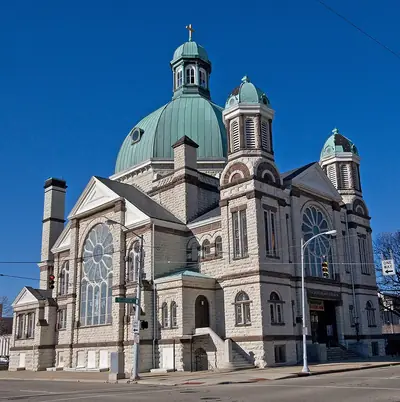
Sacred Heart Church is a striking downtown landmark built in 1888 for a growing Catholic parish. Designed by local architect Charles Insco Williams, it combines Romanesque and Queen Anne features, including tall stained-glass windows, entrance towers, rose windows, and an octagonal Baroque dome topped by a glazed cupola. Locally quarried limestone and Berea sandstone give the exterior a rich variation of texture.
The church also reflects Dayton’s history of loss and renewal. The Great Flood of 1913 destroyed much of its original woodworking, artwork, and chandeliers. Regular operations ended in 1996, and the building gained a new use in 2001 when a Vietnamese Catholic group began using it.
Deeds Carillon
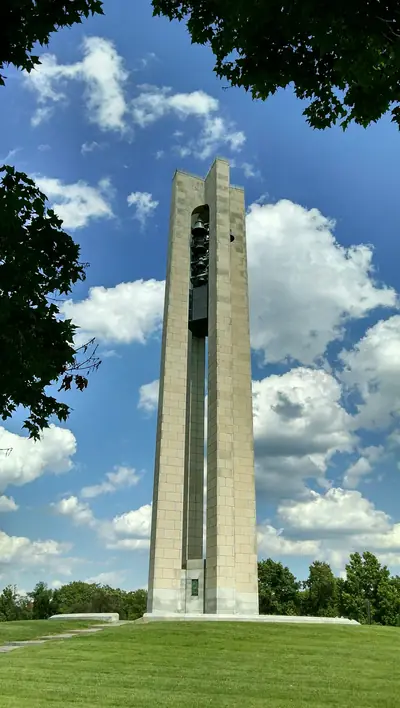
Deeds Carillon is a bell tower in Dayton and one of the stops on the route through Carillon Historical Park. It can be combined with the nearby Wright Brothers Aviation Center and Patterson Homestead for a walk focused on Dayton’s industrial and family history.
Dayton Art Institute
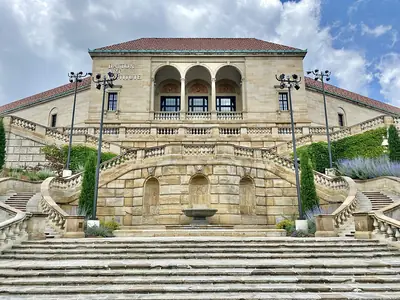
The Dayton Art Institute combines a fine-arts collection with an Italian Renaissance-style building designed by Edward B. Green. Opened in its present location in 1930, the building was modeled after the Casino in the gardens of the Villa Farnese and the garden stairs at the Villa d’Este. It is listed on the National Register of Historic Places.
Inside, more than 20,000 objects represent 5,000 years of artistic achievement. The collection is particularly strong in Asian art, seventeenth-century Baroque art, American art from the eighteenth and nineteenth centuries, and contemporary art. The institute also hosts major special exhibitions.
America’s Packard Museum
Car enthusiasts can explore more than 50 Packard automobiles at America’s Packard Museum, housed in a restored Packard dealership. The Citizens Motorcar Company began selling Packard automobiles in Dayton in 1908 and moved into the building in 1917.
The collection covers early Brass Era cars, streamlined models from the 1930s and 1940s, and Packards from the 1950s. It also includes war machines, parts, accessories, and original sales and service literature. Outside, the restored 20-foot porcelain and neon Packard sign stands at the corner of Ludlow and Franklin Streets, where it returned for the museum’s grand opening in 1992.
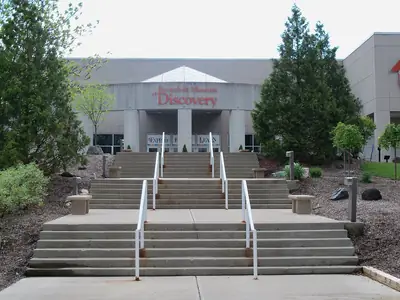
Boonshoft Museum of Discovery
The Boonshoft Museum of Discovery brings together a children’s museum, a science and technology center, and an indoor zoo. Its exhibits range from a real Egyptian mummy to a digital globe showing Earth’s systems in real time.
Permanent exhibits include the Hall of the Universe, Science on a Sphere, Oscar Boonshoft Science Central, the Tidal Pool, the Nesiur the Mummy exhibit, and the Bieser Discovery Center. The Discovery Zoo houses more than 150 animals, including otters, sloths, meerkats, and rehabilitated wildlife. The zoo is accredited by the Association of Zoos and Aquariums.
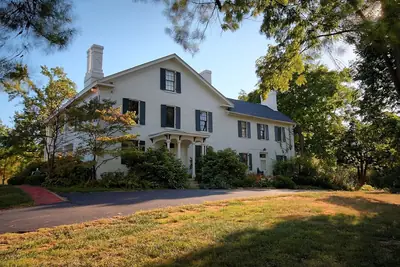
Patterson Homestead
Patterson Homestead is a historic house museum devoted to one of Dayton’s influential families. Colonel Robert Patterson built its first section in 1816, and the house expanded in stages over the following forty years. It once stood at the center of Rubicon Farm, a 2,000-acre estate.
Six restored period rooms contain eighteenth- and nineteenth-century furnishings and original Patterson family artifacts. The Federal-style house was constructed in several sections between 1816 and 1850. An additional gallery explores NCR’s pioneering role in American industry. The homestead was donated to the city in 1953 and listed on the National Register of Historic Places in 1976.
The International Peace Museum
Located in the Courthouse Plaza Building, The International Peace Museum explores nonviolence, conflict resolution, social justice, tolerance, and environmental protection. It commemorates the 1995 Dayton Agreement, which ended the war in Bosnia, and is described as America’s only brick-and-mortar peace museum.
Its spaces include a peace library, an interactive children’s room, a creative studio, the Jack Meagher Gallery, a podcasting studio, and a stage. Permanent, temporary, and travelling collections present peaceful approaches to conflict and their relevance today.
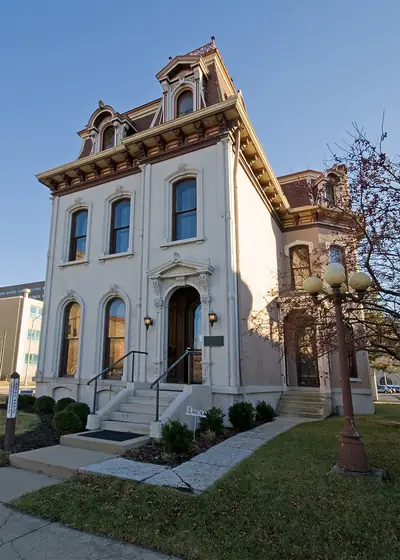
Isaac Pollack House
The Isaac Pollack House is a Second Empire-style landmark built in 1876 for Isaac Pollack, a local businessman involved in the liqueur trade. Its walls combine stone, brick, and wood above a stone foundation, beneath a slate roof.
The building later became the home and workplace of Fenton T. Bott, who operated the Bott Dancing Academy there until 1941. The Montgomery County Board of Elections used it as offices from 1956 for twenty years. In 1979, the house was moved from West Third Street to the intersection of Wilkinson Street and Monument Avenue.
West Third Street Historic District
West Third Street Historic District preserves the memory of the Wright Aeronautical Laboratory through a reproduction facade. The original laboratory was built in 1916, where Orville Wright continued his work after moving equipment from the former Wright Cycle Shop. He worked there six days a week for more than three decades.
The laboratory also housed the 1903 Wright Flyer from 1916 to 1928. The aircraft was assembled and disassembled for exhibitions before being shipped to London’s Science Museum. The original building was demolished in December 1976, making the reproduction facade an important reminder of Dayton’s aviation heritage.
Wright Company Factory
The Wright Company Factory was the first factory in the United States designed specifically for building airplanes. It forms part of the story of West Dayton and the development of aviation manufacturing.
SunWatch Indian Village
SunWatch Indian Village is an open-air museum beside the Great Miami River. Its reconstructed Native American village is based on extensive archaeological excavations sponsored by the Dayton Society of Natural History, which owns and operates the site.
Originally known as the Incinerator Site, it has provided important evidence about the Fort Ancient culture. SunWatch was added to the National Register of Historic Places in 1974 and became a National Historic Landmark in 1990.
PNC Second Street Market
PNC Second Street Market is Dayton’s largest and oldest operating public market. It brings together locally sourced fruit and vegetables, flowers, meat, honey, prepared treats, and handmade goods. Artisans sell items such as jewellery, pottery, vases, soaps, and clothing made from alpaca wool.
The market also includes a wine gallery and offers a lively view of everyday community life. Five Rivers MetroParks owns and operates it.
Aviation Trail Parachute Museum
The Aviation Trail Parachute Museum traces the development of free-fall parachutes from their beginnings in Dayton to their role in landing spacecraft. Its story focuses on parachute technology developed at McCook Field after World War One and the way that technology evolved over the following decades.
John W. Berry Sr. Wright Brothers National Museum
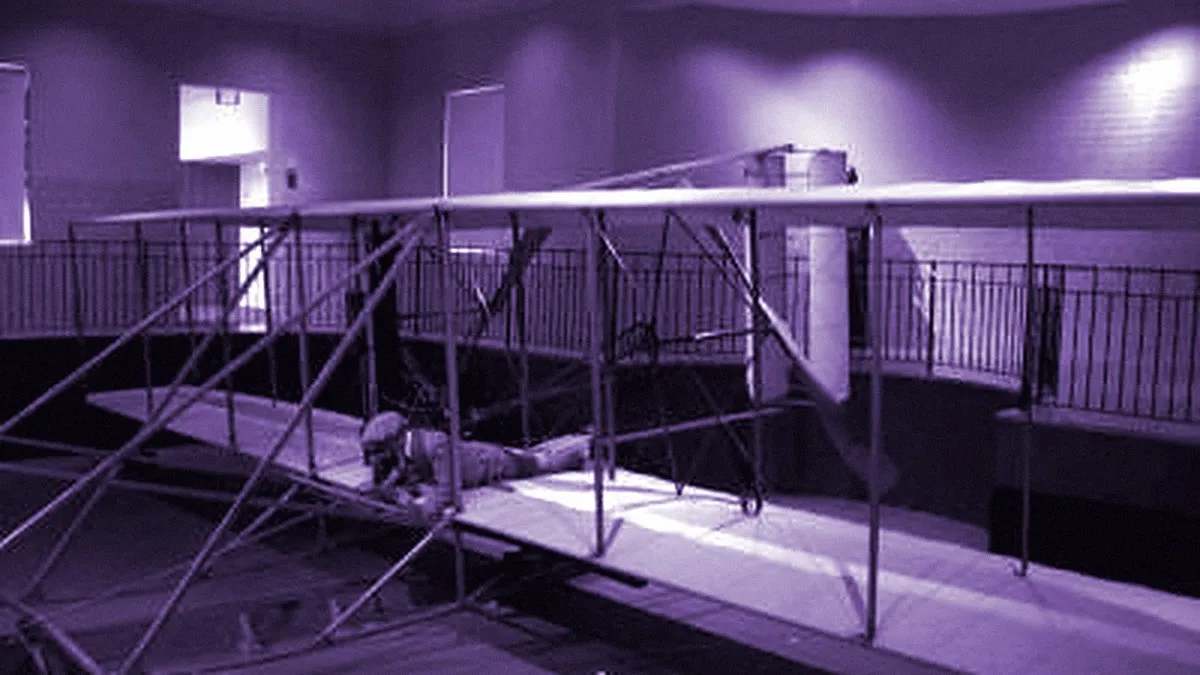
The John W. Berry Sr. Wright Brothers National Museum holds the world’s largest collection of Wright artifacts. Its centerpiece is the 1905 Wright Flyer III, the first practical flying machine and the only aircraft designated as a National Historic Landmark.
Next to Wright Hall, a replica of the Wright brothers’ bicycle shop recreates their fifth and final store in West Dayton as it appeared in late 1901.
K12 Gallery and TEJAS
K12 Gallery and TEJAS is a visual arts center offering classes, exhibitions, camps, and community outreach. Founded in 1993 by artist and teacher Jerri Stanard, it welcomes people of all ages and backgrounds, including individuals with disabilities.
TEJAS—Teen Educational and Joint Adult Studio—presents local, regional, and national artists working in painting, photography, sculpture, and mixed media. Children’s artwork is regularly shown alongside professional exhibitions.
Explore Dayton with a Self-Guided Audio Tour
A Dayton self-guided walking tour is an easy way to connect the city’s landmarks without joining a group. Neywo offers five walking tours, one bus route, and one bike route in Dayton:
- Five walking tours: routes range from 1.81 to 4.03 km and from 67 to 103 minutes, with 4 to 12 narrated stops.
- One bus route: 12.7 km, 54 minutes, and 7 narrated stops, travelling from the Oregon District to the Wright brothers’ neighbourhood.
- One bike route: 5.1 km, 26 minutes, and 2 narrated stops, connecting Dayton Memorial Hall with Deeds Carillon.
The walks cover downtown architecture, churches and mansions, West Dayton’s aviation history, the Oregon District, Packard history, Carillon Historical Park, and Patterson Homestead. The app tells the story of each place as you reach it, at your own pace, with no group and no schedule.
Download Neywo and Discover Dayton
Download Neywo’s free Dayton audio guide to explore 53 narrated places through five walks, a bus route, and a bike route. Listen in 11 languages and let the stories play as you arrive at each landmark.
Dayton is part of Ohio, in the United States. If you are continuing through the state, you can also explore Cleveland, Columbus, or Cincinnati.
Places with an audio guide in Dayton
8 places in Dayton with a Neywo audio guide. Each one starts telling its story as you reach it.

Self-guided tours in Dayton
7 tours in Dayton, free in the Neywo app. Each stop tells its story as you reach it.
- Bike ride
Memorial Hall to Deeds Carillon by Bike
Pedal the Great Miami River trail south from Dayton Memorial Hall to Deeds Carillon, the 151-foot bell tower of Carillon Historical Park, where the 1905 Wright Flyer III is displayed next door.
Dayton Memorial Hall · Deeds Carillon
Open this tour: Memorial Hall to Deeds Carillon by Bike - Bus ride
RTA Route 4: From the Oregon District to the Wright Brothers' Neighbourhood
Ride Greater Dayton RTA route 4 through downtown, past the Conover Building, the Oregon Historic District and Sacred Heart church, and out to West Dayton where the Wright brothers worked and Paul Laurence Dunbar lived.
St. Mary's Catholic Church · Dayton Metro Library · Conover Building · Oregon Historic District · Sacred Heart Church · West Third Street Historic District …
Open this tour: RTA Route 4: From the Oregon District to the Wright Brothers' Neighbourhood - Walk
Downtown Dayton: Domes, Skyscrapers and a Greek Temple
Cross the heart of Dayton from its first skyscraper, the Art Deco Liberty Tower, to the 1866 Victoria Theatre. See the glass-domed Arcade, the Greek Revival Old Courthouse, the Conover Building and the Daily News building that was meant to look like a bank. A compact walk through a century of boom-time architecture.
Liberty Tower · Dayton Daily News Building · Dayton Arcade · Benjamin F. Kuhns Building · Conover Building · Montgomery County Courthouse …
Open this tour: Downtown Dayton: Domes, Skyscrapers and a Greek Temple - Walk
Churches, Mansions and the Art Hill
Wander Dayton's quieter north side. Start at Temple Israel, then visit the 1832 Walters House, the Beaux-Arts Memorial Hall and the only Gothic Revival church left downtown. Go on to the Second Empire Pollack House and Stoddard Hill and finish at the Dayton Art Institute, a Renaissance palazzo on a hill.
Temple Israel · Dayton Metro Library · Dayton Memorial Hall · Dr. Jefferson A. Walters House · Dayton Women's Club · Westminster Presbyterian Church …
Open this tour: Churches, Mansions and the Art Hill - Walk
Wright Brothers and Dunbar: West Dayton's Birthplace of Flight
Follow Orville and Wilbur Wright through West Dayton. See their last surviving bicycle shop at 22 South Williams Street, the site of Orville's laboratory with its marker, the home of the poet Paul Laurence Dunbar and the first factory built to make airplanes.
Wright Cycle Company · West Third Street Historic District · Paul Laurence Dunbar House · Wright Company Factory
Open this tour: Wright Brothers and Dunbar: West Dayton's Birthplace of Flight - Walk
Oregon District, Packards and the Mother Church
Start at St. Mary's church, then enter the brick lanes of the Oregon Historic District, with buildings from 1820 to 1915. See a restored Packard dealership with its 20-foot neon sign, the German Gothic mother church of Dayton's Catholics and the domed Sacred Heart church.
St. Mary's Catholic Church · Oregon Historic District · America's Packard Museum · Emmanuel Catholic Church (Dayton, Ohio) · Sacred Heart Church
Open this tour: Oregon District, Packards and the Mother Church - Walk
Carillon Park, Patterson Homestead and Woodland Cemetery
Head south of downtown to Carillon Historical Park and its Wright brothers aviation center, then the Deeds Carillon bell tower. Continue to the Patterson Homestead and end in Woodland Cemetery and Arboretum, the Victorian resting place of many Dayton inventors.
John W. Berry Sr. Wright Brothers Aviation Center at Carillon Historical Park · Deeds Carillon · Patterson Homestead · Woodland Cemetery and Arboretum
Open this tour: Carillon Park, Patterson Homestead and Woodland Cemetery
Walk Dayton with Neywo
Neywo turns Dayton into a self-guided audio tour. Stories arrive as you reach the place they belong to, and the route reshapes when you wander off it.

