Things to Do in Philadelphia, United States: Walking Guide
Things to Do in Philadelphia: History, Museums, and Self-Guided Walks
Looking for things to do in Philadelphia? The city brings together the places where the Declaration of Independence and the United States Constitution were adopted, major museums, historic churches, military sites, and neighborhoods shaped by generations of local history. Its landmarks are close enough to explore on foot, making Philadelphia especially rewarding for independent travelers.
Neywo offers a free audio guide for Philadelphia with 298 narrated places, so you can discover the city while walking at your own pace.
What to See in Philadelphia
Independence Hall and the Liberty Bell
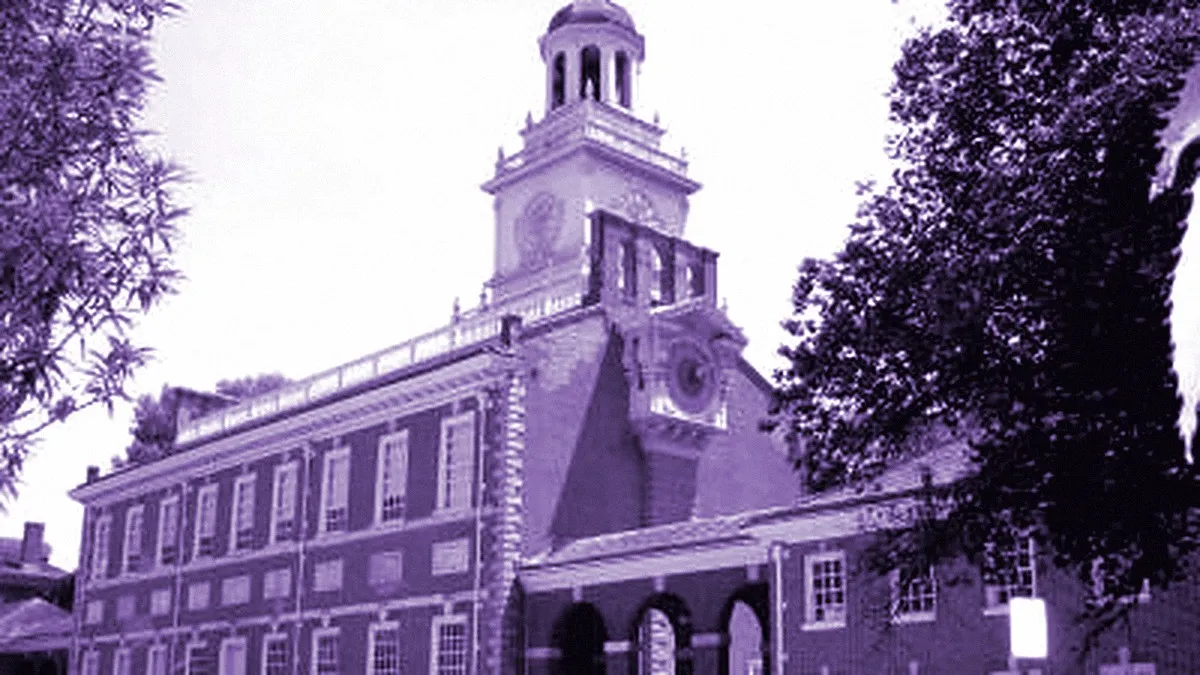
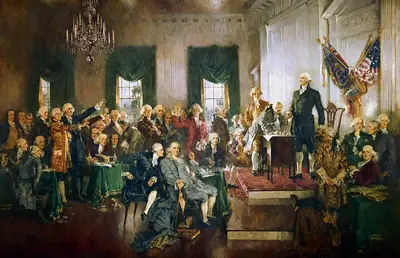
Independence Hall is the centerpiece of Independence National Historical Park and a World Heritage Site. Completed in 1753 as the Pennsylvania State House, it became a major setting for the American Revolution. The Second Continental Congress met here from 1775 to 1781, and the Declaration of Independence was adopted here on July 4, 1776. More than a decade later, the Pennsylvania State House hosted the convention that produced the United States Constitution, from May 25 to September 17, 1787.
The building is also a notable example of American Georgian architecture, with symmetry, classical proportions, exposed brick, and stone masonry accents. In 1824, it was renamed Independence Hall when it hosted the Marquis de Lafayette.
Across from Independence Hall, the Liberty Bell Center preserves one of Philadelphia’s best-known symbols. Originally called the State House Bell, it was commissioned in 1752 by Pennsylvania’s Provincial Assembly from the London firm Lester and Pack, later known as the Whitechapel Bell Foundry. Its inscription reads: “Proclaim LIBERTY Throughout all the Land unto all the Inhabitants Thereof.” The bell cracked when it was first rung after arriving in Philadelphia and was recast twice by local workmen John Pass and John Stow.
Christ Church and Philadelphia’s colonial religious history
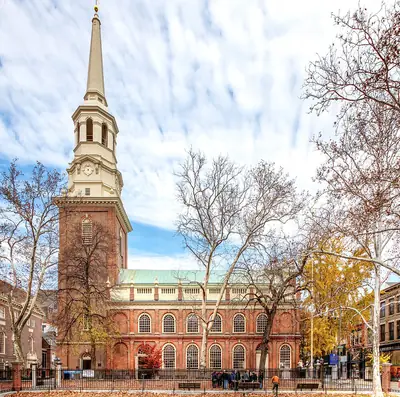
Christ Church in Old City was founded in 1695 by Anglicans as a parish of the Church of England. The current building was constructed between 1722 and 1744. Its history is closely connected with the beginnings of the Protestant Episcopal Church in the United States.
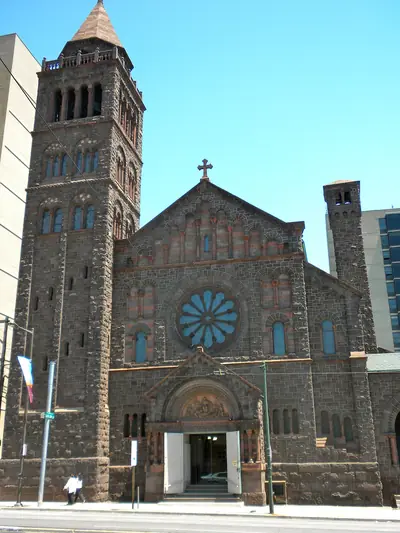
Philadelphia’s religious heritage continues in other parts of the city. The Philadelphia Episcopal Cathedral, formerly called the Protestant Episcopal Church of the Saviour, dates back to 1855. It was renovated in 1898 and rebuilt in 1906 after a fire in 1902.
The Mennonite Meetinghouse, also known as the Germantown Mennonite Church, is a historic building at 6119 Germantown Avenue. Its importance was formally recognized when it was added to the National Register of Historic Places in 1973.
Benjamin Franklin and the Thaddeus Kosciuszko National Memorial
Benjamin Franklin’s influence appears throughout Philadelphia, including at the Franklin Institute. Founded in 1824, it combines a science museum with a center for science education and research. It also houses the Benjamin Franklin National Memorial.
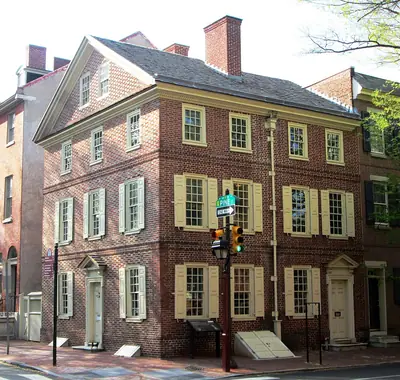
A different kind of personal history can be found at the Thaddeus Kosciuszko National Memorial at 301 Pine Street. At just 0.02 acres, it is the smallest unit in the United States National Park System. The memorial occupies the small house where the Polish patriot and American Revolutionary War hero found refuge after returning to the United States in August 1797.
Kosciuszko recuperated there before returning to Europe the following June to support the restoration of a divided Poland. The restored second-floor bedroom evokes the domestic setting of his stay and connects the modest house with the international story of his life.
Philadelphia Museum of Art and the museums of Benjamin Franklin Parkway
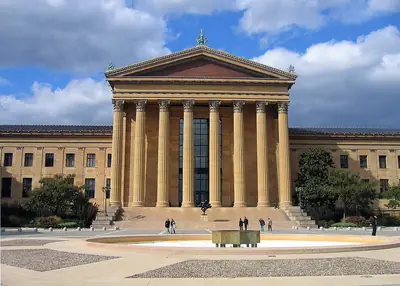
The Philadelphia Museum of Art stands on Fairmount at the northwest end of Benjamin Franklin Parkway, beside Eakins Oval. Its collections contain more than 240,000 works from Europe, the Americas, and Asia, including paintings, sculpture, prints, drawings, photographs, armor, and decorative arts.
The museum was chartered in 1876 for Philadelphia’s Centennial Exposition. The present building was completed in 1928 after construction began in 1919. Its design was created by Horace Trumbauer with the firm of Zantzinger, Borie and Medary and is described as almost Greek Revival.
The museum’s holdings include twentieth-century works by Marcel Duchamp, Constantin Brâncuși, and Pablo Picasso, as well as growing contemporary collections. Its wider group of sites includes the Rodin Museum on Benjamin Franklin Parkway and the Ruth and Raymond G. Perelman Building across the street.
Pennsylvania Academy of the Fine Arts
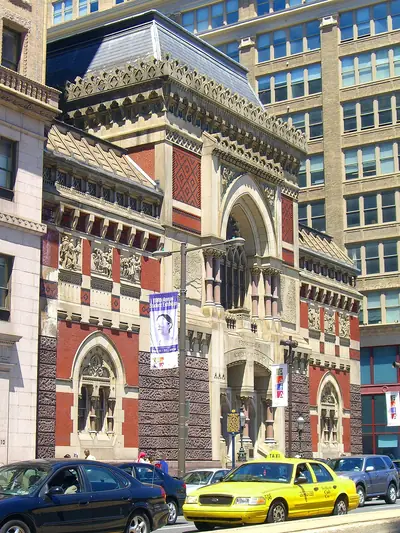
The Pennsylvania Academy of the Fine Arts, known as PAFA, has exhibited and taught art since 1805. It is both a museum and a private art school, and is the longest continuously operating art museum and art school in the United States.
PAFA is internationally known for its collections of nineteenth- and twentieth-century American paintings, sculptures, and works on paper. The building opened in 1876 and was designed by Frank Furness and George W. Hewitt. Its architecture provides a distinctive setting for the academy’s view of American art across two centuries.
The Academy of Music
The Academy of Music on Locust Street has welcomed audiences since 1857 and still serves its original purpose as a concert hall and opera house. It is the oldest opera house in the United States still used as an opera house.
Designed by LeBrun and Rungé, the building can accommodate about 2,800 spectators. It is home to Opera Philadelphia and the Philadelphia Ballet. The Philadelphia Orchestra performed there from its formation in 1900 until 2001, when it moved to the Kimmel Center for the Performing Arts.
The Academy’s stage has welcomed figures including Tchaikovsky, Strauss, Rachmaninoff, Saint-Saëns, Mahler, and Pietro Mascagni. In 1907, Enrico Caruso and Geraldine Farrar appeared there in Madama Butterfly, with Puccini in attendance.
Fort Mifflin and the Philadelphia Naval Shipyard
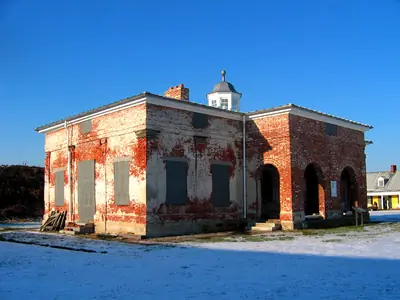
For a different perspective on Philadelphia, visit Fort Mifflin, a historic fort on Mud Island—also called Deep Water Island—in the Delaware River below the city. Commissioned in 1771 as Fort Island Battery, it was also known as Mud Island Fort. British forces bombarded and captured it in autumn 1777 during their conquest of Philadelphia.
The fort took the name Fort Mifflin in 1795, honoring Thomas Mifflin, a Continental Army officer who became Pennsylvania’s first governor after independence. The Commandant’s House is one of the designated points of interest within the site.
The Philadelphia Naval Shipyard Historic District tells another chapter of the city’s waterfront history. The site began as a commercial operation in 1776 and became the Navy’s first yard in 1801. In 1871, it was replaced by a larger yard on League Island, where the Delaware and Schuylkill Rivers meet. Most Navy activity ended in the 1990s, and the site is now part of The Navy Yard, a mixed-use campus.
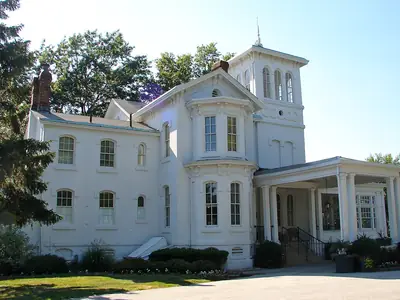
Other historic naval buildings include the Commandant’s Quarters, also known as Quarters A. Built between 1874 and 1875, this three-story painted-brick residence has an Italian Villa-style design, an off-center square tower, a slate-covered gable roof, bracketed eaves, and a bay window. It served as an officer’s residence until June 1960 and was listed on the National Register of Historic Places in 1976.
The Philadelphia Naval Asylum, also known as the U.S. Naval Home, has an earlier educational history. From 1838 to 1845, the site served as the first United States Naval Academy before becoming a retirement home for sailors and Marines. The Marine Barracks, also known as Buildings 100 and 101, is another historic part of the former Philadelphia Naval Shipyard.
Germantown and historic houses
Germantown adds colonial architecture and Revolutionary history to the list of things to do in Philadelphia. Its historic places include Grumblethorpe, the Germantown White House, Market Square, Ebenezer Maxwell House, Johnson House Historic Site, Concord School House, and Cliveden.
The neighborhood is also home to the Mennonite Meetinghouse, a reminder of Philadelphia’s religious and architectural history beyond the central districts.
Explore Philadelphia with a self-guided audio tour
Neywo’s Philadelphia audio guide includes seven walking tours, one bus route, and one bike route, with 298 narrated places in total. The walks range from 1.22 to 3.54 km and from 59 to 111 minutes, while the bike route covers 10.2 km in 51 minutes. The bus route covers 6.5 km in 28 minutes.
The tours include:
- Birthplace of a Nation: Independence Mall — 1.22 km, 93 minutes, 12 stops
- Quakers, Franklin and Betsy Ross: Old City — 3.12 km, 111 minutes, 12 stops
- Museums of the Parkway: Love Park to the Rocky Steps — 3.02 km, 109 minutes, 10 stops
- Society Hill: A Polish Hero and Colonial Churches — 2.19 km, 96 minutes, 11 stops
- Germantown: Revolutionary Battle Ground and Colonial Houses — 3.54 km, 109 minutes, 8 stops
- University City: Computers, Colleges and a Museum of the Ancient World — 3.06 km, 87 minutes, 8 stops
- Fairmount Park: Boathouse Row and the Riverside Statues — 1.82 km, 59 minutes, 6 stops
- One bus route through Rittenhouse Square, Washington Square, and Society Hill — 6.5 km, 28 minutes, 11 stops
- One bike route along Kelly Drive and the Fairmount Park Mansions — 10.2 km, 51 minutes, 10 stops
The app tells the story of each place as you reach it, at your own pace, with no group and no schedule. Narration is available in 11 languages.
Download Neywo and explore Philadelphia independently, from Independence Hall and the Liberty Bell to Old City, Germantown, the Parkway, and the former naval sites. You can also continue exploring Pennsylvania, with nearby destinations such as Pittsburgh, Lancaster, and Doylestown.
Places with an audio guide in Philadelphia
8 places in Philadelphia with a Neywo audio guide. Each one starts telling its story as you reach it.
Self-guided tours in Philadelphia
9 tours in Philadelphia, free in the Neywo app. Each stop tells its story as you reach it.
- Bike ride
Kelly Drive and the Fairmount Park Mansions
Ride the Schuylkill River Trail from the Rocky statue past the Perelman Building, Boathouse Row and the Viking statue, then up into Fairmount Park for the John Coltrane House, the Grant statue and its Georgian mansions.
Rocky Statue · Perelman Building · Boathouse Row · Thorfinn Karlsefni · John Coltrane House · Equestrian statue of Ulysses S. Grant …
Open this tour: Kelly Drive and the Fairmount Park Mansions - Bus ride
Route 12: Rittenhouse Square, Washington Square and Society Hill
A regular SEPTA bus along the south side of Center City. Ride from Rittenhouse Square past the Forrest and Walnut Street theatres, Washington Square and the Kosciuszko house, then back west by way of the Library Company and the Academy of Music.
Church of the Holy Trinity, Philadelphia · Forrest Theatre · Walnut Street Theatre · Washington Square · Society Hill Synagogue · Thaddeus Kosciuszko National Memorial …
Open this tour: Route 12: Rittenhouse Square, Washington Square and Society Hill - Walk
Birthplace of a Nation: Independence Mall
In a few blocks stand the site of the first presidential mansion, the bell that became a symbol of liberty and the hall where independence was declared. Continue past Congress Hall, Philosophical Hall, the nation's first banks and the old Supreme Court to Carpenters' Hall, the Merchants' Exchange and City Tavern.
President's House · Liberty Bell · Independence Hall · Congress Hall · Philosophical Hall · Second Bank of the United States …
Open this tour: Birthplace of a Nation: Independence Mall - Walk
Quakers, Franklin and Betsy Ross: Old City
Follow the Quaker and revolutionary footprints of Old City: the Constitution Center, a Friends meeting house, the flag-maker's house, a rebel Quaker chapel, the church where Franklin worshipped and the museum that tells the Revolution's story.
Philadelphia History Museum · National Constitution Center · St. Augustine Church, Philadelphia · St. George's United Methodist Church · Arch Street Friends Meeting House · Museum for Art in Wood …
Open this tour: Quakers, Franklin and Betsy Ross: Old City - Walk
Museums of the Parkway: Love Park to the Rocky Steps
Walk Philadelphia's answer to the Champs-Elysees from the LOVE sculpture past a cathedral, a science museum, Shakespeare's monument and the Rodin, Calder and Barnes collections. The finish is the statue of a fictional boxer and the Philadelphia Museum of Art.
AMOR · Cathedral Basilica of Saints Peter and Paul · Shakespeare Memorial · Academy of Natural Sciences of Drexel University · Franklin Institute · Calder Gardens …
Open this tour: Museums of the Parkway: Love Park to the Rocky Steps - Walk
Society Hill: A Polish Hero and Colonial Churches
Quiet brick streets south of Independence Park hold Washington Square, the Athenaeum, Georgian churches, a Georgian mansion, the Mother Bethel church founded by Richard Allen and the house where General Kosciuszko recovered.
Washington Square · Athenaeum of Philadelphia · Old St. Joseph's Church · St. Mary's Roman Catholic Church · Powel House · Society Hill Synagogue …
Open this tour: Society Hill: A Polish Hero and Colonial Churches - Walk
Germantown: Revolutionary Battle Ground and Colonial Houses
Walk Germantown Avenue, where Washington's army fought the Battle of Germantown in 1777. Pass the Germantown White House, a Victorian villa, the Mennonite meetinghouse, the Johnson House stop on the Underground Railroad and the Chew family's Cliveden.
Grumblethorpe · Germantown White House · Market Square · Ebenezer Maxwell House · Mennonite Meetinghouse · Johnson House Historic Site …
Open this tour: Germantown: Revolutionary Battle Ground and Colonial Houses - Walk
University City: Computers, Colleges and a Museum of the Ancient World
Cross the Schuylkill to the campuses of Drexel and Penn: the birthplace of the electronic computer, the Penn Museum, the Irvine Auditorium and a statue of the preacher George Whitefield, ending at the Wharton School and St Agatha-St James.
Drexel University · ENIAC · University of Pennsylvania Museum of Archaeology and Anthropology · Irvine Auditorium · University of Pennsylvania · Statue of George Whitefield …
Open this tour: University City: Computers, Colleges and a Museum of the Ancient World - Walk
Fairmount Park: Boathouse Row and the Riverside Statues
Stroll the Schuylkill's east bank: the lamp-lit clubhouses of Boathouse Row, the Lemon Hill mansion, a Viking explorer, a Stone Age sculpture and the Philadelphia Zoo.
Statue of Abraham Lincoln · Boathouse Row · Lemon Hill · Thorfinn Karlsefni · Stone Age in America · Philadelphia Zoo
Open this tour: Fairmount Park: Boathouse Row and the Riverside Statues
Walk Philadelphia with Neywo
Neywo turns Philadelphia into a self-guided audio tour. Stories arrive as you reach the place they belong to, and the route reshapes when you wander off it.

