Visiting Akron, United States: Top Sights on Foot
Things to Do in Akron: Historic Churches, Art and Industrial Heritage
Looking for things to do in Akron? This Ohio city brings together industrial history, distinctive architecture, religious landmarks and cultural institutions, from the atmospheric Akron Civic Theatre to the Akron Art Museum and historic Akron Plan churches. Neywo has a free audio guide for Akron with 25 narrated places, making it easier to explore the city while its stories unfold around you.
What to See in Akron
The most interesting places to visit in Akron reveal how the city developed from a canal town into a major industrial centre, while also showing the communities and institutions that shaped its identity.
St. Bernard’s Church
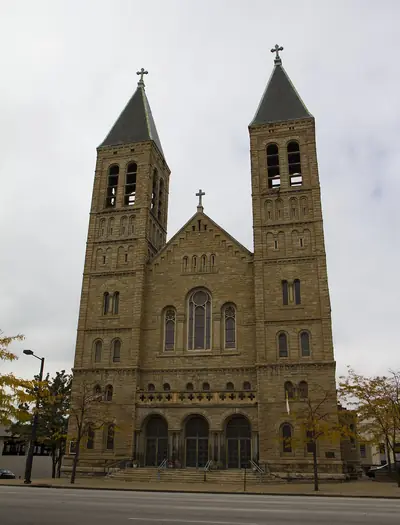
St. Bernard’s Church has stood on University Avenue for more than a century. Built between 1902 and 1905, it replaced an earlier church dating from 1861.
Its German Romanesque architecture is marked by monochromatic stone, rounded arches and two imposing bell towers, with Baroque details adding to its monumental appearance. Inside, a marble altar, decorative wall paintings and religious artwork contrast with the stone structure. The church was added to the National Register of Historic Places in 1989.
Akron Art Museum
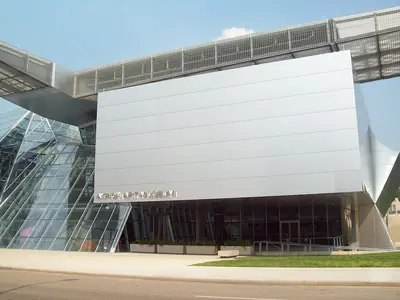
The Akron Art Museum grew from the Akron Art Institute, founded on February 1, 1922, in two rooms in the basement of the public library. After more than three decades in a Carnegie library building, the institution entered a new phase with the opening of the Knight Building on July 17, 2007.
The museum’s architecture brings together the original 1899 Italian Renaissance revival building and the contemporary extension. The historic building presents Western art from 1850 to 1950, while the Knight Building contains eight galleries devoted to art from 1950 to the present. The collection includes modern and contemporary works, photography and pop art.
Akron Civic Theatre
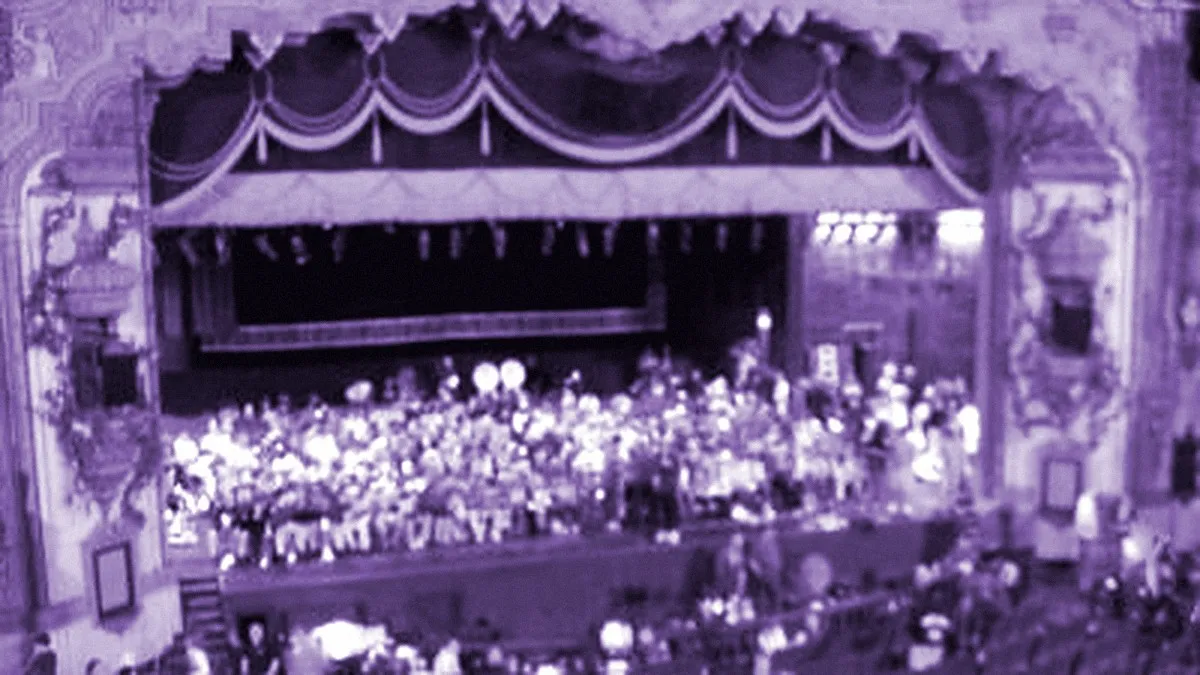
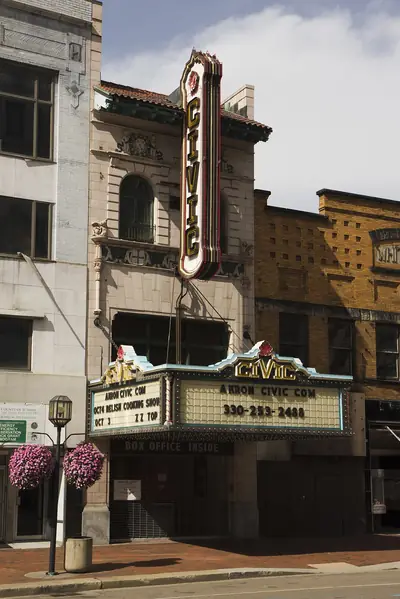
The Akron Civic Theatre is one of the city’s most remarkable landmarks and one of only five remaining atmospheric theatres in the United States designed by John Eberson.
Opened in 1929 by Marcus Loew, it was the last surviving theatre of the eleven Loew’s theatres he built. The auditorium is designed as a Moorish castle courtyard beneath a Mediterranean night sky, complete with a deep blue ceiling, twinkling lights and drifting clouds created by a projection system. Medieval-style carvings, European antiques and Italian alabaster sculptures complete the elaborate interior.
The theatre also reflects Akron’s industrial past: its lobby extends over the historic Ohio and Erie Canal.
East Market Street Church of Christ
Built in 1912, East Market Street Church of Christ is one of the oldest surviving examples of the Akron Plan. The system was developed in Akron by inventor Lewis Miller and arranged a central sanctuary with Sunday school rooms around it, allowing the rooms to open directly into the main space.
The building was designed by Harpster & Bliss in a Neoclassical style. Its Flemish-bond brickwork, stone foundation, pedimented portico and terracotta details make it a significant example of both local and national religious architecture.
First Congregational Church
First Congregational Church belongs to Akron’s oldest continuous religious community, chartered in 1835. The present building dates from 1910 and was designed by Charles Henry & Son in the Richardsonian Romanesque style.
Its heavy stonework, rounded arches and crenellated tower give it a fortress-like appearance, while stained-glass windows soften the interior. The sanctuary also follows the Akron Plan, with a rounded worship space and classrooms radiating outward around it.
St. Paul’s Sunday School and Parish House
At the corner of East Market and Forge Streets, St. Paul’s Sunday School and Parish House preserves a complex history. St. Paul’s Episcopal Church built the stone structure in 1884 and 1885 as a Sunday school and parish house, although it also served as a sanctuary.
Later, the building became the Firestone Conservatory of Music at the University of Akron. It was placed on the National Register of Historic Places in 1976. After a period of vacancy, a three-alarm fire in 2018 destroyed much of the historic interior. The University of Akron accepted a local developer’s preservation bid in 2021, leaving the surviving walls as an important reminder of the building’s changing roles.
Eagles Temple
The Eagles Temple is a downtown landmark associated with the Fraternal Order of Eagles, an organisation that had thousands of members. Its façade is a bold example of Art Deco, with geometric lines and stylised details characteristic of the 1920s.
The building received historic designation before it was sixty-five years old, reflecting the importance of its architecture and place in Akron’s community history.
Wesley Temple AME Zion Church
Built in 1928, Wesley Temple AME Zion Church has served as a significant community landmark on North Prospect Street for nearly a century. It was added to the National Register of Historic Places in 1994.
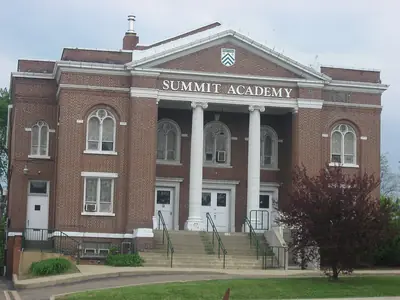
Akron Baptist Temple
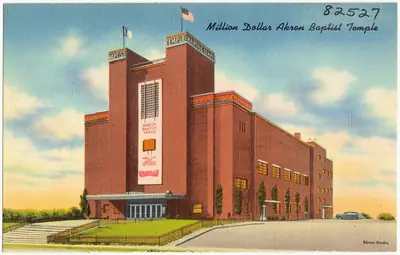
The former Akron Baptist Temple offers another perspective on Akron’s religious history. The congregation first gathered at the site in 1934 and formally organised the following year. It later became one of America’s first megachurches and was considered the largest church on the continent at its peak.
After more than eight decades on Manchester Road, the building was sold in 2019. The congregation moved to Coventry Township and became Connect Church, while the former building remains a landmark.
Akron Jewish Center
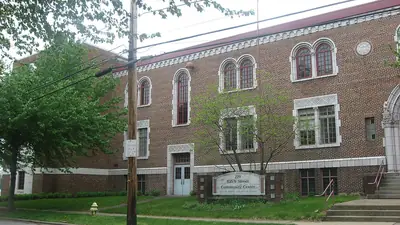
The Akron Jewish Center opened in 1929 as a synagogue and community hub. An expansion in 1951 provided more space for worship and community activities, and the building remained at the centre of Jewish life in Akron for more than forty-five years.
It later became a church, and since 1985 it has operated as a city-run community centre open to everyone.
Perkins Stone Mansion
Perkins Stone Mansion is a historic house museum preserved by the Summit County Historical Society. Nearby, John Brown’s former home recalls the years when the abolitionist lived in Akron, from 1844 to 1854.
The museum presents Brown’s room, personal belongings, original documents and photographs connected with his campaign against slavery and his later role in the raid on Harpers Ferry.
St. Elia the Prophet Orthodox Church
St. Elia the Prophet Orthodox Church is an English-speaking Eastern Orthodox parish belonging to the Bulgarian Diocese of the Orthodox Church in America. It was formerly known as St. Elia Macedono-Bulgarian Orthodox Church.
Grace Reformed Church
The site of Grace Reformed Church, at 172 West Bowery Street, now preserves the memory of a building that served the community for ninety years. Constructed in 1926 and later known as Grace United Church of Christ, it was listed on the National Register of Historic Places in 1984.
Akron Children’s Hospital purchased the property, and the church was demolished in 2016. Its story illustrates how the city’s historic landscape can survive through memory even after a building disappears.
Summit County and the Akron Area
Akron is the county seat and largest city of Summit County, formed on March 3, 1840, from parts of Medina, Portage and Stark counties. The county took its name from the highest elevation on the historic Ohio and Erie Canal.
Beyond Akron, the county includes communities such as Cuyahoga Falls, Stow, Barberton, Hudson, Twinsburg and Green. Its landscape also contains numerous lakes and reservoirs, including Portage Lakes and Nimisila Reservoir, while the Cuyahoga River and the Little Cuyahoga connect the area’s waterways.
Akron is part of Ohio, in the United States. If you are planning a wider trip through the state, Cleveland, Columbus and Toledo are other Ohio destinations to explore.
Explore Akron with Neywo
Neywo offers a free Akron audio guide with 25 narrated places. The app includes two walking tours and one bus route:
- Rubber City Landmarks: Theatre, Courthouse and Akron Plan Churches — a 4.33 km walk lasting 111 minutes, with 10 narrated stops.
- John Brown’s Akron: Cemetery, Mansion and Zoo — a 2.63 km walk lasting 55 minutes, with 4 narrated stops.
- METRO RTA 6: Downtown Akron to East Market Street — a 6.4 km bus route lasting 27 minutes, with 7 narrated stops.
The stories play as you reach each place, at your own pace, with no group and no schedule. Download Neywo and explore Akron as the city’s theatres, churches, museums and historic buildings tell their stories around you.
Places with an audio guide in Akron
8 places in Akron with a Neywo audio guide. Each one starts telling its story as you reach it.
Self-guided tours in Akron
3 tours in Akron, free in the Neywo app. Each stop tells its story as you reach it.
- Bus ride
METRO RTA 6: Downtown Akron to East Market Street
Route 6 runs east from downtown Akron along East Market Street, past the courthouse, the art museum, the Art Deco Eagles Temple and some of Akron's oldest churches. A cheap local ride (free in downtown on weekdays) through the city's historic spine.
East Market Street Church of Christ · St. Paul's Sunday School and Parish House · First Congregational Church · Eagles Temple · Akron Art Museum · St. Bernard's Church …
Open this tour: METRO RTA 6: Downtown Akron to East Market Street - Walk
Rubber City Landmarks: Theatre, Courthouse and Akron Plan Churches
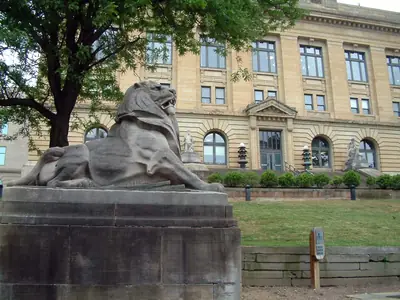
Follow Akron from its canal-era heart to its rubber-boom churches. See an atmospheric 1929 movie palace built over the canal, a courthouse guarded by stone lions, an art museum that fuses an 1899 mansion with a modern wing, and the Akron Plan churches that gave the city's architecture a worldwide reputation.
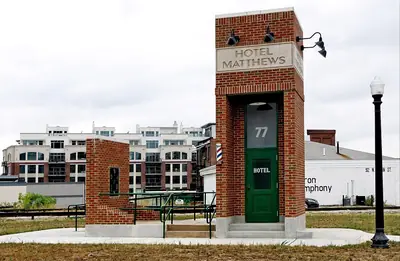
Akron Civic Theatre · Mayflower Manor Apartments · St. Bernard's Church · Summit County Courthouse · Akron Art Museum · Akron Northside station …
Open this tour: Rubber City Landmarks: Theatre, Courthouse and Akron Plan Churches - Walk
John Brown's Akron: Cemetery, Mansion and Zoo
Head west of downtown to the home where abolitionist John Brown lived from 1844 to 1854, now a house museum. The walk takes in Glendale Cemetery's Civil War chapel, a former synagogue turned community centre and the Akron Zoo, the most visited attraction in Summit County.
Akron Rural Cemetery Buildings · Akron Jewish Center · Perkins Stone Mansion · Akron Zoo
Open this tour: John Brown's Akron: Cemetery, Mansion and Zoo
Walk Akron with Neywo
Neywo turns Akron into a self-guided audio tour. Stories arrive as you reach the place they belong to, and the route reshapes when you wander off it.

