Visiting Cincinnati, United States: Top Sights on Foot
Things to Do in Cincinnati: Historic Churches, Art and Riverfront Landmarks
Looking for things to do in Cincinnati? This Ohio city brings together historic neighborhoods, remarkable churches, cultural institutions, distinctive architecture, and views shaped by the Ohio River. From the German heritage of Over-the-Rhine to the hilltop landscapes of Eden Park, Cincinnati rewards travelers who explore beyond its main streets. Neywo offers a free audio guide for Cincinnati with 136 narrated places.
What to See in Cincinnati
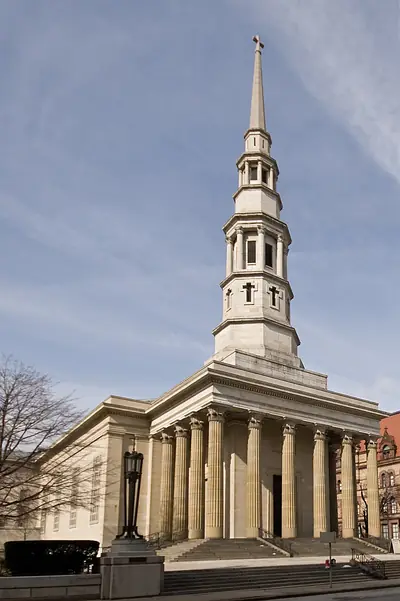
Cathedral Basilica of St. Peter in Chains
The Cathedral Basilica of Saint Peter in Chains is one of downtown Cincinnati’s most distinctive landmarks. This Greek Revival cathedral serves the Archdiocese of Cincinnati and is dedicated to Saint Peter’s imprisonment and liberation in Rome.
Its white limestone spire rises 224 feet, or about 68 meters, above the street. The entrance columns are 33 feet high, a reference to the number of years traditionally associated with Jesus’ life. Inside, Greek-inspired mosaics depict the Stations of the Cross, while Corinthian columns, bronze doors, murals by Carl Zimmerman, and an apse mosaic by Anton Wendling add to the cathedral’s richly detailed interior.
The cornerstone was laid by Bishop John Baptist Purcell in 1841, and the church was dedicated in 1845. The building also has a connection with the Cincinnati Art Museum: large stone angels once held in the cathedral are now part of the museum’s collection.
Old Saint Paul Church
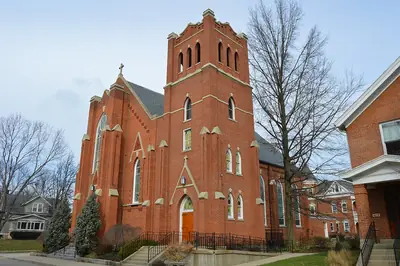
At Twelfth and Spring Streets, Old Saint Paul Church reflects Cincinnati’s German Catholic heritage. German-speaking parishioners established the church in 1848, and the substantial brick building that followed has a strongly Romanesque character.
Its grand arched windows and three arched doorways face Spring Street. Inside, twelve Corinthian columns frame the main space, while a Renaissance tower rises to a Pope’s Mitre cupola and gilded cross. A fire destroyed much of the church in 1899, but the original German-made stained glass windows and walls survived. The restored building reopened in 1900 and now serves as a venue for weddings and corporate events.
St. Louis Church
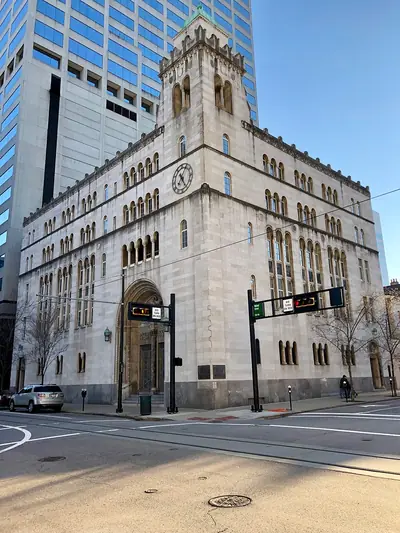
St. Louis Church is a five-story limestone landmark at Walnut Street and East Eighth Street. Completed in 1928, it combines Florentine-style architecture with an unusual history: the building was originally constructed for the Campellites before being adapted for Roman Catholic services.
The former church included two chapels and more than 35,000 square feet across several floors, with worship areas, mezzanines, offices, and residential rooms. Its Catholic services ended in 2021, leaving the building’s future open between preservation and a possible new downtown use.
Cincinnati Art Museum
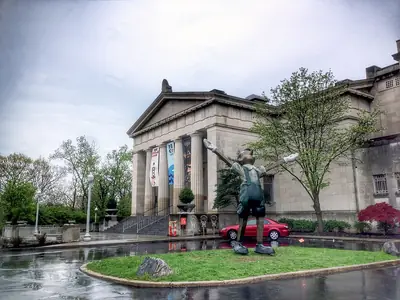
Eden Park is home to the Cincinnati Art Museum, one of the oldest art museums in the United States. Founded in 1881, it was the first purpose-built art museum west of the Alleghenies. Its collection includes more than 67,000 works spanning 6,000 years of human history.
The original building opened in 1886 and was designed by Cincinnati architect James W. McLaughlin in the Romanesque Revival style. Later additions have given the museum several architectural layers. The Cincinnati Wing, opened in 2003, presents around 400 works created for Cincinnati or by Cincinnati artists since 1788, including pieces connected with Frank Duveneck, Rookwood Pottery, Robert Scott Duncanson, and Mitchell and Rammelsberg Furniture.
Contemporary Arts Center
The Contemporary Arts Center, or CAC, offers a very different museum experience. Rather than maintaining a permanent collection, it presents new ideas and recent developments in painting, sculpture, photography, architecture, performance art, and new media.
The CAC moved into the Lois and Richard Rosenthal Center for Contemporary Art in 2003. Designed by Zaha Hadid after she won an architectural competition in 1998, the building is an artwork in its own right. Black matte aluminum boxes and white concrete appear to be stacked in motion, creating a deconstructivist presence in the city center.
Aronoff Center for the Arts
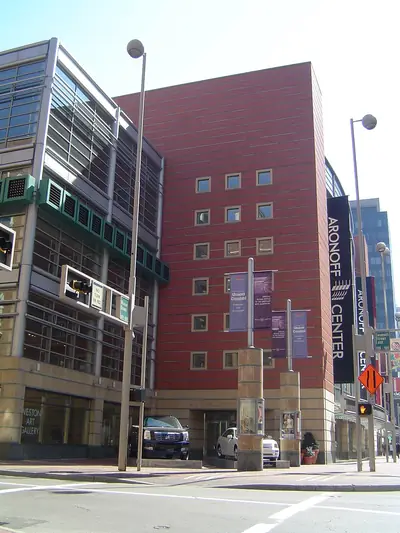
The Aronoff Center brings theater, ballet, concerts, comedy, musicals, and exhibitions together in a modern downtown venue. It opened in 1995 and was designed by César Pelli, using glass, stainless steel, and brick to create a contemporary contrast with Cincinnati’s historic surroundings.
Its principal performance space, Procter & Gamble Hall, seats 2,700. Smaller performances take place in the Jarson-Kaplan Theater and the adaptable Fifth Third Bank Theater. The Weston Art Gallery adds a visual-arts dimension to the center.
Cincinnati Observatory
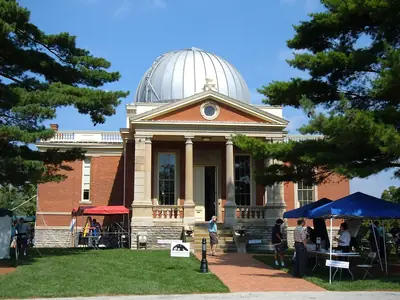
On Mount Lookout, the Cincinnati Observatory is the oldest professional observatory in the United States. Founded in 1842, it consists of two buildings housing historic refracting telescopes with apertures of 11 inches and 16 inches.
The University of Cincinnati owns the observatory, which remains a contributing property to the Observatory Historic District. Its nineteenth-century instruments continue to connect the site with Cincinnati’s history of astronomical research and education.
American Sign Museum
The American Sign Museum explores the artistry, technology, and commercial history of American signage. More than 200 signs are displayed alongside equipment once used to design and manufacture them, while the wider collection contains more than 3,800 cataloged artifacts dating from the late 1800s through the 1970s.
Highlights include signs associated with Big Bear Stores, Howard Johnson’s, and Earl Scheib, as well as a 20-foot-tall genie statue, a 1963 single-arch McDonald’s sign featuring Speedee, and a neon sign from Johnny’s Big Red Grill.
Eden Park Stand Pipe
The castle-like Eden Park Stand Pipe is one of the park’s most unusual landmarks. Completed in 1894 and designed by Cincinnati architect Samuel Hannaford, the water tower rises 172 feet, or 52 meters, above the park.
Its ashlar stone base, crenellated parapets, and winged gargoyles were intended to complement the landscape rather than detract from it. The standpipe once supplied water pressure to Walnut Hills, but it went out of operation in 1916. Public access to its observation site also ended, leaving the tower as a striking reminder of Cincinnati’s infrastructure history.
Historic houses and neighborhood landmarks
Cincinnati’s smaller historic buildings add detail to any city walk. The Betts House, built in 1804, is the oldest surviving building in Cincinnati and the oldest brick home in Ohio.
In Over-the-Rhine, the Bernard Ratterman House is a particularly well-preserved example of Italianate architecture. Built in 1865, it features a brick façade with sandstone and iron details, including an ornate cornice, bracketed window trim, and unusual acorn decorations.
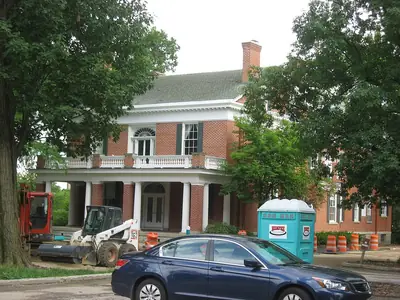
The Wilson-Gibson House brings together Federal and Neoclassical elements. Its brick walls, stone foundation, shuttered windows, fanlights, sidelights, and paired interior chimneys give the mid-nineteenth-century residence a distinctive architectural character.
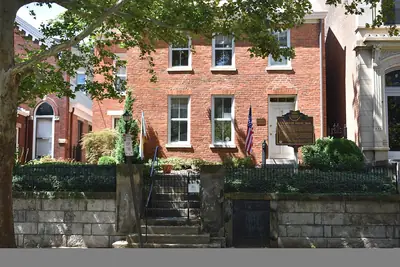
The Harriet Beecher Stowe House in Walnut Hills is connected with the writer’s early life and developing abolitionist views. Built in 1833 for the president of Lane Theological Seminary, it was the Beecher family home after they moved to Cincinnati. Harriet Beecher Stowe lived there until her marriage in 1836, and she gave birth to twin daughters in the house that same year.
Explore Cincinnati with a Self-Guided Audio Tour
Neywo turns a visit into a Cincinnati self-guided walking tour. The app tells the story of each place as you reach it, at your own pace, with no group and no schedule. Narration is available in 11 languages.
Cincinnati has five walking tours:
- Plum Street and Beyond: 1.55 km, 88 minutes, and 11 narrated stops, including the Cathedral Basilica of St. Peter in Chains and St. Louis Church.
- Art Deco Downtown: 2.16 km, 83 minutes, and 10 narrated stops, including the Aronoff Center and Contemporary Arts Center.
- Over-the-Rhine: 3.27 km, 100 minutes, and 11 narrated stops, including Findlay Market, Cincinnati Music Hall, and Washington Park.
- Riverfront and Taft Row: 3.02 km, 97 minutes, and 11 narrated stops, including the National Underground Railroad Freedom Center and Taft Museum of Art.
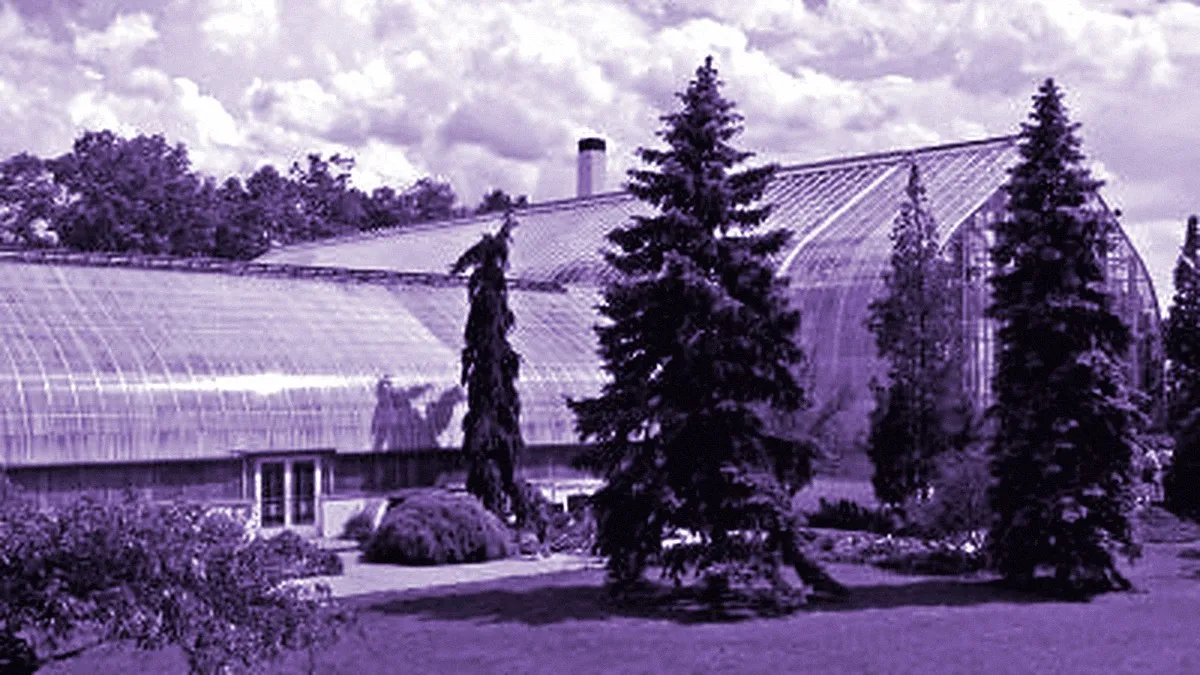
- Mount Adams and Eden Park: 3.02 km, 85 minutes, and 8 narrated stops, including the Cincinnati Art Museum, Krohn Conservatory, and Eden Park Stand Pipe.
There is also one bus route, covering 10.4 km in 45 minutes with 12 narrated stops, and one bike route, covering 2.3 km in 12 minutes with 8 narrated stops. Together, they make it easy to explore Cincinnati on foot, by bus, or by bike.
Download Neywo and discover Cincinnati’s architecture, museums, churches, neighborhoods, and riverfront landmarks through stories that begin when you arrive. Cincinnati is part of Ohio in the United States, with other Ohio destinations including Cleveland, Columbus, and Dayton.
Places with an audio guide in Cincinnati
8 places in Cincinnati with a Neywo audio guide. Each one starts telling its story as you reach it.
Self-guided tours in Cincinnati
7 tours in Cincinnati, free in the Neywo app. Each stop tells its story as you reach it.
- Bike ride
Mount Adams to Eden Park by Bike: Hilltop Churches, Castle Arch and the Standpipe
A short ride from the Immaculata church on Mount Adams along the park roads of Eden Park: the miniature-castle Elsinore Arch, the Playhouse, the Art Museum, the Krohn Conservatory, then the Gothic-looking Standpipe water tower and a bronze Capitoline wolf, with views over the Ohio River.
Immaculata Church · Pilgrim Presbyterian Church · Elsinore Arch · Cincinnati Playhouse in the Park · Cincinnati Art Museum · Krohn Conservatory …
Open this tour: Mount Adams to Eden Park by Bike: Hilltop Churches, Castle Arch and the Standpipe - Bus ride
Metro Route 1: Eden Park to Taft Museum and Mount Adams
A weekday city bus from Eden Park's Krohn Conservatory through Mount Adams to the downtown churches, Fountain Square and the Taft Museum, finishing near the Immaculata church on the hilltop. A cheap way to link the park, the old Lytle Park district and the city centre.
Walnut Hills United Presbyterian Church · Capitoline Wolf Statue, Cincinnati · Krohn Conservatory · Pilgrim Presbyterian Church · Literary Club of Cincinnati · Christ Church Cathedral …
Open this tour: Metro Route 1: Eden Park to Taft Museum and Mount Adams - Walk
Plum Street and Beyond: Spires, Domes and a Clock Tower
Cincinnati's most photogenic block. A Greek Revival cathedral with a 224-foot limestone spire faces a Moorish Revival synagogue inspired by the Alhambra, while a Richardsonian Romanesque City Hall plays tricks with its windows. Add the oldest firehouse museum in town and an Art Deco telephone building whose frieze shows Alexander Graham Bell. The walk then drifts east past a Jewish businessmen's club with Tiffany windows, the oldest synagogue building west of the Alleghenies and a limestone Florentine-style church.
Cincinnati Fire Museum · Lloyd Library and Museum · Cincinnati City Hall · Black Lives Matter · Cathedral Basilica of St. Peter in Chains · Isaac M. Wise Temple …
Open this tour: Plum Street and Beyond: Spires, Domes and a Clock Tower - Walk
Art Deco Downtown: Fountain Square to the Zaha Hadid Box
From a bronze Garfield and the book-stack fountain outside the main library to the black-and-white stack of Zaha Hadid's first American building, this downtown loop mixes skyscrapers (a lighthouse-shaped Scripps Center and a Greek mausoleum crowning 4th & Vine), an upstairs library for merchants and clerks, a Jesuit church and the bronze Genius of Water on Fountain Square.
Statue of James A. Garfield · Cincinnati & Hamilton County Public Library · Aronoff Center · Contemporary Arts Center · St. Francis Xavier Church · Mercantile Library of Cincinnati …
Open this tour: Art Deco Downtown: Fountain Square to the Zaha Hadid Box - Walk
Over-the-Rhine: Market, Music Hall and German Brick
Over-the-Rhine is one of the largest intact Victorian districts in the United States, built by German immigrants. Start under the gilded pointing hand of Philippus church, browse Ohio's oldest public market, pass German churches, the Gothic fantasy of Music Hall and its neighbour Memorial Hall on Washington Park, and finish at the city's oldest church in continuous use and a Richard Haas mural of Cincinnatus.
Philippus United Church of Christ · Findlay Market · Saint Francis Seraph Church · St. Paulus Kirche · Nast Trinity United Methodist Church · Cincinnati Music Hall …
Open this tour: Over-the-Rhine: Market, Music Hall and German Brick - Walk
Riverfront and Taft Row: Freedom, Steam and Baseball
Walk the Ohio River bank where thousands of people crossed toward freedom. Begin by the Bengals' stadium, visit the Underground Railroad Freedom Center, reach the Reds ballpark and the red paddlewheel of the National Steamboat Monument, then step aboard history at the last American showboat theatre before climbing back to the Taft Museum, the Literary Club by Lytle Park and the Art Deco Taft Theatre.
Paycor Stadium · Brady Music Center · National Underground Railroad Freedom Center · Cincinnati Reds Hall of Fame and Museum · Great American Ball Park · National Steamboat Monument …
Open this tour: Riverfront and Taft Row: Freedom, Steam and Baseball - Walk
Mount Adams and Eden Park: Hilltop Views and a Gothic Standpipe
Climb Mount Adams to the Immaculata church and the old hillside Presbyterian church, then follow the park roads of Eden Park past a miniature castle arch, the Art Museum, the Playhouse and the Krohn Conservatory to the Standpipe water tower and a bronze Capitoline wolf, with the Ohio River below.
Immaculata Church · Pilgrim Presbyterian Church · Elsinore Arch · Cincinnati Playhouse in the Park · Cincinnati Art Museum · Krohn Conservatory …
Open this tour: Mount Adams and Eden Park: Hilltop Views and a Gothic Standpipe
Walk Cincinnati with Neywo
Neywo turns Cincinnati into a self-guided audio tour. Stories arrive as you reach the place they belong to, and the route reshapes when you wander off it.

