Visiting Dubrovnik, Croatia: Top Sights on Foot
Things to do in Dubrovnik
Dubrovnik is a coastal city where medieval stone walls, red‑tiled roofs and the sparkling Adriatic create one of the most distinctive landscapes in Croatia. Known as the “Pearl of the Adriatic,” it blends the atmosphere of a historic maritime republic with the energy of a modern Mediterranean destination. Neywo offers a free audio guide for Dubrovnik with 33 narrated places, so you can hear the story of each site as you walk at your own pace.
Explore Dubrovnik’s highlights
Dom Marina Držića (museum)
Located near the All Saints Church, the Dom Marina Držića museum offers a glimpse into the city’s religious and cultural heritage.
Walls of Dubrovnik
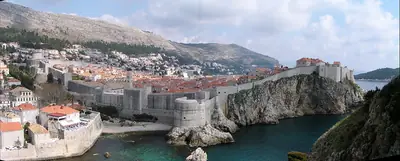
The mighty stone walls that encircle the Old Town form a continuous defensive ring built from the 13th to the 17th century. Stretching about 1,940 metres, they reach up to 25 metres in height, are 4–6 metres thick on the landward side and narrow to 1.5–3 metres facing the sea, and are reinforced by towers on all four sides. Over 753,000 people walked them in the first nine months of 2013, making them one of Dubrovnik’s most visited attractions.
Sponza Palace
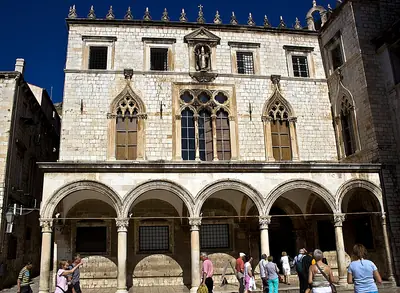
This graceful Gothic‑Renaissance building once served as the customs house, treasury, bank and mint of the Dubrovnik Republic. Its sun‑lit atrium features elegant arcades and a vaulted passage bearing a Latin warning that even traders’ scales are watched by God. By the late 1500s the palace became a cultural centre, hosting the earliest literary academy while the state mint continued to operate until the Republic fell.
Marin Držić Theatre
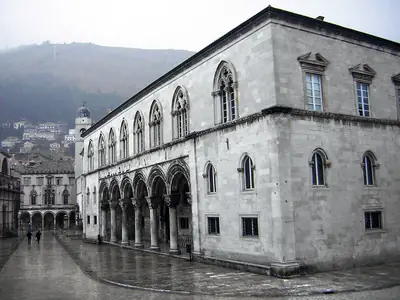
Dubrovnik’s premier stage for drama, the Marin Držić Theatre was founded in 1944 as a professional theatre and occupies a building erected in 1865 between the Rector’s Palace and the City Guardhouse within the UNESCO World Heritage Old Town. The neighbouring Rector’s Palace, seat of the rector and centre of power until 1808, now houses the city’s Cultural Historical Museum and bears the Latin inscription Obliti privatorum publica curate – “Forget private affairs and attend to public ones.”
Fort Lovrijenac
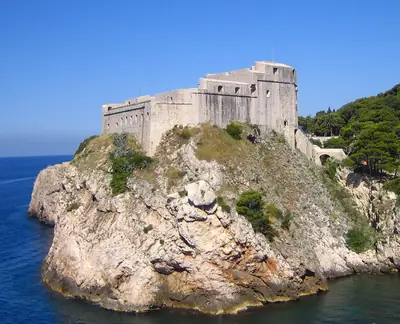
Perched on a cliff 37 metres above the sea, Fort Lovrijenac is often called Dubrovnik’s Gibraltar. The fortress, which also functions as an open‑air theatre, was erected in just three months to thwart a Venetian plan to build a tower on the rock. First mentioned in the 1300s, it is believed to date back to around 1018, with major expansions carried out between the 1400s and 1600s. Its impregnable stance gave the Dubrovnik Republic a vital defensive advantage, especially against Venetian attacks.
Fort Imperial
Crowning Srđ hill, Fort Imperial was built between 1806 and 1812 by the French administration then governing the area. As the largest fortress on the hill, it anchors a network that includes the smaller forts of Strinčjera, Gradci and Delgorgue. Inside its walls lies the Museum of Croatian War of Independence, opened to the public in 2010, with a permanent exhibition titled Dubrovnik in the Homeland War 1991–1995.
Dubrovnik Cathedral
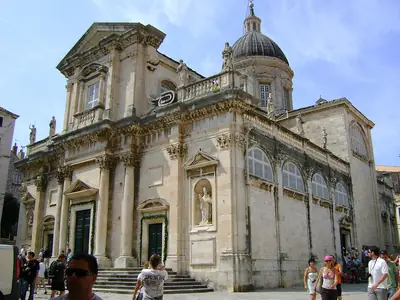
Dedicated to the Assumption of the Blessed Virgin Mary, the Dubrovnik Cathedral stands on Marin Držić Square in the Old Town. Its interior is lavishly decorated; above the main altar hangs a 16th‑century painting of the Assumption signed by Titian, and the unique altar of Saint John of Nepomuk is crafted from purple marble. The present Baroque building was erected between 1671 and 1713 on the site of an earlier Byzantine and Romanesque cathedral destroyed in the great earthquake of 1667. Legend links the original cathedral to a donation of 100,000 ducats from England’s King Richard the Lionheart after his shipwreck near Lokrum in 1192.
St. Michael’s Church
A modest place of worship tucked within the Old Town, St. Michael’s Church serves the local community and adds to the city’s varied ecclesiastical landscape.
Church of St. Roch (crkva svetog Roka)
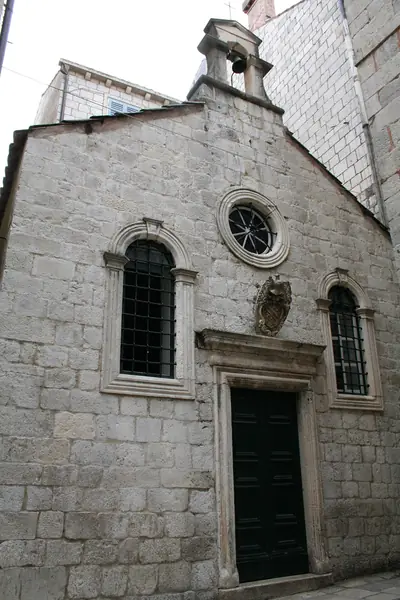
Located as you wander through Dubrovnik, the Church of St. Roch offers a quiet spot for reflection and is another example of the city’s rich religious fabric.
Fort Royal
Situated on the summit of Lokrum Island, Fort Royal is a historic fortification whose construction began in 1806 under the orders of Napoleon’s general Auguste Marmont. The fort was completed around 1835 during the period of Austrian administration of the island and now provides panoramic views of the surrounding waters.
Maritime Museum
Housed in Saint John’s Fortress, which was built into the famous city walls, the Maritime Museum tells the story of Dubrovnik’s seafaring past through model ships, flags and portraits. The fortress dates back to 1346, was linked with the nearby Gundulić fortress by 1557 into a semi‑circular shape, once stored large quantities of gunpowder, and its broad terraces now serve as a summer stage for festivals. A heavy chain once stretched between this fortress and its northern counterpart, St. Luke, until the artificial island of Kaše was built in 1484 to take its place.
Franciscan Church and Monastery
Nestled in the northwestern corner of the Old Town near Stradun, the Pile Gate and Onofrio’s great fountain, the Franciscan complex combines a place of worship, a working pharmacy, a historic library and a museum. The church’s main entrance is framed by a richly carved Gothic portal, the only part of the building to survive the 1667 earthquake; it was crafted by the Andrijić brothers in 1498 and centres on a stone Pieta. The cloister, built around 1360 by Mihoje Brajkov from Bara, features 120 columns and encloses Dubrovnik’s oldest garden, tended without interruption since the monastery moved inside the walls. Construction of the monastery and church began in 1317, with the main works finished during the fourteenth century, and the pharmacy has been operating continuously since then.
Muzej franjevačkog samostana (Church of St. Saviour)
Built in the early 1500s as a votive offering after the devastating 1520 earthquake, the Church of St. Saviour stands as a testament to the city’s gratitude and resilience. Its pure Renaissance style is marked by a trilobed gable—a three‑arched façade typical of eastern Adriatic Renaissance churches. Remarkably, when the powerful earthquake of 1667 struck Dubrovnik, the church emerged almost unscathed and today hosts classical music concerts and art exhibitions.
Dubrovnik‑Neretva County
Dubrovnik lies in the southernmost county of Croatia, which also includes the towns of Metković, Korčula, Ploče and Opuzen. Because of Bosnia and Herzegovina’s Neum corridor, the county is divided into two separate parts. You can learn more about the region on the Dubrovnik‑Neretva County page.
Republic of Ragusa
For centuries Dubrovnik was the heart of the independent Republic of Ragusa, a patrician maritime republic that flourished from the mid‑14th century until the early 1800s. At its height it ranked among the most developed economies of the world, with ships sailing every European and Mediterranean sea and even reaching the Atlantic and Indian Oceans. The republic endured until Napoleonic troops occupied Dubrovnik in 1806 and was formally abolished in 1808. The devastating earthquake of 1667 marked a turning point that contributed to its eventual decline.
Explore Dubrovnik with Neywo
Neywo’s free audio guide turns your walk into a self‑guided discovery of the city. In Dubrovnik you have 2 walking tours to choose from:
- “From the Gibraltar of Dubrovnik to the Old Town Gates” – 1.12 km, 78 minutes, 10 narrated stops (including St. Mary church and monastery at Danče, Lovrijenac, Pile Gate, St. Claire’s convent, crkva svetog Roka, St. Saviour Church, Franciscan Church and Monastery, Domino, the Walls of Dubrovnik and the Holy Annunciation Orthodox church).
- “The Republic’s Heart: from Luža to the Harbour” – 1.08 km, 79 minutes, 11 narrated stops (including Saint Ignatius Church, Prirodoslovni muzej, Gundulićs, Dubrovnik Cathedral, Rector’s Palace, St Blaise’s Church, Sponza Palace, Dominican Church and Monastery, Ploče Gate, Fort Revelin and the Maritime Museum).
Each story plays automatically as you reach the corresponding place, allowing you to explore at your own pace with no group and no schedule. The narration is available in 11 languages, and the guide covers 33 narrated sites across the city.
If you’d like to keep exploring beyond Dubrovnik, you might also consider visiting nearby destinations such as the historic town of Ston or the island gem of Korčula. Other Croatian cities like Zagreb, Zadar, Bale and Vodice are also covered by Neywo’s growing catalogue of free audio guides.
Download Neywo today, put on your headphones, and let the walls, palaces and churches of Dubrovnik tell their stories as you walk.
Places with an audio guide in Dubrovnik
8 places in Dubrovnik with a Neywo audio guide. Each one starts telling its story as you reach it.
Self-guided tours in Dubrovnik
2 tours in Dubrovnik, free in the Neywo app. Each stop tells its story as you reach it.
- Walk
From the Gibraltar of Dubrovnik to the Old Town Gates
Start at the cliff-top fortress that Dubrovnik raised in three months to stop Venice, cross the three-arched bridge into Pile Gate and walk the western Old Town: the convent that ran one of the world's first orphanages, the Renaissance church vowed after the 1520 earthquake, the Franciscan cloister with Europe's third oldest pharmacy and the foot of the great walls.
St. Mary church and monastery at Danče · Lovrijenac · Pile Gate, Dubrovnik · St. Claire's convent · Crkva svetog Roka · St. Saviour Church …
Open this tour: From the Gibraltar of Dubrovnik to the Old Town Gates - Walk
The Republic's Heart: from Luža to the Harbour
Climb the Jesuit staircase, cross the old market and stand where the Republic of Ragusa governed itself: the cathedral said to be funded by Richard the Lionheart, the Rector's Palace where the ruler gave back the city keys each morning, and the Sponza customs house. End at Ploče Gate, the moat fort and the old harbour fortress.
Saint Ignatius Church · Prirodoslovni muzej · Gundulićs · Dubrovnik Cathedral · Rector's Palace, Dubrovnik · St Blaise's Church …
Open this tour: The Republic's Heart: from Luža to the Harbour
Walk Dubrovnik with Neywo
Neywo turns Dubrovnik into a self-guided audio tour. Stories arrive as you reach the place they belong to, and the route reshapes when you wander off it.

