What to See in Pula, Croatia: Free Audio Guide
Things to do in Pula
Pula is a coastal city on Croatia’s Istrian Peninsula where a remarkably preserved Roman amphitheatre sits alongside Austro‑Hungarian forts, medieval churches and sparkling Adriatic waters. Its layered past—from Roman gladiators to Venetian traders—makes it a rewarding stop for anyone interested in archaeology, architecture and seaside relaxation. Neywo offers a free audio guide for Pula with 32 narrated places, letting you explore at your own pace.
Explore Pula’s highlights
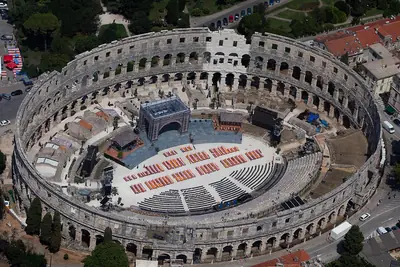
Pula Arena
The Pula Arena is the largest and best‑preserved Roman amphitheatre in Croatia and ranks as the sixth largest of its kind worldwide. Its outer wall, reinforced by four stairway towers, retains all three Roman architectural orders. Construction started under Emperor Augustus (between 2 BC and AD 14) and was finished under Emperor Titus in AD 81. In antiquity the arena hosted gladiatorial combats; later it served as a venue for knights’ tournaments. Locals call it Divić‑grad, and its image appears on the reverse of the old ten‑kuna banknote alongside a plan of Motovun. Despite its cultural significance, the arena has never been inscribed on the UNESCO World Heritage List.
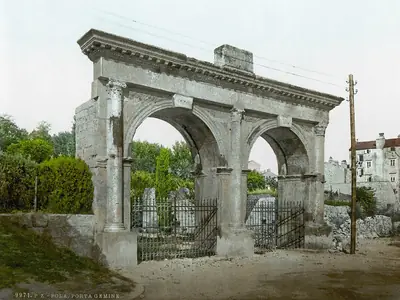
Porta Gemina (Twin Gates)
Just a short walk from the arena, the Porta Gemina dates to the late second century AD, though it rests on an earlier gateway. Built as a decorative portal toward the ancient theatre, each of its two arched passages is framed by three half‑columns topped with composite capitals, linked by a continuous relief wreath. Slots for iron grates are still visible in the vaulting. Beyond the gates lies a quiet courtyard that leads to the Archaeological Museum of Istria and the Small Roman Theatre.
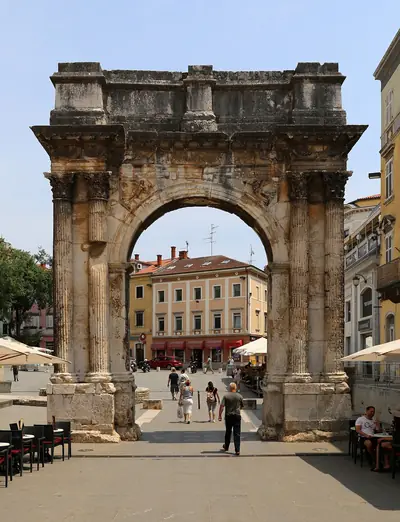
Arch of the Sergii (Golden Gate)
Erected between 29 and 27 BC, the Arch of the Sergii honours three members of the influential Sergii family, including Lucius Sergius Lepidus, a military tribune who fought at the Battle of Actium. The monument blends late‑Hellenistic style with Oriental motifs, featuring capitals, reliefs of victories, weapons, garlands and a war chariot drawn by horses. Its detailed reliefs attracted the attention of artists; a drawing of the arch is kept in the Wicar Museum in Lille, France.
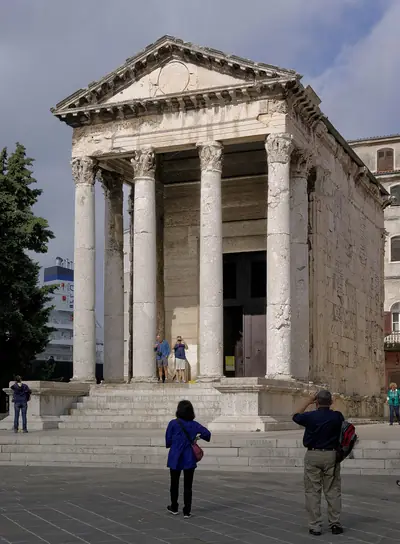
Temple of Augustus
Situated on the Forum, the Temple of Augustus is one of Pula’s finest Roman temples. Dedicated to Emperor Augustus and the goddess Roma while the emperor was still alive, it measures roughly eight metres wide and seventeen point three metres long. The temple stands on a raised podium with a four‑column Corinthian porch, built using the opus isodomum technique. Its richly decorated frieze closely resembles that of the Maison Carrée in Nîmes, France. Most of the original bronze inscription has vanished, but the fixing holes remain.
Pula Cathedral (Cathedral of the Assumption)
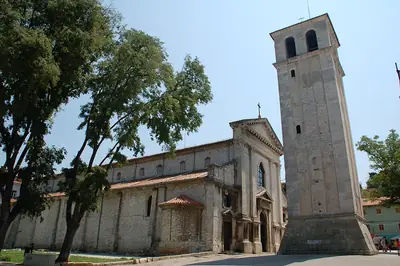
The cathedral has been a sacred site since ancient Roman times, with successive expansions shaping the building we see today. Its current façade dates to the early 1700s. The church sits along the southern edge of Pula Bay, at the foot of the hill crowned by the seventeenth‑century Castle, and serves as one of the two seats of the bishop for the Poreč‑Pula diocese.
Fort Monvidal
Constructed by the Austro‑Hungarian Empire in the second half of the nineteenth century, Fort Monvidal formed part of a defensive ring around Pula’s harbour. Its horseshoe‑shaped, half‑buried design oriented its thick stone walls northeast‑southwest, allowing cannons to reach 800‑1 000 metres. Though never fired in combat, the fort stored weapons until World War I, then served as a barracks and warehouse. After the Yugoslav Army departed in the 1950s, the local company Puljanka used it for fruit processing.
Fort San Michele
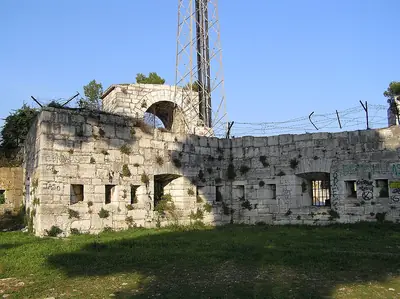
Also built by the Austro‑Hungarians at the end of the nineteenth century, Fort San Michele is a semi‑circular fortress on the hill of the same name. It remained empty until 1914, when it became a storage depot and barracks. After 1920 it housed a warehouse for Pula’s General Hospital, and in 1945 it provided shelter for families displaced by the Second World War.
Battery San Giovanni
This coastal artillery fortification was erected to protect Fort Verudella. The military abandoned it in 1947, and in 1964 the site reopened as a café, restaurant and disco, giving the former battery a new social life.
Fort Verudella
Built between 1881 and 1886, Fort Verudella is a pentagonal stronghold situated thirty‑one metres above sea level. Its earth‑and‑stone mass blends into the landscape, and a central block contains a two‑story casemated barracks. The fort’s main armament—a rotating armoured turret mounting two 280‑millimetre cannons—represents a technological shift toward modern naval artillery. Italian forces altered it slightly after taking control in 1918, and the Yugoslav People’s Army used it briefly after 1947.
Archaeological Museum of Istria
Founded in 1902, the museum occupies a building east of Pula Fortress and the Small Roman Theatre, entered through the ancient Double Gate. Its collections are arranged into prehistory, antiquity, and late antiquity and the Middle Ages, presenting the evolving cultures of Pula and Istria across roughly 3 600 square metres.
Historical and Maritime Museum of Istria
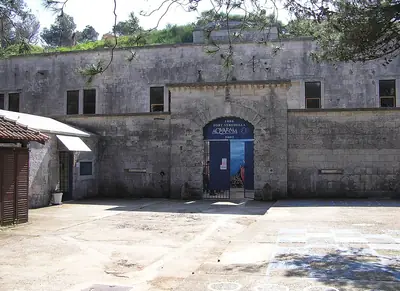
Housed in a Venetian star‑shaped fortress on Pula’s highest hill (thirty‑two metres above sea level), this museum began in 1955 as the Museum of Revolution. It moved into the fortress in 1961, transforming the former military stronghold into a venue for Istria’s history and its deep connection to the sea.
Roman Theatre, Pula (Small Roman Theatre)
Set on the eastern slope of Pula’s central hill below the old Castrum fortress, the theatre was built in the first century AD. Its seating follows the natural hillside—a Greek design choice—while the stage building, proscenium and semicircular auditorium once accommodated up to five thousand spectators. Today only the foundations and sections of the curved seating remain, accessed via the Twin Gates. Pula also possessed a larger Roman theatre outside the city walls, which fell into ruin during the Middle Ages.
Zerostrasse
Beneath the city lies Zerostrasse, a network of underground tunnels that form a hidden layer of Pula waiting to be explored.
Brijuni
A short distance from the coast, the Brijuni archipelago consists of fourteen islands and islets, most of which is water (about eighty percent). The national park has been inhabited since the Stone Age; the Histri, who gave Istria its name, settled here in the first millennium BC. Roman remains include a seaside villa on Veliki Brijun with baths and a temple to Venus, while the Byzantines left a fortified castrum and the basilica of Saint Mary.
University of Pula (Sveučilište Jurja Dobrile)
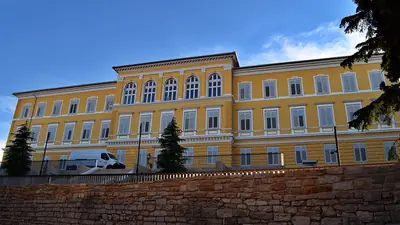
Established on 29 September 2006, the university united existing colleges and faculties in Pula. It celebrates Dies Academicus each 16 April, the anniversary of Bishop Dobrila’s birth, and bears the Latin name Universitas Studiorum Georgii Dobrila Polensis.
Explore Pula with Neywo
Neywo’s free audio guide lets you discover the city’s stories at your own pace, with no group and no schedule. In Pula you can choose from four walking tours and one bus route:
- Gates, Temples and an Arena: Roman Pula in One Loop – 2.3 km, 107 minutes, 11 stops (Pula Arena, Porta Gemina, Hercules Gate, Arch of the Sergii, Chapel of St. Mary Formosa, Forum, Temple of Augustus, Pula Cathedral, Kaštel Fortress, Roman Theatre, Archaeological Museum of Istria)
- Austria’s Naval Port: Forts, a Memorial and the Arena Shore – 2.3 km, 60 minutes, 4 stops (Borcima narodnooslobodilačke borbe i žrtvama fašizma 1941‑1945, Pula Arena, Fort Monvidal, Fort San Giorgio)
- Sailors, Students and the Stage: Southern Pula – 3.23 km, 66 minutes, 4 stops (Istrian National Theater, University of Pula, Stadion Aldo Drosina, Crkva Gospe od Mora)
- Austria’s Southern Fort Ring: From the Stadium to Verudella – 4.59 km, 86 minutes, 4 stops (Stadion Aldo Drosina, Fort Casoni Vecchi, Fort Bourguignon, Fort Verudella)
- Bus 6: Hercules Gate to the Sailors’ Church and the Stadium – 11.9 km, 51 minutes, 6 stops (Hercules Gate, Arch of the Sergii, Crkva Gospe od Mora, Franciscan Monastery in Pula, Istrian National Theater, Stadion Aldo Drosina)
As you approach each point, the app plays the corresponding narration, allowing you to linger or move on whenever you wish. Download Neywo today and let the city’s past and present unfold step by step.
Places with an audio guide in Pula
8 places in Pula with a Neywo audio guide. Each one starts telling its story as you reach it.
Self-guided tours in Pula
4 tours in Pula, free in the Neywo app. Each stop tells its story as you reach it.
- Bus ride
Bus 6: Hercules Gate to the Sailors' Church and the Stadium
Pulapromet's line 6 passes through the centre of Pula from Hercules Gate and the Arch of the Sergii south past the Franciscan monastery to the Habsburg navy's Sailors' Church and the football stadium. A cheap way to link the Roman core with the Austrian town.
Hercules Gate · Arch of the Sergii · Crkva Gospe od Mora · Franciscan Monastery in Pula · Istrian National Theater · Stadion Aldo Drosina
Open this tour: Bus 6: Hercules Gate to the Sailors' Church and the Stadium - Walk
Gates, Temples and an Arena: Roman Pula in One Loop
Start at the sixth-largest Roman amphitheatre in the world and walk through the old Roman town: the twin gates, Hercules' gate, the triumphal Arch of the Sergii and the Temple of Augustus on the forum. Climb the hill past a Byzantine chapel to the Venetian fortress and the hillside theatre. Two thousand years of stone in under two hours.
Pula Arena · Porta Gemina · Hercules Gate · Arch of the Sergii · Chapel of St. Mary Formosa · Forum, Pula …
Open this tour: Gates, Temples and an Arena: Roman Pula in One Loop - Walk
Austria's Naval Port: Forts, a Memorial and the Arena Shore
Pula was the Austro-Hungarian navy's main base, and its hills still carry the ring of forts built to guard it. Walk from the waterfront memorial in Tito's Park past the Arena to two of the horseshoe-shaped forts, one of which has been a restaurant, a nightclub and a film set.
Borcima narodnooslobodilačke borbe i žrtvama fašizma 1941-1945 · Pula Arena · Fort Monvidal · Fort San Giorgio
Open this tour: Austria's Naval Port: Forts, a Memorial and the Arena Shore - Walk
Sailors, Students and the Stage: Southern Pula
Leave the Roman core for the Pula the Habsburg navy built: the striped Sailors' Church paid for by Emperor Franz Joseph, the home ground of Istria's football clubs, the new university and the theatre that grew out of a Victorian music hall.
Istrian National Theater · University of Pula · Stadion Aldo Drosina · Crkva Gospe od Mora
Open this tour: Sailors, Students and the Stage: Southern Pula
Walk Pula with Neywo
Neywo turns Pula into a self-guided audio tour. Stories arrive as you reach the place they belong to, and the route reshapes when you wander off it.


More in Istria County
Elsewhere in Croatia
- CresPrimorje-Gorski Kotar County
- Mali LošinjPrimorje-Gorski Kotar County
- RabPrimorje-Gorski Kotar County
- RijekaPrimorje-Gorski Kotar County
- BolSplit-Dalmatia County
- HvarSplit-Dalmatia County
- MakarskaSplit-Dalmatia County
- OmišSplit-Dalmatia County
- SplitSplit-Dalmatia County
- TrogirSplit-Dalmatia County
- Karlovac
- Ozalj