What to See in Zadar, Croatia: Free Audio Guide
Things to Do in Zadar
Zadar is a historic coastal city in Croatia where Roman ruins, Venetian walls and contemporary seaside art meet the Adriatic Sea. Visitors can wander through layers of history, enjoy the unique music of the Sea Organ and watch the light show of the Monument to the Sun, all within a compact, walkable centre — highlighting what to see in Zadar. Neywo offers a free audio guide for Zadar that covers 17 narrated places.
Explore Zadar’s Highlights
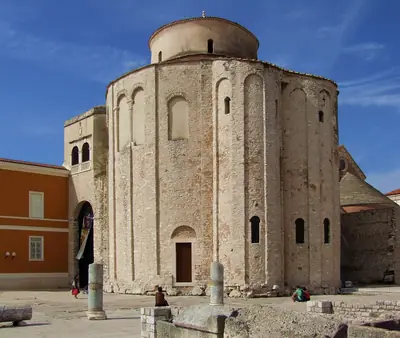
Church of St. Donatus
This cylindrical church rises 27 metres high and spans 22 metres across, its massive stone walls giving it a fortress‑like appearance. Inside, a double interior space features a ground‑floor nave and a gallery level, both following the same circular plan. Begun in the ninth century by Bishop Donatus of Zadar on the northeastern corner of the ancient Roman forum, the building incorporates reused Roman stones and columns. Originally dedicated to the Holy Trinity, it received its present name in the fifteenth century. The church was noted by the Byzantine emperor Constantine Porphyrogennetos in the tenth century and, while it follows early Byzantine and Carolingian central‑church traditions, its pure cylindrical form and rough monumentality make it unique.
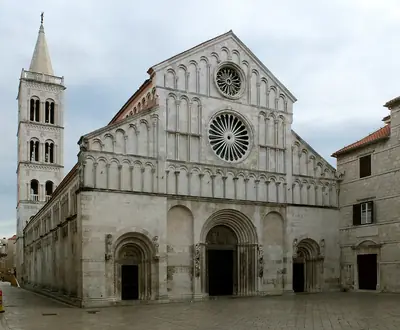
Zadar Cathedral
As the largest church in Dalmatia and the seat of the Archdiocese of Zadar, the cathedral is dedicated to Saint Anastasia (locally Sveta Stošija). Its origins trace to a fourth‑ or fifth‑century early Christian basilica on the same site. The present three‑nave Romanesque structure was erected in two main phases during the twelfth and thirteenth centuries, with layers of ninth‑ and eleventh‑century churches visible in the façade. Inside, a Baroque main altar contrasts with the Romanesque walls, while thirteenth‑century frescoes survive in the side apses. The cathedral has been a continuous place of worship for over a millennium.
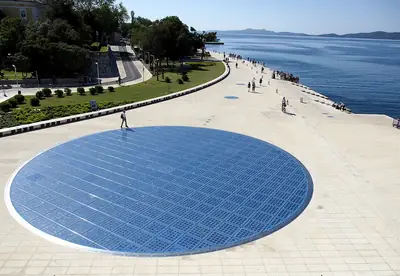
Monument to the Sun
Also known as Greeting to the Sun, this waterfront installation forms a 22‑metre‑wide circle of 300 multi‑layered glass plates set flush with the stone paving. Beneath the plates, photovoltaic modules collect solar energy during the day; at night, embedded lighting elements produce a subtle, shifting light show. Smaller circles in the pavement represent the planets of our solar system, positioned in proportion to their distance from the Sun. The monument stores sunlight by day and returns it as light by night, creating a quiet dialogue between technology and the natural world on Zadar’s ancient shoreline.
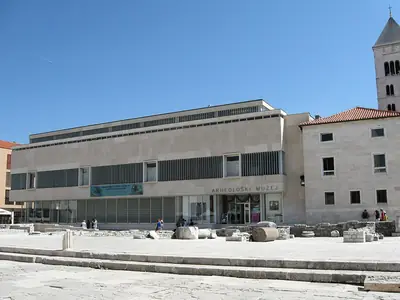
Archaeological Museum Zadar
Situated along the Šimun Kožičić Benja promenade just before the Saint Mary monastery complex, this is the second oldest archaeological museum in Dalmatia (only Split’s is older). Founded in 1832, its collection was housed for more than sixty years inside the Church of Saint Donatus (1893‑1954) before moving to the modern building. As a state museum it covers Zadar County, including the islands of Rab and Pag, and includes departments for prehistoric, ancient, medieval and underwater archaeology. Visitors can also see a conservation workshop, a library and the Museum of Nin Antiquities.
Zlato i srebro Zadra
Located in the Benedictine convent of Saint Mary, this permanent exhibition of church art occupies eight modern halls covering 1 200 square metres. It holds one of the largest and most significant collections of its kind in the country, illustrating Zadar’s role as a major cultural centre from the eighth to the eighteenth century. The project was initiated by writer Miroslav Krleža in 1951, took shape in 1972 from a convent heavily damaged during the Second World War, and opened in December 1976. Among the objects on display is a tiny cross‑reliquary (enkolpion) from the seventh or eighth century, popularly called Čika’s Cross, along with numerous other precious reliquaries.
Sea Organ
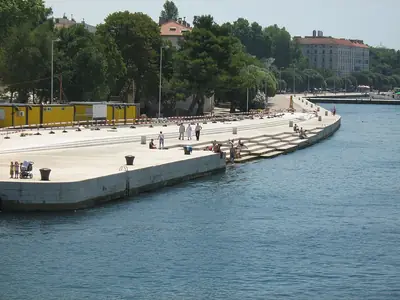
A broad flight of white marble steps descends into the Adriatic. Beneath the steps lie thirty‑five polyethylene tubes, each tuned to a different musical note. As waves roll in, they push air through the tubes and the sound escapes through whistle‑holes along the promenade, producing a constantly shifting chord progression that is never the same twice. There is no keyboard, organist or sheet music; the Adriatic itself performs, offering gentle harmonies on calm days and louder, urgent chords when the bura wind stirs the sea. The installation has been operating continuously for nearly two decades.
Kopnena Vrata/Porta terraferma
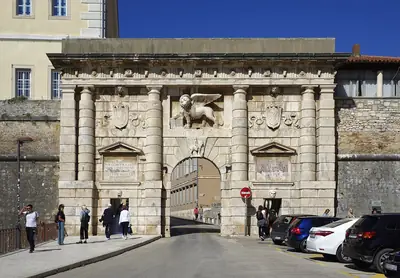
Known as the Land Gate, this grand entrance for travelers arriving by land was built in 1543 to a design by the Venetian architect Michele Sanmicheli. It takes the form of a classical triumphal arch: a wide central archway for carriages and carts, flanked by two smaller rectangular passages for pedestrians. The design is rigorously symmetrical, featuring Tuscan columns and an architrave decorated with triglyphs and metopes. The keystone of the main arch shows Saint Chrysogonus on horseback, the patron saint of Zadar, with the city’s coat of arms beneath the Lion of Saint Mark — the emblem of the Venetian Republic. Stone inscriptions on the gate record the names and coats of arms of the city prince and city captain at the time of its construction.
Biskupska palača
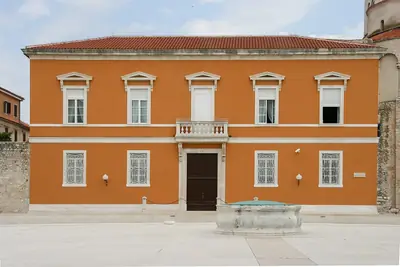
This building serves as the historic residence of Zadar’s archbishops and is officially recognised as a monument of history and architecture.
St. Mary’s Church
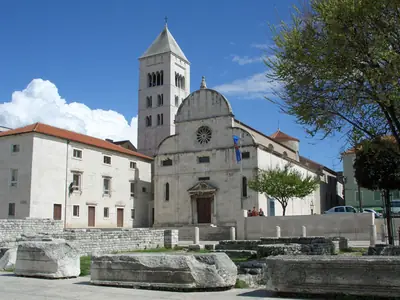
A Benedictine monastery has stood on the eastern edge of Zadar’s ancient Roman Forum for nearly a thousand years. Founded in 1066, it is one of the city’s oldest religious institutions. The monastery sits alongside the church, tucked into the eastern side of what was once the bustling heart of Roman Zadar.
University of Zadar
The university traces its roots to 1396, making it the oldest higher‑education institution in Croatia and one of the oldest in Europe. The original university operated for more than four hundred years before closing in 1807, but the tradition of higher learning persisted through faculties in Zagreb and Split. In the mid‑twentieth century a Dominican scholar, Father Stjepan Krasić, uncovered proof of the 1396 founding, sparking a movement that led to the 2002 parliamentary act re‑establishing the University of Zadar. It reopened as an integrated university with sixteen departments — the first of its kind in the country — and today serves thousands of students across its faculties and research centres.
Church of St. Chrysogonus
This Romanesque basilica has stood on the site since the twelfth century, named for Zadar’s patron saint. Consecrated in 1175 by Archbishop Lampridius, it rises on the location of an ancient Roman emporium, replacing an earlier church dedicated to Saint Anthony the Hermit. It is the only surviving fragment of a once‑vast Benedictine abbey. Inside, a classic three‑nave layout is anchored by three decorated semi‑circular apses, a hallmark of regional Romanesque design. The bell tower was begun in 1485 but work halted in 1546, leaving an unfinished silhouette. According to tradition, the murdered queen dowager Elizabeth of Bosnia was secretly buried here in 1387 and remained for three years before being transferred to the basilica at Székesfehérvár.
Church of St. Simon
The origins of this church reach back to the fifth century, when the first building was raised on the spot and dedicated to Saint Stephen, the first Christian martyr. Over the centuries the structure was enlarged and rebuilt several times, with the last major reconstruction taking place in the first half of the seventeenth century, giving the building much of its present form. Behind the main altar lies a gilded silver sarcophagus holding the relics of Saint Simon, crafted in 1381 and regarded as one of the finest masterpieces of Croatian goldsmith work.
Teatro Nobile
This site marks the location of Zadar’s first permanent professional theatre, opened in 1783. Before its construction, theatre life in the city included an ancient amphitheatre, medieval liturgical dramas in the eleventh century and stagings of the legend of Saint Margaret as early as 1500. By 1697 a dedicated theatre building existed, and later performances moved to Palazzo Fozza. Teatro Nobile served as the main stage until 1865, when the grand New Theatre — later known as Teatro Verdi — replaced it.
Teatro Verdi
Opened in 1865 as the New Theatre (originally Novo kazalište), Teatro Verdi became the cultural heart of Zadar for decades. The initiative came from musician and critic Giovanni Salghetti‑Drioli, part of the family that owned the famous maraschino liqueur factory, who rallied local patrons such as Natale Filippi, Simeone Cattich and the Luxardo and Perlini families to form a joint‑stock company. They purchased a ruined palace from the Lantana counts — once the residence of the Bishop of Nin — set in gardens near the Church of Our Lady of Health on Theatre Street. Clearing the site allowed the construction of a grand, modern theatre in the fashionable historicist style, a blend of Renaissance and Classical elements that brought Northern Italian architectural trends to Dalmatia for the first time. The opening night on 7 October 1865 featured Verdi’s Un Ballo in Maschera — A Masked Ball.
Narodni trg
Known as People’s Square, this space has been the beating heart of Zadar since the Middle Ages, when it was called Platea Magna, the Great Square. It served as the centre of civic life where the administration gathered and justice was dispensed. The square is dominated by the City Hall, completed in 1934 and replacing an earlier, undistinguished town hall demolished during the Italian administration. Opposite it stands the City Loggia, first mentioned in the thirteenth century and rebuilt in 1565; today it hosts international art exhibitions during the summer months. Next to the Loggia is the City Guard building from 1562, to which an eighteenth‑century clock tower was added; the clock mechanism installed in 1803 has been ticking continuously ever since. The large bell that strikes the hours came from the Captain’s Tower, while the smaller quarter‑hour bell originated from the nearby church of Saint Lawrence. The clockmaker was the local artisan Martini.
Explore Zadar with Neywo
Neywo provides a free audio guide for Zadar that covers 17 narrated places. The app offers one walking tour: “Zadar: Roman Stones, Venetian Gates and a Sea That Plays Music” – 1.7 km long, taking about 93 minutes and featuring 12 stops. As you reach each point, the app tells the story of that place, letting you go at your own pace with no group and no schedule. Narration is available in 11 languages. Download Neywo to enjoy a free walking tour of Zadar and discover the city’s highlights at your leisure.
Places with an audio guide in Zadar
8 places in Zadar with a Neywo audio guide. Each one starts telling its story as you reach it.
Self-guided tours in Zadar
1 tour in Zadar, free in the Neywo app. Each stop tells its story as you reach it.
- Walk
Zadar: Roman Stones, Venetian Gates and a Sea That Plays Music
Zadar's old town sits on a narrow peninsula, and two thousand years of history are stacked along it. Enter through Sanmicheli's Venetian Land Gate, pass the silver shrine of St. Simon and the Romanesque church of St. Chrysogonus, then walk across the Roman forum beside the round pre-Romanesque church of St. Donatus. End on the waterfront, where the Sea Organ plays music with the waves and the Monument to the Sun glows at dusk.
Kopnena Vrata/Porta terraferma · Church of St. Simon · Church of St. Chrysogonus · Zlato i srebro Zadra · St. Mary's Church · Roman forum in Zadar …
Open this tour: Zadar: Roman Stones, Venetian Gates and a Sea That Plays Music
Walk Zadar with Neywo
Neywo turns Zadar into a self-guided audio tour. Stories arrive as you reach the place they belong to, and the route reshapes when you wander off it.


More in Croatia
Elsewhere in Croatia
- DubrovnikDubrovnik-Neretva County
- KorčulaDubrovnik-Neretva County
- StonDubrovnik-Neretva County
- BaleIstria County
- MotovunIstria County
- PorečIstria County
- PulaIstria County
- RovinjIstria County
- UmagIstria County
- CresPrimorje-Gorski Kotar County
- Mali LošinjPrimorje-Gorski Kotar County
- RabPrimorje-Gorski Kotar County