What to See in Gudhjem, Denmark: Free Audio Guide
Things to do in Gudhjem
Gudhjem is a coastal town on Bornholm island in Denmark’s Capital Region, known for its rocky shores, colorful houses, maritime heritage, and long‑standing smoked‑fish traditions. The town offers a mix of scenery, history, and local culture that makes it a rewarding stop for anyone exploring the Baltic island. Neywo provides a free audio guide for Gudhjem with 59 narrated places.
Explore Gudhjem’s highlights
Hammershus (castle)
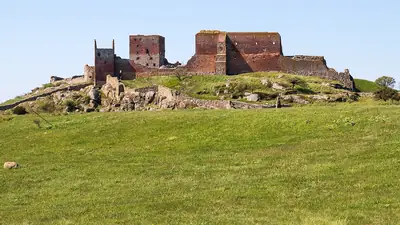
The ruins of Hammershus sit on a rocky height south of Hammerknuden on Bornholm’s northwestern coast. Regarded as Northern Europe’s largest castle ruin, the fortress stands on a cliff about 74 metres above the sea and is encircled by a wall roughly 750 metres long. It is thought to have been built around 1255 by Jakob Erlandsen, archbishop of Lund, possibly expanding an earlier refuge fortress. Parts were demolished around 1750 and later restored circa 1900. A new visitor centre opened beside the site in 2018, designed by Christoffer Harlang with Arkitema Architects and funded by a donation from Almenfonden.
NaturBornholm (museum)
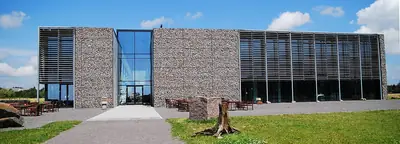
Just outside Aakirkeby, near Klintebakken, NaturBornholm is an interpretive centre devoted to the island’s geology and natural history. Housed in a large stone structure designed by Henning Larsen, it opened on 16 May 2000 and was inaugurated by Prince Henrik together with Birthe Juel‑Jensen. The centre operates as a science education activity centre under the NaturBornholm foundation. Visitors can follow Bornholm’s journey through time as narrated by Bent Jørgensen, former director of Copenhagen Zoo, and explore archaeological finds with the help of nature guides.
Bornholm Art Museum (museum)
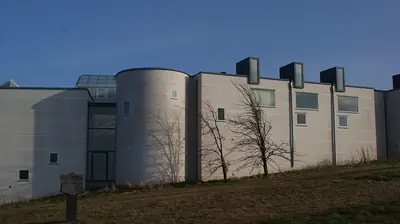
A short distance north of Gudhjem, the Bornholm Art Museum lies beside the Sanctuary Rocks (Helligdomsklipperne). The building covers about 4 000 square metres, opened in 1993 to a design by Fogh og Følner and extended in 2003. Its collection traces Bornholm’s artistic story from the early 19th century to the present, featuring paintings and a substantial craft collection, especially ceramics and glass. The museum highlights the Bornholm painters Oluf Høst, Olaf Rude, Karl Isakson and Niels Lergaard. Originating in 1893 as part of Bornholms Museum in Rønne, it became an independent institution when it moved into its current premises in 1993; the collection is owned by the Bornholms Museumsforening while the buildings belong to Bornholms Regionskommune.
Kongemindet (monument) – Rytterknægten
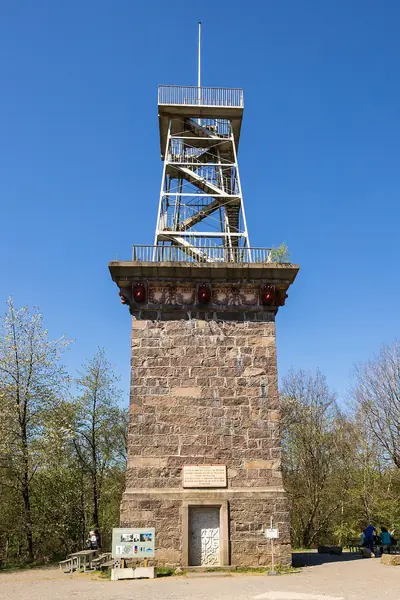
Kongemindet, also known as Rytterknægten, is a memorial tower marking a royal visit in 1854. It stands at the highest point on Bornholm, 162 metres above sea level in the heart of Almindingen, Denmark’s third‑largest forest. The stone tower was erected in 1856 to commemorate King Frederik VII and Countess Danner, who had visited the island a few years earlier, and was designed by Gottlieb Bindesbøll. In 1899 a nine‑metre steel structure was added above the original thirteen‑metre stone tower, raising the summit to about 172 metres. The memorial inscription recalls the king’s visit from 8 to 16 August 1851 and the Bornholmers’ dedication of the monument.
Bornholm Automobilmuseum Aakirkeby (museum)
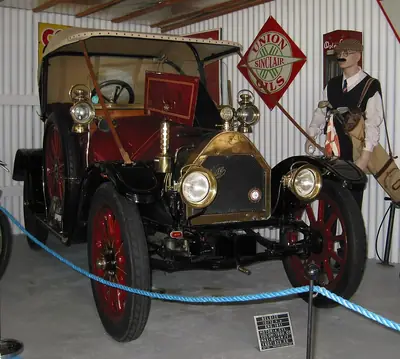
Southeast of Aakirkeby, the Bornholm Automobilmuseum displays more than 80 cars, tractors and motorcycles that illustrate everyday technology of earlier times. Opened on 5 May 1989, most exhibits come from the private collection of Ole Hermansen. Notable rarities include a 1909 Metz Two Runabout, a 1911 Belsize Motors car (only one other example known in the Nordic region), a 1919 Harley Davidson, a 1930 Ford A, a 1936 Fordson van and Bornholm’s first NSU Prinz; English sports cars form a large part of the collection.
Bornholm Museum (museum)
Located in Rønne, Bornholm Museum is a cultural history institution covering the island’s heritage from the Stone Age to recent times. The association was founded in 1893 and the doors opened the following year in a former hospital building on Sankt Mortensgade; the building was enlarged between 1921 and 1923 and still houses the museum’s archive and administration. Exhibits trace chapters such as Bornholm under Swedish rule, the period when Russian forces were present, and the island’s long maritime history. Special exhibitions focus on the small gold figures known as goldgubber and on Bornholm clocks. Additional sites explore traditional crafts and military history, including Hjorth’s Factory—a preserved terracotta workshop from 1859 described as Denmark’s oldest functioning ceramics factory—and the Kastellet defense installation, where a tower museum run by the Friends of Kastellet shows a tank and cannons.
Bornholm Railway Museum (museum)
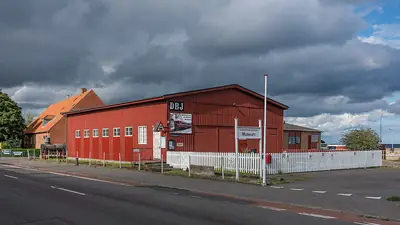
Situated in Nexø’s harbour area, the Bornholm Railway Museum tells the story of De Bornholmske Jernbaner, the island’s railway system that operated from 1900 to 1968. The exhibition is housed in a large wooden building beside the harbour, formerly used by the boatbuilding company Nexø Både. In 1999 Nexø Museum and the Bornholm Railway Association renovated the space to create the “Train and Harbour” display. A highlight is DBJ number 26, a mail car and the only surviving Bornholm railway carriage, presented alongside a recreated station setting.
Bornholms Forsvarsmuseum (museum)
Bornholms Forsvarsmuseum is devoted to the military and defence history of the island, with displays housed in Kastellet and the surrounding buildings. The museum’s story began in 1975 with an exhibition in Kastellet before the building ceased to be used as a military storehouse; the institution was established in 1980. Kastellet, one of Rønne’s oldest buildings, forms part of the former fortifications. The round tower was built between 1679 and 1684 on the orders of King Christian V and put into use on 23 May 1689. It measures 18 metres in diameter, 10 metres in height, with walls 3.5 metres thick. On the second floor, ten cannons could fire through fifteen openings in every direction.
Bornholms Tekniske Samling (museum)
In Allinge, the Bornholms Tekniske Samling occupies Østre Borregård, a site that once lay under Hammershus. Spread across 4 000 square metres, the museum’s collection includes machines, household utensils, furniture, vehicles and many other objects, offering a broad view of the practical aspects of life on Bornholm.
Erichsens Gård (museum)
Erichsens Gård in Rønne is a timber‑framed home built in 1806 and enlarged during the 1830s and 1840s. Now part of Bornholms Museum, it shows how a Bornholm family lived in the second half of the nineteenth century. The property takes its name from chancellor Thomas Erichsen, who moved to Bornholm in 1832, bought the house and married Michelle Westh in 1838; they raised twelve children there. The house also reflects the earlier presence of Henning Pedersen, who lived on the site from 1816 to 1837 and designed Rønne’s parsonage and the old town hall on Store Torv.
Gudhjem Museum (museum)
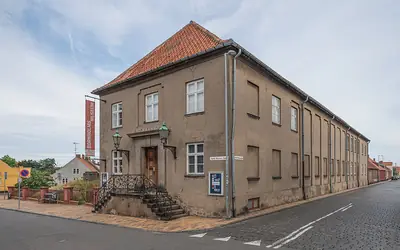
Gudhjem Museum is housed in the town’s former railway station. The setting combines changing art exhibitions, local history and an outdoor sculpture park. The exhibition building hosts rotating art shows throughout the year, while the protected former station building focuses on local history, providing both contemporary artistic experiences and a sense of Gudhjem’s past. The station dates from 1916, designed by Kay Fisker and Aage Rafn, with an entrance marked by two brick pillars and patterned paving. It received official protection in 1984. After serving as a stop on the Gudhjem Railway (an extension of the Nexø Railway branch to Almindingen) and later as a bus station, the building was acquired by the Gudhjem Town and Memorial Association in 1968 to counteract the growing culture of ice cream and sausages. A new exhibition building opened on 11 May 1990, and important artworks have been added since.
L. Hjorth’s Terracottafabrik (museum)
In Rønne, L. Hjorth’s Terracottafabrik—also known as Hjorths Fabrik—is a former ceramics factory that now operates as a working museum at Krystalgade 5. The factory was in operation from 1859 until 1993; since 1995 it has continued as a working museum under Bornholms Museum, preserving the industrial heritage of the island’s terracotta production.
Melstedgård (museum)
A little south of Gudhjem, Melstedgård is an open‑air farm museum set in a traditional half‑timbered farm. It offers a close look at farming and food culture on Bornholm. The farm’s origins trace back to the seventeenth century; the original main residential building was demolished in 1796 and the present northern range was erected then. Additional buildings were added between 1867 and 1869. Around the farmyard visitors can see animals, old agricultural tools, horse‑drawn wagons and tractors, illustrating how farming was carried out before mechanisation. Across the road the museum maintains a separate plot where grain is grown and cattle are kept; this is also where Tejn Mølle, a post mill moved here from Tejn in 2006, can be found.
Moseløkken Stenbrudsmuseum (museum)
Set in an old working quarry on Hammerknuden, Moseløkken Stenbrudsmuseum is a technical museum that tells the story of Bornholm’s stone industry, where stone is still quarried on a small scale. The history of stone quarrying on the island reaches back to 1754, when sandstone began to be extracted; granite quarrying started in the nineteenth century, adding another important chapter. Inside the museum you can view the tools and equipment once used for quarrying stone, along with the history of this particular quarry. The exhibition presents Bornholm’s different geological structures and examples of the island’s various stone types. Visitors may see a stonecutter at work and even try shaping granite themselves.
Explore Gudhjem with Neywo
Neywo’s free audio guide for Gudhjem includes 59 narrated places and one walking tour: “Gudhjem: Artists, Granite and a Post Mill.” This route covers 2.24 kilometres, takes about 57 minutes and stops at five sites—Oluf Høst Museum, Gudhjem Church, Gudhjem Museum, Melstedgård and Tejn Mølle. As you reach each location, the app tells the story of the place, allowing you to explore at your own pace with no group and no schedule. Narration is available in 11 languages. Download Neywo to enjoy a self‑guided experience of Gudhjem’s history, art and landscape.
Places with an audio guide in Gudhjem
8 places in Gudhjem with a Neywo audio guide. Each one starts telling its story as you reach it.
Self-guided tours in Gudhjem
1 tour in Gudhjem, free in the Neywo app. Each stop tells its story as you reach it.
- Walk
Gudhjem: Artists, Granite and a Post Mill
A walk through the pearl of Bornholm's north coast: the villa of painter Oluf Høst, a granite church built beside the ruins of a medieval chapel, a museum in a 1916 railway station, and a working farm museum with a rare post mill whose sails turn the wrong way.
Oluf Høst Museum · Gudhjem Church · Gudhjem Museum · Melstedgård · Tejn Mølle
Open this tour: Gudhjem: Artists, Granite and a Post Mill
Walk Gudhjem with Neywo
Neywo turns Gudhjem into a self-guided audio tour. Stories arrive as you reach the place they belong to, and the route reshapes when you wander off it.

