What to See in Kolding, Denmark: Free Audio Guide
Things to do in Kolding
Kolding is a compact Danish city at the head of Kolding Fjord, where royal history, green spaces, and modern urban life come together. It offers a distinctive mix of heritage, culture, and relaxed character, making it worth visiting for anyone exploring Southern Jutland. Neywo offers a free audio guide for Kolding with 55 narrated places.
What to see in Kolding
Koldinghus
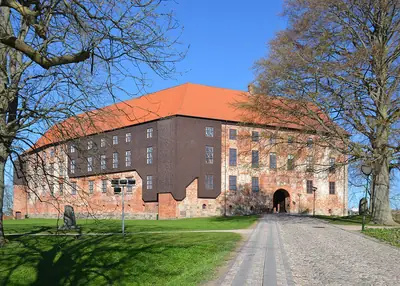
Koldinghus is a Danish royal castle founded in the thirteenth century. Over the centuries it served as a fortress, a royal residence and a setting for military discussions and peace negotiations. After being destroyed by fire in 1808 it lay as a ruin for a long time before a major restoration turned the ruined castle into one of its most distinctive features today. The oldest surviving part is the north façade overlooking Slotssøen, dating from the reign of King Christopher the Third. The west wing was added during the reign of Christian the First, and Christian the Third later expanded the southern side and added small towers in the courtyard. From the fortifications you can look out over Kolding and Slotssøen, and the castle tower has a viewing platform 75 metres above the lake.
Harteværket
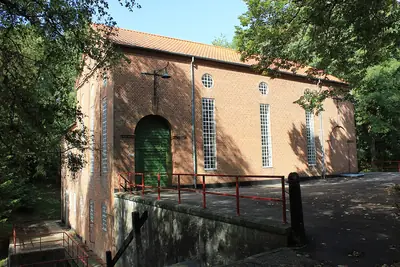
A little outside Kolding, by the Kolding Å, lies Harteværket, Denmark’s first larger hydropower station. It uses a drop in the water of about twenty‑five to twenty‑six metres to generate power. Built between 1918 and 1920 and operating since 1920, the plant is now maintained as a memorial to industrialisation, with a visitor centre that presents the site as a gateway to energy, health and natural beauty.
Trapholt
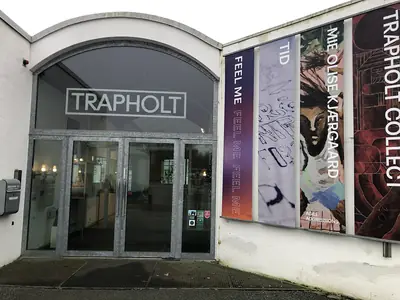
Set beside Kolding Fjord, Trapholt brings modern art and design together with a sculpture park and installations in the surrounding landscape. Opened in 1988, it houses a furniture museum focusing on contemporary Danish furniture design and holds more than 500 twentieth‑century chairs, Denmark’s largest collection of its kind. The architecture takes inspiration from the Guggenheim Museum in New York, with a spiral walkway guiding visitors through the space. Permanent exhibitions include paintings by Richard Mortensen and Arne Jacobsen’s unique Kubeflex summer house, while a changing programme of special exhibitions means the experience can vary from visit to visit.
Kommandocentralen
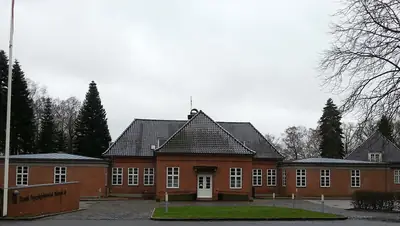
A few steps ahead you’ll find Kommandocentralen, a military bunker complex on Rømøvej built during the Second World War. It preserves a glimpse of the communications infrastructure created in 1944. The complex consists of two large bunkers: one built underground to house telephone and teleprinter services, and another planned as an amplifier station to improve speech clarity on the German telephone network. Only the amplifier station was completed before the German capitulation, leaving the site in an unfinished state that reveals both the scale of the wartime project and how abruptly its construction ended.
Genforenings- og Grænsemuseet
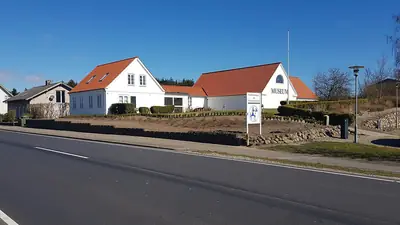
North of Christiansfeld, the museum stands beside the former main road, now Route 170, at the border that separated Denmark and Prussia (later Germany) from 1864 to 1920. Its most memorable story took place on 10 July 1920, when King Christian X crossed the border on a white horse, welcomed by many Danish‑minded people from Southern Jutland celebrating their return to Denmark. Inside, exhibitions follow the years from Denmark’s defeat at Dybbøl in 1864 to reunification in 1920 and explore the constructive relationship that exists today between Denmark and Germany, including the two national minorities. Objects on display include items connected with the participation of many Danish‑minded people from Southern Jutland in the First World War.
Geographical Garden
Geographical Garden, or Geografisk Have, groups trees, shrubs and herbs according to their countries of origin, creating a botanical garden with regions to explore rather than ordinary planting beds. Begun as a nursery in 1917 when Aksel Olsen bought an area known as Sibirien in southern Kolding, the garden now covers fourteen hectares and includes sections devoted to North America, Japan, China, South America, Manchuria, Korea, Siberia and Southwest Asia. Beyond the geographical sections you’ll find a rosarium, a rose garden, medicinal herb areas, a bamboo grove, themed gardens and greenhouses, plus a fenced animal area and two playgrounds.
Kolding Miniby
Located within the Geographical Garden, Kolding Miniby is a miniature recreation of the city as it appeared between 1860 and 1870. Built at a scale of one to ten, it offers a compact glimpse of Kolding’s historic layout.
Staldgården
Just east of Koldinghus, Staldgården is a historic complex whose present buildings form three wings. Originally an outer fortification for the castle, from the mid‑sixteenth century it served as the king’s stables. During the reign of Christian the Fourth tower‑like pavilions stood at the eastern corners (later removed). The buildings you see today date mainly from the seventeenth century. From the late seventeenth century Staldgården became increasingly important for the organisation of the army’s cavalry regiments, and in 1718 it became the base of the cavalry, first for the Koldinghus Cavalry District and later for the Holstein Lancer Regiment. During the English Wars from 1808 to 1814 its large buildings were used to store military equipment, and the fire that destroyed Koldinghus on the night of 28‑29 March 1808 did not reach Staldgården. After around two hundred years of horses here, the military ended its horse breeding and training.
Christiansfeld
Founded in 1773 as a settlement of the Moravian Church, Christiansfeld is recognised as a UNESCO World Heritage site for its exceptionally well‑preserved townscape. Created as a planned town, its unified architectural appearance is still visible in the remarkably consistent settlement of streets and buildings. At the heart of the town stands the Moravian Church, and the community that founded Christiansfeld still has a strong presence with around 450 members. Tyrstrup Church in the southern part forms another important religious landmark.
Almind Church
A little north of Kolding, in the village of Almind, Almind Church is a nineteenth‑century church built in 1887 using materials from the demolished Romanesque church that once stood on the site. Designed by master bricklayer S. L. Gynther, the choir and nave are built of dressed stone over a sloping‑edged base, while the tower is made of small red bricks topped with a copper‑covered spire. A Romanesque window lintel has been set into the north wall and a Romanesque portal on the south side of the tower leads into the lower room that now serves as the porch. Inside the porch are several gravestones, including a late sixteenth‑century stone for Mette Søfrens, a worn stone dated 1654 and a child’s gravestone from 1789, offering a quiet connection to people associated with the earlier church and its surrounding community.
Explore Kolding with Neywo
Neywo provides two walking tours and one bike route in Kolding. The walk “From Royal Ruin to Railway Yards” is 4.31 km long, takes about 118 minutes and includes 10 stops such as Kommandocentralen, Koldinghus and Staldgården. The walk “Gardens, Models and the Fjord Ridge” covers 4.95 km in roughly 104 minutes with 6 stops, including Geographical Garden and Kolding Miniby. The bike route “From the Theatre to Nørre Bjert” spans 9 km, takes about 45 minutes and has 3 stops, passing Kolding Teater and Godset. Each story plays automatically as you reach the place, letting you explore at your own pace with no group and no schedule. Narration is available in 11 languages. Download the free Neywo app to start your self‑guided adventure through Kolding.
Places with an audio guide in Kolding
8 places in Kolding with a Neywo audio guide. Each one starts telling its story as you reach it.
Self-guided tours in Kolding
3 tours in Kolding, free in the Neywo app. Each stop tells its story as you reach it.
- Bike ride
From the Theatre to Nørre Bjert
Start at Kolding Teater, pass the old freight station that is now the Godset concert hall, and follow the cycle paths north-east out of town to the village church of Nørre Bjert, with its altarpiece by J. Th. Skovgaard. A short, easy ride from city centre to countryside.
Kolding Teater · Godset · Nørre Bjert Church
Open this tour: From the Theatre to Nørre Bjert - Walk
From Royal Ruin to Railway Yards
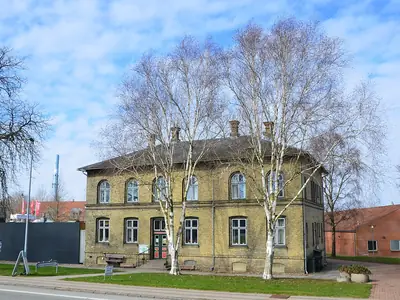
Follow Kolding's story from the wartime bunker and the quiet churches south of the river to the old market square, the castle that burned in 1808 and was reborn as a ruin-and-glass museum, the former royal stables, the old freight station and the theatre by the fjord road. A varied, mostly flat walk through the heart of the town.
Kommandocentralen · Church of Christ · Sankt Michaels Kirke · Akseltorv · Borchs Gård · Koldinghus …
Open this tour: From Royal Ruin to Railway Yards - Walk
Gardens, Models and the Fjord Ridge
A green walk through south Kolding: a Neoclassical church by the royal architect C. F. Hansen, the Geographical Garden where plants are grouped by the countries they come from, the miniature Kolding of the 1860s, a modern church on the ridge above the fjord, and the wartime command bunker and quiet church in the residential streets near the centre.
Vonsild Church · Geographical Garden · Kolding Miniby · Brændkjær Church · Kommandocentralen · Immanuelskirken
Open this tour: Gardens, Models and the Fjord Ridge
Walk Kolding with Neywo
Neywo turns Kolding into a self-guided audio tour. Stories arrive as you reach the place they belong to, and the route reshapes when you wander off it.

