Things to Do in Vejle, Denmark: Walking Guide
Things to Do in Vejle: Art, History and the Landscapes of Jutland
Vejle is a Danish city where museums, historic churches, Viking monuments, public landmarks and green landscapes come together. It is an excellent base for discovering the Vejle River Valley and the wider history of Jutland, from Iron Age settlements to Denmark’s conversion to Christianity. Neywo’s free audio guide for Vejle includes 69 narrated places, helping you explore the city and its surroundings as you walk, cycle or travel by bus.
As part of Southern Denmark, Vejle is also well placed for exploring nearby cities such as Kolding, Fredericia and Odense.
What to see in Vejle and the surrounding area
Vejle Museum of Art
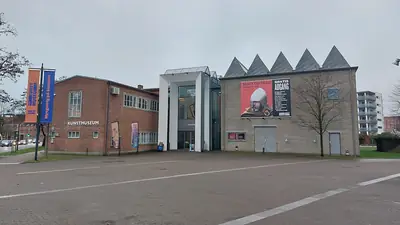
Vejle Museum of Art, or Vejle Kunstmuseum, is in the heart of the town centre and holds around 1,500 paintings and sculptures. Its collection covers Danish art from classic modernism to the pre-COBRA period, alongside Danish Golden Age works, many depicting Vejle and the surrounding area.
The museum also has an important collection of drawings, including around 50 etchings by Rembrandt. Its present arrangement brings together three buildings: a red-brick house from 1923, the former Vejle Library from 1934 and a 2006 exhibition building designed by Kim Utzon Architects.
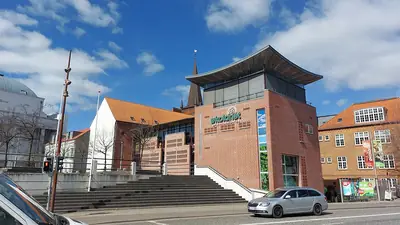
Økolariet
Økolariet is a knowledge and experience centre dedicated to nature, the environment, climate, energy, inventions and innovation. Its hands-on exhibitions explore subjects including drinking water and wastewater, waste and resources, climate change, robotics, space travel and the competition for raw materials.
The centre has been approved as a science pedagogical activity centre since 2009, making it a particularly useful stop for visitors who want to understand the natural and technological challenges shaping society.
Vejle Vindmølle
Vejle Vindmølle is a Dutch-style tower mill built in 1890 after an earlier mill on the same site burned down. It stands high above the city near the upper end of Kiddesvej, in the middle of a residential area.
The mill has a whitewashed stone base and a round upper section beneath a boat-shaped cap. Its cap is turned manually by a tail vane, while the sails use a traditional lifting mechanism. From the gallery, views extend across Vejle, Grejsdalen, Vejle Fjord and Vejle Ådal when conditions are clear.
St. Nicolai Church
St. Nicolai Church is one of Vejle’s historic landmarks and is identified in the source material as the city’s oldest building. It provides a direct link with Vejle’s medieval past and appears alongside other central churches and cultural sites on the city’s self-guided routes.
Jelling Church and the Jelling monuments
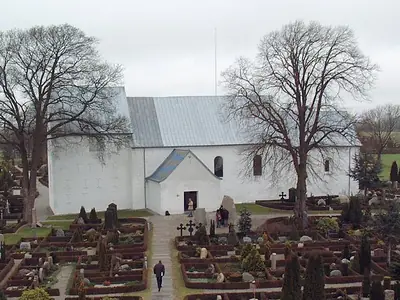
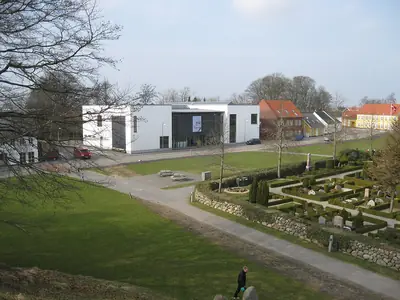
A short journey from Vejle, Jelling Church forms part of the Jelling monuments, a UNESCO World Heritage Site since 1994. The church stands between two large Viking Age burial mounds, with two 10th-century runestones in the churchyard.
The site is significant because it reflects the transition from paganism to Christianity in Scandinavia. The church visible today is a Romanesque fieldstone building dating from around 1100, but it is the fourth church to have stood here. Three earlier wooden churches were destroyed by fire. The first was built by King Harald Bluetooth around 960, after he introduced Christianity to Denmark and integrated Norway into his realm.
Kongernes Jelling
Kongernes Jelling is a museum and visitor experience centre beside the Jelling monuments. It explores the period when Jelling was the centre of Danish history and the home of Gorm the Old and Harald Bluetooth.
The museum is part of the National Museum of Denmark. Its exhibition explains the runestones and burial mounds, shows how the Jelling stones may originally have looked and follows Gorm’s family line through to the present day. It also places the Christianization of the Danish Vikings in the context of the reigns of Gorm the Old and Harald Bluetooth.
Ravning Bridge
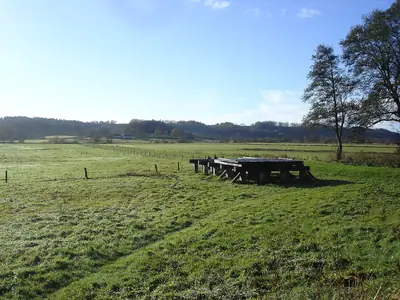
Ravning Bridge, or Ravningbroen, was a Viking Age timber bridge built under King Harald Bluetooth around 980. It crossed the meadows of Ravning Enge at the Vejle River, around 10 kilometres south of Jelling.
The bridge stretched nearly 760 metres and was five metres wide. It rested on approximately 1,800 posts driven into the marshy ground. The bridge was in use for only about five years, but until the Little Belt Bridge was built in 1935, it held the record as Denmark’s longest bridge.
Its construction dates from the same period as the Viking fortresses of Aggersborg, Fyrkat, Nonnebakken and Trelleborg. Ravning Bridge is especially notable because it is described as the only larger early historic bridge discovered in Denmark and Scandinavia.
Vingsted Historiske Værksted
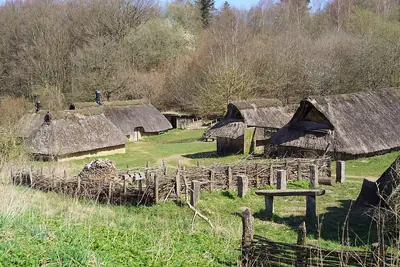
Vingsted Historiske Værksted is an open-air museum in the Vejle River Valley, roughly halfway between Bredsten and Ødsted. The site recreates an Iron Age environment with houses, fields, a forge, a sacrificial site and livestock.
The museum has welcomed visitors since the 1970s and is part of the Vejle Museums network. The experience also includes Vingsted Mølle, where workshops focus on traditional crafts.
Bindeballe Station
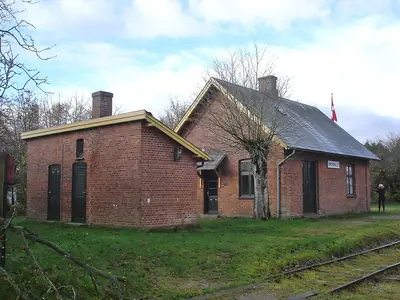
Bindeballe Station is a quiet reminder of the railway history of the region. It once belonged to the Vejle-Vandel-Grindsted Railway, which opened to Vandel in 1897 and was extended to Grindsted in 1914.
The railway closed in 1957, after several decades of service. Today, the former station offers a way to explore how this rural part of Denmark was once connected to the wider world.
Museum Give
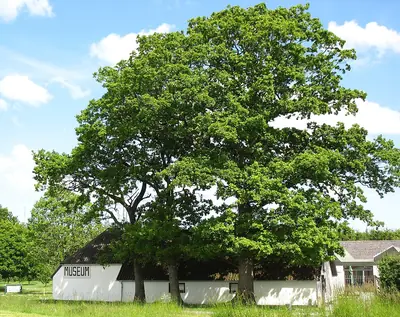
Museum Give is a state-recognized cultural history museum devoted to the history and culture of the surrounding area. Its collections of objects and photographs trace the development of farming, crafts and industry.
The museum was founded in 1985 and has been at its present location since the 1990s. It also presents special exhibitions and activities focused on different aspects of local history and culture.
Vandel Bunker Museum
The Vandel Bunker Museum tells the story of Denmark’s military aviation history. The original museum was housed in a 250-square-metre NBC-protected bunker at the former Vandel Air Base, around five kilometres east of Billund.
The air base was established by the German Air Force in 1943 during the occupation of Denmark. Later, it was home to the Army Air Service, whose small helicopters were also used by the police for traffic surveillance. The original bunker museum is no longer there; the history of the air base is now presented at Randbøl Parish Archive and Museum in Vandel.
Tirsbæk
Tirsbæk is a historic manor house on the shore of Vejle Fjord, surrounded by woodland. The earliest known document mentioning the estate dates from 1401. The main building was constructed in 1550, and its distinctive stepped tower was added in 1577.
The park covers about 12 hectares, while the wider estate extends across roughly 414 hectares. In 1779, chamberlain Christian Benzon raised the estate to the status of a stamhus, a hereditary family foundation.
Stoltenbjerg and the heathland landscape
Stoltenbjerg is a hilltop in the Staldbakkerne area and, at 88 metres, the highest point on Randbøl Hede, Denmark’s largest inland heathland. Its hills were formed by wind-blown sand, with the dunes developing from sediments deposited by flowing water during the late Ice Age.
The summit rises 17 metres above the surrounding heath and offers views across the landscape. Heather, blueberry bushes, grasses and other herbs grow around the hill, while some areas still reveal bright white wind-formed layers in the sand.
Vejle and Jutland
Vejle offers an introduction to the varied geography of Jutland, the peninsula that forms Denmark’s continental portion. Jutland covers about two-thirds of Denmark’s total area, with flatter landscapes in the west and greener, hillier terrain, lakes and forests in the east.
The region around Vejle brings these contrasts together through river valleys, heathland, woodland and the waters of Vejle Fjord. Holtserhage adds another peaceful green space to the area, while the Gudenå—Denmark’s longest river—runs for 149 kilometres through eastern Jutland, from Tinnet Krat to Randers Fjord.
Explore Vejle with a free audio guide
Neywo lets you discover Vejle independently, with stories that play as you reach each place. The app includes one walking tour, one bus route and one bike route:
- A 4.76 km walking tour lasting 118 minutes, with 10 narrated stops, through Vejle’s old centre. It includes Vejle Museum of Art, St. Nicolai Church, Økolariet and Vejle Vindmølle.
- A 4.8 km bus route lasting 21 minutes, with four narrated stops, connecting Vejle’s old town with Grejsdalen.
- A 13 km bike route lasting 65 minutes, with eight narrated stops, including Vejle Vindmølle, St. Nicolai Church, Vejle Museum of Art and Grejsdal Church.
Download Neywo and explore at your own pace: the app tells the story of each place as you reach it, with no group and no schedule.
Places with an audio guide in Vejle
8 places in Vejle with a Neywo audio guide. Each one starts telling its story as you reach it.
Self-guided tours in Vejle
3 tours in Vejle, free in the Neywo app. Each stop tells its story as you reach it.
- Bike ride
Vejle by Bike: Windmill, Skull Wall and the Grejsdal Valley
A cycle-lane ride through Vejle from the south: a hilltop windmill, the oldest church in town, the art museum, the first Adventist church in Denmark and the station quarter, then north up the valley to a modern church with a five-sided floor plan. About 13 km, mostly on separated cycle paths.
Søndermarkskirken · Vejle Vindmølle · St. Nicolai Church · Vejle Museum of Art · Adventistkirken i Vejle · Banegårdspladsen …
Open this tour: Vejle by Bike: Windmill, Skull Wall and the Grejsdal Valley - Bus ride
Bus 5: Vejle's Old Town to Grejsdalen
A regular local bus from the town centre north into the Grejsdal valley. It passes the Methodist church, Vor Frelsers Kirke and St. Nicolai, the oldest building in Vejle, and ends at a five-sided modern church tucked into the valley.
Vejle Methodist Church · Church of Our Saviour · St. Nicolai Church · Grejsdal Church
Open this tour: Bus 5: Vejle's Old Town to Grejsdalen - Walk
Bog Woman, Skulls and Rembrandt: Vejle's Old Centre
Stroll through Vejle's old centre, from the oldest Adventist church in Denmark to the oldest building in town, with its wall of 23 mysterious skull-sized holes, and a museum that mixes three eras of Danish architecture and holds Rembrandt etchings. Finish at a working hilltop windmill with views over the fjord and a church that sits on its own churchyard.
Adventistkirken i Vejle · Vejle Musikteater · Vejle Museum of Art · St. Nicolai Church · Kirketorvet · Økolariet …
Open this tour: Bog Woman, Skulls and Rembrandt: Vejle's Old Centre
Walk Vejle with Neywo
Neywo turns Vejle into a self-guided audio tour. Stories arrive as you reach the place they belong to, and the route reshapes when you wander off it.

