Aarhus, Denmark: Self-Guided Walking Tour
Things to do in Aarhus
Aarhus is Denmark’s second‑largest city, where Viking origins, medieval streets, and contemporary design come together. It offers a mix of historic sites, museums, and cultural spaces that show how the city has evolved from its early settlement to a modern cultural hub. Neywo provides a free audio guide for Aarhus with 127 narrated places to explore at your own pace.
Explore Aarhus’s key attractions
The Old Town (Den Gamle By)
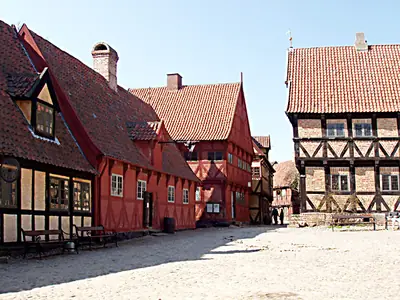
The Old Town is the world’s first open‑air museum devoted to urban life rather than village life. Seventy‑five historic buildings were taken apart in towns across Denmark, moved to the Aarhus Botanical Gardens and rebuilt piece by piece. The oldest structures date to the 1500s, the newest to the early 1900s, forming a complete Danish market town with half‑timbered merchant houses, a post office, customs house, school, theatre, 34 workshops, 10 shops, five historic gardens and 27 furnished rooms or kitchens. Museum staff bring the town to life by stepping into period roles as merchants, blacksmiths and other townsfolk.
ARoS Aarhus Kunstmuseum
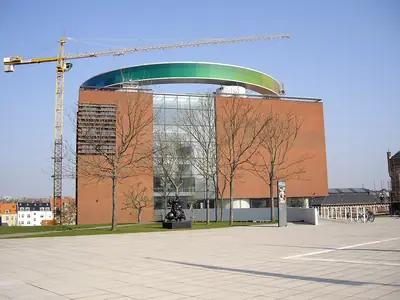
ARoS is one of Northern Europe’s largest art museums. It grew from the Aarhus Art Association founded in 1859 and moved into a ten‑storey cube designed by Schmidt Hammer Lassen in 2004. The building follows a Dante‑inspired route: the basement evokes the Inferno, the galleries represent Purgatory, and the roof holds Your rainbow panorama, a circular glass walkway by Olafur Eliasson completed in 2011. Inside, the collection exceeds 8,000 works, with the oldest pieces from 1770 and a strong showing of Danish Golden Age painters.
Moesgaard Museum
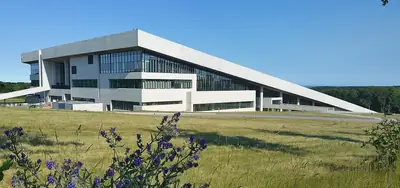
Moesgaard Museum is Denmark’s leading centre for archaeology and ethnography, working closely with Aarhus University. Its most famous exhibit is the Grauballe Man, the world’s best‑preserved bog body, displayed in a dimly lit chamber where his leather‑dark skin, fingerprints and peaceful Iron Age face are visible. Nearby, massive weapon caches from Illerup Ådal testify to the violence of the same era.
Aarhus Cathedral
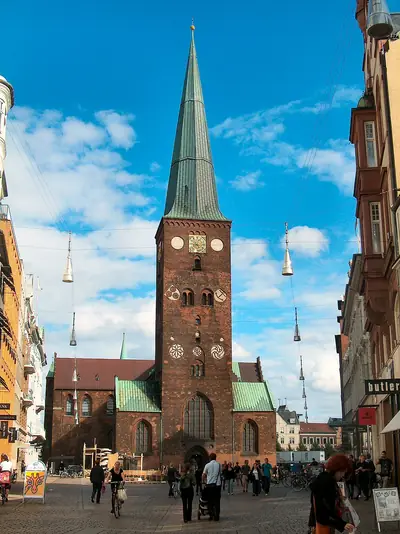
Aarhus Cathedral (Aarhus Domkirke) is the longest and tallest church in Denmark. Dedicated to Saint Clemens, patron of sailors, it stands on Store Torv in the city centre. The nave stretches 93 metres (over 300 ft) and the tower reaches 96 metres, offering space for about 1,200 worshippers. Built in Baltic brick Gothic style, construction began in the 12th century, making it one of the oldest brick buildings on the Jutland peninsula.
Aarhus Søfartsmuseum
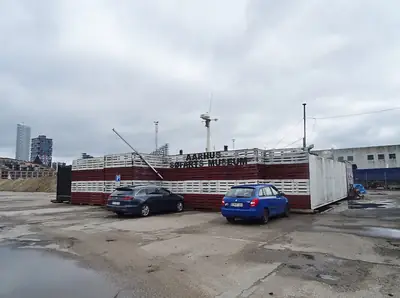
Located in Denmark’s second‑largest city, the Aarhus Søfartsmuseum is the city’s maritime museum. It presents the seafaring history that has long shaped Aarhus as a port town.
Museum of Ancient Art
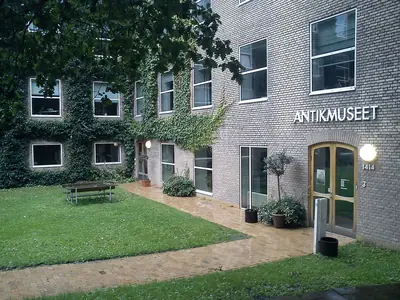
Tucked on the Aarhus University campus, the Museum of Ancient Art holds one of Denmark’s finest collections of Mediterranean antiquity. Greek vases, Etruscan bronzes, Roman sculpture and everyday objects that once passed through Mediterranean hands are on display. The collection began in 1949 with a study donation of 500 artefacts from the National Museum and plaster casts from the old Aarhus Museum, and it expanded after a dedicated exhibition space was created beneath Solgården in 1971.
Occupation Museum
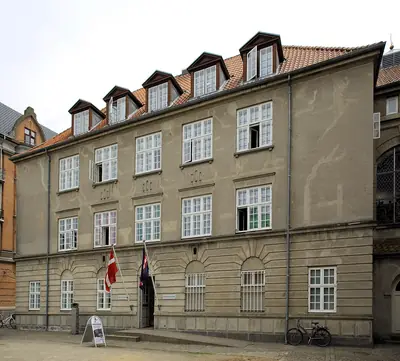
Housed in the former city hall behind Aarhus Cathedral, the Occupation Museum documents the Gestapo headquarters that operated there after the Danish police were arrested in 1944. Original cells, interrogation implements, uniforms, weapons, mines, tools, identity passes and posters from Danish, German and British sources illustrate daily life under occupation, the black humour that helped people cope, the Aarhus Air Raid of 1944 and the resistance movement, including the story of informant Grethe Bartram and Allied weapons drops.
Danish Poster Museum
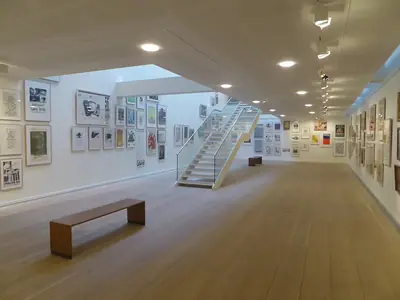
Situated inside Den Gamle By, the Danish Poster Museum is Denmark’s only museum devoted entirely to poster art. It started with painter Peder Stougaard’s private collection in 1972 and became a formal institution in 1993 when he donated his entire assemblage. Visitors enter through a pavilion originally built for the Danish National Exhibition of 1909, then move into a modern two‑story exhibition complex designed by C. F. Møller. The museum has been part of Den Gamle By since 2006, with its current halls opening in 2009.
Den Gamle By Bendtsens Pakhus (Toy Museum)
This delightful department within Den Gamle By showcases around five thousand toys that trace the evolution of play. The collection includes German Märklin model cars, Bing toy trains, Lehmann mechanical wonders, Danish Tekno vehicles and numerous homemade toys, reminding visitors that imagination has always been a key ingredient of childhood.
Kunsthal Aarhus
Kunsthal Aarhus is the contemporary arts centre in the heart of the city. It focuses exclusively on experimental work from local, national and international artists, providing a platform for cutting‑edge visual art.
Moesgård Forest Mill (Skovmøllen)
Just south of Aarhus in the Marselisborg Forests lies Denmark’s only functioning undershot mill that still retains its original grain millstones and a working sawmill. An overshot wheel drives an internal gear system that pulls the millstones from underneath. The mill has stood on this site since at least 1570; the present timber‑framed building dates from 1785 with an 1852 extension, and the miller’s house was built in 1824. Commercial milling ceased in 1910, but the site continued as a restaurant and a favoured Sunday outing for Aarhus families. It was protected in 1959, carefully restored in 1991, and the mill operates on selected Sundays under the care of a volunteer mill guild.
Museum Ovartaci
Museum Ovartaci combines an art museum with a psychiatric history museum. The hospital opened in 1852 as the Jutish Asylum, designed by Michael Gottlieb Bindesbøll. Around 1900, administrator Albert Lund began saving objects made by patients, forming a collection that now includes about 850 works on display from a total of roughly 12,000 pieces. The art ranges from Ovartaci’s vivid, imaginative creations to works by other artists who used creativity as a path to self‑understanding. The psychiatric exhibition displays period furniture, medical instruments, kitchen equipment and workshop tools, tracing changing attitudes toward mental health over more than a century.
Natural History Museum Aarhus
Located in the university’s Midtbyen district, the Natural History Museum Aarhus has been studying the natural world for over a century. It found its permanent home in Universitetsparken in 1941, though its origins reach back to 1911. Today it operates as an independent institution funded by the Ministry of Culture, Aarhus Municipality, Aarhus University and visitors. It boasts the highest publication activity among Denmark’s state‑recognised museums, with researchers active in entomology, freshwater ecology, earth biology, fauna studies and bioacoustics. A remote storage facility in Trige, north of Aarhus, safeguards spirit‑preserved specimens and other parts of the collection.
Steno Museet
Steno Museet is Denmark’s Museum of the History of Science, housed in the distinctive yellow buildings of Aarhus University Park designed by C. F. Møller. It opened on 25 March 1994, emerging from the merger of two earlier institutions—the Museum of the History of Science and the Museum of Medical History—both of which had been collecting and preserving material since the early 1980s.
Viking Museum
Beneath Sankt Clemens Torv, below the Nordea bank building, lies the Viking Museum. It protects and presents the Viking‑age remains uncovered during excavations that reveal Aarhus’s earliest settlement in the 900s. Opened in 1968 and renovated in 2008, the museum displays everyday objects recovered from the site, offering a direct connection to life in Aarhus over a thousand years ago.
Explore Aarhus with Neywo
Neywo’s free audio guide turns your walk through Aarhus into a self‑guided adventure. The app offers 4 walking tours and 1 bus route:
- “Vikings, Gestapo and the Longest Church in Denmark” – 1.24 km, 76 minutes, 11 stops
- “From Hell to Heaven: ARoS and the Old Town” – 2.35 km, 85 minutes, 9 stops
- “University Park: Yellow Brick, Nobel Prizes and Natural History” – 2.57 km, 67 minutes, 6 stops
- “Station, Squares and Stages” – 1.45 km, 51 minutes, 6 stops
- “Bus 3A: Old Town, ARoS and the Harbour” – 6.4 km, 27 minutes, 9 stops
Each story plays automatically as you reach a place, letting you explore at your own pace with no group and no schedule. Narration is available in 11 languages. Download Neywo today and let the city’s stories unfold step by step.
Central Denmark
Denmark
Brædstrup
Horsens
Juelsminde
Klampenborg
Hillerød
Places with an audio guide in Aarhus
8 places in Aarhus with a Neywo audio guide. Each one starts telling its story as you reach it.
Self-guided tours in Aarhus
5 tours in Aarhus, free in the Neywo app. Each stop tells its story as you reach it.
- Bus ride
Bus 3A: Old Town, ARoS and the Harbour
AarBus line 3A from Hasle Torv past Den Gamle By and ARoS, through City Hall Square, the station square and Our Lady's Church to Østbanetorvet and the maritime museum by the harbour. A simple way to join the main sights without walking.
Hasle Torv · Den Gamle By G.M. Holsts Købmandsgård · ARoS Aarhus Kunstmuseum · Rådhuspladsen · St. Nicholas' Church · Banegårdspladsen …
Open this tour: Bus 3A: Old Town, ARoS and the Harbour - Walk
Vikings, Gestapo and the Longest Church in Denmark
Aarhus's medieval heart on foot: a church with the oldest preserved stone vault in the Nordics, the Latin Quarter's cobbled squares, an underground Viking museum, the Water Dragon of Store Torv, Denmark's longest cathedral and the old city hall that became Gestapo headquarters in 1944. End at the theatre where Holberg's characters look down on the street.
Church of Our Lady · Klostertorvet · Lille Torv · Store Torv · Viking Museum · Skt. Clemens Torv …
Open this tour: Vikings, Gestapo and the Longest Church in Denmark - Walk
From Hell to Heaven: ARoS and the Old Town
Start on City Hall Square, climb through Dante's Inferno and Purgatory to the rainbow panorama on the roof of ARoS, then step back in time at Den Gamle By, the world's first open-air museum of urban life, with its merchant's house, toy museum, Denmark's oldest theatre and the Danish Poster Museum.
Rådhuspladsen · Kunsthal Aarhus · ARoS Aarhus Kunstmuseum · Vesterbro Torv · The Old Town · Den Gamle By G.M. Holsts Købmandsgård …
Open this tour: From Hell to Heaven: ARoS and the Old Town - Walk
University Park: Yellow Brick, Nobel Prizes and Natural History
Aarhus University's park-like campus of yellow-brick buildings by C.F. Moller and Kay Fisker, home of three Nobel-linked researchers and three small museums: ancient art, the history of science and natural history. Start at a 1930s red-brick functionalist church and finish at a Hack Kampmann church by the cemetery.
St. Mark's Church · Aarhus University · Steno Museet · Natural History Museum Aarhus · Museum of Ancient Art · St. John's Church
Open this tour: University Park: Yellow Brick, Nobel Prizes and Natural History - Walk
Station, Squares and Stages
Aarhus's southern core: the steel-and-glass Frederiks Plads high-rises, the station square that greets every train, a Neo-Gothic Catholic church that faces east, a century-old variety theatre, the city's first planned square outside the medieval town and the harbour square born from a BP headquarters.
Frederiks Plads · Banegårdspladsen · Catholic Church of Our Lady · Kasino-Teatret · Fredens Torv · Europaplads
Open this tour: Station, Squares and Stages
Walk Aarhus with Neywo
Neywo turns Aarhus into a self-guided audio tour. Stories arrive as you reach the place they belong to, and the route reshapes when you wander off it.

