Things to Do in Horsens, Denmark: Walking Guide
Things to do in Horsens
Horsens is a Danish city on the east coast of Jutland, set at the innermost part of Horsens Fjord and known for its blend of industrial heritage, art, and historic sites. Visitors can explore museums, castles, churches, and a vibrant sculpture route that turns the streets into an open‑air gallery. Neywo offers a free audio guide for Horsens with 40 narrated places, available in 11 languages.
Discover Horsens’ highlights
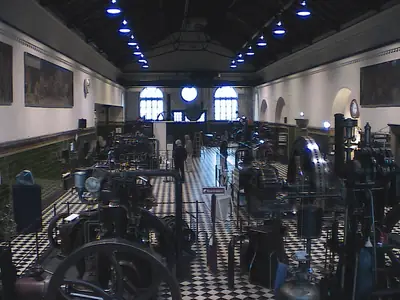
Danish Industrial Museum
The museum explores the culture of workers, craftspeople and industry in Denmark after 1850. It stands on the former grounds of Horsens’s electricity and gasworks, opened to visitors in 1977 and received state recognition in 1984. A special section presents the Nimbus Touring Motorcycle Museum, showcasing motorcycles made by the Danish manufacturer Nimbus.
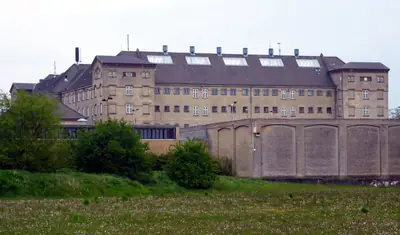
Horsens Statsfængsel
Opened in 1853 as Horsens Straffeanstalt, the prison was Denmark’s first built around rational organization and isolation. It housed up to 400 male prisoners for 153 years before closing in 2006. After reopening as FÆNGSLET in 2012 and expanding in 2016, it became the world’s largest prison museum, also offering accommodation, a café, event spaces and concert facilities.
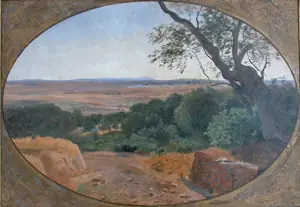
Horsens Art Museum
The museum’s collection focuses on Danish visual art after 1900, with emphasis on experimental work from 1980 onward. It holds the largest existing collection of Michael Kvium’s paintings and a Mogens Zieler collection of around six hundred works. Outside, the sculpture park at Caroline Amalie Lunden features Bjørn Nørgaard’s Menneskemuren and Christian Lemmerz’s Gestalt, Todesfigur.
Horsens Museum
This state‑recognized museum is devoted to the cultural history of Horsens and its surroundings. It originally combined art and cultural history; later the art collection was moved to Horsens Art Museum, leaving this venue to tell the city’s story through artefacts, photographs and displays of everyday life.
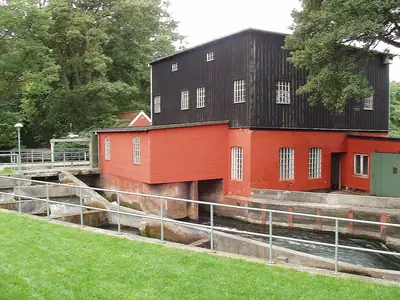
Klostermølle
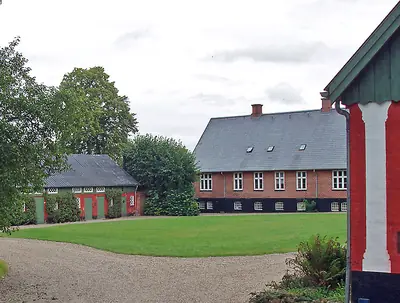
Located at the western end of Lake Mossø, this historic watermill once served Voer Abbey. After the Reformation it functioned as a grain mill, was converted to wood‑processing in 1872 and later housed a cardboard factory whose product was shipped by steamboat across Mossø to the railway station at Alken. Production ended in 1974 after a fire, but the long drying shed remains as a reminder of the site’s industrial past.
Horsens (district)
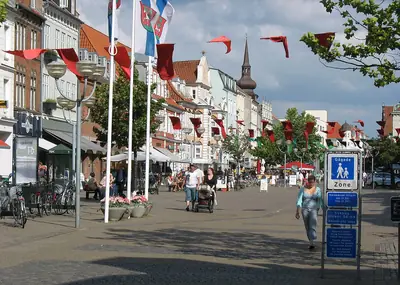
Horsens lies on the east coast of Jutland at the innermost part of Horsens Fjord. With 65,037 inhabitants it is Denmark’s sixth‑largest city and the main town of Horsens Municipality. The city first appears in written records in the twelfth century, grew with monasteries and fortifications in the Middle Ages, and became a merchant town in the eighteenth century. Patrician houses such as Jørgensens Hotel reflect that prosperous era, Søndergade is noted as Denmark’s widest main street, and the city hosts Denmark’s only industrial museum.
Boller
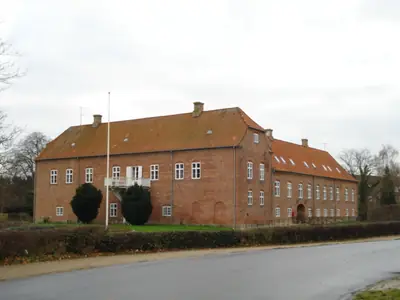
Also known as Boller Slot, this manor house was first mentioned in 1350. The present buildings were erected between 1537 and 1588 by Holger Ottesen Rosenkrantz and his wife Karen Gyldenstierne. Powerful families repeatedly remodelled the estate; a major transformation between 1759 and 1769 removed the three towers. In 1931‑32 the main building became a convalescent home for De Danske Sygekasser, later a nursing home that closed in 2012. In 2015 Peter Vognsen Nørgaard acquired the property and restored it for apartments and other uses.
Bygholm Castle
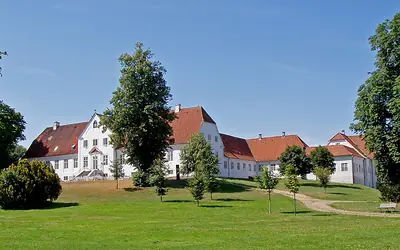
Just outside Horsens, this former royal castle later became a manor house. Its main building now operates as a hotel, while the grounds form a public park and fairground. The estate’s story reaches back to 1313, likely established by King Erik Menved after a peasant uprising. During the era of alchemist Erik Lange the property fell into disrepair. The present Baroque main building dates from 1775, following an earlier reconstruction by Joachim Werner Bülow in 1670. A rampart in the park is said to mark the site of the original Bygholm.
Voer Abbey
The Benedictine monastery of Voer Abbey was founded before 1172 and continued until 1552. Its buildings were demolished before 1560, but the monks redirected most of the Gudenå’s water into a 1,300‑metre Klosterkanal that drove a water mill. Until 2020 this canal was the river’s main course; today the water follows its original route through Klosterkæret. There is a possibility that Voer Abbey formed a double monastery with the nearby Vissing Abbey.
AC Horsens
The city’s football club, known as Alliance Club Horsens (ACH), was established in 1994. It grew from a merger of Horsens Forenede Sportsklubber (founded 1915) and FC Horsens. AC Horsens has spent 13 seasons in Denmark’s top division, the Superliga.
Church of our Saviour
Recognised as the oldest building in Horsens, the church houses an organ built by Frobenius Orgelbyggeri in 1977 with 40 stops. On 22 August 2018 the building was deliberately set alight, destroying the pulpit that dated from 1670.
Endelave Church
Located on Endelave Island, this Gothic church’s origins reach back to the fifteenth century. It has been altered several times, with important changes in 1707 and the latest major rebuilding in 1931 when the tower was added. The chancel and nave are built from fieldstone resting on large boulders, and the doorway preserves an opening from the original period; the door itself dates from around 1550 and is made of three oak planks reinforced with iron bands.
Gangsted Church
This church building in Horsens Municipality bears the Danish name Gangsted Kirke and belongs to Gangsted Parish in Voer Herred, which was part of the former Aarhus County.
Explore Horsens with Neywo
Download the free Neywo app and let the city’s stories unfold as you walk. Neywo provides one walking tour in Horsens: “From Monastery to Prison: Horsens Through the Ages.” The route is 5.25 km long, takes about 105 minutes and includes six narrated stops – the Danish Industrial Museum, Horsens Art Museum, Horsens Klosterkirke, Church of our Saviour, Horsens Statsfængsel and Bygholm Castle. Each story plays automatically when you reach the site, allowing you to explore at your own pace with no group and no schedule. The audio guide is available in 11 languages, giving you a flexible way to discover Horsens’ industrial past, artistic present and historic landmarks.
Places with an audio guide in Horsens
8 places in Horsens with a Neywo audio guide. Each one starts telling its story as you reach it.
Self-guided tours in Horsens
1 tour in Horsens, free in the Neywo app. Each stop tells its story as you reach it.
- Walk
From Monastery to Prison: Horsens Through the Ages
Horsens in one walk: Danish industry and contemporary art in the east of town, then the medieval brick Franciscan church and the city's oldest building, up to the Statsfængsel, a prison that is now the world's largest prison museum, and the royal-castle-turned-manor of Bygholm.
Danish Industrial Museum · Horsens Art Museum · Horsens Klosterkirke · Church of our Saviour · Horsens Statsfængsel · Bygholm Castle
Open this tour: From Monastery to Prison: Horsens Through the Ages
Walk Horsens with Neywo
Neywo turns Horsens into a self-guided audio tour. Stories arrive as you reach the place they belong to, and the route reshapes when you wander off it.

