Things to Do in Brescia, Italy: Walking Guide
Things to Do in Brescia: Roman Ruins, Cathedrals and Lombard Heritage
The best things to do in Brescia include exploring the Roman remains of Brixia, visiting the Monastery of Santa Giulia, comparing the city’s two cathedrals, and discovering its Renaissance squares and museums. Brescia brings together Roman, Longobard, medieval and modern history within its historic center and surrounding neighborhoods. Neywo’s free audio guide for Brescia tells the stories of 141 narrated places in 11 languages.
What to See in Brescia
Monastery of Santa Giulia
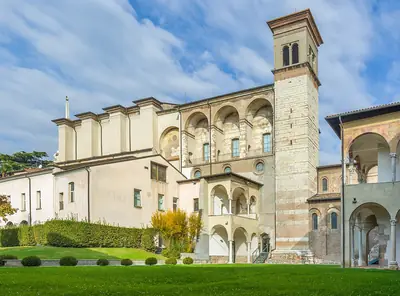
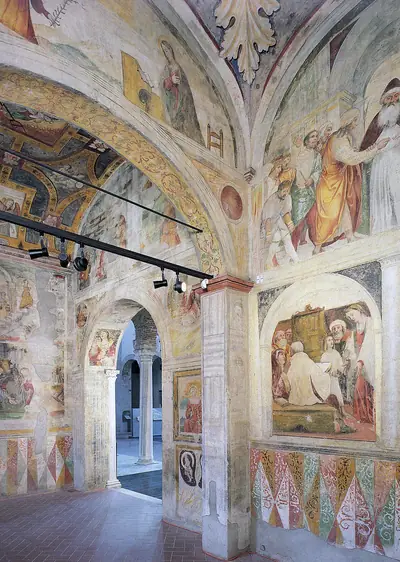
The Monastery of Santa Giulia, formerly known as the Monastery of San Salvatore, brings together more than a thousand years of Brescia’s history. Its architecture ranges from the Longobard period to the Renaissance, although much of its present appearance comes from rebuilding in the fifteenth and sixteenth centuries.
The complex houses the Museo di Santa Giulia, Brescia’s principal museum. Its galleries occupy former monastic buildings, including the Church of Santa Maria in Solario, the nuns’ choir and the Church of Santa Giulia. The exhibition space covers about 14,000 square metres.
Tradition connects the monastery with Desiderata, daughter of the Longobard king Desiderius and wife of Charlemagne. According to that tradition, she spent her exile here after Charlemagne rejected her in 771.
San Salvatore and the Cappella della Vergine
The former monastic church of San Salvatore was founded in 753 for the female monastery of San Salvatore. Its buildings reveal successive layers of Brescia’s history, with Roman remains alongside pre-Romanesque, Romanesque and Renaissance architecture.
The church dedicated to Santa Giulia was completed in 1599. Together, the church and the wider Santa Giulia complex offer a particularly clear view of how the monastery changed over the centuries. The royal-exile tradition associated with Desiderata also adds another dimension to the site.
Brixia and the Roman Forum
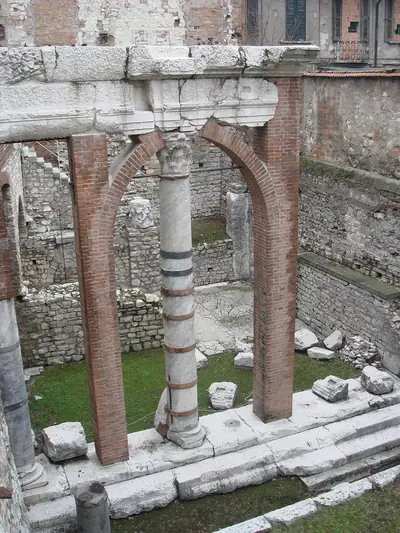
The archaeological area of Brixia presents the remains of the ancient Gallo-Roman city that became modern Brescia. Brixia was founded by the Cenomani Gauls in the seventh century BCE and was gradually colonized by the Roman Republic between the third and second centuries BCE. It became a municipium with Latin rights in 89 BCE, received Roman citizenship in 49 BCE and became a Roman colony in 27 BCE.
The Roman Forum, or Foro Romano, was the city’s main public square. It began taking shape in the first century BCE and was later completed under Vespasian. Much of its outline is now traced by Piazza del Foro, while further remains lie outside and beneath the surrounding buildings.
The archaeological complex includes the Capitolium, the civil basilica, the Roman theatre and excavations connected with Palazzo Martinengo Cesaresco Novarino. The Capitolium, also called the Temple of the Capitoline Triad, is the clearest focus for understanding Roman Brixia.
Brescia’s Two Cathedrals
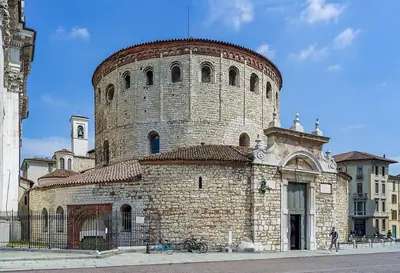
Piazza del Duomo is home to two neighboring cathedrals. The Duomo Vecchio, officially the Winter Co-Cathedral of Santa Maria Assunta, is also known as La Rotonda because of its circular form. Begun in the eleventh century on the site of an earlier basilica, it remains one of Italy’s important round Romanesque churches.
Inside, traces of the building’s long history include thirteenth-century frescoes, sections of fifth- or sixth-century floor mosaics and the sixth-century crypt of San Filastrio, restored in the eighth century. Near the entrance is the red-marble sarcophagus of Bishop Berardo Maggi, made in 1308.
Beside it stands the Duomo Nuovo, or New Cathedral, also known as the Cattedrale di Santa Maria Assunta. Construction lasted from 1604 to 1825, and its late Baroque design is associated with Giovanni Battista Lantana, Pier Maria Bagnadore and Lorenzo Binaghi. The cathedral occupies the site of the early Christian Basilica of San Pietro de Dom, which dated from the fifth or sixth century.
Palazzo Beretta and Piazza del Mercato
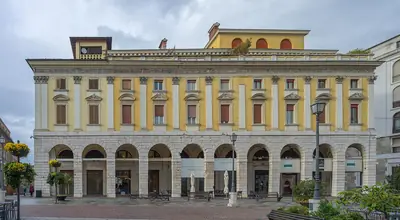
Piazza del Mercato offers a different view of Brescia’s urban history. On the northern side of the square, Palazzo Beretta was built in 1558 by Lodovico Beretta as a luxurious residence for the linen merchants active in the area. Its façade remains one of the distinctive architectural features of the piazza.
Tosio Martinengo Gallery
In Piazza Moretto, the Tosio Martinengo Gallery occupies the historic Martinengo da Barco Palace. The collection includes more than 800 paintings and sculptures displayed across 21 galleries, covering the period from the fourteenth century to the nineteenth century and Romanticism.
The gallery is particularly important for its presentation of the Brescian Renaissance. Works by Romanino, Moretto and Giovanni Gerolamo Savoldo form the most substantial part of the collection. Founded in 1851, the museum reopened on 17 March 2018 after a major renovation. In 2022, it acquired new works connected with eighteenth-century Lombard art and created a display devoted to Giacomo Ceruti.
Museo Mille Miglia
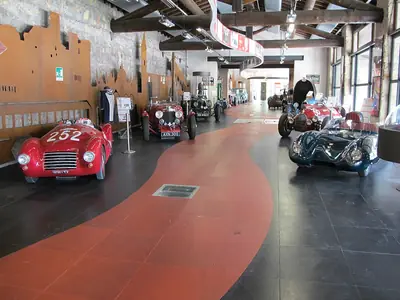
The Museo Mille Miglia is housed in the ancient Monastery of Saint Euphemia, in Brescia’s Sant’Eufemia district. It tells the story of the famous Mille Miglia race, held between Brescia and Rome from 1927 to 1957.
The exhibition is divided into nine chronological sections. Seven cover the races from 1927 to 1957, another follows the event from 1958 to 1961, and the final section presents the contemporary Mille Miglia. Historic cars are displayed throughout the museum and periodically replaced so that they can take part in historic car races, including the Mille Miglia itself.
The Luigi Marzoli Arms Museum
Inside the Mastio Visconteo of Brescia Castle, the Luigi Marzoli Arms Museum presents ancient European weapons. The collection came to the city through the testamentary bequest of Luigi Marzoli, an entrepreneur from Palazzolo sull’Oglio who spent 50 years assembling it.
Marzoli left his collection to the municipality of Brescia on 26 January 1965. The museum opened in 1988, with an installation designed by Carlo Scarpa and Francesco Rovetta. Its ten exhibition rooms display 580 pieces from Marzoli’s bequest, together with around 300 objects from the city’s civic collections, including nineteenth-century firearms.
Brescia’s Photography Museums
Brescia also has museums devoted to photography and moving images. The Museo Nazionale della Fotografia follows the development of photography and cinema from the earliest experiments to the present, with photographic and cinematographic equipment illustrating changing techniques and technology.
The Museo Ken Damy was devoted to photography and was located inside the Loggia delle Mercanzie on Corsetto Sant’Agata. Its setting placed the history of photography within one of Brescia’s historic commercial spaces.
Museo Diocesano and the Museum of Natural Sciences
Near Piazza della Loggia, the Museo Diocesano occupies the greater cloister of the Monastery of Saint Joseph. Founded in 1978 by Bishop Luigi Morstabilini, it brings together works from across the Diocese of Brescia, including paintings, sculptures, gold and silver work, and liturgical vestments. The museum also hosts exhibitions of sacred art connected with the Brescia area.
The Museo civico di scienze naturali, or Museum of Natural Sciences, is another museum in the city, dedicated to the natural sciences.
SNFT 1
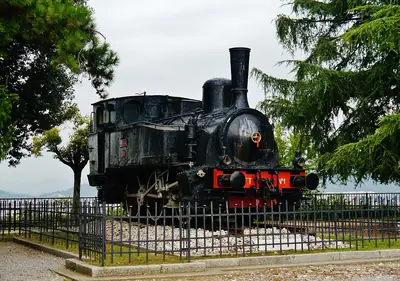
SNFT 1 is a monument featuring a steam locomotive. It is also known as La Prigioniera del Falco d’Italia, or the Italian Monument to the Steam Locomotive. The monument appears on the route up Cidneo Hill towards Brescia Castle.
Explore Brescia with a Self-Guided Audio Tour
A Brescia self-guided walking tour lets you explore the city’s history without joining a group or following a fixed timetable. Neywo offers six walking tours, one bus route and one bike route:
- Brixia: Romans, Lombards and a Queen in Exile — 1.26 km, 84 minutes and 12 narrated stops.
- Venetian Squares and Linen Merchants: Loggia to Mercato — 1.21 km, 75 minutes and 11 stops.
- Two Cathedrals, Two Theatres and a Medieval Tower — 1.6 km, 76 minutes and 10 stops.
- The Falcon of Italy: Up Cidneo Hill — 1.65 km, 67 minutes and 8 stops.
- Palaces and Sanctuaries of the Pallata Quarter — 2.02 km, 74 minutes and 9 stops.
- Baroque Brescia: From Piazza Moretto to Piazzale Arnaldo — 1.94 km, 78 minutes and 10 stops.
- Bus 11: From the Mille Miglia Museum to the Old Centre — 10.2 km, 44 minutes and 9 stops.
- By Bike from the Mille Miglia Museum to Piazzale Arnaldo — 4.1 km, 20 minutes and 4 stops.
The app tells the story of each place as you reach it, at your own pace, with no group and no schedule. You can also place Brescia within the wider region with the Lombardy guide or continue exploring Italy.
Download Neywo and Explore Brescia
Download Neywo to explore Brescia with a free audio guide covering 141 narrated places. Choose one of six walks, the bus route or the bike route, then let the app guide your visit as you move through the city. From Roman Brixia and the Monastery of Santa Giulia to the two cathedrals and Brescia Castle, the stories play when you arrive—at your own pace, with no group and no schedule.
Places with an audio guide in Brescia
8 places in Brescia with a Neywo audio guide. Each one starts telling its story as you reach it.
Self-guided tours in Brescia
8 tours in Brescia, free in the Neywo app. Each stop tells its story as you reach it.
- Bike ride
By Bike from the Mille Miglia Museum to Piazzale Arnaldo
A 4 km ride on separated cycle paths from the monastery that houses the Mille Miglia museum into the southern edge of the old town, passing the Good Shepherd church to end at the Arnaldo da Brescia monument and the Baroque church of San Gaetano.
Museo Mille Miglia · Buon Pastore · Monumento ad Arnaldo da Brescia · San Gaetano
Open this tour: By Bike from the Mille Miglia Museum to Piazzale Arnaldo - Bus ride
Bus 11: From the Mille Miglia Museum to the Old Centre
A regular Brescia Mobilità city bus that links the Mille Miglia museum, in the monastery of Sant'Eufemia, with the old centre: Santa Giulia, the castle, the New Cathedral, the Baroque church of San Gaetano and the Arnaldo monument. A cheap ride through the race that made Brescia famous and the city it started from.
Museo Mille Miglia · Monastery of Santa Giulia · Castle of Brescia · SNFT 1 in Brescia · Santa Maria delle Consolazioni · Duomo Nuovo …
Open this tour: Bus 11: From the Mille Miglia Museum to the Old Centre - Walk
Brixia: Romans, Lombards and a Queen in Exile
Brescia's UNESCO core in one compact loop. Stand in the Roman forum beside the Capitolium temple, go down into the excavations under a palace, peek at the ancient theatre, then step into Santa Giulia, the Lombard monastery where Charlemagne's rejected wife is said to have spent her exile, with its churches and treasures.
Church of Saint Mark the Evangelist · Palazzo Uggeri · Palazzo Maggi Gambara · Scavi archeologici di palazzo Martinengo Cesaresco Novarino · Roman forum · Brixia …
Open this tour: Brixia: Romans, Lombards and a Queen in Exile - Walk
Venetian Squares and Linen Merchants: Loggia to Mercato
From Piacentini's monumental Piazza della Vittoria to the palaces of the old linen market, then up to the Renaissance Piazza della Loggia, where a Venetian lion once stood and Titian's lost paintings once hung. Past a hidden Romanesque church, the merchants' house and a cone-shaped chapel at the Burnt Gate: Brescia as seen by its merchants, rulers and patriots.
Piazza della Vittoria · Palazzo Beretta · Palazzo Martinengo Palatini · Church of Madonna del Lino · Church of Saint Agatha · Palazzo della Loggia …
Open this tour: Venetian Squares and Linen Merchants: Loggia to Mercato - Walk
Two Cathedrals, Two Theatres and a Medieval Tower
A walk through Brescia's stage sets: a Liberty-style theatre and an opera house with Venetian frescoes, the round Romanesque Duomo Vecchio beside its Baroque twin, a diocesan museum in a monastery cloister, a carved stone face on a street corner and the lone surviving tower of the medieval fortifications.
Church of San Lorenzo · Piazza Bruno Boni · Teatro Sociale · Teatro Grande · San Luca · Duomo vecchio …
Open this tour: Two Cathedrals, Two Theatres and a Medieval Tower - Walk
The Falcon of Italy: Up Cidneo Hill
Climb through one of Brescia's oldest churches and past a steam locomotive monument to the Visconti castle called the Falcon of Italy. Visit its arms museum and Risorgimento museum, then walk down to the quiet Carmelite church of San Pietro in Oliveto and the monastery of the Holy Body of Christ.
Church of Saint George · Santa Maria delle Consolazioni · Church of Santa Maria della Carità · SNFT 1 in Brescia · Castle of Brescia · Luigi Marzoli Arms Museum …
Open this tour: The Falcon of Italy: Up Cidneo Hill - Walk
Palaces and Sanctuaries of the Pallata Quarter
Cross the west side of the old centre, the quarter of the medieval Pallata tower: the Colleoni palace, the churches of Cosma and Damiano and of Our Lady of the Angels, and the Renaissance sanctuaries of Santa Maria delle Grazie and San Rocco. A quieter Brescia of cloisters, courtyards and Baroque altars.
Santa Maria degli Angeli · Church of Saints Cosma and Damiano · Bargnani palace · Palazzo Colleoni alla Pace · Santa Maria ad Elisabetta · Church of Saint Rocco …
Open this tour: Palaces and Sanctuaries of the Pallata Quarter - Walk
Baroque Brescia: From Piazza Moretto to Piazzale Arnaldo
Walk the southern half of the old town, from the Martinengo palace and the Baroque church of Sant'Alessandro to the Tosio Martinengo picture gallery, then east through quiet piazzette to the bronze monument of the friar Arnaldo da Brescia.
Palazzo Martinengo Colleoni di Malpaga (Brescia) · Church of Saint Alexander · Sant'Angela Merici · Tosio Martinengo Gallery · Church of Saint Barnaba · Church Santa Maria in Calchera …
Open this tour: Baroque Brescia: From Piazza Moretto to Piazzale Arnaldo
Walk Brescia with Neywo
Neywo turns Brescia into a self-guided audio tour. Stories arrive as you reach the place they belong to, and the route reshapes when you wander off it.