Visiting Anykščiai, Lithuania: Top Sights on Foot
Things to do in Anykščiai: a self-guided walk through churches, railways and history
The best things to do in Anykščiai combine remarkable architecture with Lithuania’s railway heritage and a hillfort linked to one of the country’s greatest historical mysteries. This small town on the Šventoji River is an rewarding stop for travellers exploring Lithuania, especially if you want to discover its landmarks at your own pace. Neywo has a free audio guide for Anykščiai with 5 narrated places, available in 11 languages.
What to see in Anykščiai
The main sights can be explored on foot, from the town centre to its railway museum, Orthodox church and the archaeological site of Šeimyniškėliai hillfort.
Church of St. Matthew
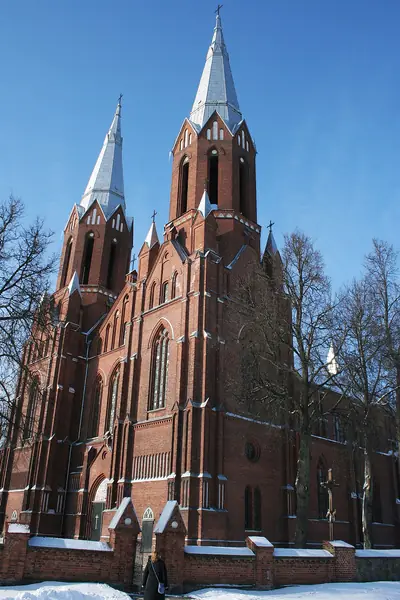
The Church of St. Matthew is the tallest church in Lithuania, with twin spires reaching 79 metres above the banks of the Šventoji River. Built entirely from red brick, it is a striking example of Neo-Gothic architecture, with pointed arches, tall windows and two matching towers that dominate the Anykščiai skyline.
The spires were even taller before the First World War, reaching 84 metres before being shortened during reconstruction. Inside, stained-glass windows bring colour to the lofty interior. They were created by Anortė Mackelaitė, one of Lithuania’s best-known glass artists, over a fifteen-year period from 1971 to 1986.
Siauruko muziejus at Anykščiai railway station
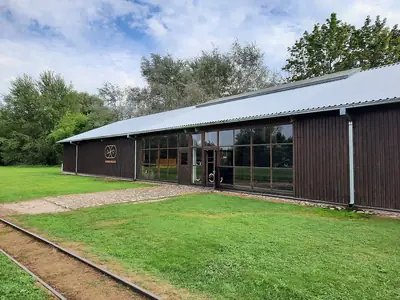
At the historic Anykščiai railway station, the Siauruko Museum preserves the story of Lithuania’s narrow-gauge railways. The museum is part of the Baranauskas and Vienuolio-Žukauskas Memorial Museum complex, but its exhibitions occupy the original station buildings and extend along the tracks.
Its collection includes railway equipment, photographs and documents gathered from former narrow-gauge lines across Lithuania. The setting makes the visit especially atmospheric: the history is presented in the same station environment where railway activity once connected the countryside.
A highlight is the opportunity to climb aboard a hand-powered draisine or a small three-wheeled rail cart and ride the rails. The museum’s growing exhibition received the Teresė Mikeliūnaitė Culture Prize in 2001, after being recognised as Anykščiai’s most significant cultural achievement.
Orthodox Church of Saint Alexander Nevsky
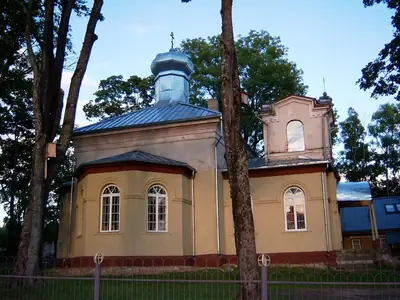
Northeast of the town centre, in the Janydžių district, the Orthodox Church of Saint Alexander Nevsky stands in a quiet square near the Regional Park Directorate. The brick church was built in 1873, replacing an earlier wooden chapel, and was consecrated on 17 September that year.
Its history reflects the upheavals experienced by the local community. During the First World War, the priest fled and the church remained empty for nine years. There were plans to convert the damaged building into a school, but they were never carried out. Services resumed in 1924 with the arrival of Father Ilja Gabiec.
The church was registered again as a functioning Orthodox parish in 1947, during the Soviet period. A major restoration followed in the 1990s, and the building continues to serve the Saint Alexander Nevsky parish and Anykščiai’s Orthodox community.
Šeimyniškėliai hillfort and the mystery of Voruta
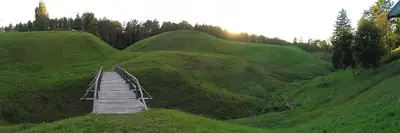
Šeimyniškėliai hillfort is one of the most intriguing early medieval archaeological sites in the Anykščiai region. It lies in a quiet valley between the villages of Šeimyniškėliai and Naujieji Elmininkai, and is associated with the legendary name Voruta.
According to the Hypatian Chronicle, King Mindaugas took refuge in a castle called Voruta around 1251 while defending himself against rival Lithuanian princes and their allies from Galicia-Volhynia. Voruta appears only once in a written source, and its exact location remains uncertain. One prominent theory identifies it with Šeimyniškėliai hillfort.
The site’s scale helps explain why the theory has attracted attention. The main platform is 80 metres long, widening to 35 metres at one end and narrowing to 23 metres at the other. Its roughly triangular area covers about 3,000 square metres. The fortifications include a five-metre-high, fifteen-metre-wide rampart on the southeastern side and a second rampart, two metres high and twelve metres wide, on the opposite side. Deep ditches and additional outer defences complete the layout.
Whether this was Mindaugas’ actual stronghold or not, the hillfort offers a tangible connection with a dramatic episode in Lithuanian history: a newly crowned king holding his position against a coalition of enemies.
Explore Anykščiai with a free audio guide
For an Anykščiai self-guided walking tour, download Neywo and let the app tell the story as you reach each place. The Anykščiai tour is one walk covering 5.12 km, taking around 93 minutes and including 4 narrated stops: the Church of St. Matthew, Siauruko muziejus at Anykščiai railway station, the Orthodox church and Šeimyniškėliai hillfort.
Each story plays when you reach the place, at your own pace. There is no group and no schedule, so you can explore independently while keeping the town’s history and landmarks in context. It is a free walking tour in Anykščiai through the Neywo app, with narration available in 11 languages.
Places with an audio guide in Anykščiai
5 places in Anykščiai with a Neywo audio guide. Each one starts telling its story as you reach it.
Walk Anykščiai with Neywo
Neywo turns Anykščiai into a self-guided audio tour. Stories arrive as you reach the place they belong to, and the route reshapes when you wander off it.

