What to See in Kaunas, Lithuania: Free Audio Guide
Things to do in Kaunas: a guide to the city’s historic and creative sights
Kaunas is Lithuania’s second-largest city, set where the Nemunas and Neris rivers meet. The city combines a medieval Old Town, Gothic and Baroque churches, Kaunas Fortress, modernist architecture, unusual museums, and a lively creative culture. This guide brings together what to see in Kaunas, from its best-known landmarks to places that reveal its more distinctive side.
Neywo has a free audio guide for Kaunas with 113 narrated places, so you can explore the city while its stories play at the places themselves.
What to see in Kaunas
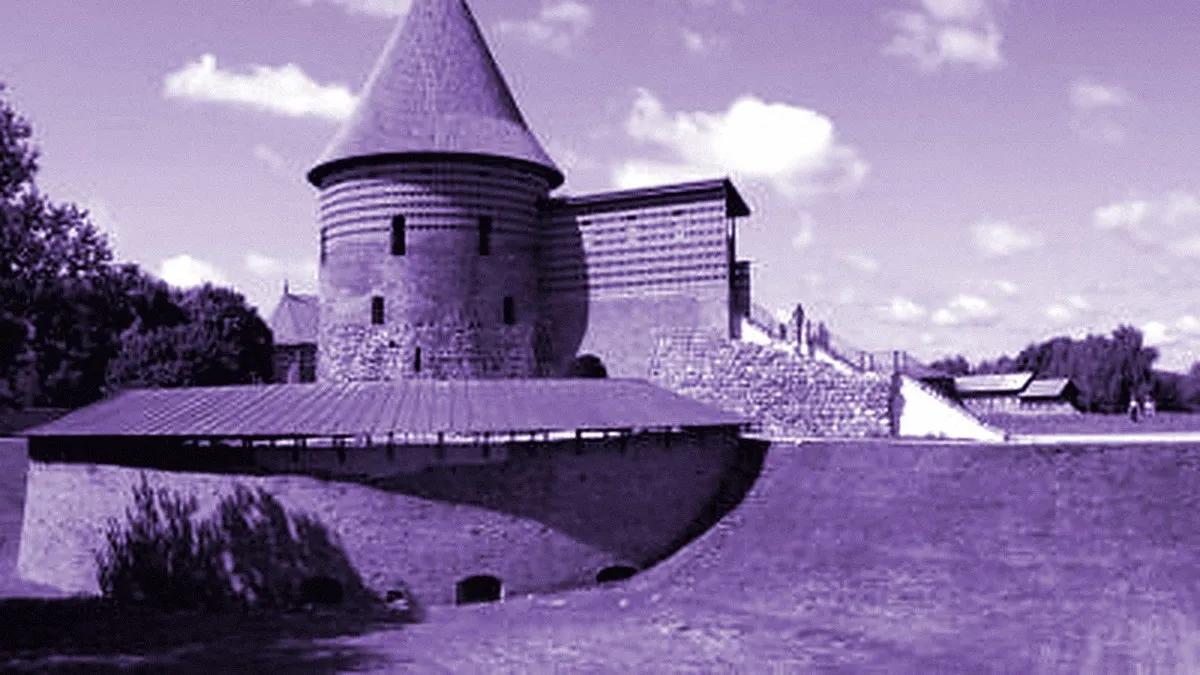
Kaunas Castle
Kaunas Castle stands on a rise near the confluence of the Nemunas and Neris rivers. Archaeological evidence suggests that the medieval Gothic fortress was built in the middle of the fourteenth century. It was expanded in the sixteenth century, although only around one third of the original castle remains.
The castle is among Lithuania’s oldest masonry castles. Its first recorded mention appears in a fourteenth-century chronicle by Wigand of Marburg, which records both Kaunas and its castle in 1361. The surviving ruins, riverside position, and Gothic character make it one of the essential places to visit in Kaunas.
Kaunas Cathedral Basilica
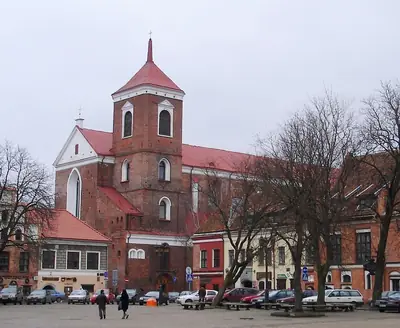
In the Old Town, near Town Hall Square, Kaunas Cathedral Basilica is dedicated to Saints Peter and Paul and serves as the seat of the Archbishop of Kaunas. It began as a Gothic brick church in the fifteenth century and was rebuilt several times, bringing together Gothic, Renaissance, Baroque, and later Neogothic features.
The cathedral is described as the largest Gothic building in Lithuania. Its exterior combines sculptures, reliefs, and columns, while the interior includes Baroque and Neoclassical elements, ornate altars, frescoes, and a large organ. The main altar, made by Tomasz Podhajski in 1755, presents the Crucifixion surrounded by the twelve apostles.
House of Perkūnas
House of Perkūnas is one of Kaunas Old Town’s most distinctive Gothic secular buildings. Its richly decorated brick façade includes rectangular ornamental niches and a sun symbol made from glazed stones. The building also has an elaborate gable and spacious cellars.
Hanseatic merchants used the house as an office from 1440 to 1532. It later passed to the Jesuits, who established a chapel there in 1643. After a period of decline, the building was restored in the nineteenth century and used as a school and theatre. The Polish poet Adam Mickiewicz attended the school.
M. K. Čiurlionis National Art Museum
The M. K. Čiurlionis National Art Museum is dedicated above all to Mikalojus Konstantinas Čiurlionis, a Lithuanian painter and musician whose work connects visual art with music, nature, mythology, and abstract ideas.
Founded in Kaunas on December 14, 1921, it is the oldest art museum in Lithuania. Its collections include paintings, drawings, graphics, sculpture, and decorative art from Lithuania and beyond. One room allows visitors to listen to Čiurlionis’s music alongside his paintings. The museum’s interwar section was designed in the Art Deco and early functionalism styles, while a 1969 expansion created additional exhibition space.
The Devil Museum
The Žmuidzinavičius Museum, better known as the Devil Museum, is devoted entirely to devils and demons. Its collection contains around 3,000 sculptures, carvings, masks, paintings, and other objects from around the world.
The collection began with Lithuanian artist Antanas Žmuidzinavičius, who gathered devil-related objects throughout his life. The figures appear in wood, ceramic, stone, paper, masks, and paintings on silk or canvas. Some have even been incorporated into everyday objects such as pipes and nutcrackers. The collection also includes political works, including a sculpture of Hitler and Stalin represented as devils dancing above human bones.
Kaunas Mosque
At the corner of Totorių and Trakų streets, Kaunas Mosque has a distinction found nowhere else in Lithuania: it is the country’s only brick mosque. Its story is connected with the city’s Tatar community and reaches back to at least 1795, when an earlier wooden mosque was destroyed by fire.
The present building refers to Mamluk architecture. Its minaret was modelled on the Kait Bey Mosque in Egypt, while the decorative details are described as Neo Moorish. Soviet authorities closed the mosque in 1941, and the building was later used as a sports hall, circus warehouse, and library. It was returned to the Muslim community in the late 1980s and reopened in July 1991 after restoration.
Christ’s Resurrection Church
Christ’s Resurrection Church is a monumental Roman Catholic basilica in Žaliakalnis and one of Kaunas’s important modernist landmarks. It is recognized as the largest basilical church in the Baltic states and is protected as a cultural heritage site.
The church was rebuilt between 2004 and 2005 as a votive expression of thanks for the restoration of Lithuanian independence in 1918 and 1991. It was solemnly consecrated on December 26, 2004, and is one of eight churches in Lithuania to hold the title of basilica.
Pažaislis Monastery and the Church of the Visitation
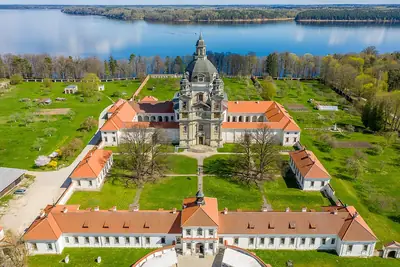
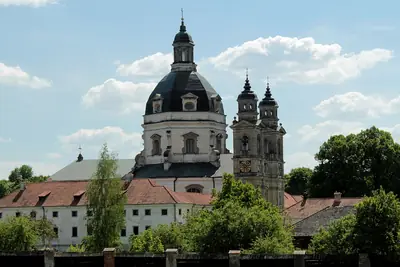
Pažaislis Monastery is the largest monastery complex in Lithuania and one of the country’s most celebrated Baroque landmarks. Built in 1664 by Camaldolese monks, it is regarded as one of the finest examples of Italian Baroque in Eastern Europe. Since 1992, the complex has been cared for by the Sisters of Saint Casimir.
The monastery and the Church of the Visitation form an important Catholic pilgrimage site on a peninsula of the Kaunas Reservoir near Petrašiūnai. The church is described as the most marble-decorated Baroque church of the former Grand Duchy of Lithuania. The complex also hosts the international Pažaislis Music Festival and received an award as the best European film location in 2020 at the 2021 Berlin International Film Festival.
Kaunas Fortress
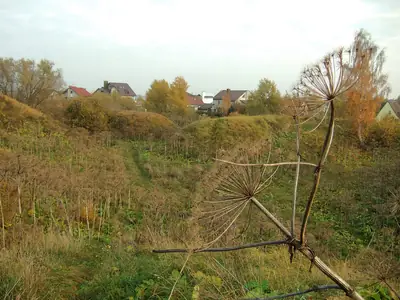
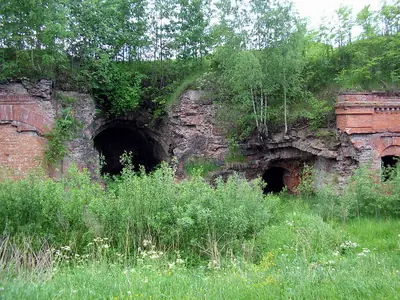
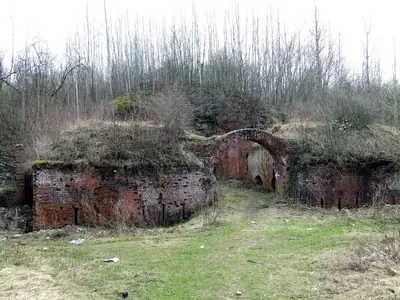
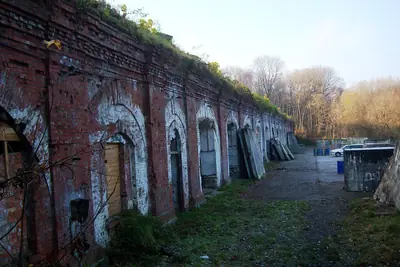
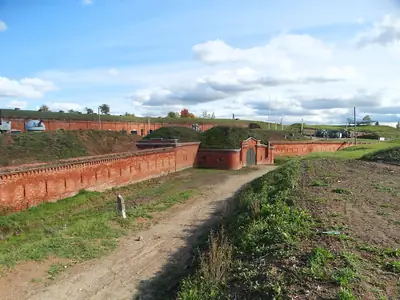
Kaunas Fortress offers a different perspective on the city’s history through a network of former military fortifications.
- Eighth Fort, also known as VIII Fortas or Linkuva, was built in 1889 and 1890 as part of the Kaunas Fortress during the Russian Empire. It has a regular, symmetrical, pentagonal layout and was the first element of the fortress to use concrete.
- Second Fort, or II Fortas, stands in Julijanava. Built between 1887 and 1888, it was part of the First Defensive Section of Kaunas Fortress and was later reconstructed between 1893 and 1898 and again in 1908.
- IV Fort lies in the southern part of the city and is described as one of the most modern forts built by the Russian Empire. It was added to Lithuania’s Register of Cultural Heritage in 2002.
- V Fort is in the Zuikinė area beside the Kaunas Reservoir and the upper terrace of the Sėmena River. It belonged to the fortress’s Second Defensive Section and stands within Kaunas Reservoir Regional Park.
- VI Fort is in Gričiupis, in eastern Kaunas. Its symmetrical pentagonal plan is oriented toward the northeast, and it now includes an exhibition of military equipment.
- Seventh Fort, or VII Fortas, is in Žaliakalnis and also functions as a museum. Built during the first phase of the fortress’s construction, it was the last brick fortification added to Kaunas Fortress. Its two ramparts have survived particularly well, along with authentic iron window frames and fragments of ammunition warehouse gates.
Plan a Kaunas self-guided walking tour with Neywo
Neywo offers four walking tours in Kaunas, one bus route, and one bike route. The walks range from 1.45 to 2.61 km and take between 74 and 97 minutes, with 8 to 12 narrated stops each. The 3.7 km bus route takes 16 minutes and has 7 stops, while the 1.5 km bike route takes 8 minutes and has 5 stops.
The walks cover the Gothic Old Town, Kaunas as an interwar capital, the road from the Nemunas to Laisvės Alėja, and the city’s Fluxus, religious, and architectural landmarks. The bus and bike routes provide additional ways to explore places including Kaunas Castle, Kaunas Synagogue, Kaunas Picture Gallery, and Jurgis Mačiūnas square.
Download Neywo and explore Kaunas at your own pace. The app tells the story of each place as you reach it, with narration available in 11 languages—no group and no schedule. Kaunas is part of Kaunas County in Lithuania, and it can also be a starting point for discovering nearby Kėdainiai or Birštonas.
Places with an audio guide in Kaunas
8 places in Kaunas with a Neywo audio guide. Each one starts telling its story as you reach it.
Self-guided tours in Kaunas
6 tours in Kaunas, free in the Neywo app. Each stop tells its story as you reach it.
- Bike ride
Old Town by Bike: From the Castle to the Zamenhof Synagogue
A short ride along the cycle lane through Kaunas Old Town. Start at the ruins of Kaunas Castle, pass the Pinecone Man statue and the sport museum, then roll by the oldest church in the city to the 19th century synagogue on Zamenhof Street.
Kaunas Castle · Žmogus-kankorėžis · Lithuanian Sport Museum · Church of Vytautas the Great, Kaunas · Kaunas Synagogue on Zamenhof Street
Open this tour: Old Town by Bike: From the Castle to the Zamenhof Synagogue - Bus ride
Bus 42: From the Old Town Along the Road to the New Town
A city bus from Kaunas Old Town to the interwar New Town. Start at the Gothic Church of Vytautas the Great, the oldest church in the city, pass the Baroque Blessed Sacrament church and the Choral Synagogue, the only one in Kaunas still in use, and ride on to the Picture Gallery, the square named after Fluxus founder Jurgis Mačiūnas and the museum of the history of education.
Church of Vytautas the Great, Kaunas · Church of the Blessed Sacrament, Kaunas · Kaunas Synagogue · Kauno technologijos universiteto muziejus · Kaunas Picture Gallery · Jurgis Mačiūnas square …
Open this tour: Bus 42: From the Old Town Along the Road to the New Town - Walk
Gothic Kaunas: Castle, Cathedral and the Merchants' Perkūnas House
Start where two rivers meet, at the ruins of Kaunas Castle and the late Gothic church of St George, then climb into the Old Town. The Baroque palace of the poet Maironis, Town Hall Square, Lithuania's largest Gothic cathedral, a Hanseatic merchants' house with a glazed sun on its brick facade and the oldest church in the city bring six centuries of Kaunas into one easy loop.
Church of St. George · Kaunas Castle · Church of the Holy Trinity, Kaunas · Maironis Lithuanian Literature Museum · Town Hall Square · Museum of the History of Lithuanian Medicine and Pharmacy …
Open this tour: Gothic Kaunas: Castle, Cathedral and the Merchants' Perkūnas House - Walk
Devils, Aviators and Art Deco: Kaunas as Interwar Capital
When Kaunas was Lithuania's temporary capital it built modernist museums and monuments that still define the city. Pass the oldest drama company in the country and a 19th century synagogue, meet 3,000 devils, the wreck of a transatlantic aeroplane and the university founded in 1922, then climb through Žaliakalnis to the monumental Resurrection basilica and the small church that served the parish before it.
Kaunas State Drama Theatre · Kaunas Hausman Synagogue · Knygnešių sienelė · Žmuidzinavičius Museum · M. K. Čiurlionis National Art Museum · Vytautas the Great War Museum …
Open this tour: Devils, Aviators and Art Deco: Kaunas as Interwar Capital - Walk
The Old Road to Vilnius: From the Nemunas to Laisvės Alėja
Follow Vilniaus Street, the road that once led all the way to the Lithuanian capital, from the riverside Lutheran church to the heart of the New Town. On the way you pass the former Butchers' Synagogue, a surviving 19th century synagogue, Baroque and Gothic churches tucked into courtyards, the presidential palace of the 1920s, the only Kaunas synagogue still in use and the theatres and concert halls around Laisvės Alėja.
Evangelical Lutheran Church in Kaunas · Textiles department of Kaunas Art Faculty · Vilniaus Street in Kaunas · Kaunas Synagogue on Zamenhof Street · Church of the Blessed Sacrament, Kaunas · Historical Presidential Palace …
Open this tour: The Old Road to Vilnius: From the Nemunas to Laisvės Alėja - Walk
New Town Crossroads: Garrison Church, Fluxus and Lithuania's Only Brick Mosque
Walk the eastern end of Laisvės Alėja, where empires and faiths left their mark. See the Neo-Byzantine Garrison Church with a museum for the blind in its catacombs, the Picture Gallery with its Fluxus cabinet, the square named after Fluxus founder Jurgis Mačiūnas, the Tatar mosque of Ramybės Park, the two Orthodox churches beside it and the Baroque Carmelite church.
St. Michael the Archangel Church · Kaunas Museum for the Blind · Kaunas Picture Gallery · Jurgis Mačiūnas square · Kaunas Mosque · Holy Resurrection Orthodox Church …
Open this tour: New Town Crossroads: Garrison Church, Fluxus and Lithuania's Only Brick Mosque
Walk Kaunas with Neywo
Neywo turns Kaunas into a self-guided audio tour. Stories arrive as you reach the place they belong to, and the route reshapes when you wander off it.

