Juodkrantė, Lithuania: Self-Guided Walking Tour
Things to Do in Juodkrantė, Lithuania
The best things to do in Juodkrantė combine the Curonian Spit’s forests, dunes, lagoon views, and cultural heritage. This settlement in Klaipėda County is a rewarding place to experience the unusual landscape of the Curonian Spit, where pine woodland and wind-shaped sand meet the Curonian Lagoon and the Baltic Sea. Neywo’s free audio guide for Juodkrantė covers 23 narrated places, with stories available in 11 languages.
What to See in Juodkrantė
Juodkrantė is a useful base for exploring the Curonian Spit, with viewpoints, woodland sculptures, museums, and distinctive natural landmarks spread through the settlement and the surrounding national park.
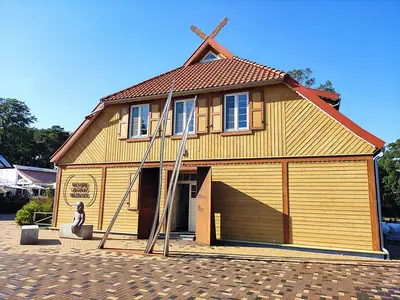
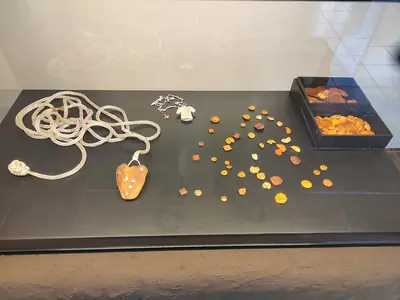
Mizgirių Amber Museum
The Mizgirių Amber Museum is a private museum and gallery devoted to amber. Its exhibitions explore the history of this distinctive material, including the ways it has been used and processed. It offers a focused introduction to one of the Curonian Spit’s most characteristic cultural and natural materials.
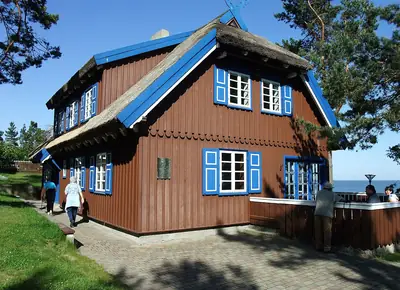
Thomas Mann Memorial Museum
The Thomas Mann Memorial Museum occupies the summer house where Nobel laureate Thomas Mann spent three summers with his family. The house was built in 1930, and Mann stayed there in the summers of 1930, 1931, and 1932, writing in a study on the upper floor with views toward the dunes and lagoon.
The building later faced an uncertain future. It was nationalized in 1939 and became the property of the German Reich before being threatened with demolition after the Second World War. Instead, it was restored in 1967. The first floor contains a permanent exhibition about Mann’s life and work, while his preserved study is upstairs. The house also functions as a cultural centre and includes a memorial reading room.
Bear’s Head Viewing Platform
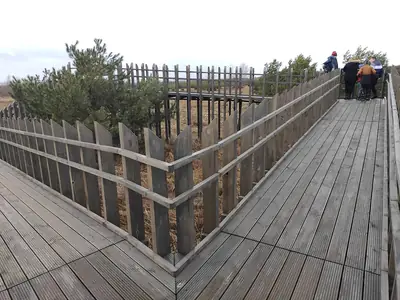
The Bear’s Head viewing platform stands on the Bear’s Head sand dune near Alksnynė, within the Curonian Spit National Park. This low wooden structure on the eastern side of the Meškos galva dune provides a place to pause and take in the surrounding landscape.
Avikalnio ragas
South of Juodkrantė, Avikalnio ragas forms a small peninsula on the eastern shore of the Curonian Spit. Its quiet natural setting gives it a different character from the settlement itself and makes it a calm place to experience the lagoon landscape.
Bulvikio ragas
Bulvikio ragas, also called the Horn of Bulvikis, is a narrow projection reaching into the Curonian Lagoon between Nida and Preila. It is one of the distinctive headlands that shape the lagoon shore of the Curonian Spit.
Garsų Gaudyklė, the Sound Catcher
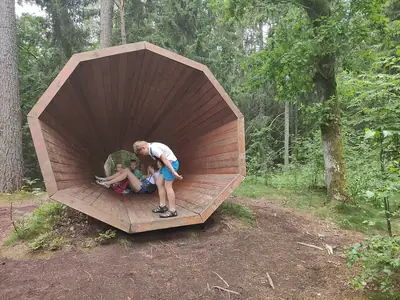
In the forests of the Curonian Spit National Park, Garsų Gaudyklė— the Sound Catcher—turns listening into the main activity. Created in 2016, this wooden sculpture resembles a giant gramophone. Its hollow truncated-pyramid shape is about three metres high and three metres wide, with a nine-sided base.
Visitors can step inside. The structure is designed to amplify the natural sounds of the forest, while an information stand includes QR codes for sound recordings that can be played on a mobile phone.
Explore Nida and the Curonian Spit
Several notable places on the Curonian Spit lie beyond Juodkrantė, including Nida, the most important tourist centre on the peninsula and the administrative centre of Neringa municipality.
Nida lies between the Curonian Lagoon and the Baltic Sea. Its streets preserve old houses and villas from around the turn of the nineteenth and twentieth centuries alongside newer buildings, maintaining the atmosphere of a former lagoon settlement and resort. The town’s landmarks include the Nida Evangelical Lutheran Church, built in 1888, and the Church of Our Lady of Help of Christians. The Evangelical Lutheran Church stands beside ethnographic cemetery grounds where wooden grave markers known as krikštai can be seen.
Nida also offers several museums and viewpoints. The Amber Gallery-Museum, or Gintaro galerija-muziejus, explores amber’s history, processing, and artistic uses. The Nida Fisherman’s Ethnographic Homestead presents the history and traditions of fishing on the Curonian Spit.
Italian View
Italian View, known in Lithuanian as Itališkas vaizdelis, is a forest viewpoint in Skruzdynė, a neighbourhood of Nida within Neringa and the Curonian Spit National Park.
Neringa’s Chair
Neringos krėslas, or Neringa’s Chair, is a tall outdoor wooden chair, sculpture, and memorial in Tylos Slėnis, the Valley of Silence. The valley lies within the site of a vanished village on the Curonian Lagoon coast. The monument stands in Nida, in Neringa municipality.
Nida Observation Tower
The wooden Nida Observation Tower, or Nidos apžvalgos bokštas, offers a place to pause beneath the summit of Urbo kalnas, a wooded sand dune on the Curonian Spit.
Parnidis Dune
Parnidis Dune is one of the Curonian Spit’s most striking landscapes. It rises 52 metres above the lagoon and belongs to the White Dunes massif, whose sand contains between 85 and 99 percent quartz. The high quartz content gives the dune its pale, luminous appearance.
Parnidis remains a moving landscape. Wind drives the sand eastward toward the Curonian Lagoon, and the dune once reached 60 metres. Between 1675 and 1854, four villages of the Nagliai settlement were swallowed by advancing sand. In the twentieth century, the movement also buried part of the coastal forest and a section of Nida’s harbour.
The Parnidis Sundial stands at the summit. Local explanations connect the dune’s name with the Lithuanian phrase perėjusi per Nidą, meaning “passed through Nida”—a reference to the way the moving dune has crossed the settlement over time.
Pervalka Birdwatching Point
The observation tower in Pervalka, also known as the Pervalka Birdwatching Point, stands at Žirgų ragas on the Curonian Lagoon shore. The site is intended for observing birds and the natural surroundings of the lagoon coast.
Ožkų ragas
Ožkų ragas is a small headland reaching into the western edge of the Curonian Lagoon near Karvaičiai Dune. The name is also translated as the Hord of Goats. The headland is about 150 metres long and up to 375 metres wide.
Explore Juodkrantė with Neywo
Neywo’s free audio guide makes a Juodkrantė self-guided walking tour easy to follow. It includes 23 narrated places in Juodkrantė and the surrounding Curonian Spit. There are no scheduled walks or group tours: the app tells the story of each place as you reach it, at your own pace, with no group and no schedule. Narration is available in 11 languages.
Download Neywo and explore Juodkrantė independently, from the amber museum and Thomas Mann’s former summer house to the forest sculptures, viewpoints, lagoon headlands, and dunes that make this part of Lithuania so distinctive. You can also continue your journey through the county with Klaipėda or Palanga.
Places with an audio guide in Juodkrantė
8 places in Juodkrantė with a Neywo audio guide. Each one starts telling its story as you reach it.
Walk Juodkrantė with Neywo
Neywo turns Juodkrantė into a self-guided audio tour. Stories arrive as you reach the place they belong to, and the route reshapes when you wander off it.

