Things to Do in Vilnius, Lithuania: Walking Guide
Things to Do in Vilnius: What to See in Lithuania’s Capital
Vilnius is Lithuania’s capital, a city where medieval streets, grand religious buildings, former royal residences, and creative neighbourhoods come together around a compact historic centre. The most rewarding things to do in Vilnius range from exploring the Old Town and its castles to discovering viewpoints, palaces, museums, and distinctive districts such as Užupis. Neywo has a free audio guide for Vilnius with 197 narrated places.
What to See in Vilnius
Gediminas’ Tower and the Castle Complex
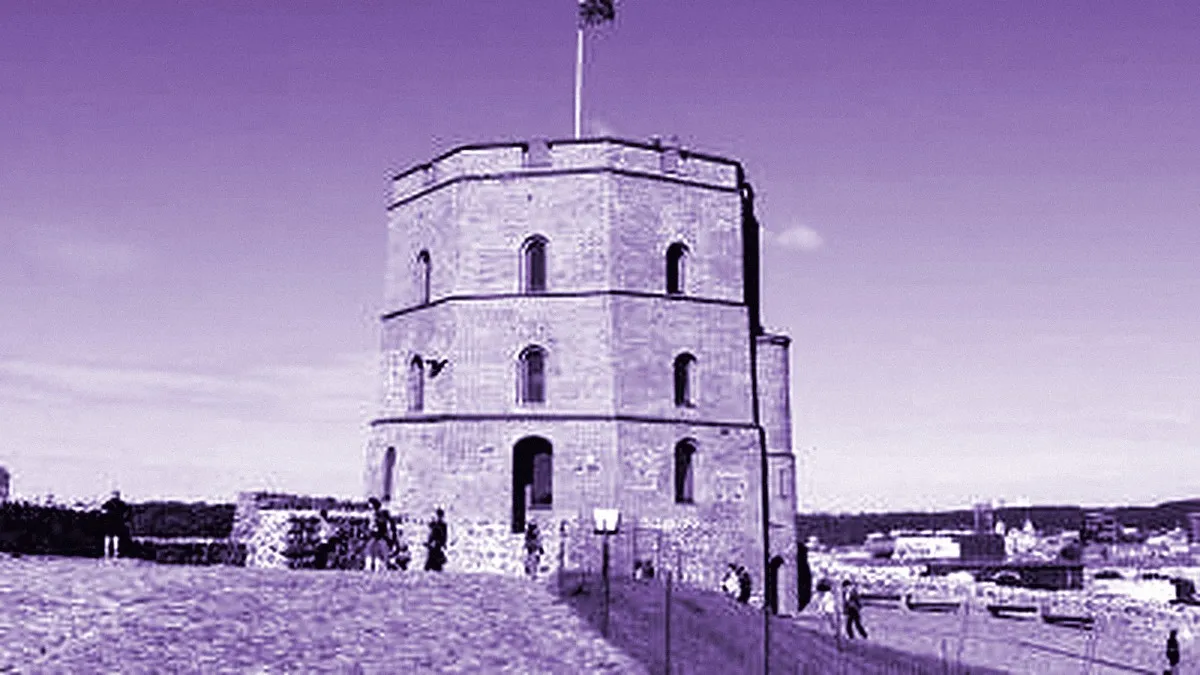
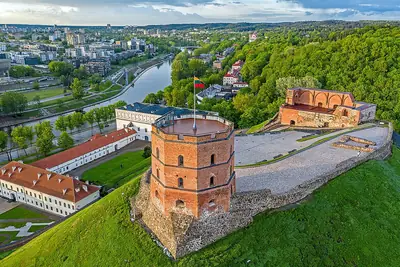
Gediminas’ Tower is one of the defining symbols of Vilnius. It is the surviving western tower of the Upper Castle, which was built as a Gothic fortress during the rule of Grand Duke Vytautas. The earlier stronghold on Gediminas Hill was associated with Grand Duke Gediminas.
The tower is about twenty metres high and built from rough rubble stone and red brick. Its lower section is four-sided, while the upper part has eight sides and three storeys. Foundations of the southern tower and part of the defensive wall remain nearby.
The viewing platform is one of the main reasons to climb the hill. From here, the panorama takes in Vilnius Old Town, the Vilnia valley, and the city’s Central Business District.
Vilnius Cathedral and Cathedral Square
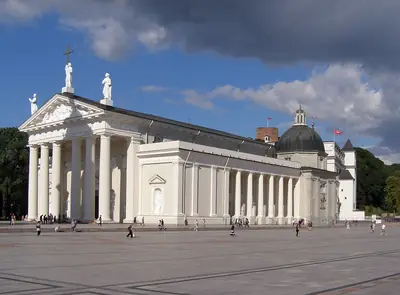
Vilnius Cathedral is Lithuania’s main Catholic cathedral and one of the country’s most important Classical buildings. Dedicated to Saint Stanislaus and Saint Ladislaus, it stands in the historic castle area at the centre of the city’s religious and national life.
Inside, the Chapel of Saint Casimir and ten other side chapels add detail to the monumental building. The cathedral has also been a place of national ceremony: Lithuanian monarchs were once inaugurated here with the Gediminas’ Cap, while modern masses have been held for elected presidents after their inauguration ceremonies.
The cathedral bell tower stands beside the church and reaches 57 metres high, making it one of the most recognisable landmarks around Cathedral Square.
Palace of the Grand Dukes of Lithuania
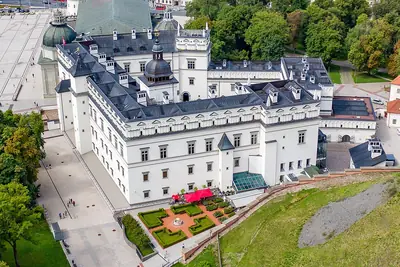
The Palace of the Grand Dukes of Lithuania houses the National Museum—Palace of the Grand Dukes of Lithuania. Its history reaches back to a fifteenth-century palace created for the rulers of the Grand Duchy of Lithuania. Over time, it became a political, administrative, and cultural centre of the Polish–Lithuanian Commonwealth.
The original palace was demolished in 1801. The building seen today is a Renaissance-style reconstruction based on archaeological remains excavated between 1987 and 2001, historical images, and other evidence. The modern museum opened in stages, and the fully reconstructed palace was ceremonially opened in 2018.
Church of St. Anne
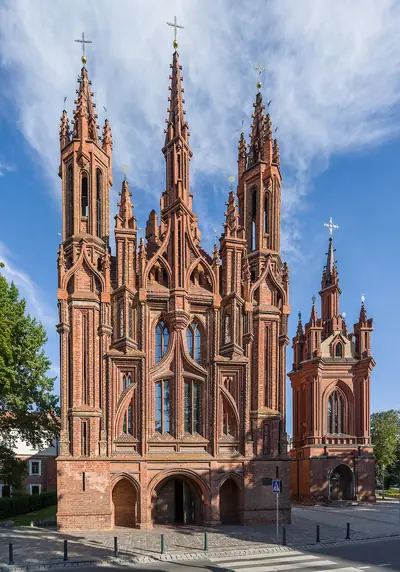
Church of St. Anne is one of the most memorable Gothic landmarks in Vilnius Old Town. Its brick façade has a delicate, lace-like appearance and combines Brick Gothic with the more elaborate Flamboyant Gothic style.
Built around 1495 to 1501, the church’s façade uses 33 different types of shaped bricks. Repeated fires and later rebuilding altered the building over the centuries, while the interior now combines nineteenth-century Neo-Gothic furnishings with three eighteenth-century late-Baroque altars designed by Johann Christoph Glaubitz.
A Neo-Gothic bell tower built in 1874 stands beside the church, echoing its late-Gothic character.
Presidential Palace of Lithuania
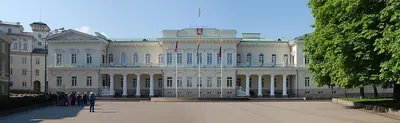
The Presidential Palace of Lithuania, or Prezidentūra, occupies S. Daukanto Square beside the Vilnius University ensemble. It is the official residence and workplace of the President of Lithuania.
The two-storey building has a late Classical, or Empire, style. Its history began in the fourteenth century, when it was used as the residence of the Bishop of Vilnius. Later reconstructions were supervised by architects including Laurynas Gucevičius and Vasily Stasov. Since 1997, it has been the official seat of the President.
Look for the Vytis, the Lithuanian coat of arms, on the façade. When the President is in the palace, the presidential flag is raised above the building.
Gate of Dawn
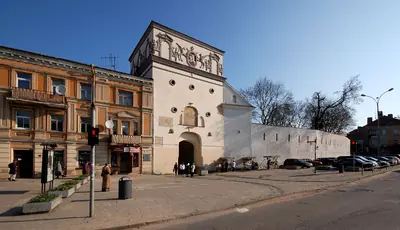
The Gate of Dawn, known in Lithuanian as Aušros Vartai, is the only surviving gate of Vilnius’s former defensive wall. Built in Gothic style between 1503 and 1514, it also contains one of the city’s most important religious sites.
A chapel above the inner side of the gate holds the celebrated image of Our Lady of the Gate of Dawn, or Aušros Vartų Dievo Motina. The image is regarded as miraculous and is a major focus of Catholic pilgrimage in Lithuania.
The chapel’s history developed after the Discalced Carmelites arranged for a wooden chapel in 1671. After a fire destroyed it in 1715, the image was moved temporarily while a masonry chapel was built at the gate.
National Museum of Lithuania
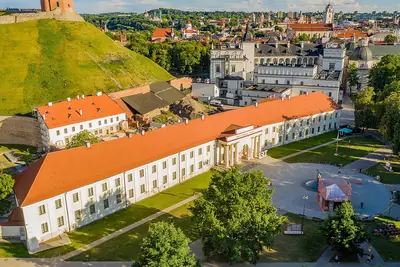
The National Museum of Lithuania is spread across several historically important buildings rather than occupying a single exhibition space. Its collections bring together Lithuania’s history, heritage, and material culture, with more than one and a half million exhibits organised into twelve divisions.
The museum was established in 1952 as a state-sponsored historical museum. Its buildings include the Castle Keeper’s House, Gediminas Castle Tower, the Old and New Arsenals, and the bastion of the Vilnius defensive wall. Together, these locations offer different perspectives on Lithuania’s past, from early historical periods to the country’s modern revival.
Church of St. Peter and St. Paul
In the Antakalnis neighbourhood, the Church of St. Peter and St. Paul offers one of Vilnius’s most extraordinary Baroque interiors. More than two thousand stucco figures and decorations cover the sanctuary, creating a highly detailed artistic environment.
The church was funded by Michał Kazimierz Pac, also known as Mykolas Kazimieras Pacas, to commemorate a victory over the Muscovites and their expulsion from Vilnius after six years of occupation. It became the centrepiece of a monastery complex belonging to the Canons Regular of the Lateran.
The sculptural work is associated with Giovanni Pietro Perti, while the ornamentation was created by Giovanni Maria Galli. The church was designed and built by Jan Zaor of Kraków.
Radvila Palace
Radvila Palace, also known as Radvilų rūmai or Radziwiłł Palace, is a late-Renaissance landmark on Vilnius Street. It was connected with the Radvila family and stood just outside the city walls, near the Vilnius Gate.
Among the Radvila palaces in Vilnius, it was the largest, although the older Bogusław Palace was more important. The restored section now houses a branch of the Lithuanian National Museum of Art, with exhibitions focused on the Radvila family and visual art from other countries dating from the sixteenth to the twentieth century.
Three Crosses
Three Crosses, or Trys Kryžiai, rises above Kalnai Park as three joined white concrete crosses. The monument is one of the most recognisable elements of the Vilnius skyline and provides another elevated view over the city.
The site is linked to a legend about seven Franciscan friars who were beheaded on the hill. Wooden crosses had stood here since the early seventeenth century. Antanas Vivulskis designed a concrete monument in 1916, but it was demolished in 1950 by order of the Soviet authorities. The present monument was erected in 1989, based on a design by Henrikas Šilgalis and created by Stanislovas Kuzma.
Užupis and Vilnius’s Hillside Landmarks
Across the Vilnia River, Užupis is one of the city’s most distinctive neighbourhoods. Its identity is associated with an artist community, galleries, murals, studios, and a playful self-declared “republic.” The area offers a different atmosphere from the historic centre and is included in one of Neywo’s walks together with the Hill of the Three Crosses.
Other places broaden the picture of Vilnius beyond the Old Town. The Centre for Wooden Architecture, also known as the Museum of Wooden Architecture, focuses on the city’s wooden architectural heritage. Sapieha Palace in Antakalnis is the only surviving palace in Vilnius that once belonged to the Sapieha family, with a rich High Baroque character and restored gates. Verkiai Palace forms part of a valuable Neoclassical estate in Verkiai Regional Park, where palace buildings, parkland, and historic landscape occupy the steep bank of the Neris.
The Bastion of the Vilnius Defence Wall reveals the city’s military past through its tower, cannon room, and connecting tunnel. Twinsbet Arena, also known as Arena Vilnius, provides a modern contrast as a major indoor venue for basketball, concerts, and other events.
Explore Vilnius with Neywo’s Free Audio Guide
A Vilnius self-guided walking tour lets you explore the city without having to follow a group. Neywo offers seven walking tours, one bus route, and one bike route, with narration available in 11 languages.
The walks range from 1.14 to 2.73 km and from 52 to 90 minutes, covering between seven and ten narrated stops:
- Where Vilnius Began: Cathedral Square and the Castles — 1.14 km, 82 minutes, 10 stops.
- Gothic Lace, Jesuit Scholars and a President’s Palace — 1.39 km, 79 minutes, 10 stops.
- Pilgrims, Bastions and the Last Synagogue — 1.61 km, 74 minutes, 9 stops.
- Užupis and the Hill of Three Crosses — 1.43 km, 58 minutes, 7 stops.
- Gediminas Avenue: Theatre, Bridge and Lukiškės — 2.73 km, 90 minutes, 9 stops.
- Radvila Palace to Zappa: The Western Old Town — 2.08 km, 74 minutes, 7 stops.
- The Old Town Heart: Town Hall, Jesuits and Palaces — 1.19 km, 52 minutes, 7 stops.
For a different way to see the city, the bus route covers 7.8 km in 33 minutes and includes 10 narrated stops. The bike route covers 1.2 km in 6 minutes and includes four stops.
Download Neywo and explore Vilnius at your own pace. The app tells the story of each place as you reach it, with no group and no schedule. If you are extending your trip through Lithuania, you can also discover nearby destinations such as Trakai, Kaunas, and Anykščiai.
Places with an audio guide in Vilnius
8 places in Vilnius with a Neywo audio guide. Each one starts telling its story as you reach it.

Self-guided tours in Vilnius
9 tours in Vilnius, free in the Neywo app. Each stop tells its story as you reach it.
- Bike ride
Kalnai Park Ride: Hills, Crosses and a Palace
A short ride on the park paths of Kalnai Park, just above the Old Town: the museum at the foot of the hill, the Slushko palace, the white Three Crosses and Gediminas' Grave Hill.
National Museum of Lithuania · Slushko Palace · Three Crosses · Gedimino kapo kalnas
Open this tour: Kalnai Park Ride: Hills, Crosses and a Palace - Bus ride
Bus 89: From the Train Station through the Old Town
A regular city bus that runs from the railway station past the Choral Synagogue and the modern art museums to the Gate of Dawn and the Old Town. Ride it for the Gate of Dawn, the Orthodox cathedral, St. Anne's and the monument to Gediminas, then get off by the river.
Railway Museum in Lithuania · Choral Synagogue of Vilnius · MO Museum · Contemporary Art Centre · Church of All Saints, Vilnius · Gate of Dawn …
Open this tour: Bus 89: From the Train Station through the Old Town - Walk
Where Vilnius Began: Cathedral Square and the Castles
Start at the cathedral that crowned Lithuanian kings and the odd statue of Gediminas, the duke who dreamed up the city. Pass the rebuilt Palace of the Grand Dukes, the old arsenals and climb to the red-brick tower that has flown the national flag since 1990.
Vilnius Cathedral · Vilnius Cathedral Bell Tower · Chapel of Saint Casimir · Gediminas Monument in Vilnius · Palace of the Grand Dukes of Lithuania · New Arsenal …
Open this tour: Where Vilnius Began: Cathedral Square and the Castles - Walk
Gothic Lace, Jesuit Scholars and a President's Palace
A walk through the Old Town's learning and power: the brick-lace facade of St. Anne's, the poet Mickiewicz carved in granite, one of Europe's oldest universities with its Rococo church, and the palace where Lithuania's president works today.
Church of St. Anne, Vilnius · Church of St. Francis and St. Bernard · Adam Mickiewicz Monument · Adam Mickiewicz Museum · Church of St. Johns, Vilnius · Vilnius University …
Open this tour: Gothic Lace, Jesuit Scholars and a President's Palace - Walk
Pilgrims, Bastions and the Last Synagogue
Follow the old defensive wall from its seventeenth-century bastion to the Gate of Dawn, where pilgrims still kneel in the street below a miracle-working icon. Then wander through Orthodox, Carmelite and Catholic churches to the Choral Synagogue, the only one left in Vilnius.
Vilniaus gynybinės sienos bastėja · Orthodox Church of the Holy Spirit, Vilnius · Gate of Dawn · Church of St. Theresa · Church and monastery of the Holy Trinity, Vilnius · Church of St. Joseph the Betrothed …
Open this tour: Pilgrims, Bastions and the Last Synagogue - Walk
Užupis and the Hill of Three Crosses
Cross the Vilnia to the self-declared Republic of Užupis, the artists' quarter with its mermaid and its angel, then climb to the white crosses that look over the whole city. Short, steep in places, and rewarded with the best view in town.
Užupis Bridge · Mermaid of Užupis · Angel of Užupis · Užupis · Church of St. Bartholomew, Vilnius · Three Crosses …
Open this tour: Užupis and the Hill of Three Crosses - Walk
Gediminas Avenue: Theatre, Bridge and Lukiškės
Vilnius's main boulevard and the river behind it: the drama theatre with its Feast of the Muses, the money museum, the neo-Gothic Raduškevičius Palace above the Neris, the Green Bridge, then west to Lukiškės Square and the former KGB building that is now the Museum of Occupations and Freedom Fights.
Lietuvos nacionalinis dramos teatras · Money Museum of the Bank of Lithuania · Vinco Kudirkos Square · Raduškevičius Palace · Green Bridge · Vytautas Kasiulis Museum of Art …
Open this tour: Gediminas Avenue: Theatre, Bridge and Lukiškės - Walk
Radvila Palace to Zappa: The Western Old Town
A quieter walk through the west of the Old Town: the late-Renaissance Radvila Palace, the theatre, music and cinema museum, the Franciscan monastery, the MO modern art museum, a Reformed church and the old Pohulanka theatre, ending at the Frank Zappa memorial.
Radvila Palace · Lithuanian Theater, Music and Cinema Museum · Franciscan Monastery · MO Museum · Evangelical Reformed Church in Vilnius · Old Theatre of Vilnius …
Open this tour: Radvila Palace to Zappa: The Western Old Town - Walk
The Old Town Heart: Town Hall, Jesuits and Palaces
Start at the Philharmonic by the Gate of Dawn road and walk up Didžioji street: the first Baroque church in Vilnius, Town Hall Square, the picture gallery in the Chodkevičiai palace, Pac Palace and two churches that rise above the Old Town.
Lithuanian National Philharmonic Society · Church of St. Casimir, Vilnius · Vilnius Town Hall Square · Vilnius Picture Gallery · Pac Palace · Divine Mercy Sanctuary in Vilnius …
Open this tour: The Old Town Heart: Town Hall, Jesuits and Palaces
Walk Vilnius with Neywo
Neywo turns Vilnius into a self-guided audio tour. Stories arrive as you reach the place they belong to, and the route reshapes when you wander off it.

