What to See in Kėdainiai, Lithuania: Free Audio Guide
Things to Do in Kėdainiai: Churches, Synagogues and Historic Streets
Looking for things to do in Kėdainiai? This historic city in central Lithuania is known for its old-town heritage, churches and unusually rich Jewish architectural legacy. Its compact centre brings together Catholic, Lutheran, Orthodox and Reformed places of worship, as well as three historic synagogues. Neywo has a free audio guide for Kėdainiai with 10 narrated places, available in 11 languages.
Kėdainiai is in Kaunas County, and its cultural heritage makes it a rewarding stop for anyone exploring Lithuania beyond its largest cities. The city is particularly well suited to discovering on foot, with many important sites gathered in and around the historic centre.
What to See in Kėdainiai
Church of St. George
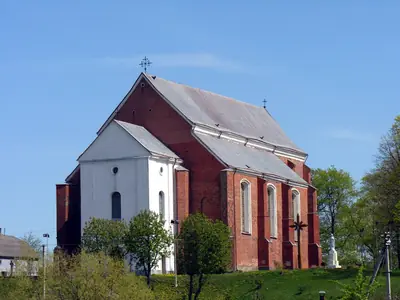
The Church of St. George is Kėdainiai’s oldest building and a protected cultural heritage site. Its setting makes it especially distinctive: the Gothic church stands on a terrace above the Nevėžis River valley, on the river’s left bank and beside the mouth of a small stream that circles the church hill. Seen from across the valley, the church has a striking presence on the slope.
Church of St. Joseph
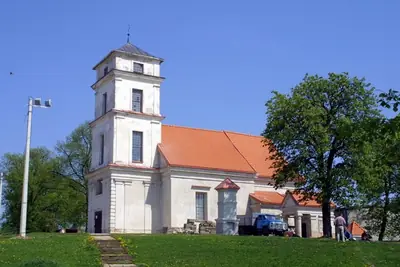
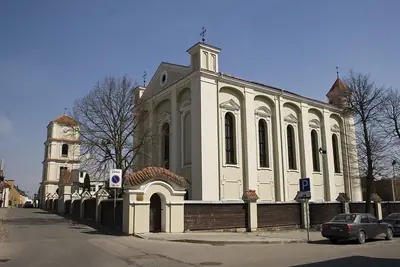
The Church of St. Joseph stands on the right bank of the Nevėžis River. It is one of Kėdainiai’s cultural heritage sites and forms part of the city’s varied collection of historic religious buildings.
Evangelical Lutheran Church
The present Evangelical Lutheran Church dates from 1679. It belongs to a larger architectural complex that also includes the Totleben and Merkurijus Liaunė chapel-mausoleums in the churchyard. Together, the buildings are listed in Lithuania’s Cultural Heritage Register as number 1389.
Holy Transfiguration Church
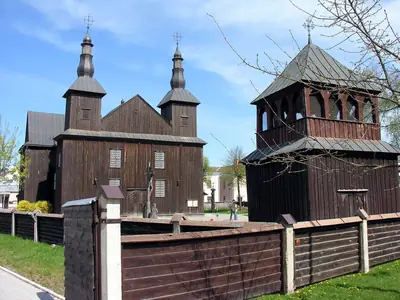
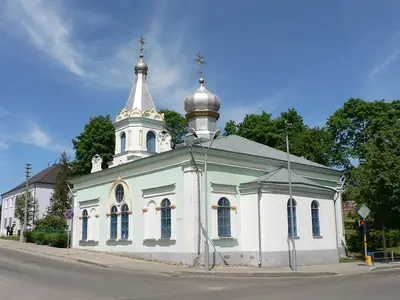
At the junction of J. Basanavičiaus and Gedimino streets, the Holy Transfiguration Church represents Kėdainiai’s Eastern Orthodox tradition. Orthodox worship in the city dates back to 1643, when the first wooden church was built. From 1652, it belonged to a Holy Transfiguration monastery, which was destroyed by fire in 1771 and officially closed in 1798.
The present church replaced an earlier building in 1895, when the original had become too small. It was abandoned during the First World War, but new parish clergy arrived in 1918. In 1947, the Soviet government registered it as an active parish.
Kėdainiai Regional Museum
The Kedainiai Regional Museum, or Kėdainių krašto muziejus, is a local history museum devoted to the Kėdainiai region. It offers a way to place the city’s buildings, communities and historical changes in a wider local context.
Smilgos Street Synagogue
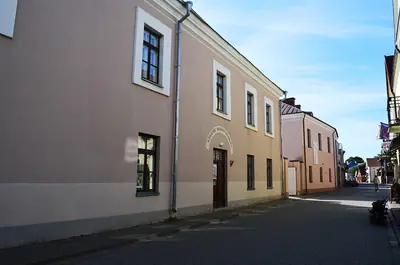
Smilgos Street Synagogue is one of Kėdainiai’s three surviving synagogues. Built in the 1870s, it is one of the few surviving Classicist brick Jewish prayer houses in Lithuania. The freestanding building is an important reminder of the city’s Jewish architectural heritage.
Evangelical Reformed Church
The Evangelical Reformed Church stands at the meeting point of Senosios and Didžiosios Streets in Kėdainiai’s historic centre. It remains a place of worship as well as a protected cultural heritage site, and its position makes it a natural stop while exploring the old town.
New Synagogue
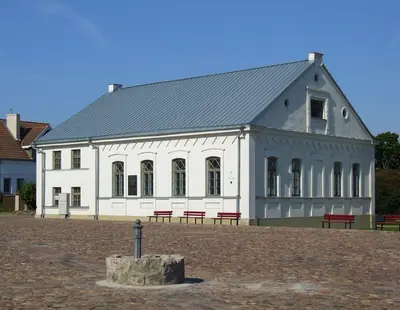
The New Synagogue is also known as the Small Synagogue or Winter Synagogue. Built in the nineteenth century in a Classical style, it stands beside the Old Synagogue and opposite the former Jewish market. That setting reflects its connection with Kėdainiai’s historic Jewish community.
The synagogue ceased religious activity during the Second World War. After extensive renovation, it became a cultural house, museum and gallery in 2002. An exhibition inside presents the history of Kėdainiai’s Jewish community.
Old Synagogue
The Old Synagogue, also called the Great or Summer Synagogue, is a rare surviving example of a brick Baroque synagogue in Lithuania. It was built in the second half of the seventeenth century and rebuilt in 1784. Although the building was devastated during the Second World War, extensive renovation gave it a new role as a regional museum.
Today it is a secular building, but its original purpose remains central to understanding Kėdainiai’s Jewish heritage.
Kėdainiai Minaret
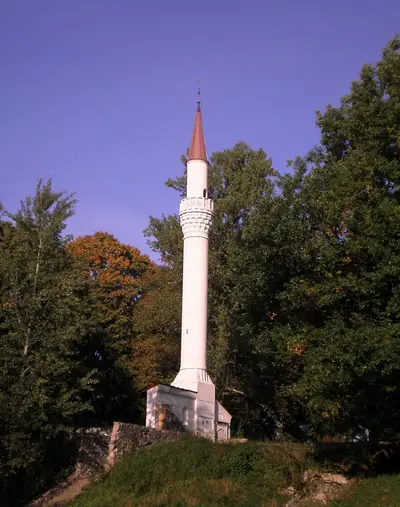
In the city’s central park, the Kėdainiai Minaret offers one of the town’s most unexpected sights. It is Lithuania’s only free-standing minaret and one of just two minarets in the country. The tower was built in 1880 by Russian general Eduard Totleben, who owned the Kėdainiai estate.
The 25-metre tower was created to commemorate the Russo-Turkish War and later served as a viewpoint from which Totleben showed visitors his park and surrounding lands. Its Ottoman architectural details include a pointed top crowned by an Islamic crescent and a single balcony reached by stairs inside the minaret.
The story behind its construction is uncertain. One account connects it with a similar tower beside the mosque at Pleven, where Totleben often spent time during the war; another says it was built in honour of his Turkish mistress. The minaret can be reached from the park across the Minaret Bridge over the Dotnuvėlė.
A Kėdainiai Self-Guided Walking Tour of Churches and Synagogues
The city’s religious landmarks are close enough to form a coherent walking route. A self-guided visit can connect the Evangelical Lutheran Church, Holy Transfiguration Church, Church of St. Joseph, Kedainiai Regional Museum, Smilgos Street Synagogue, Evangelical Reformed Church, New Synagogue, Old Synagogue and Church of St. George.
This sequence shows how several religious traditions shaped Kėdainiai and how the city’s Jewish heritage remains visible in its historic centre. It also brings together buildings from different periods, from the Church of St. George’s Gothic architecture to the Baroque Old Synagogue and the nineteenth-century New Synagogue.
For a wider Lithuanian city break, Kėdainiai can be combined with a visit to nearby Kaunas, while Vilnius offers another perspective on the country’s religious and urban history.
Explore Kėdainiai with Neywo
Download Neywo and explore Kėdainiai with the walking tour “Faiths on the Nevėžis: Kėdainiai’s Churches and Three Synagogues.” The route covers 1.99 km, takes about 73 minutes and includes 9 narrated stops: the Evangelical Lutheran Church, Holy Transfiguration Church, Church of St. Joseph, Kedainiai Regional Museum, Smilgos Street Synagogue, Evangelical Reformed Church, New Synagogue, Old Synagogue and Church of St. George.
The app tells the story of each place as you reach it, at your own pace. There is no group and no schedule, so you can explore independently while the narration connects Kėdainiai’s churches, museums and synagogues into one walk.
Places with an audio guide in Kėdainiai
8 places in Kėdainiai with a Neywo audio guide. Each one starts telling its story as you reach it.
Self-guided tours in Kėdainiai
1 tour in Kėdainiai, free in the Neywo app. Each stop tells its story as you reach it.
- Walk
Faiths on the Nevėžis: Kėdainiai's Churches and Three Synagogues
Kėdainiai was once a rare meeting place of Catholics, Lutherans, Reformed Protestants, Orthodox and Jews, and the old town still shows it. Walk from a 1679 Lutheran church with its mausoleum chapels past a Baroque synagogue to the Gothic church that is the oldest building in town.
Evangelical Lutheran Church in Kėdainiai · Holy Transfiguration Church · Church of St. Joseph, Kėdainiai · Kedainiai Regional Museum · Smilgos Street Synagogue · Evangelical Reformed Church in Kėdainiai …
Open this tour: Faiths on the Nevėžis: Kėdainiai's Churches and Three Synagogues
Walk Kėdainiai with Neywo
Neywo turns Kėdainiai into a self-guided audio tour. Stories arrive as you reach the place they belong to, and the route reshapes when you wander off it.

